






LC-MS vs GC-MS for Untargeted Metabolomics: Which to Choose?
In metabolomics research, untargeted metabolomics has emerged as a powerful approach for biomarker discovery, metabolic pathway elucidation, and the investigation of disease mechanisms. Among the available analytical platforms, mass spectrometry-based techniques are central, with LC-MS (liquid chromatography-mass spectrometry) and GC-MS (gas chromatography-mass spectrometry) representing the two most widely used strategies. A key practical question faced by researchers is how to select between LC-MS and GC-MS when designing untargeted metabolomics studies, and whether one method must be prioritized over the other. In practice, neither technique demonstrates inherent superiority; rather, they serve complementary roles depending on metabolite properties and research objectives. This article systematically examines the technical principles, metabolite coverage, data characteristics, and experimental design considerations of LC-MS and GC-MS, providing guidance for informed methodological selection.
Advantages of LC-MS in Untargeted Metabolomics
1. Technical Principle
LC-MS separates compounds using liquid chromatography, followed by mass spectrometric detection of ion mass-to-charge ratios and abundances. A key advantage of this technique is that it does not require sample vaporization, making it particularly suitable for thermally labile or highly polar metabolites.
Common chromatographic modes include:
-
Reverse-phase chromatography (RP-LC)
-
Hydrophilic interaction chromatography (HILIC)
-
Ion-exchange chromatography
These modes enable the analysis of diverse classes of metabolites.
2. Metabolite Classes Suitable for LC-MS Analysis
LC-MS is particularly well suited for the analysis of:
- Medium- to high-polarity metabolites, such as amino acids, nucleotides, peptides, and carbohydrate metabolites
-
Lipid species, including phospholipids, triglycerides, sphingolipids, and cholesterol esters
-
Thermally labile metabolites
Many bioactive compounds are prone to degradation at elevated temperatures and are therefore more reliably analyzed using LC-MS.
3. Major Advantages of LC-MS
(1) Broad Metabolite Coverage
LC-MS enables the detection of polar, moderately polar, and structurally complex metabolites, making it widely applicable in lipidomics, drug metabolism, and signaling molecule studies.
(2) No Derivatization Required
Unlike GC-MS, which typically requires chemical derivatization to enhance volatility, LC-MS allows direct analysis of compounds, thereby simplifying sample preparation workflows.
(3) High Sensitivity and Resolution
Advanced high-resolution mass spectrometry platforms (e.g., Orbitrap and TOF) provide ppm-level mass accuracy and high sensitivity, which are critical for detecting low-abundance metabolites.
Unique Advantages of GC-MS in Untargeted Metabolomics
Despite the widespread use of LC-MS, GC-MS remains indispensable in metabolomics research.
1. Technical Principle
GC-MS separates volatile compounds via gas chromatography, followed by electron impact (EI) ionization to generate reproducible fragment ions for detection.
Key features include:
-
High separation efficiency
-
Highly reproducible fragmentation patterns
-
Well-established spectral databases
2. Metabolite Classes Suitable for GC-MS Analysis
GC-MS is primarily used for the analysis of:
-
Volatile and semi-volatile compounds, including organic acids, alcohols, aldehydes, and ketones
-
Small-molecule primary metabolites, such as sugars, amino acids, and fatty acids, which can be analyzed after derivatization
3. Core Advantages of GC-MS
(1) Comprehensive Spectral Databases
GC-MS benefits from highly developed spectral libraries (e.g., NIST and the Fiehn metabolomics library), enabling reliable metabolite identification through fragment matching.
(2) High Reproducibility in Qualitative Analysis
Fragmentation patterns generated by EI ionization are highly consistent, ensuring strong inter-laboratory reproducibility, which is particularly important in multi-center studies.
(3) Superior Separation Efficiency
Gas chromatography columns provide exceptional resolving power, allowing effective separation of structurally similar small molecules.
Core Differences Between LC-MS and GC-MS
In untargeted metabolomics experimental design, the two platforms can be compared across several key dimensions:
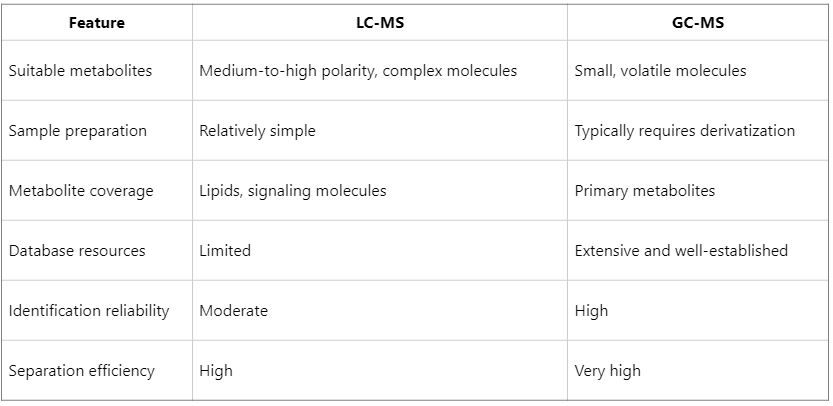
Therefore, LC-MS is more suitable for broad profiling of complex biological samples, whereas GC-MS is better suited for precise analysis of small-molecule metabolites.
Optimal Strategy in Untargeted Metabolomics: Combined LC-MS and GC-MS Analysis
Key advantages include:
-
Expanded metabolite coverage
-
Enhanced metabolic pathway interpretation
-
Improved biomarker discovery potential
This multi-platform strategy has become increasingly prevalent in disease research, microbial metabolism studies, and nutritional metabolomics.
In summary, LC-MS and GC-MS are not competing technologies but complementary approaches in untargeted metabolomics. LC-MS is more suitable for the analysis of lipids and medium-to-high polarity metabolites, whereas GC-MS excels in the characterization of small-molecule primary metabolites. For comprehensive metabolic network analysis, a combined LC-MS and GC-MS strategy is generally recommended. With ongoing advances in high-resolution mass spectrometry and metabolite databases, untargeted metabolomics is rapidly emerging as a key tool in systems biology. By carefully selecting analytical platforms and leveraging specialized metabolomics services, researchers can achieve deeper insights into metabolic regulation and facilitate progress in precision medicine and life sciences. MtoZ Biolabs has established a comprehensive metabolomics platform, and its multi-platform integrated strategy enables efficient identification of key metabolic biomarkers and in-depth analysis of metabolic regulatory mechanisms.
MtoZ Biolabs, an integrated chromatography and mass spectrometry (MS) services provider.
Related Services
How to order?




