






Lactylation Proteomics Analysis: A Comprehensive Workflow from Enrichment to Identification
Lactylation (Lysine Lactylation, Kla) is an important post-translational modification discovered in recent years and has been demonstrated to play critical roles in gene expression regulation, immunometabolism, tumor biology, and related fields. However, as a low-abundance and technically challenging acylation modification, lactylation research imposes higher demands on experimental methodologies. How can lactylation sites be accurately captured from complex proteomes? How can high-throughput, high-resolution qualitative and quantitative analyses be achieved? This article systematically reviews the complete workflow of lactylation proteomics, covering sample preparation, modification enrichment, and mass spectrometry-based identification, to help researchers establish robust and reliable experimental strategies.
Sample Preparation for Lactylation Proteomics
The prerequisite for lactylation analysis is the preparation of high-quality and reproducible protein samples. The general workflow includes the following steps:
1. Sample Source Selection
Lactylation is widely present in mammalian cells, tissues, and pathological samples. Common sample processing methods include cell lysis, tissue homogenization, and protein extraction.
2. Protein Quantification and Quality Assessment
A protein concentration greater than 2 mg/mL is recommended, and protein integrity should be verified using SDS-PAGE or Coomassie blue staining. Protein degradation and modification loss should be minimized throughout sample preparation.
3. Trypsin Digestion
Efficient digestion approaches, such as FASP or S-Trap, are commonly employed to digest proteins into peptides while removing impurities that may interfere with downstream enrichment, including salts and lipids.
Peptide Enrichment in Lactylation Proteomics
Because lactylated peptides are present at extremely low abundance in complex biological samples, enrichment using specific antibodies is generally required prior to mass spectrometry analysis.
1. Selection of Kla-Specific Antibodies
Commercially available anti-lactylation antibodies can specifically recognize Kla-modified peptides. Antibody quality directly influences enrichment efficiency and specificity.
2. Enrichment Workflow
Immobilized antibodies, such as magnetic bead- or agarose-based carriers, are incubated with peptide samples to capture lactylated peptides.
(1) Washing steps are performed to remove non-specifically bound peptides.
(2) Low-pH elution buffers are used to recover target peptides.
(3) Vacuum drying followed by peptide reconstitution is carried out prior to LC-MS/MS analysis.
Enrichment efficiency directly determines the depth and reliability of downstream detection. Therefore, a global peptide mass spectrometry analysis before enrichment is recommended as a reference control.
Mass Spectrometry Analysis
1. LC-MS/MS Acquisition Strategies
(1) Recommended instruments: high-resolution platforms such as Orbitrap Exploris 480 and Q Exactive HF-X.
(2) Acquisition modes: DDA (Data-Dependent Acquisition) is commonly used for modification site discovery, whereas DIA (Data-Independent Acquisition) is suitable for global quantitative analysis.
(3) Resolution requirements: MS1 ≥ 60,000 and MS2 ≥ 15,000 are recommended to ensure reliable detection of low-abundance modifications.
2. Identification Parameter Settings
(1) Lactylation (+72.021 Da) should be included as a variable modification during database searching.
(2) Site localization algorithms, such as ptmRS or Ascore, should be enabled to improve site assignment confidence.
(3) Algorithms such as Percolator are recommended for false-positive control, with a false discovery rate (FDR) below 1%.
Data Analysis: Constructing Functional Landscapes of Lactylated Proteins
1. Identification Statistics
- Number of lactylated peptides, proteins, and modification sites.
- Site distribution characteristics, including N-terminal enrichment and domain-specific localization.
- Motif analysis to identify sequence preferences associated with lactylation.
2. Functional Annotation
- GO enrichment analysis for biological processes, molecular functions, and cellular components.
- KEGG pathway analysis for associated signaling pathways and metabolic networks.
- Protein-protein interaction (PPI) network analysis to evaluate the regulatory roles of lactylated proteins.
3. Quantitative Analysis of Lactylation (Optional)
If the experimental design includes multiple treatment groups, such as high-glucose versus normal-glucose conditions, label-based quantification methods (TMT/iTRAQ) or DIA-based label-free quantification can be applied to identify differentially lactylated proteins.
Solutions and Advantages of MtoZ Biolabs
As a professional multi-omics service provider, MtoZ Biolabs offers one-stop customized lactylation proteomics analysis services:
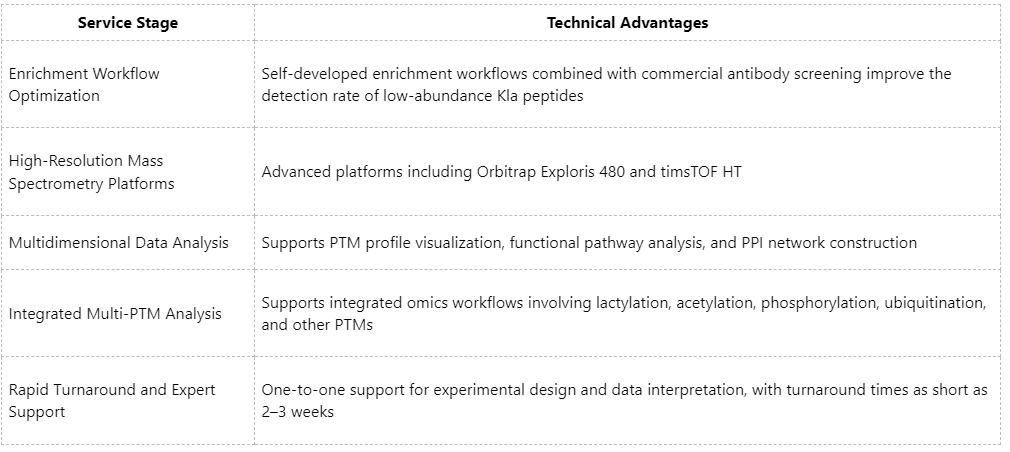
Whether investigating the role of lactylation in disease mechanisms or identifying potential therapeutic targets, we provide end-to-end support from experimental execution to biological interpretation.
Lactylation proteomics represents an important strategy for understanding metabolic-epigenetic regulatory networks. From efficient enrichment and high-precision identification to systems-level functional characterization, each step requires the integration of advanced technologies and rigorous scientific strategies. MtoZ Biolabs will continue optimizing its post-translational modification omics platforms to support researchers in uncovering the biological significance of lactylation and advancing its applications in both basic research and clinical translation.
MtoZ Biolabs, an integrated chromatography and mass spectrometry (MS) services provider.
Related Services
How to order?




