






How to Perform Hybridoma Sequencing: Key Steps for Obtaining Antibody Variable Region Sequences
Introduction
Hybridoma sequencing is often requested when a monoclonal antibody is available from a hybridoma cell line, but the VH and VL sequences are missing from lab records. A culture may still produce antibody, binding assays may look acceptable, and frozen stocks may remain in storage, yet the variable-region sequences needed for recombinant expression, clone backup, or documentation were never archived.
The workflow is not a single PCR reaction. Hybridoma sequencing depends on cell health, RNA quality, species and isotype metadata, primer design, amplification success, sequence assembly, and CDR annotation. Weak results usually trace back to sample readiness or project scoping rather than to the concept of hybridoma recovery itself. A structured step-by-step workflow reduces repeat submissions and improves the chance of obtaining usable VH and VL sequences.
Related Services
| Service Area | Recommended Service |
| Hybridoma sequencing | Hybridoma Antibody Sequencing Service |
| PCR-based antibody sequencing | PCR Based Antibody Sequencing Service |
| De novo antibody sequencing | De Novo Antibody Sequencing Service |
| Full antibody sequencing | Antibody Sequencing Service |
| IgG sequencing | IgG Antibody Sequencing Service |
| Protein-level confirmation | Peptide Mapping Service |
Teams preparing a first hybridoma sequencing submission can consult MtoZ Biolabs to review cell status, metadata completeness, and expected VH/VL deliverables before RNA extraction or shipment begins.
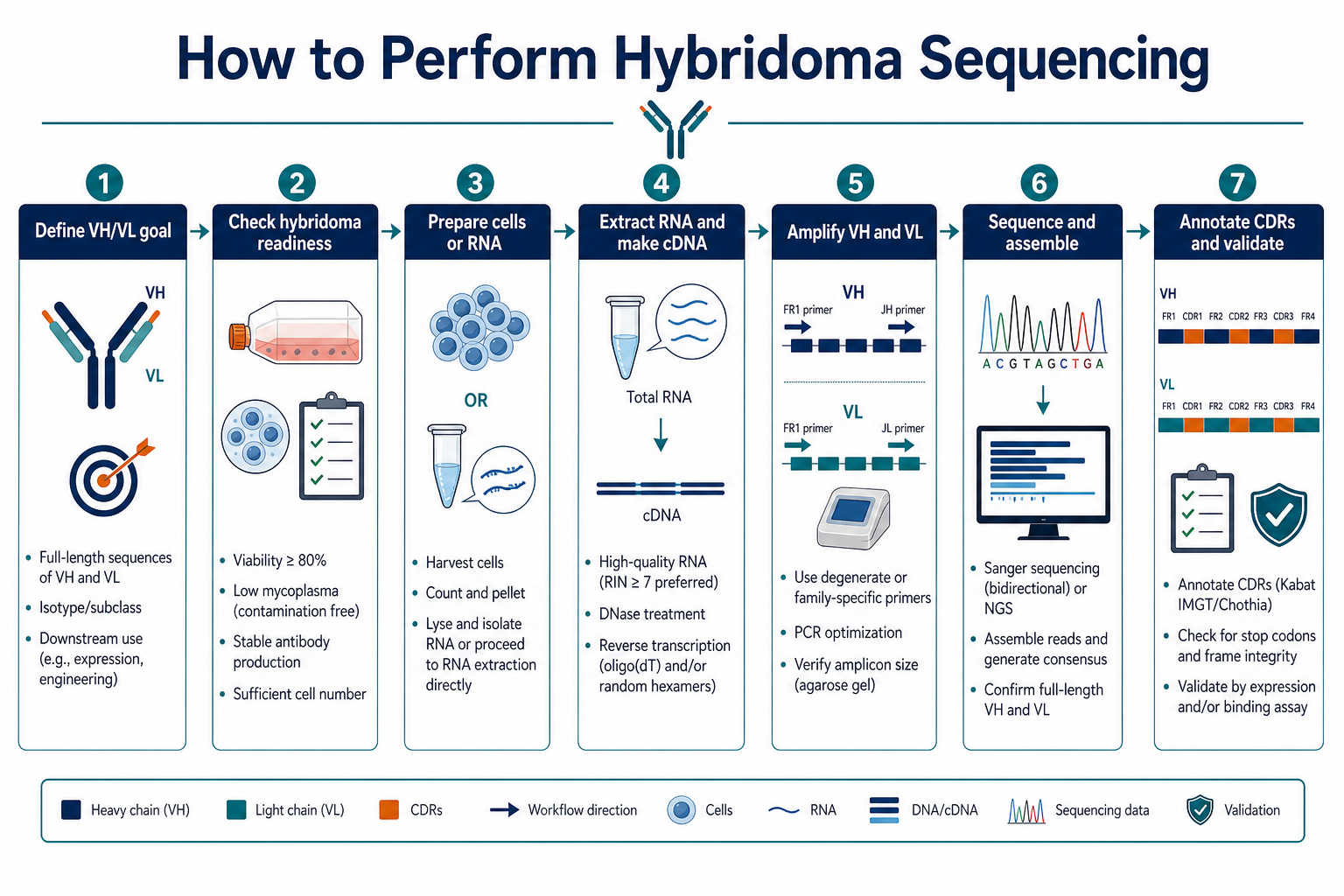
Figure 1. Hybridoma sequencing moves from project definition and hybridoma readiness through RNA recovery, VH/VL amplification, assembly, and validation.
Common Pain Points Before Starting
Researchers often begin a hybridoma sequencing project after encountering one or more of these problems:
-
VH and VL sequences were never recorded for a productive hybridoma
-
recombinant expression cannot begin because variable-region sequences are missing
-
legacy hybridoma records lack species, isotype, or clone background information
-
only frozen stocks remain and post-thaw viability is uncertain
-
prior in-house PCR attempts produced weak bands or incomplete assembly
-
the team needs a sequence report suitable for vector design, not just raw trace files
These issues are common for legacy hybridoma lines, shared lab stocks, and cultures that have undergone repeated passage or freeze-thaw cycles. The practical question is not whether hybridoma sequencing is theoretically possible. The question is whether the current material and workflow can support reliable VH and VL recovery.
Why Hybridoma Sequencing Projects Fail Early
Most early failures come from readiness and design rather than from sequence assembly alone.
1. Poor Cell Viability or Stressed Cultures
Overgrown, repeatedly passaged, or poorly recovered hybridoma cultures may not yield usable RNA even if low-level antibody secretion continues.
2. Degraded or Insufficient RNA
Delayed processing after harvest, improper storage, or low cell input can reduce amplification success.
3. Incorrect Species, Isotype, or Primer Assumptions
Primer design depends on accurate metadata. Wrong assumptions can prevent valid VH or VL amplification.
4. Unconfirmed Monoclonality
Mixed cultures can produce overlapping sequence evidence and ambiguous assembly.
5. Unclear Project Scope
Teams may expect full-chain coverage or immediate expression-ready files when the project was scoped only for variable-region recovery.
Understanding these root causes helps researchers fix the workflow before resubmitting material.
Step 1: Define the VH/VL Deliverable and Downstream Use
Before cells are expanded or RNA is extracted, define what the project must deliver.
-
Is VH and VL recovery sufficient, or is broader chain coverage required?
-
Will the sequence support vector construction, internal documentation, patent filing, or clone rescue only?
-
Are germline assignment and CDR annotation required in the final report?
-
Is a single defined clone sequence required, or is preliminary recovery acceptable?
A feasibility review should match workflow depth to project need. A documentation-focused project may require different validation than a sequence intended for immediate recombinant expression.
Step 2: Confirm Hybridoma Readiness and Metadata
Hybridoma readiness is the highest-leverage step in VH/VL recovery.
1. Check Cell Viability and Passage History
Review culture health, growth rate, and passage number. When possible, use lower-passage material or expand from an earlier frozen stock before extraction.
2. Confirm Monoclonality
Mixed or unstable cultures are a frequent source of ambiguous VH/VL assembly. Subcloning or monoclonality confirmation should be completed before sequencing when the downstream use requires one defined sequence.
3. Verify Species, Isotype, and Clone Background
Record the source species, immunoglobulin isotype, and any known fusion partner or clone history. Primer design and interpretation depend on this information.
4. Decide on Submission Format
Determine whether viable cells, frozen vials, extracted RNA, or cDNA will be submitted. Each route has different handling requirements and feasibility constraints.
The table below summarizes readiness checks that should be completed before extraction or shipment. It supports planning but does not replace sample-specific feasibility review.
| Readiness Check | What to Verify | Common Mistake |
| Cell health | Viability, growth behavior, and passage number | Sequencing overgrown or repeatedly stressed cultures |
| Monoclonality | Single productive clone assumption | Submitting mixed cultures without review |
| Metadata | Species, isotype, and clone background | Relying on incomplete legacy records |
| Backup material | Earlier passage or frozen stock availability | Using the only remaining poor-quality culture |
| Downstream goal | VH/VL only vs broader reporting needs | Expecting expression-ready deliverables without scoping |
| Alternative route | Availability of purified antibody if cells fail | Waiting until all cell material is exhausted |
Completing these checks before sample preparation often prevents the most common repeat submissions.
Step 3: Prepare Hybridoma Cells or RNA for Sequencing
Sample preparation should preserve transcript quality and provide enough material for amplification and repeat testing if needed.
1. Expand Healthy Cultures When Possible
If viability is borderline, expand from a healthier frozen stock or earlier passage before harvest. Avoid waiting until productivity has declined sharply.
2. Harvest and Process Promptly
Process cells soon after collection when performing in-lab RNA extraction. Delayed lysis or improper storage can degrade immunoglobulin transcripts.
3. Handle Frozen Stocks Carefully
Thaw and recover cells according to standard hybridoma culture practice. Post-thaw viability should be acceptable before RNA extraction or shipment.
4. Document Shipping and Storage Conditions
If viable cells or RNA are sent to a service provider, follow the provider's guidance on transport temperature, medium, and required metadata.
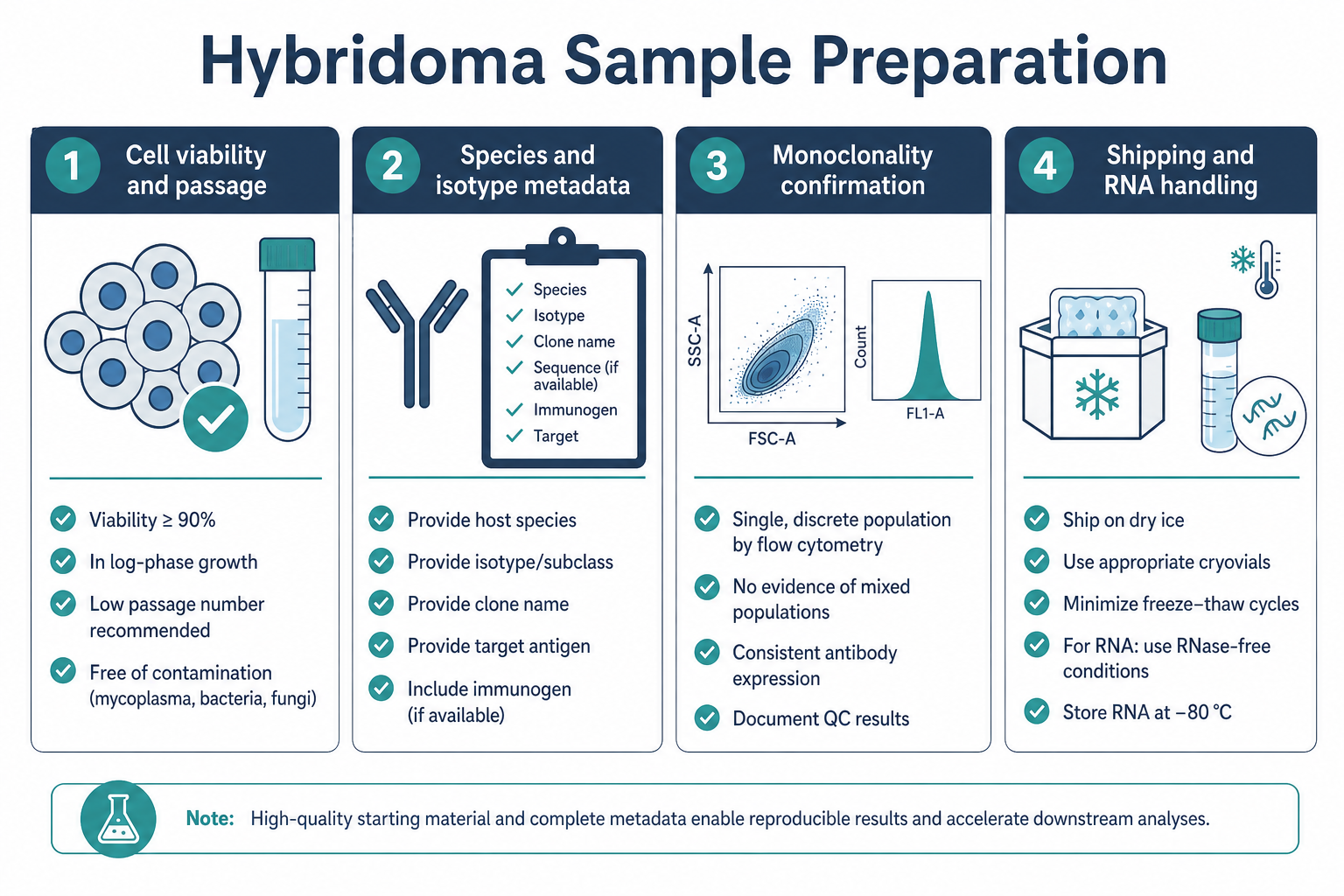
Figure 2. Strong hybridoma sequencing outcomes usually begin with viability review, metadata confirmation, monoclonality checks, and careful RNA handling.
Step 4: Extract RNA and Generate cDNA
RNA quality is central to hybridoma sequencing success.
Review RNA concentration and integrity before reverse transcription. Low yield or degraded RNA often leads to weak VH or VL amplification. If extraction quality is poor, repeat from healthier material rather than proceeding with borderline input.
cDNA synthesis should preserve immunoglobulin transcript representation for downstream PCR. The exact protocol may vary by provider, but the goal is consistent template generation for variable-region amplification.
Key QC goals at this stage include:
-
sufficient RNA yield for amplification and repeat testing
-
acceptable integrity for the planned workflow
-
clear documentation of extraction timing and storage conditions
-
confirmation that species and isotype metadata match the sample
Step 5: Amplify VH and VL Variable Regions
Variable-region amplification is the core PCR step in hybridoma sequencing.
Primers should match the immunoglobulin gene families of the source species and the expected heavy-chain and light-chain class or type. Heavy-chain and light-chain regions are usually amplified separately. Weak or missing products may indicate primer mismatch, poor template quality, mixed clones, or incorrect metadata.
Useful amplification practices include:
-
design or confirm primer coverage before the first run
-
review amplification specificity and product size
-
repeat from fresher template when bands are weak or ambiguous
-
avoid over-interpreting mixed products from unstable cultures
If amplification fails after readiness review, troubleshoot RNA quality and metadata before switching methods.
Step 6: Sequence Amplicons and Assemble VH/VL Contigs
Amplified VH and VL products are typically sequenced by Sanger or NGS methods depending on project design. Raw reads or traces are then assembled into contigs representing the variable heavy and variable light regions.
Assembly should produce contiguous VH and VL sequences with clear read support. Ambiguous positions, mixed signal, or inconsistent framework patterns may indicate mixed clones, primer issues, or low-quality template.
A strong assembly usually shows:
-
clean read support across the variable region
-
plausible framework structure for the stated species
-
consistent pairing logic between heavy and light chain contigs
-
explicit notation of low-confidence or unsupported segments
Step 7: Annotate CDRs and Validate the Final Sequence
The final deliverable is more useful when CDR and framework boundaries are annotated and the sequence is reviewed for biological plausibility.
Typical annotation outputs include:
-
CDR1, CDR2, and CDR3 boundaries for VH and VL
-
framework region assignment
-
germline gene usage where applicable
-
QC notes on RNA quality, assembly confidence, and ambiguous regions
Validation should match the intended use. For expression design, CDR accuracy and clean VH/VL pairing matter most. For documentation, transparent reporting of unsupported regions may be sufficient if the goal is archival evidence rather than immediate cloning.
Useful validation options include:
-
repeat amplification from independent template when material allows
-
secondary primer strategies for uncertain regions
-
comparison against any historical sequence record
-
orthogonal protein-level confirmation when purified antibody is also available
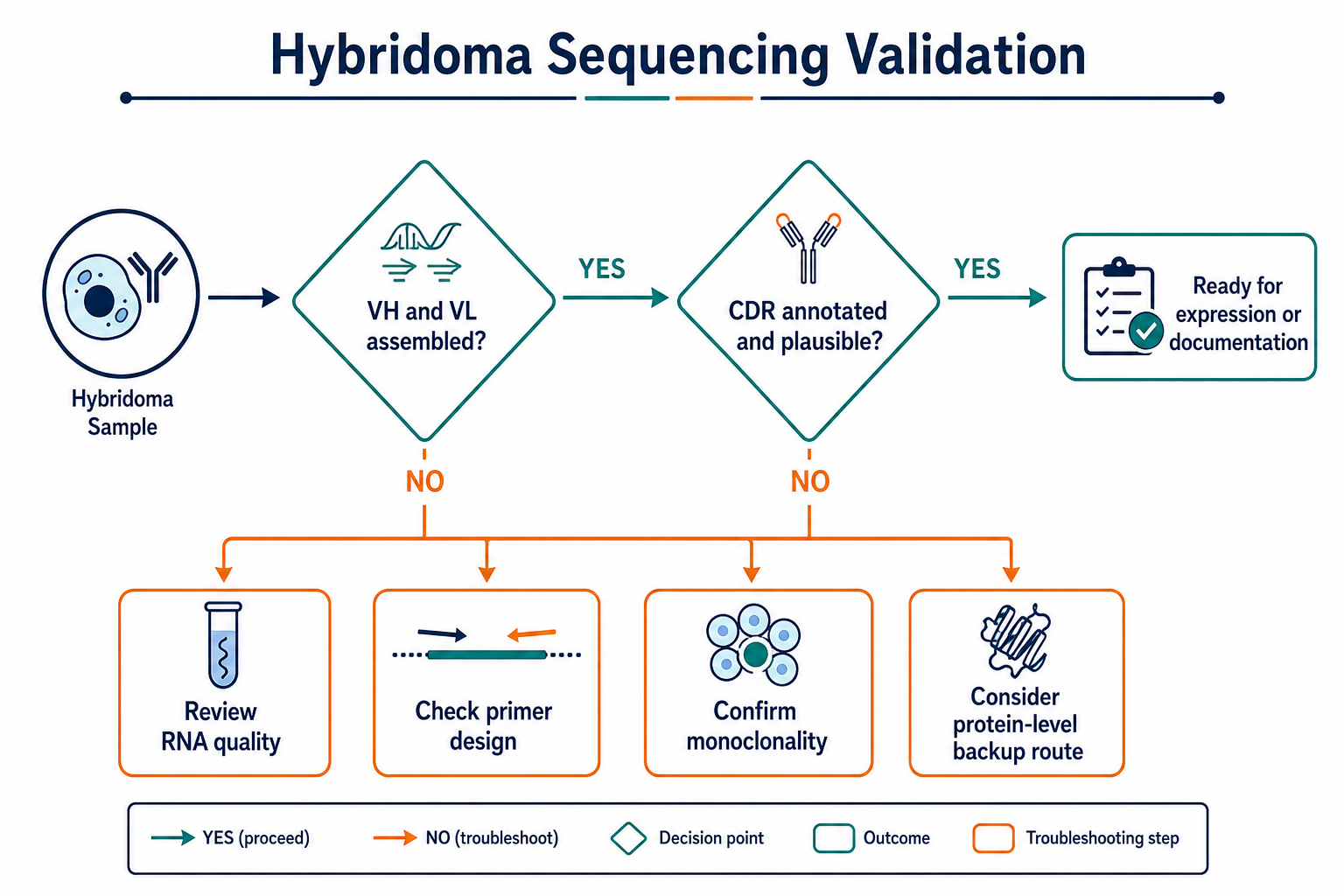
Figure 3. Validation should confirm assembly quality, CDR plausibility, and fit with the intended expression or documentation goal.
Expected Results and How to Judge Success
A successful hybridoma sequencing project may deliver one of several outcomes depending on the goal.
1. Annotated VH and VL Variable Regions
The most common deliverable for recombinant planning and clone backup.
2. CDR-level Annotation with Framework Boundaries
Useful when the sequence will support engineering, humanization, or documentation.
3. Expanded Reporting with Germline Assignment and QC Notes
Useful when the report must support internal review, publication, or tech transfer.
Success should be judged by sequence confidence and fit with the stated use, not by read count alone. A clean VH/VL pair with documented limitations is more valuable than an overconfident assembly with hidden ambiguity.
Troubleshooting Common Problems
When results fall short, review the workflow in the order that most often resolves the issue.
| Problem | Likely Cause | Recommended Fix |
| Low RNA yield | Poor viability, low input, or delayed processing | Expand healthier culture, repeat extraction promptly |
| Failed VH or VL amplification | Primer mismatch or degraded template | Verify species and isotype metadata, repeat from fresher RNA |
| Partial variable- region recovery | Low-quality template or incomplete primer coverage | Use backup material, adjust primer strategy |
| Mixed or ambiguous assembly | Non-monoclonal culture or overlapping products | Confirm monoclonality, subclone before re-sequencing |
| Implausible CDR pattern | Mixed sequence evidence or assembly error | Repeat amplification, request expert manual review |
| No viable cells remain | Cell loss after repeated use | Evaluate purified antibody for de novo antibody sequencing |
If troubleshooting does not improve recovery, the project may need an alternative route rather than repeated identical submissions.
Key Precautions
Do not assume that antibody secretion alone means hybridoma sequencing will succeed. Cell health and RNA quality still matter.
Do not proceed without species and isotype metadata when primer design depends on them. Do not treat mixed cultures as monoclonal without review when the sequence will be used for expression design.
Do not expect protein-level confirmation from hybridoma sequencing alone. Binding and product QC may still require separate assays.
Do not skip documentation of ambiguous CDR segments. A transparent report is more useful than an overconfident partial sequence.
For legacy or low-viability hybridomas, a feasibility review before expansion or shipment can prevent unnecessary loss of material.
Frequently Asked Questions
1. How much hybridoma material is needed for VH/VL recovery?
Requirements vary by cell health, extraction method, and provider workflow. Healthier low- passage cultures generally improve success rates. A feasibility review before submission is recommended.
2. Can hybridoma sequencing work from frozen cell stocks?
Yes, when post-thaw viability and RNA integrity remain acceptable. Earlier passage stocks are often preferable to heavily used cultures.
3. Is hybridoma sequencing the same as PCR-based antibody sequencing?
PCR-based antibody sequencing is a common technical route when the starting material is hybridoma cells, RNA, or cDNA from those cells.
4. Does hybridoma sequencing provide full-length antibody sequence?
Many projects focus on VH and VL variable regions. Broader chain coverage should be defined during project scoping.
5. What if hybridoma cells are no longer available?
If purified monoclonal antibody remains, de novo antibody sequencing or related protein-level workflows may be the appropriate recovery route.
Conclusion
Hybridoma sequencing moves from project scoping and hybridoma readiness through RNA recovery, VH/VL amplification, assembly, CDR annotation, and validation. Strong results depend on defining the deliverable early, confirming cell health and metadata, preparing material carefully, designing amplification appropriately, and reporting supported sequence regions transparently. When viable hybridoma material remains available, this workflow provides an efficient route to antibody variable-region sequences for expression, rescue, and documentation. Researchers preparing hybridoma sequencing projects can contact MtoZ Biolabs to review sample readiness and build a VH/VL recovery plan from hybridoma assessment through final sequence validation.
How to order?




