






Exosome Characterization Before Proteomics
Exosome characterization before proteomics is not a single pass/fail assessment. Particle measurements, morphology, and protein-marker evidence describe different aspects of the preparation entering LC-MS/MS. The main value of characterization is to provide preparation-level context for interpreting the measured proteome and to identify unexpected technical or preparation-related patterns that could overlap with biological protein differences.
Characterization results should be interpreted together with study design, preparation history, and subsequent proteomic observations. Differences between biological groups do not need to disappear before proteomics can proceed, because some particle-, morphology-, or composition-level differences may reflect the biology under study. The more relevant question is whether a characterization pattern is expected within the study context or whether the pattern suggests an additional preparation-related explanation. For a broader view of how sample preparation, quantitative strategy, and data interpretation fit together, see Exosome Proteomics: A Practical Guide for Protein Analysis Studies.
Why Characterize Exosome Preparations Before Proteomics?
LC-MS/MS measures proteins present in the preparation that enters the analytical workflow, but it does not independently describe the particle population, structural appearance, or protein-marker context of that preparation. Characterization provides this preparation-level information through particle measurements, morphology, and protein-marker evidence, helping researchers understand the material from which the measured proteome was generated.
This context becomes particularly useful when proteomic results show unexpected sample- or group-associated patterns. If an unusual protein profile coincides with an atypical characterization pattern, preparation state or preparation history may need to be considered as one possible contributor. Conversely, the absence of an obvious characterization-level abnormality reduces, but does not eliminate, concern that a visible preparation discrepancy is driving the proteomic pattern.

Figure 1. Characterization provides preparation context for interpreting the proteome measured by LC-MS/MS.
What Should Exosome Characterization Evaluate?
Particle measurements, morphology, and protein markers answer different preparation-level questions. No single result provides a complete description of the preparation.
|
Characterization Evidence |
Main Question |
Contribution to Proteomics Interpretation |
|
Particle size and concentration |
Is there an unexpected particle-level pattern associated with a sample, preparation batch, or biological group? |
Provides context for deciding whether particle-level variation should be considered when interpreting protein-level differences |
|
Morphology |
Are vesicle-like structures present, and is there an unusual pattern of aggregation, irregular material, or structural heterogeneity? |
Adds structural context when particle measurements alone do not explain unusual sample behavior |
|
Protein markers |
Is the marker and background pattern consistent with the intended exosome-focused preparation? |
Provides molecular context for preparation composition and may indicate co-isolated background that should be considered during proteomic interpretation |
Together, particle measurements, morphology, and protein-marker evidence provide complementary particle-level, structural, and molecular context for the preparation.
If existing characterization results are difficult to interpret in relation to a planned proteomics comparison, researchers can contact MtoZ Biolabs directly with the sample source, isolation history, available characterization data, and study design for project-specific review.
How Should Particle Size and Concentration Data Be Used?
Particle size and concentration data are most informative when interpreted in relation to the study design and preparation history. Similar particle profiles are not a requirement for comparative proteomics, because biological groups may themselves differ at the particle level. Greater attention is warranted when a particle pattern is unexpected for the study design, limited to one sample, or associated with a preparation batch rather than the intended biological comparison.
For example, an isolated sample with an unusual particle concentration may justify review of sample input, isolation history, handling, aggregation, or sample loss. If the same sample also shows reduced protein identification depth relative to otherwise similarly processed samples, preparation state becomes one possible explanation that should be evaluated. The combined observation does not establish that the particle difference caused the analytical result.
Particle measurements provide useful preparation-level context for later proteomic interpretation, particularly when an unexpected particle pattern coincides with unusual analytical behavior or preparation history. Particle concentration should not, however, be used alone to infer exosome purity, exosome-derived protein content, or expected protein identification depth.

Figure 2. Particle-level patterns should be interpreted in relation to study design and preparation history.
What Does Morphology Add Before Proteomics?
Morphology provides structural context that particle measurements cannot provide. TEM or cryo-EM can show whether vesicle-like structures are present and whether a preparation contains conspicuous aggregates, irregular material, or marked structural heterogeneity. Such observations can be useful when an unusual proteomic result may have a preparation-level explanation.
A sample-specific abnormal pattern may justify reviewing preparation or imaging conditions, whereas a group-linked difference may reflect biology, preparation-related variation, or both. Interpretation should therefore consider both the study design and preparation context.
How Should Protein Markers Be Interpreted Before LC-MS/MS?
Protein-marker evidence is most informative when several expected exosome-associated markers are considered together with markers or background signals that may reflect co-isolated material. The resulting pattern provides molecular context for the preparation and can help identify sample- or batch-linked differences in preparation composition that may also appear in the measured proteome.
When an unusual marker or background pattern coincides with a distinct LC-MS/MS protein profile, preparation history and co-isolated material should be considered as possible contributors to the observation. Positive exosome-associated markers support the interpretation of an exosome-focused preparation, but they do not establish that every protein later detected by LC-MS/MS is exclusively exosome-derived.
How Should Characterization Results Guide the Next Proteomics Decision?
Characterization results become most informative when they are interpreted together with the corresponding LC-MS/MS observations. Interpretation should consider whether a characterization pattern provides a plausible preparation-level explanation for the proteomic result and whether the pattern is sample-specific, batch-linked, or aligned with the biological grouping.
|
Characterization + Proteomics Observation |
How to Interpret It |
|
No unexpected sample- or batch-linked characterization discrepancy is evident, while proteomics shows reproducible group-associated protein differences |
The characterization results do not suggest an obvious preparation-related explanation for the protein pattern. The protein differences can be examined further in relation to the biological study question. |
|
One sample shows an unusual particle concentration together with reduced protein identification depth |
Review whether sample input, isolation, handling, aggregation, or preparation state may have contributed to the analytical behavior of that sample. |
|
One preparation batch shows an atypical marker or background pattern, while LC-MS/MS also shows increased high-abundance background proteins |
Evaluate whether shared isolation or preparation history may have contributed to the measured protein profile in that batch. |
|
Morphology, particle, or marker evidence shows a systematic group-linked pattern, and proteomics also separates according to the same groups |
Interpret the proteomic differences together with the characterization pattern and assess whether preparation-related variation may overlap with the intended biological comparison. |
If a batch-linked pattern coincides with shared isolation or purification history, the effects of recovery, co-isolated background, preparation composition, and workflow consistency are discussed in How Exosome Isolation and Purification Affect Proteomics Results.
If unusual protein identification depth or profiling behavior remains unexplained after reviewing characterization and preparation history, LC-MS/MS-Based Exosome Protein Profiling explains how protein identification evidence and profiling depth should be interpreted.
What Should Be Reviewed Before Proceeding to Proteomics?
Before proteomic analysis, characterization information should be reviewed in relation to the planned comparison and preparation history. The aim is to identify preparation-level context that may need to be considered when the proteomic results are interpreted.
1. What Characterization Data Are Available?
Confirm which particle size, concentration, morphology, and protein-marker data are available for the relevant samples or preparation batches. Missing data are not automatically a problem, but the available evidence should be sufficient to address the preparation questions that matter for the planned comparison.
2. Where Does an Unusual Pattern Occur?
Determine whether an unusual characterization pattern is limited to one sample, shared within a preparation batch, or aligned with a biological group. A sample-specific or batch-linked pattern may suggest a preparation-related source of variation, whereas a group-linked pattern may require interpretation alongside the biological design.
3. Does the Pattern Match Preparation History?
Compare unusual characterization findings with known differences in isolation, purification, storage, or handling. When a characterization pattern coincides with a documented preparation difference, that history provides a plausible context for later proteomic variation.
4. Would More Characterization Change the Interpretation?
Additional characterization is most useful when it can resolve a specific uncertainty that matters for the proteomic comparison. For example, further characterization may be justified when an atypical sample needs structural review or when a marker pattern appears to be linked to a preparation batch.
If the unresolved question is whether an already isolated preparation is technically ready for protein extraction and LC-MS/MS, see Exosome Proteomics Sample Preparation and LC-MS/MS Compatibility for a more focused sample-readiness framework.
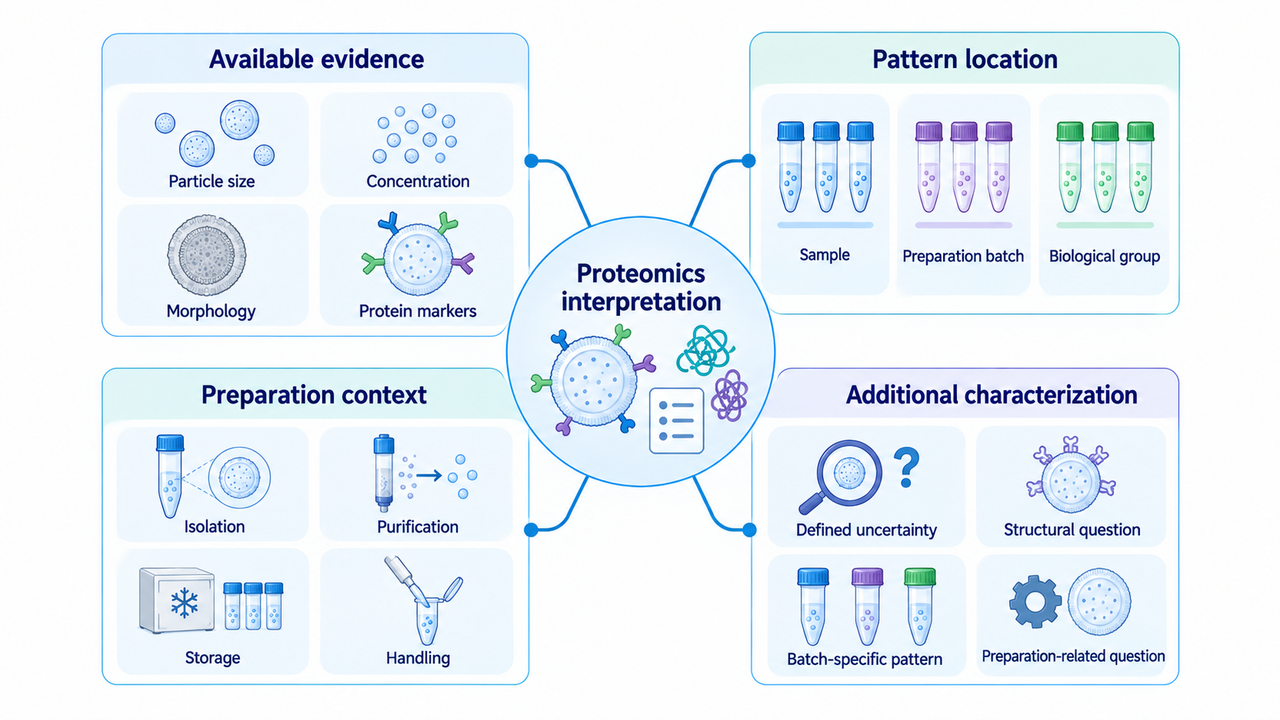
Figure 3. Framework for reviewing exosome characterization information in relation to proteomics interpretation.
Conclusion
If existing characterization results leave uncertainty about how preparation state should be considered in the planned proteomics comparison, researchers can share the sample source, isolation history, available characterization evidence, and comparison design with MtoZ Biolabs for project-specific evaluation. The Exosome Protein Analysis Service provides additional information on the corresponding protein analysis workflow and project planning.
How to order?




