






AQUA Peptide or Other Internal Standards? Comparing Isotope Dilution Routes for Targeted Quantitation
Introduction
Internal standard selection determines whether a targeted LC-MS assay can support absolute reporting, relative comparison, or both. One team may need a synthetic AQUA peptide spiked at a known amount for biomarker quantitation in plasma. Another may rely on SILAC-labeled cell cultures for relative proteome comparison. A third may use unlabeled synthetic peptides with external calibration curves. Each strategy answers a different quantitative question and carries different setup requirements.
An AQUA peptide is a sequence-matched stable isotope-labeled synthetic standard used for isotope dilution quantitation in targeted assays. Other strategies may provide relative normalization or external calibration without the same labeled-to-unlabeled ratio anchor. The best choice depends on whether concentration units are required, whether synthetic standards are feasible, and whether the sample type supports metabolic labeling.
Teams selecting an internal standard strategy before assay development can compare options across reporting needs, sample type, and validation depth. MtoZ Biolabs can Compare AQUA peptide and alternative standard workflows before synthesis or sample submission begins.
Related Services
Start With the Reporting Goal
Standard selection usually begins with one of four scenarios:
-
Absolute concentration reporting. Results must be expressed in ng/mL, fmol, or ppm against a known amount.
-
Relative comparison across conditions. Fold change matters more than defined concentration units.
-
Cell culture-based relative quantitation. Metabolic labeling during growth is feasible and preferred.
-
External calibration without isotope-labeled surrogate. Unlabeled standards and calibrator curves may suffice in some matrices.
These scenarios lead to different default routes. Specification-driven work favors an AQUA peptide. Cell culture comparison studies may favor SILAC. Some clean matrices may support unlabeled external calibration when isotope dilution is not required.
Route Comparison at a Glance
|
Decision Factor |
AQUA Peptide |
SILAC / Metabolic Labeling |
Unlabeled Spike / External Calibration |
|---|---|---|---|
|
Core readout |
Absolute amount via isotope dilution |
Relative abundance across labeled states |
Absolute or semi-quantitative via calibrators |
|
Best sample type |
Predefined peptide targets in most matrices |
Cultured cells or compatible systems |
Clean matrices or validated external curves |
|
Standard requirement |
Synthetic isotope-labeled peptide |
Heavy amino acid labeling during culture |
Unlabeled synthetic peptide or protein standard |
|
Target definition |
Required upfront |
Broad or targeted depending on workflow |
Required upfront |
|
Matrix strategy |
Spike optimization and matrix pilot |
Label incorporation efficiency matters |
Matrix-matched calibrators often required |
|
Common bottleneck |
Synthesis quality and spike design |
Labeling completeness and mixing design |
Calibration fit and recovery |
|
Ideal deliverable |
L/H ratio-based absolute reporting |
Relative quantitation across conditions |
Calibrated concentration with external curve |
When an AQUA Peptide Is the Better Fit
An AQUA peptide is usually the preferred standard when:
-
absolute concentration units are required
-
a predefined proteotypic peptide is already selected
-
sample type does not support metabolic labeling
-
isotope dilution precision is needed in targeted MRM or PRM assays
-
specification or QC documentation requires a defined synthetic standard
Strengths include a known spike amount, sequence-matched ratio measurement, and direct integration into targeted panels.
Limitations include synthesis cost, purity requirements, and the need to qualify each AQUA peptide individually.
Teams with specification-driven targets may review Absolute Quantitative Analysis (AQUA) Service or Peptide Absolute Quantification Service.
When SILAC or Metabolic Labeling Fits Better
Metabolic labeling workflows are often selected when:
-
the study uses cultured cells and relative comparison is the primary goal
-
heavy and light proteomes can be mixed after labeling
-
broad proteome quantitation is more important than synthetic spike control for each peptide
SILAC remains valuable for relative quantitation but is usually less direct than an AQUA peptide when a specific plasma or tissue matrix requires synthetic standard spiking for absolute reporting.
When Unlabeled Spike or External Calibration Fits Better
Unlabeled synthetic spikes with external calibration may be sufficient when:
-
the matrix is relatively clean
-
calibrator curves show stable recovery across the required range
-
absolute reporting is needed but isotope-labeled synthesis is not yet justified
This route can work for some assays but often requires careful matrix validation because ionization differences between calibrator and endogenous peptide are not corrected by isotope dilution in the same way as an AQUA peptide.
Combined Standard Strategies
Many programs use staged strategies. Discovery identifies candidate peptides. Relative targeted quantitation confirms behavior across groups. An AQUA peptide is then introduced when absolute reporting or specification testing is required.
Planning the standard strategy during peptide selection reduces delay when the project moves from relative screening to absolute validation.
If the team is uncertain whether an AQUA peptide is justified, request a short matrix pilot comparing isotope dilution performance with external calibration on the same surrogate peptide. That pilot often clarifies whether labeled standard investment is necessary for the reporting goal.
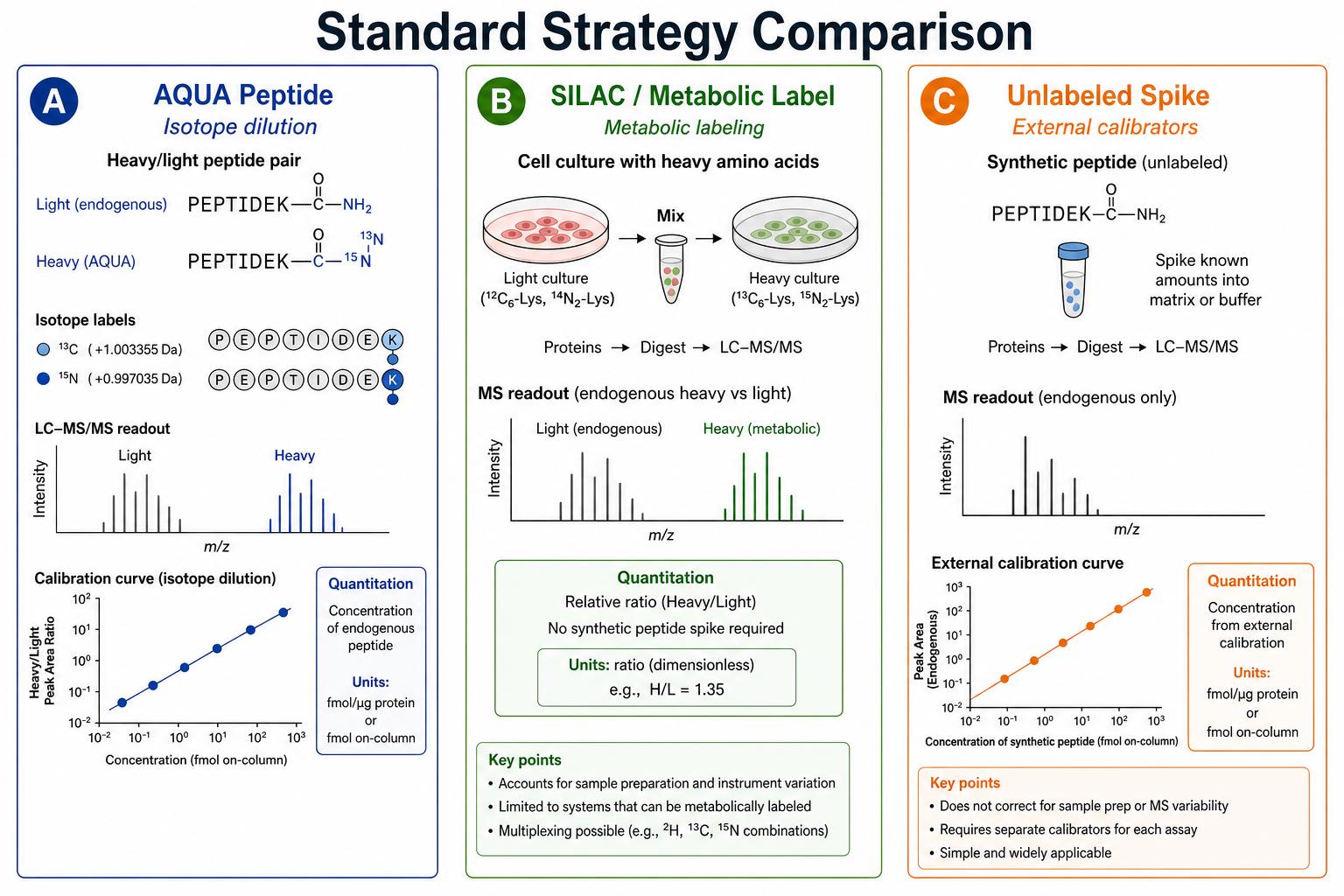
Figure 1. Reporting goal, sample type, and validation depth determine whether an AQUA peptide, SILAC, or external calibration is the better standard strategy.
Decision Recommendations by Project Goal
Choose an AQUA peptide when:
-
concentration units are required
-
a predefined proteotypic peptide is available
-
isotope dilution precision is needed in matrix
Choose SILAC when:
-
cultured cells are the primary sample type
-
relative comparison is the primary deliverable
Choose unlabeled external calibration when:
-
matrix is clean and calibrator recovery is demonstrated
-
absolute reporting is needed without labeled synthesis initially
Choose a staged pipeline when:
-
relative screening precedes absolute validation with an AQUA peptide
Practical Examples by Study Type
1. Plasma Biomarker with Clinical Cutoff
AQUA peptide spiked at optimized level with MRM or PRM ratio reporting.
2. Cell Line Treatment Study with Proteome-Wide Comparison
SILAC labeling with relative quantitation across conditions.
3. Clean Buffer or Simple Matrix QC Monitor
Unlabeled synthetic peptide with external calibration if recovery is stable.
4. Biopharmaceutical Impurity Near Specification Limit
AQUA peptide with qualified synthesis and matrix pilot before release testing.
For internal route selection, use one decision line: if the result must be anchored to a known synthetic standard amount in matrix, prioritize an AQUA peptide; if the result must compare labeled and unlabeled proteomes in culture, metabolic labeling may suffice.
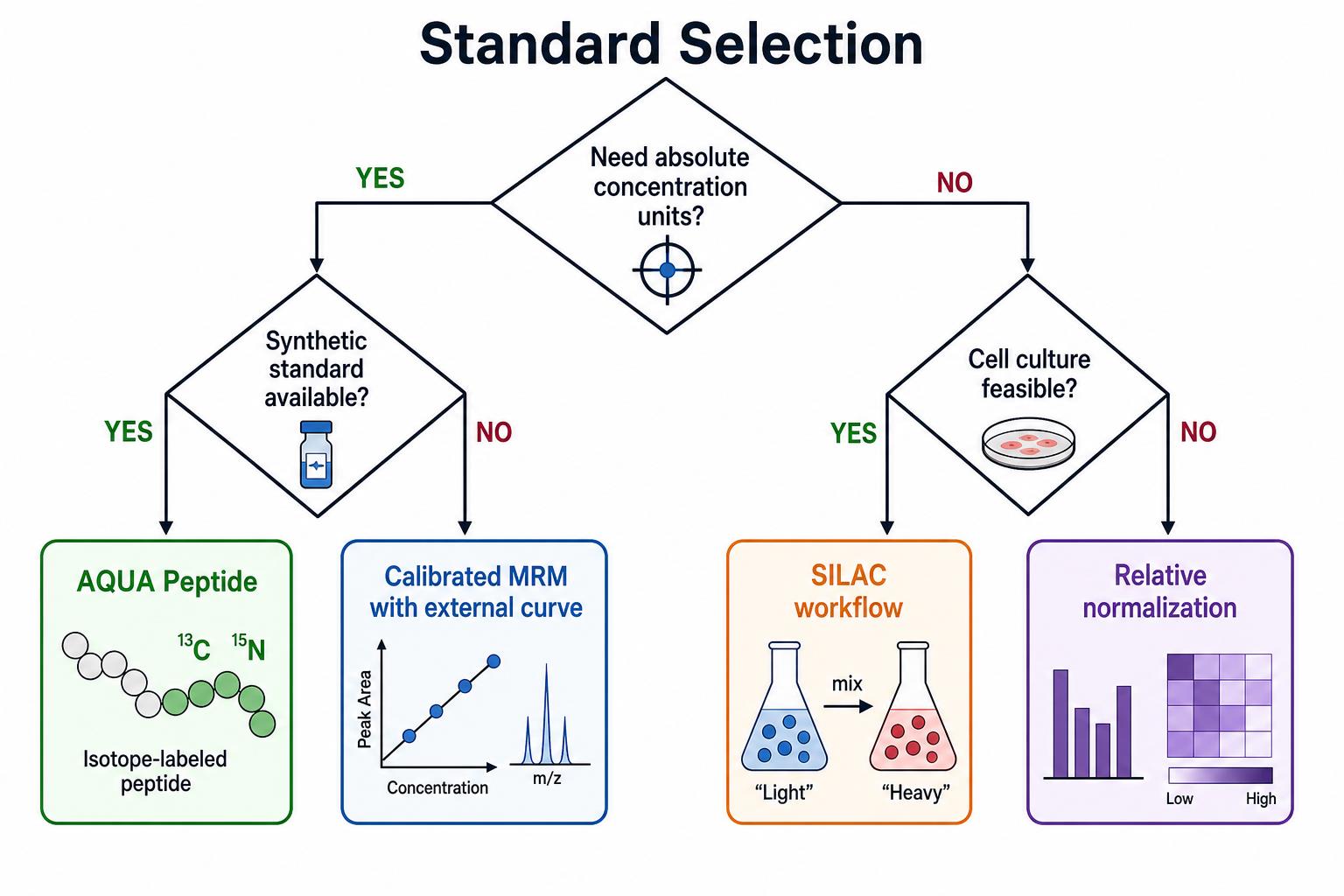
Figure 2. Reporting requirements and sample type determine whether an AQUA peptide, SILAC, or external calibration is the preferred standard strategy.
Frequently Asked Questions
1. Is an AQUA peptide the same as a SIL peptide?
Both use stable isotope labels, but an AQUA peptide refers to a synthetic standard spiked at known amount for absolute quantitation. SILAC labels proteins metabolically during cell culture for relative comparison.
2. Can SILAC results be converted to absolute concentration?
Sometimes with additional calibration, but SILAC is primarily designed for relative quantitation rather than specification-level absolute reporting in complex clinical matrices.
3. Are unlabeled spikes ever enough for absolute reporting?
In some clean matrices with validated external calibration, yes. Complex matrices often benefit from isotope dilution with an AQUA peptide.
4. Can one assay combine AQUA peptides and external calibrators?
Yes. Some workflows use AQUA peptides for ratio measurement and external calibrator curves for final unit conversion, depending on validation design.
5. Does every targeted peptide need its own AQUA standard?
Each quantified surrogate typically requires a sequence-matched AQUA peptide unless a validated alternative standard strategy is documented.
Conclusion
An AQUA peptide, SILAC labeling, and unlabeled external calibration serve different reporting needs within targeted quantitation. The AQUA peptide provides the most direct isotope dilution anchor when absolute concentration reporting is required for predefined peptides. Method selection should begin with reporting goal and sample type, not standard habit alone.
MtoZ Biolabs can Match the internal standard workflow to project stage across Absolute Quantitative Analysis (AQUA) Service, AQUA Proteomics Service, and Targeted Proteomics Service. Contact the technical team to compare options before standard ordering.
How to order?




