



In vitro cross-linking of two purified proteins requires more than a named bifunctional reagent. The tube needs both proteins at a written concentration, a buffer that does not consume the reagent, the matched cross-linker, and a quench. For an amine-reactive NHS ester the buffer is amine-free: HEPES or phosphate, not Tris. A no-cross-linker mix of the same two proteins, and each protein incubated with reagent alone, travel through the same quench. Those arms are part of the reagent plan. They are not optional extras.
The original five names remain useful only after that list is written. BS3 is the usual water-soluble amine reagent for an aqueous pair. DSS shares the same spacer and is added from a small DMSO stock into the same aqueous tube. It is not a reagent for non-aqueous environments. EDC is zero-length carboxyl–amine chemistry. Glutaraldehyde builds heterogeneous networks. Sulfo-EGS is a longer, water-soluble amine spacer. None of those five is required in every two-protein tube. For the broader site-and-residue choice that includes in-cell work, How to Select a Crosslinker for XL-MS Structural Studies provides a complementary selection page.
Researchers who already have two purified proteins and need a residue-pair or shift table can also review the MtoZ Biolabs Crosslinking Mass Spectrometry Protein Interaction Analysis Service for project-specific feasibility and analysis planning.
What the Tube Must Contain
The two proteins are reagents in this experiment. Their purity, buffer, and molar ratio decide who can react. A stoichiometric mix is a tube choice. It does not recreate a cell. Residual imidazole, Tris, or glycine from a purification tag elution consumes NHS ester before the intended lysines do.
The cross-linker is the second chemical class. For a lysine-to-lysine pair in water, BS3 or a small DMSO spike of DSS is the usual amine reagent. If the next table is liquid chromatography–tandem mass spectrometry (LC-MS/MS) of linked peptides, an MS-cleavable amine spacer such as DSSO can replace DSS or BS3. That substitution is a search choice, not a more accurate structure.
The quench is the third required chemical. Tris or glycine stops leftover NHS ester. Leaving the tube on ice so that the ester hydrolyzes is not a written quench. For that stop, How to Handle Samples After Adding Crosslinkers in Protein Crosslinking provides a complementary handling page. For the purified-protein route that uses this tube, What Is the Protocol for Crosslinking-Based Protein Interaction Analysis? provides a complementary protocol page.
pH and temperature belong on the same card as the reagent class. NHS esters are typically used near pH 7–8. They are not selected by listing pH as a free physicochemical factor.
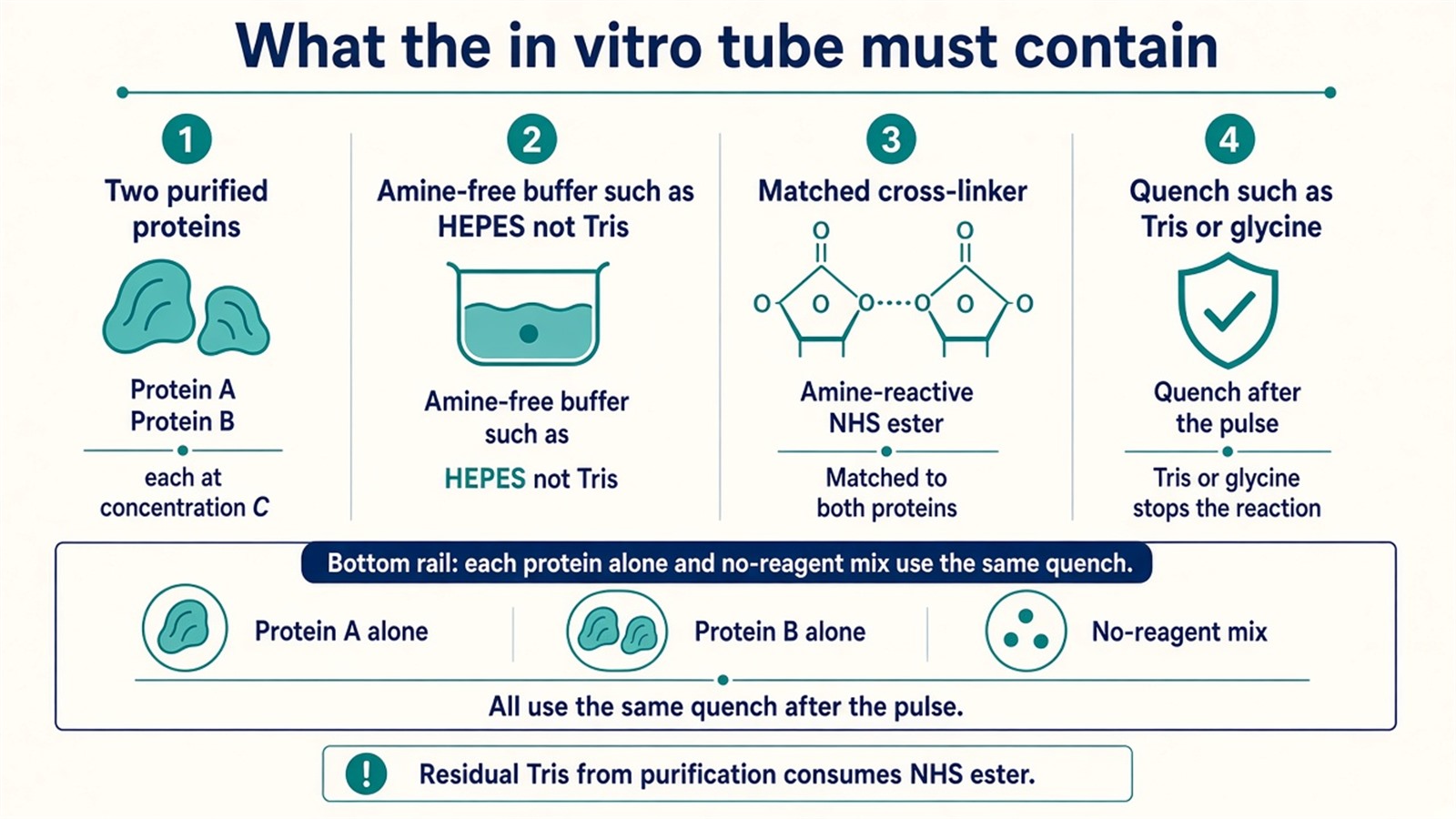
Figure 1. Two purified proteins, an amine-free buffer for NHS chemistry, the reagent, and a quench. Each-protein-alone and no-reagent mix are processed the same way.
Write the buffer and the quench before naming BS3. A water-soluble lysine reagent does not fix a Tris carryover.
What the Five Named Reagents Can Do in This Tube
BS3 targets primary amines, mainly lysines and N-termini, and dissolves in water. That is why it is the default for two aqueous purified proteins.
DSS is the same spacer without the sulfo groups. It is dissolved in DMSO and diluted into the aqueous protein mix so that the final organic fraction stays low. Calling DSS suitable for non-aqueous environments misstates the experiment. The proteins are still in water.
EDC joins a carboxyl to an amine with no spacer. It is a conjugation chemistry. It is not a required DSS-class reagent for in vitro two-protein XL-MS.
Glutaraldehyde reacts with amines and can polymerize. Extensive networks are useful for some fixation jobs. They are a poor first reagent when the claim is a defined pair between two purified proteins.
Sulfo-EGS is water-soluble and longer than BS3. Greater molecular distance is a reach estimate, not a guarantee that distant surfaces will be linked. For what a named pair is allowed to support after any of these reagents, What Are the Specific Experimental Methods for Cross-Linking Protein Interaction Analysis provides a complementary methods page.
Reagent |
In this tube |
What it is not |
|---|---|---|
BS3 |
Aqueous amine XL of two purified proteins |
A required reagent for every pair |
DSS |
Same spacer, added from DMSO into water |
A non-aqueous protein method |
EDC |
Zero-length carboxyl–amine conjugation |
A BS3-class spacer |
Glutaraldehyde |
Broad amine fixation |
A clean two-protein pair reagent |
Sulfo-EGS |
Longer aqueous amine spacer |
A measured interface length |
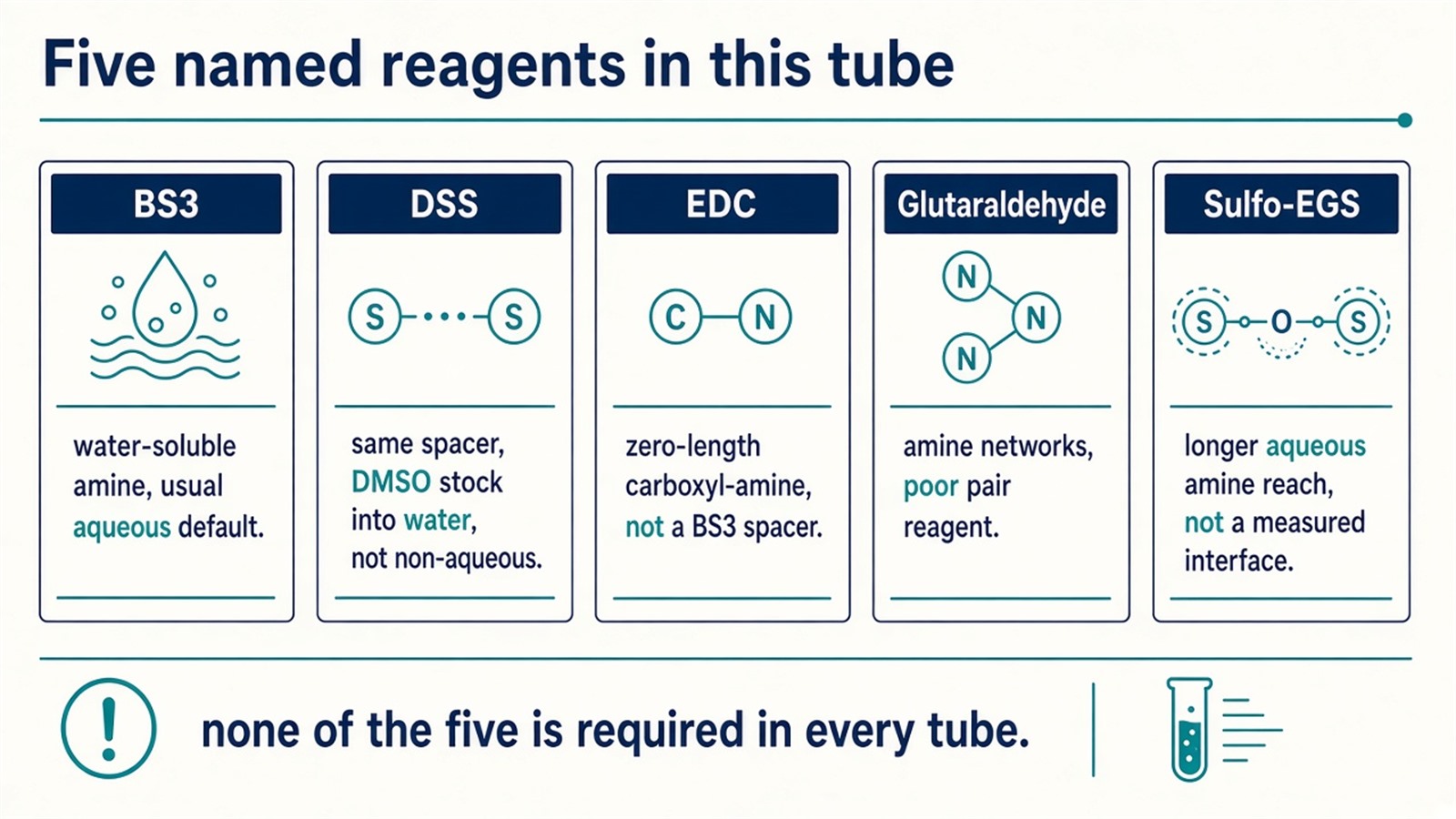
Figure 2. BS3 in water. DSS from DMSO into water. EDC is zero-length. Glutaraldehyde networks. Sulfo-EGS is a longer amine reach.
What Is Not Required
A longer spacer is not required to make the experiment structural. Solubility, spacer length, and reactivity are decision questions. They do not become a list of generally preferable properties plus pH and temperature.
Two purified proteins in a tube are an in-vitro reconstitution. A cross-link in that tube reports that those residues could react under that buffer, ratio, and dose. It does not report a cellular interaction. For when a residue pair still does not prove direct binding, Can Crosslinking MS Prove a Direct Protein Interaction? provides a complementary proof page.
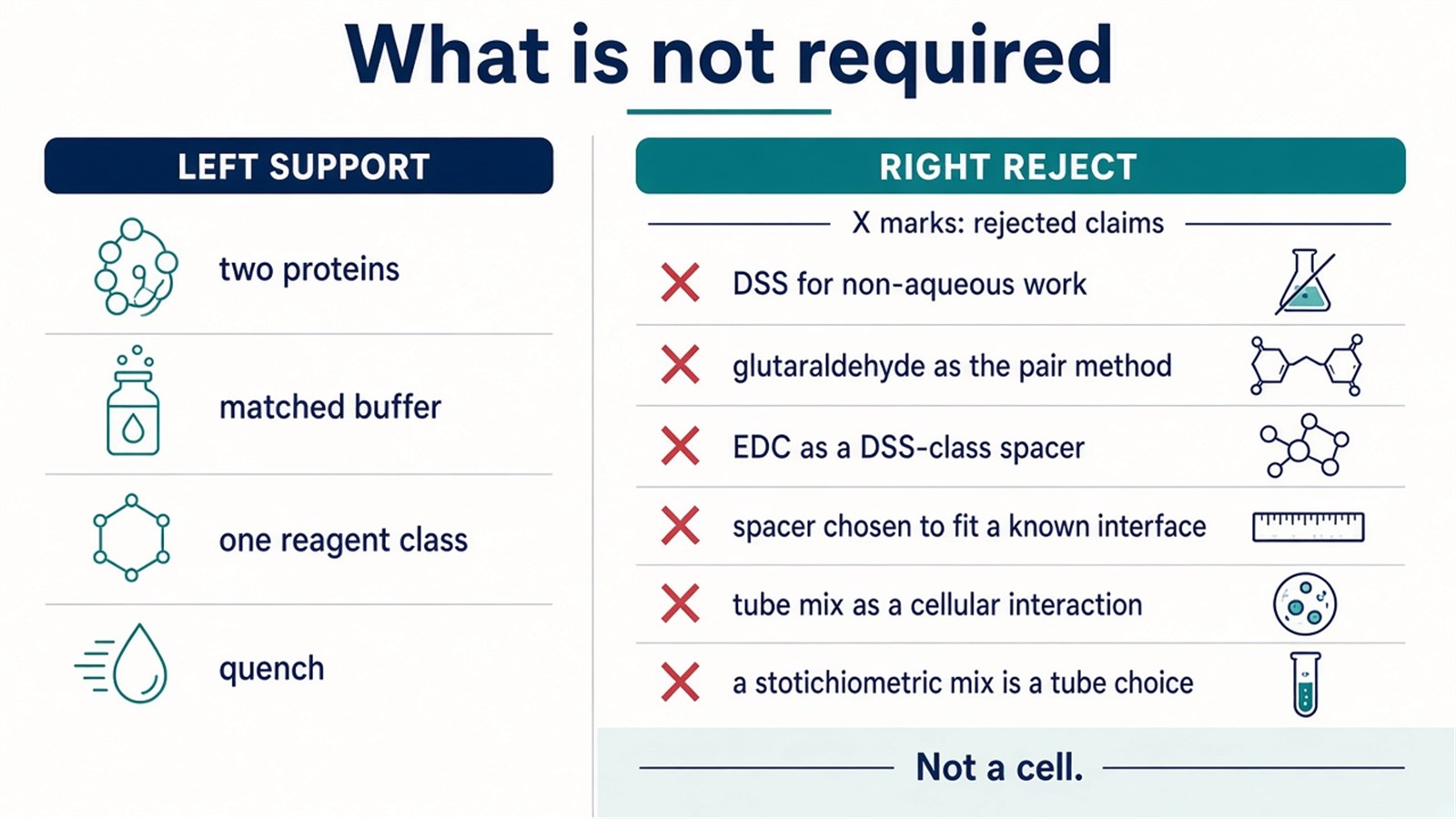
Figure 3. Supported: two proteins, matched buffer, one reagent class, a quench. Not granted: DSS for non-aqueous work, glutaraldehyde as the pair method, or a spacer chosen to fit a known interface.
Experimental Limits
An in-vitro two-protein reaction reduces the claim to what one buffer, one ratio, one reagent, and one quench can report. Diagnostic or cellular-interaction language sits outside ordinary research reporting unless a separately validated assay is in place.
Project Planning and Service Scope
A usable reagent plan names the two proteins, the amine-free or carboxyl-compatible buffer, BS3, DSS, or an MS-cleavable analog, and the quench, before the first dose. MtoZ Biolabs scopes crosslinking MS with Orbitrap-class LC-MS/MS. Interpretability still follows those arms, not a common-cross-linker list.
Once the next sentence is a cellular partner list rather than a tube pair, the project should not be forced through a purified-protein mix. Researchers who need that pellet can review the MtoZ Biolabs Protein-Protein Interaction Analysis Service for project-specific sample evaluation, feasibility assessment, and workflow planning.
Frequently Asked Questions
1. What reagents are required for in vitro cross-linking of two purified proteins?
Both proteins, a buffer that does not consume the reagent, one matched cross-linker, and a quench. For NHS esters the buffer is amine-free.
2. Is DSS used in non-aqueous environments?
No. DSS is dissolved in DMSO and added to aqueous protein. The experiment remains in water.
3. Is BS3 required?
It is the usual water-soluble amine reagent for this tube. It is not required if a written analog such as DSSO is used.
4. Should glutaraldehyde be used for two purified proteins?
Not when the claim is a defined residue pair. It forms heterogeneous amine networks.
5. Is EDC a standard spacer like BS3?
No. EDC is zero-length carboxyl–amine chemistry.
Reference
- Leitner A., Walzthoeni T., Kahraman A., et al. (2014). Probing native protein structures by chemical cross-linking, mass spectrometry, and bioinformatics. Nat. Protoc., 9, 120-135. https://doi.org/10.1038/nprot.2013.168
- Merkley E.D., Rysavy S., Kahraman A., et al. (2014). Distance restraints from crosslinking mass spectrometry: mining a molecular dynamics database to evaluate lysine-lysine distances. Protein Sci., 23, 747-759. https://doi.org/10.1002/pro.2458
- O'Reilly F.J., Rappsilber J. (2018). Cross-linking mass spectrometry: methods and applications in structural, molecular and systems biology. Nat. Struct. Mol. Biol., 25, 1000-1008. https://doi.org/10.1038/s41594-018-0147-0
- Yu C., Huang L. (2018). Cross-linking mass spectrometry: an emerging technology for interactomics and structural biology. Anal. Chem., 90, 144-165. https://doi.org/10.1021/acs.analchem.7b04431
- Kao A., Chiu C.L., Vellucci D., et al. (2011). Development of a novel cross-linking strategy for fast and accurate identification of cross-linked peptides of protein complexes. Mol. Cell. Proteomics, 10, M110.002212. https://doi.org/10.1074/mcp.M110.002212
