



A laboratory comparing several treatment groups often wants those digests measured in one liquid chromatography-tandem mass spectrometry (LC-MS/MS) injection. Tandem mass tag (TMT) isobaric labeling is a chemical method that attaches a channel-specific tag to peptides so the same sequence from every sample shares one precursor mass, then releases a distinct reporter ion after fragmentation (Thompson et al. 2003). The quantitative claim is a relative ratio inside that labeled set. TMT does not report mass or molar concentration unless a matched stable isotope-labeled internal standard (SIS) is added for that peptide.
Isobaric means the complete tags have the same total mass at the precursor (MS1) level. Differences appear only when the tag fragments. Labeling chemistry and acquisition mode remain separate decisions. In MtoZ Biolabs offerings, TMT workflows are typically acquired as data-dependent acquisition (DDA) so reporter ions can be read from selected precursors.
What TMT Isobaric Labeling Can Report
TMT can support a same-peptide relative comparison across channels that were labeled, quenched, and mixed together. After identification, reporter intensities are summarized to proteins and tested against a predefined group contrast. The method can multiplex many samples onto one chromatographic path, which removes run-to-run retention-time drift for that mixed set.
TMT cannot recover a protein that was never identified. It cannot rank different proteins as copy numbers from reporter height. It cannot treat a later unlabeled digest as an extra channel in the same ratio matrix. Intensity-based copy-number estimates and label-free peak areas answer other questions. Researchers can refer to A Guide to Label-Free Quantitative Proteomics: From Experiment to Data Analysis when each sample must stay on its own injection and the list of files may still grow.
A commercial kit sets how many channels exist. The study design sets which biological groups occupy those channels, including any bridge or reference channel if more than one plex is planned. Kit size is not a biological result.
How TMT Labeling Turns Separate Digests into One Precursor
A TMT reagent carries an amine-reactive handle, a mass balancer, and a reporter group. The reactive handle, commonly an N-hydroxysuccinimide (NHS) ester class, attaches the tag to peptide N-termini and lysine amines after digestion. The balancer offsets isotopic differences among channels so the intact tag mass stays matched. The reporter is the quantitative ion released by fragmentation. Researchers who need the reagent geometry in more detail can refer to Mechanism of TMT Labeling in Mass Spectrometry.
The working order is digestion, channel labeling, quenching, mixing, LC-MS/MS, then reporter extraction. Proteins are reduced, alkylated, and digested, usually with trypsin. Each digest receives one tag. Residual amine buffers compete for reagent and leave unlabeled peptides. After quenching, labeled peptides are pooled. From that point, channels share retention time, ionization, and precursor selection. At MS1, the same peptide sequence appears as one precursor. Collision-induced dissociation (CID) or higher-energy collisional dissociation (HCD) then releases channel-specific reporters (Thompson et al. 2003).
TMT is isobaric at MS1; a reporter-ion ratio exists only after fragmentation of the mixed precursor.
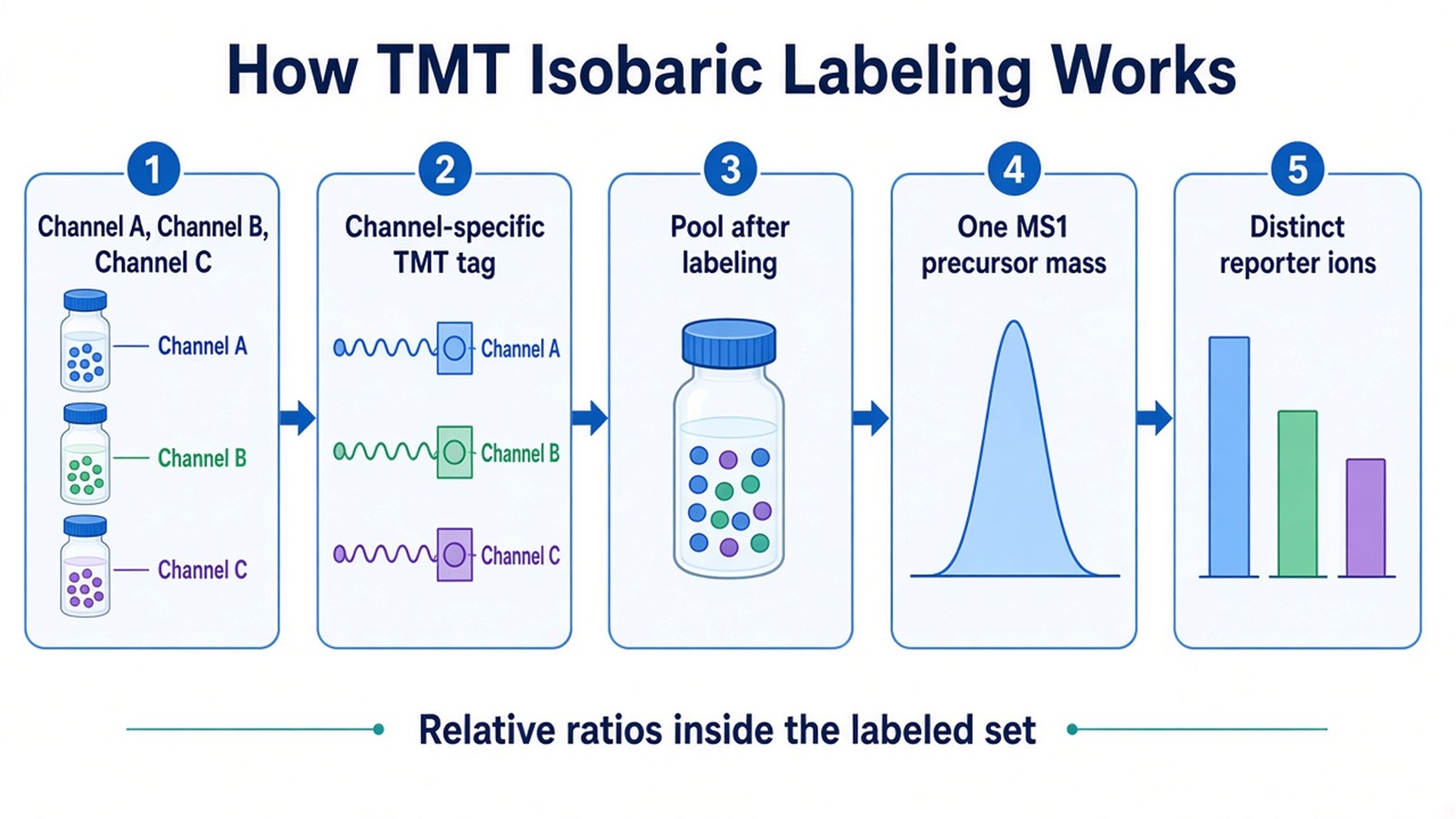
Figure 1. TMT labeling makes peptides from separate samples share one precursor mass; relative quantification comes from reporter ions released after fragmentation.
Reporter intensities are then normalized and summarized. Mixing unlabeled discovery files with a TMT plex in one statistical model does not create reporters for samples that were never tagged.
Parameters That Must Hold for Reporter Ratios to Mean Biology
Several conditions have to be true before a reporter fold change can be read as biology.
Protein input into each digest should be matched. Unequal load becomes a channel offset after mixing and is difficult to unmix in software. Digestion completeness should be similar across channels, because missed cleavages change which amines are available to the tag.
Labeling completeness should be high on N-termini and lysines. Incomplete labeling splits the same peptide into tagged and untagged forms, which weakens the reporter and can bias identification. Quenching and cleanup should remove free reagent that would otherwise dominate low-mass spectra.
Isolation purity controls whether the reporter belongs to one peptide. In MS2 TMT, co-isolated precursors contribute reporters into the same spectrum and pull ratios toward one, a distortion often called ratio compression (Ting et al. 2011). Narrower isolation, fractionation, or an additional MS3 step such as synchronous precursor selection MS3 (SPS-MS3) can reduce that mixing on compatible instruments (McAlister et al. 2014). Those acquisition choices do not repair unmatched loads or leftover amine buffer.
Channel layout should be declared before labeling: which samples occupy which tags, whether a common reference is included, and how biological replicates are split if more than one plex is required. Interleaving groups across tags remains a design task. It is not a search-engine setting.
When chromatograms or load still explain most of the variance after reporters are extracted, researchers can refer to Quantitative Proteomics: Strategies, Advantages, and Challenges for how those failure patterns are traced before a new digest is queued.
Limits Built into the Isobaric Definition
The same shared chromatographic path that stabilizes relative comparison also freezes the sample set. A sample that arrives after mixing is not an extra TMT channel. A new plex can be compared if a bridge sample or reference channel is designed. Unlabeled acquisition is often simpler when enrollment is expected to stay open.
Reporter ratios are relative. A large biological change can look smaller at MS2 when co-isolation is severe. SPS-MS3 can reduce that compression; it does not convert TMT into an absolute assay (McAlister et al. 2014). Isotopic impurities in commercial tags can leak signal into neighboring channels and should be corrected with the kit-specific factors supplied by the manufacturer.
TMT does not replace a targeted confirmation assay. If the remaining task is a short, named peptide list with fragment-level evidence, a scheduled method is the closer match. If the remaining task is amount in ng or fmol, an SIS-supported assay is required.
When TMT Isobaric Labeling Matches the Study Question
The useful test is whether samples can be labeled together, whether the claim is a relative ratio, and whether amines are free to react.
Study need |
TMT isobaric labeling often fits |
Reassess before labeling |
|---|---|---|
Group contrast on a defined set |
Relative ratios inside one mixed plex |
Files still arriving after mixing |
Same chromatographic path |
Matched load and digestion before tagging |
Channel offsets already visible in bulk assays |
Discovery protein list still open |
Multiplexed DDA identification plus reporters |
A closed peptide list that needs fragment confirmation |
Later samples expected |
Bridge channel or a second plex with a shared reference |
Treat an extra unlabeled run as the same TMT matrix |
Amount or concentration unit |
Only if a matched SIS is added for that peptide |
Ordinary reporter ratios treated as ng per mL |
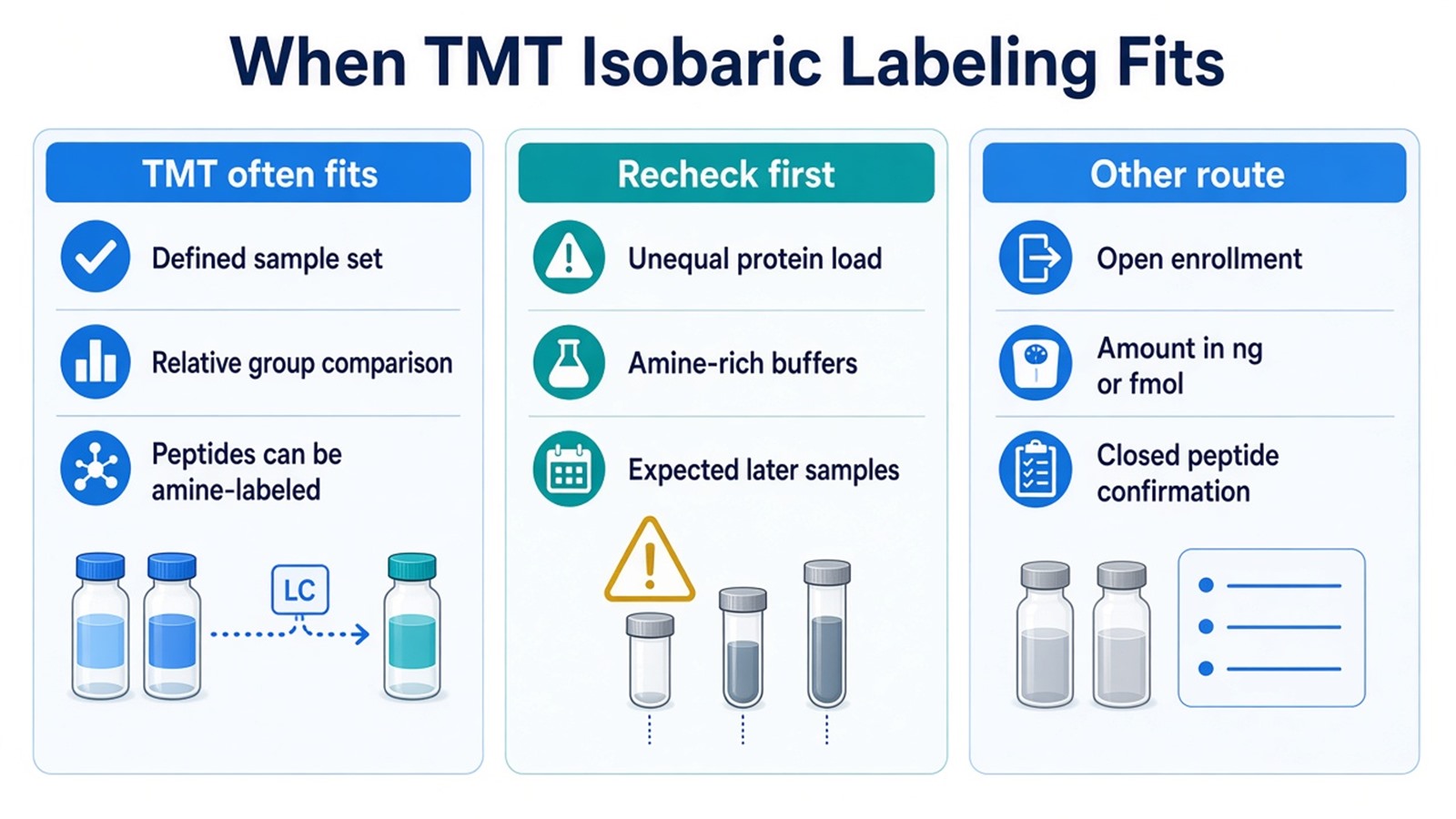
Figure 2. TMT isobaric labeling fits a defined sample set that needs relative ratios; open enrollment, amount claims, and incomplete labeling call for a different plan.
TMT more often fits a multi-group or time-course design that can be frozen at labeling. An exception is a small, well-buffered set that still needs unlabeled flexibility because a follow-up harvest is already scheduled. Unlabeled LFQ more often fits open enrollment. An exception is a short, closed cohort that must share one injection to limit run-order drift.
Researchers who already have defined groups, matched protein material, and a requested relative contrast can also review the MtoZ Biolabs TMT Quantitative Proteomics Analysis Service for project-specific plex planning and labeling feasibility.
Frequently Asked Questions
1. Is TMT the same as metabolic labeling in culture?
No. TMT is a chemical tag added after digestion. Metabolic labeling incorporates heavy amino acids during protein synthesis in cells that can be grown on labeled media. The two methods share the idea of a mass difference, not the same labeling step.
2. Does mixing labeled samples create an absolute protein amount?
No. Pooling puts every channel on one LC-MS/MS path. The readout is still a reporter ratio inside that mix. An amount unit requires a matched SIS and a declared calibration.
3. Can one more sample join a plex after the peptides are mixed?
Not as an extra reporter channel in the same mix. A new plex with a bridge or reference sample can connect experiments. Unlabeled acquisition is often the simpler plan when extra harvests are expected.
4. Why can a strong treatment effect look small in TMT ratios?
Co-isolated peptides can add reporters into the same MS2 spectrum and pull ratios toward one (Ting et al. 2011). Check isolation purity, fractionation, and whether an MS3 reporter scan is available before concluding that the biology is weak.
5. Must every TMT project be acquired as DDA?
TMT quantification needs spectra in which reporter ions are measured for identified precursors. That work is typically DDA at MS2 or MS3. Unlabeled DIA is a different acquisition choice and is not a TMT labeling step.
MtoZ Biolabs can provide TMT isobaric labeling and multiplexed relative proteomics when samples can be tagged together and the study needs a predefined group contrast.
If further evaluation of plex layout, labeling completeness, or whether unlabeled LFQ is a better fit is needed, project details can be submitted for a feasibility review.
Reference
- G.C. McAlister, D.P. Nusinow, M.P. Jedrychowski, M. Wuhr, E.L. Huttlin, B.K. Erickson, R. Rad, W. Haas, S.P. Gygi (2014). MultiNotch MS3 enables accurate, sensitive, and multiplexed detection of differential expression across cancer cell line proteomes. Anal. Chem., 86, 7150-7158. https://doi.org/10.1021/ac502040v
- A. Thompson, J. Schafer, K. Kuhn, S. Kienle, J. Schwarz, G. Schmidt, T. Neumann, R. Johnstone, A.K. Mohammed, C. Hamon (2003). Tandem mass tags: a novel quantification strategy for comparative analysis of complex protein mixtures by MS/MS. Anal. Chem., 75, 1895-1904. https://doi.org/10.1021/ac0262560
- L. Ting, R. Rad, S.P. Gygi, W. Haas (2011). MS3 eliminates ratio distortion in isobaric multiplexed quantitative proteomics. Nat. Methods, 8, 937-940. https://doi.org/10.1038/nmeth.1714
