



The protocol for crosslinking-based protein interaction analysis is a written reaction, a quench, a digestion, and a search for covalently linked peptides. It is not a single recipe that runs from 0.1–1 mg/mL protein to a reconstructed interaction network. Two routes share later steps and do not share the first tube. Route A treats a purified protein or a lysate, often with a membrane-impermeable amine reagent such as BS3. Route B treats intact cells, often with a permeable reagent such as DSS. Mixing purified proteins in a defined stoichiometric ratio is an in-vitro reconstitution. It does not reflect biologically relevant conditions.
A no-crosslinker arm is prepared with the same material and is processed through quench, digestion, and the search. Adding that arm after a single stained gel cannot reconstruct reagent-dependent pairs. Gel separation and band excision are optional. Many XL-MS files are built from an in-solution digest and an enrichment of crosslinked peptides. For which reagent belongs on which route, How to Select a Crosslinker for XL-MS Structural Studies provides a complementary selection page.
Researchers who already have a route and a reagent and need a residue-proximity table can also review the MtoZ Biolabs Crosslinking Mass Spectrometry Protein Interaction Analysis Service for project-specific feasibility and analysis planning.
Two Routes, Then a Shared Wet Order
The original seven headings remain usable if the first heading names the route. Sample preparation for Route A starts from a known concentration and a stated buffer that is compatible with the reagent. Amine-reactive NHS esters are quenched by free amines; Tris is a common stop, not a universal one. A published 0.1–1 mg/mL window is a starting range for some purified samples. It is not a concentration that facilitates efficient crosslinking in every system.
Route B starts from washed cells, a written dose, and a viability or cell-state check. The same 0.1–1 mg/mL sentence does not apply. For the no-crosslinker, quench, and dose arms that belong on Route B, What Controls Are Needed for Co-IP-MS and In-Cell Crosslinking MS? provides a complementary control page.
For when this protocol is the wrong first experiment because the next table should be a partner list, Co-IP-MS vs XL-MS: Which Protein Interaction Workflow Should You Choose? provides a complementary workflow page.
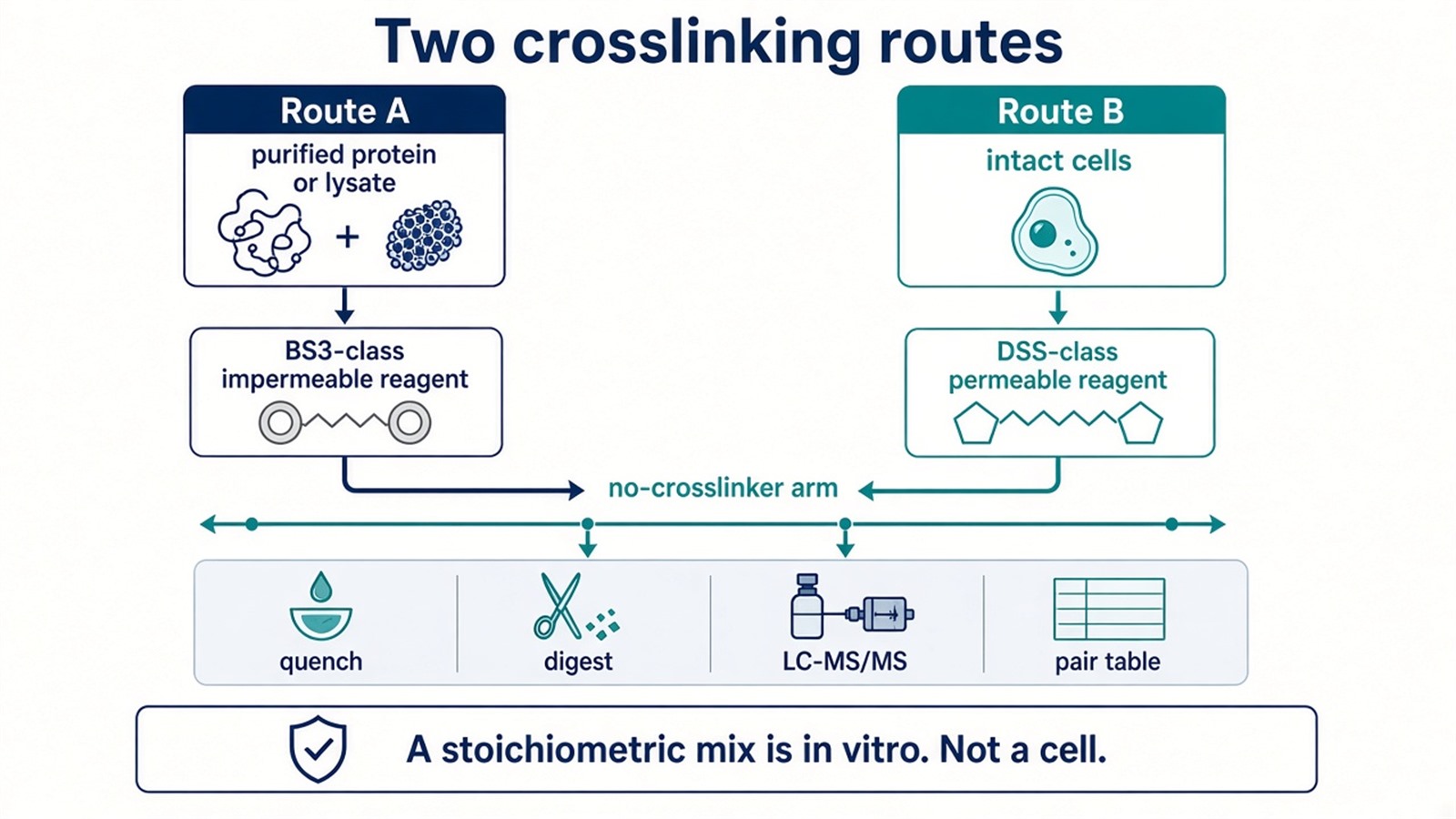
Figure 1. Route A: BS3-class reagent on a protein or lysate. Route B: DSS-class reagent on intact cells. The no-crosslinker arm is prepared on the same material.
Write the route before the first concentration. A 30-minute room-temperature incubation is not the protocol.
The Shared Steps After the Pulse
These are the original middle headings, with the steps that were missing.
Selection of crosslinker
The reagent is chosen from site, residue class, and whether the spacer must be MS-cleavable. Pilot doses are a titration, not an optimal concentration determined from physicochemical properties of the proteins.
Crosslinking reaction
The reagent is added in a stated buffer. Incubation time and temperature are written for that reagent. A 30-minute to 2-hour room-temperature window is one NHS-ester habit. It is not a condition that depends only on the reagent name. The reaction is stopped with a matched quench. For NHS esters, an amine buffer such as Tris is typical.
Protein separation and identification
SDS-PAGE and Coomassie or silver stain can show that a species shifted. They do not identify a crosslinked site. Band excision is one path into the spectrometer. It is not required.
Mass spectrometry analysis
Proteins are digested, often with trypsin, in solution or from a gel piece. Crosslinked peptides are usually a small fraction of the digest. Enrichment, when used, is processed in parallel on the no-crosslinker arm. Liquid chromatography–tandem mass spectrometry (LC-MS/MS) names linked peptide pairs. Parent mass is not an identification.
Data analysis
Specialized search tools assign candidate pairs under a declared crosslink-level false-discovery rule. The output is a residue-pair table. It does not reconstruct a protein interaction network. Annotation from known functions, pathways, or prior literature comes last and does not decide which pairs are reagent-dependent. For what those pairs are allowed to support, Can Crosslinking MS Prove a Direct Protein Interaction? provides a complementary proof page.
Validation experiments
Technical and biological replicates test whether a pair returns. They do not ensure robustness of a biological implication. A follow-up functional assay tests output. It does not validate that the observed pair was a protein–protein interaction.
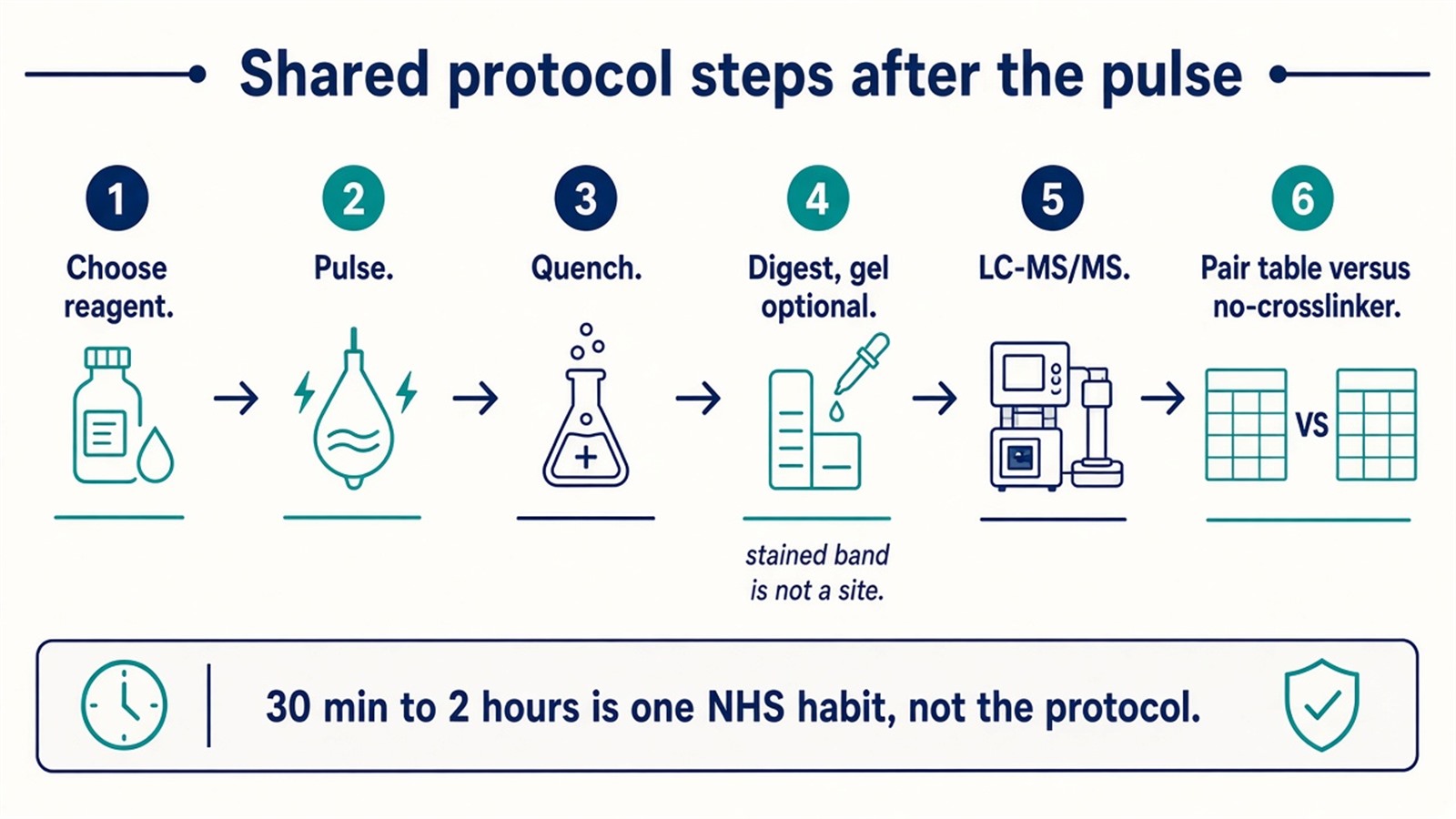
Figure 2. Reagent, pulse, quench, digest, LC-MS/MS, pair table. The no-crosslinker arm travels through every step. Stained bands are not identifications.
What This Protocol Does Not Include
A stoichiometric mix of purified proteins is a reconstitution protocol. Calling it biologically relevant collapses the tube into the cell.
A recipe that ends at stained bands, or at a literature overlay, is not XL-MS. The identification is the linked peptide, scored against the no-crosslinker digest.
Functional validation is a different experiment. Replicates belong in the protocol. Pathway language does not.
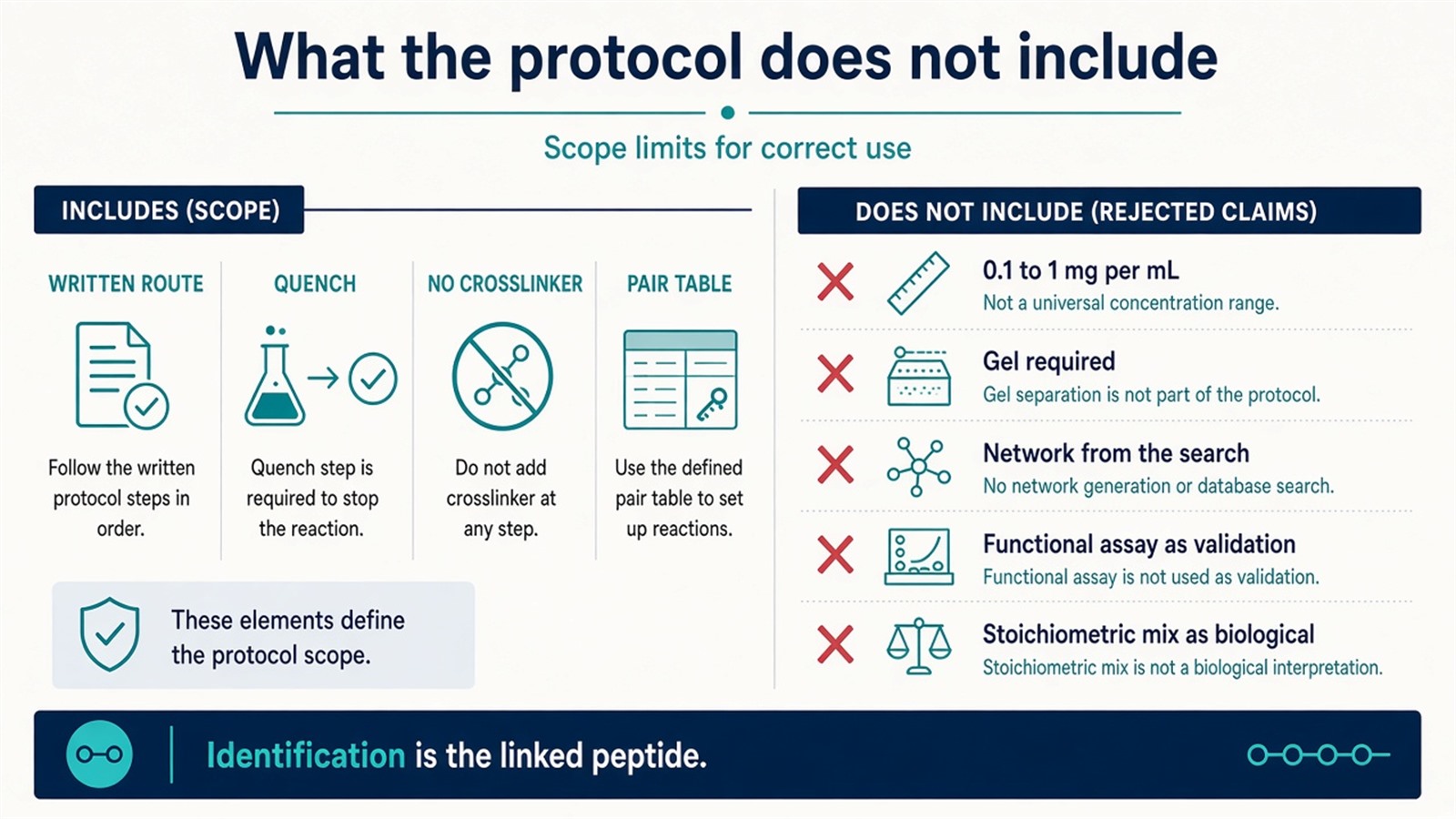
Figure 3. Supported: a written route, a quench, a pair table. Not granted: 0.1–1 mg/mL as a universal range, gel-required identification, or network reconstruction from the search.
Experimental Limits
This protocol reduces a sample to what one route, one reagent, one quench, one digestion, and one search can report. Diagnostic or complete-architecture language sits outside ordinary research reporting unless a separately validated structural method is in place.
Project Planning and Service Scope
A usable protocol plan names Route A or Route B, the reagent, the no-crosslinker arm, and the claim that will be allowed, before the first dose. MtoZ Biolabs scopes crosslinking MS with Orbitrap-class LC-MS/MS. Interpretability still follows those arms, not a 30-minute-to-2-hour slogan.
Once the next sentence is a wash-stable partner list rather than a residue pair, the project should not be forced through this protocol. Researchers who need that pellet can review the MtoZ Biolabs Co-IP-MS Protein Interaction Analysis Service for project-specific sample evaluation, feasibility assessment, and workflow planning.
Frequently Asked Questions
1. What is the protocol for crosslinking-based protein interaction analysis?
Write the route, add a matched reagent, quench, digest, and search for linked peptides against a no-crosslinker arm. It is not one concentration and one gel.
2. Is 0.1–1 mg/mL the standard protein concentration?
It is a starting range for some purified samples. It does not apply to in-cell work and does not make crosslinking efficient.
3. Must the sample be run on SDS-PAGE?
No. A stained band can show a shift. Site identification is a peptide-level search.
4. Does the search reconstruct an interaction network?
No. It assigns candidate residue pairs. Networks are a later overlay.
5. Do functional assays validate the crosslinks?
No. They test a phenotype. Replicates and the no-crosslinker arm test the pair.
Reference
- Leitner A., Walzthoeni T., Kahraman A., et al. (2014). Probing native protein structures by chemical cross-linking, mass spectrometry, and bioinformatics. Nat. Protoc., 9, 120-135. https://doi.org/10.1038/nprot.2013.168
- Leitner A., Faini M., Stengel F., Aebersold R. (2016). Crosslinking and mass spectrometry: an integrated technology to understand the structure and function of molecular machines. Trends Biochem. Sci., 41, 20-32. https://doi.org/10.1016/j.tibs.2015.10.008
- O'Reilly F.J., Rappsilber J. (2018). Cross-linking mass spectrometry: methods and applications in structural, molecular and systems biology. Nat. Struct. Mol. Biol., 25, 1000-1008. https://doi.org/10.1038/s41594-018-0147-0
- Yu C., Huang L. (2018). Cross-linking mass spectrometry: an emerging technology for interactomics and structural biology. Anal. Chem., 90, 144-165. https://doi.org/10.1021/acs.analchem.7b04431
- Iacobucci C., Piotrowski C., Aebersold R., et al. (2019). First community-wide, comparative cross-linking mass spectrometry study. Anal. Chem., 91, 6953-6961. https://doi.org/10.1021/acs.analchem.9b00658
