



The AP-MS technique is affinity purification–mass spectrometry. A bait is captured on an affinity handle, the wash filters the pellet, and liquid chromatography–tandem mass spectrometry (LC-MS/MS) names proteins in the eluate. The question it answers is which proteins were recovered with this bait under these enrichment conditions. That question is narrower than mapping every physical contact in a cell. AP-MS is not interchangeable with every immunoprecipitation or pull-down, and it is not a tagged interactome workflow by being named one.
Vendor pages and papers use AP-MS, pull-down MS, and tagged Co-IP-MS for the same enrich-then-identify logic. What defines the technique as a project type is not a bead brand or a tag name. It is affinity enrichment of a written bait before proteomics. Whole-proteome profiling of unfractionated lysate is a different experiment. A contact-surface map is a different experiment. For the detection chain inside that definition, How AP-MS Works provides a complementary mechanism page.
Researchers who already have a tagged bait and need a ranked co-enrichment table can also review the MtoZ Biolabs Affinity Purification-Mass Spectrometry Service for project-specific feasibility and analysis planning.
The Question, Then the Four Parts
Proteins that co-purify become candidates, not partners. Empty-tag, bead-only, or a matched non-bait arm ranks bait-enriched names away from resin and handle binders. Replicates stabilize that rank. AP-MS does not replace a later yes-or-no assay. If one predefined prey only needs confirmation, a focused Co-IP or pull-down is the shorter route.
The original four components remain the definition, not a protocol.
The affinity reagent decides which protein entered. Epitope tags are the common AP-MS handle on this site. Immobilized recombinant bait is pull-down-MS. Antibody capture of an endogenous bait is IP-MS when that is the written product. Those three formats do not share a control.
Binding, washing, and elution concentrate what survived the kinetic filter. Wash stringency is a technique parameter. It is not an interaction-recovery setting that can be optimized to a single correct value.
LC-MS/MS assigns peptides from fragment spectra, then protein groups. Depth decides how completely the eluate is sampled. Identification is not an interaction hypothesis.
Specificity review compares bait and control. Without that contrast the technique returns names. It does not return ranked candidates. Do not subtract every control identification. For what those names are allowed to support, Understanding AP-MS: A Comprehensive Guide provides a complementary evidence page.
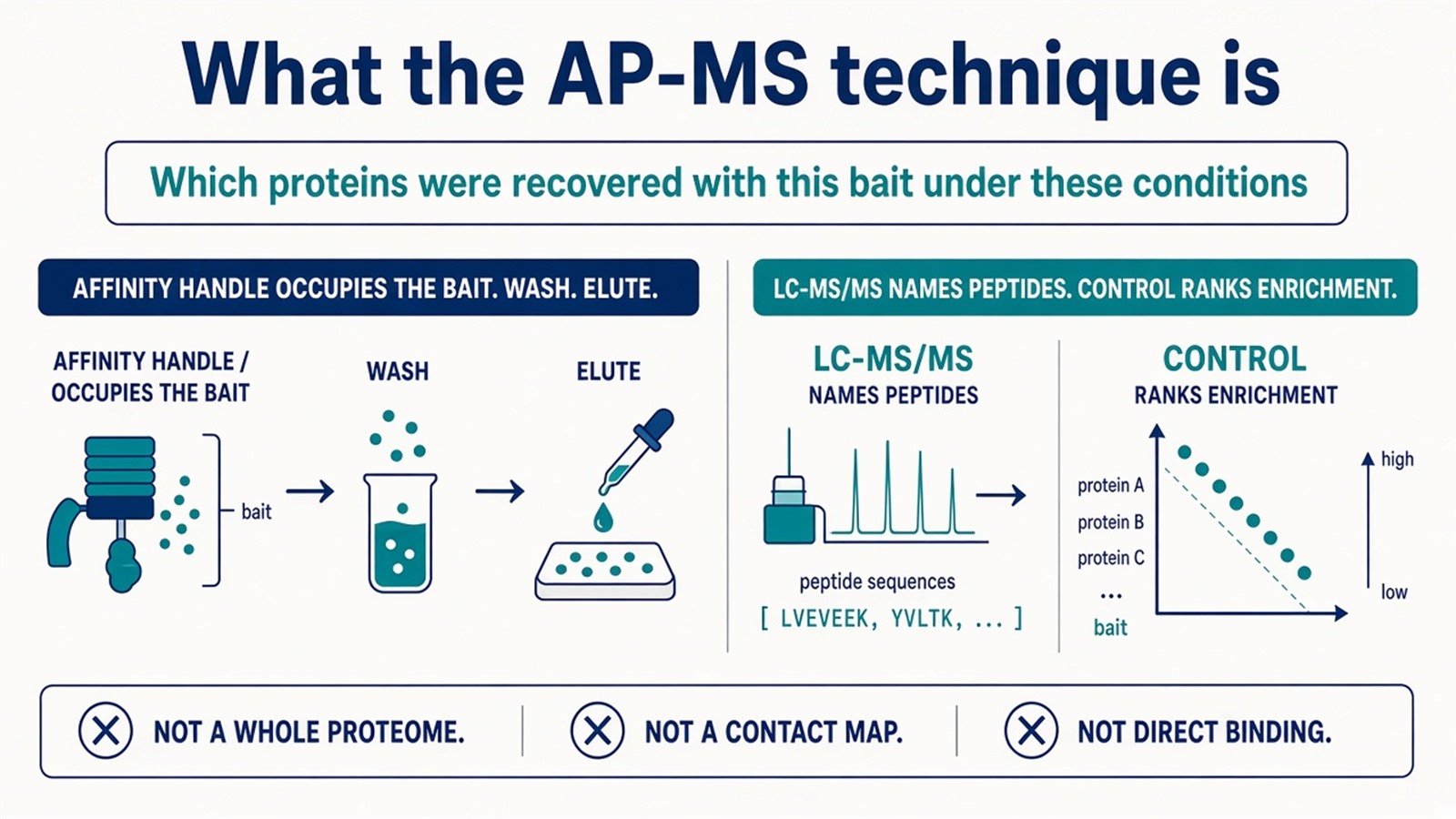
Figure 1. The question is recovery with this bait under these conditions. Not a whole proteome, a contact map, or direct binding.
Name the bait format before naming the technique. Enrich-then-MS is shared. The control is not.
What the File Delivers
Typical output remains an identification table from bait enrichments, with quantitative contrast when the acquisition and the arms match. One experiment can nominate many names and can compare treatments or matched mutants when capture chemistry is the same. Prey-specific antibodies are not required at the discovery step.
Co-enrichment does not establish direct binary binding. Indirect complex members and leftover contaminants sit on the same list. Tagged AP-MS reports the construct and the expression context that were used. It does not report endogenous complex organization. A long list without matched controls is identifications. Rank specificity. Background subtraction of every control name is not the scientific value of the technique.
When the Technique Fits, and When It Does Not
AP-MS fits when the next sentence is a ranked shortlist around a designed bait, empty-tag can be processed in parallel, and tagging is acceptable. Matched wild-type and mutant baits, or a written treatment, can be compared if recovery and wash stay the same. A panel of related constructs can share chemistry. Those are discovery and contrast uses. They are not interactome discovery, pathway-neighborhood mapping, or systematic complex inventory. A shortlist is a queue for a later assay. It is not a validated neighborhood.
AP-MS is the wrong first technique when the bait must stay endogenous and an IP-grade antibody exists, when one known partner only needs confirmation, when no negative-control arm can be generated, or when the question is global proteome composition. A highly transient contact that will not survive the planned wash will be under-recovered. That is a fit error, not a method failure. For the tagged-bait decisions that must be locked if AP-MS is chosen, Planning an Affinity Purification Mass Spectrometry Project provides a complementary planning page.
Workflow |
Typical bait |
Fit question |
Main risk |
|---|---|---|---|
AP-MS |
Tagged or engineered |
Who co-enriches with this designed bait |
Tag dose and empty-tag background |
IP-MS |
Endogenous, antibody |
Who co-purifies with the native bait |
Antibody and isotype |
Pull-down MS |
Immobilized recombinant |
Who binds this bait in vitro or in lysate |
Buffer and resin artifacts |
Targeted Co-IP |
One known partner |
Is that partner in the pellet |
No open discovery |
The table is early screening. It is not a full AP-MS versus IP-MS evaluation. For the recombinant-bait tube, In Vitro Pull-Down Assay provides a complementary pull-down page.
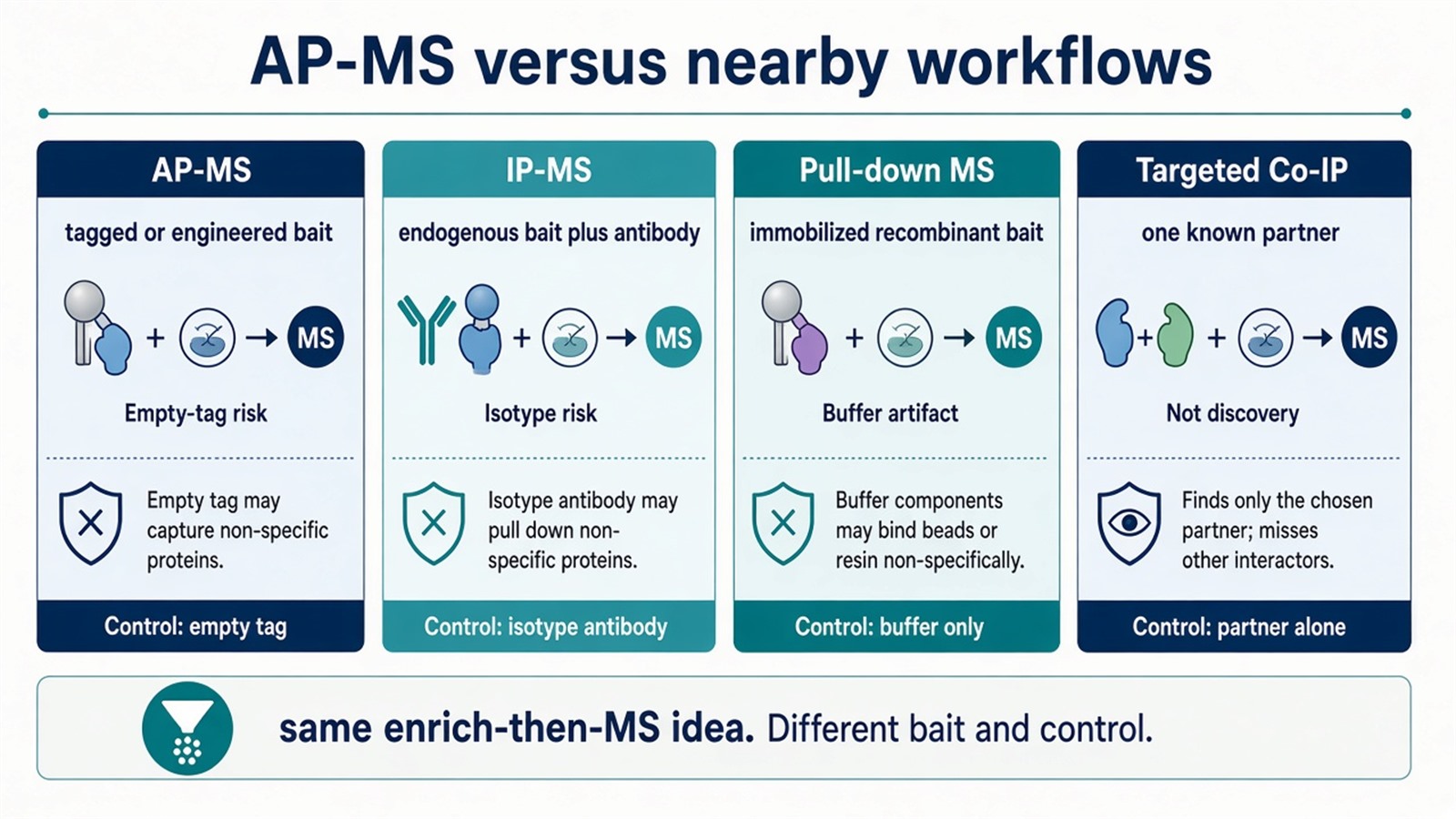
Figure 2. Tagged AP-MS, antibody IP-MS, recombinant pull-down, and a one-partner Co-IP. Same idea, different control.
Experimental Limits
The technique reduces a project to one bait format, one wash, one eluate, and one control class. Diagnostic interactome or contact-site language sits outside ordinary research reporting unless a separately validated assay is already named.
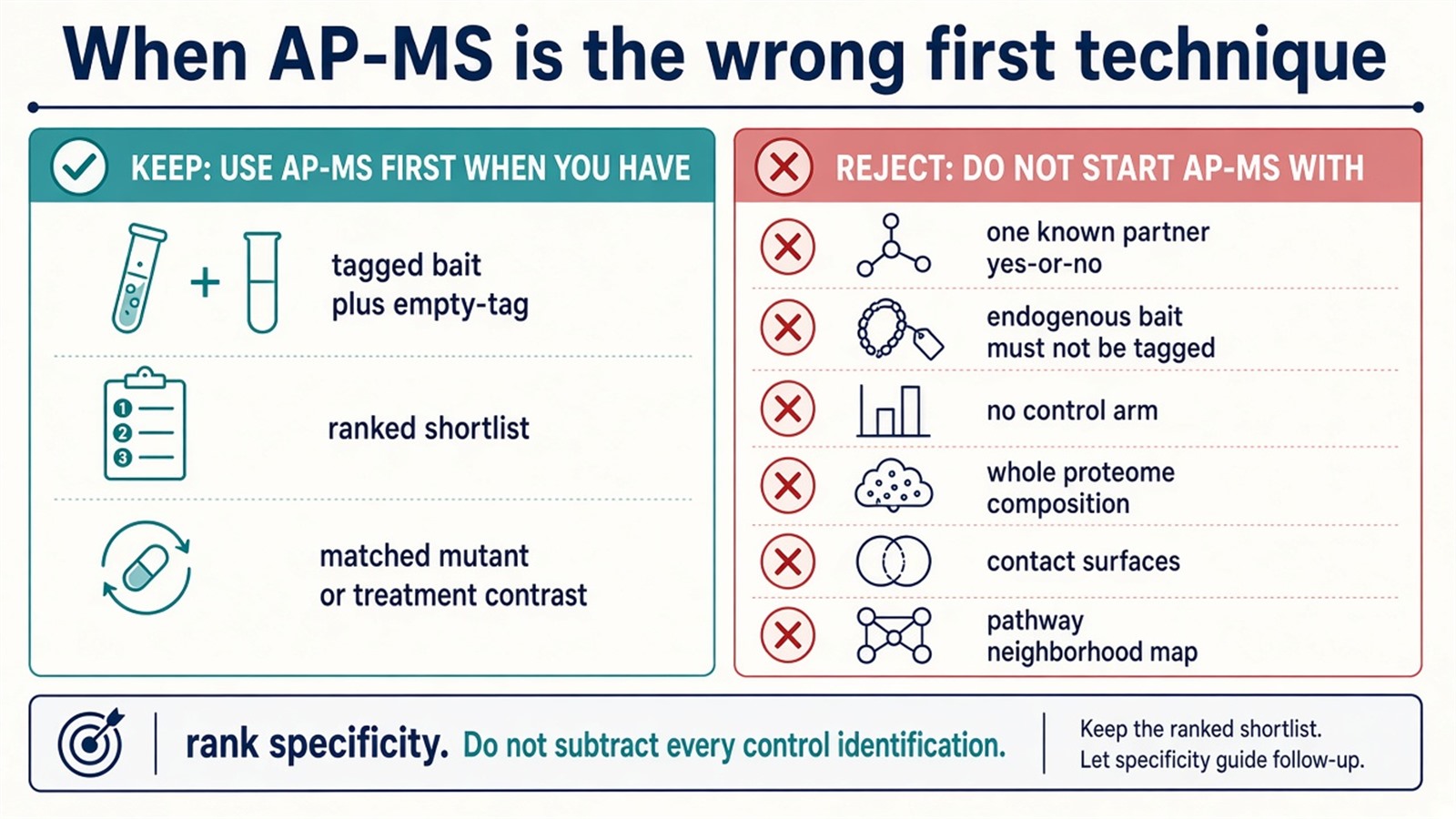
Figure 3. Keep: tagged bait plus empty-tag and a ranked shortlist. Not granted: one-partner confirmation, whole proteome, or pathway mapping.
Project Planning and Service Scope
A usable request names the bait format, whether a tag is acceptable, the matched control, and the orthogonal assay that would be required if the file returns a list. MtoZ Biolabs scopes tagged AP-MS on Orbitrap-class LC-MS/MS. Interpretability still follows those arms, not a widely-used-discovery slogan.
Once the next sentence requires endogenous antibody capture rather than a designed tag, this definition should be closed. Researchers who need that pellet can review the MtoZ Biolabs IP-Mass Spectrometry Service for project-specific sample evaluation, feasibility assessment, and workflow planning.
Frequently Asked Questions
1. What is the AP-MS technique?
Affinity purification followed by LC-MS/MS of the eluate, ranked against a matched control.
2. What does AP-MS stand for?
Affinity purification mass spectrometry.
3. Is AP-MS the same as pull-down mass spectrometry?
The labels overlap. Fit follows bait format and control, not the methods heading.
4. Can AP-MS prove direct protein-protein binding?
No. It shows co-enrichment under those conditions.
5. Do I need a tagged bait?
A tag is the common AP-MS format here. Endogenous antibody capture is usually planned as IP-MS.
Reference
- Gingras A.C., Gstaiger M., Raught B., Aebersold R. (2007). Analysis of protein complexes using mass spectrometry. Nat. Rev. Mol. Cell Biol., 8, 645-654. https://doi.org/10.1038/nrm2208
- Dunham W.H., Mullin M., Gingras A.C. (2012). Affinity-purification coupled to mass spectrometry: basic principles and strategies. Proteomics, 12, 1576-1590. https://doi.org/10.1002/pmic.201100523
- Mellacheruvu D., Wright Z., Couzens A.L., et al. (2013). The CRAPome: a contaminant repository for affinity purification-mass spectrometry data. Nat. Methods, 10, 730-736. https://doi.org/10.1038/nmeth.2557
- Choi H., Larsen B., Lin Z.Y., et al. (2011). SAINT: probabilistic scoring of affinity purification-mass spectrometry data. Nat. Methods, 8, 70-73. https://doi.org/10.1038/nmeth.1541
- Keilhauer E.C., Hein M.Y., Mann M. (2015). Accurate protein complex retrieval by affinity enrichment mass spectrometry (AE-MS) rather than affinity purification. Mol. Cell. Proteomics, 14, 120-135. https://doi.org/10.1074/mcp.M114.041012
