



High-throughput protein–protein interaction (PPI) screening is a panel strategy: many candidate pairs, complexes, or neighborhoods are tested under one written method, control set, and time window. Automation and large libraries can enlarge that panel. They do not automatically detect every true contact in a cell, and they do not make yeast two-hybrid (Y2H), affinity purification–mass spectrometry (AP-MS), BioID or TurboID, and bimolecular fluorescence complementation (BiFC) or Förster resonance energy transfer (FRET) interchangeable. Screening supports function annotation, pathway mapping, disease-mechanism work, and later target nomination. Those jobs still inherit the evidence class of the assay that produced the hit.
The useful first question is not which platform is most cutting-edge. It is which physical event the screen is allowed to report, and which orthogonal check will close the edges that appear in the next sentence.
Researchers who already have a defined bait library, proximity-labeling plan, or project objective can also review the MtoZ Biolabs Protein-Protein Interaction Analysis Service for project-specific feasibility and analysis planning.
What Is PPI and Why High-Throughput Screening Is Used
PPIs are physical contacts between two or more proteins, usually held by non-covalent interfaces. They organize signal transduction, metabolic regulation, cell-cycle control, and transcription. Literature catalogs already contain hundreds of thousands of reported PPIs. The human genome encodes about 20,000 proteins, so the combinatorial space of possible pairs is far larger than any published catalog. That scale argument explains why a pair-by-pair Western cannot draft a first network. It does not imply that hundreds of millions of those combinations are real cellular contacts.
Conventional low-throughput assays such as co-immunoprecipitation (Co-IP) and GST pull-down remain appropriate for a nominated pair when reagents and controls fit. They are limited in how many pairs they can assess in one campaign. High-throughput screening is used when the next table must cover a library, a bait panel, or a first-pass neighborhood. For how that panel is scoped as a project rather than as a technology name, High-Throughput Protein-Protein Interaction provides a complementary process-level discussion.
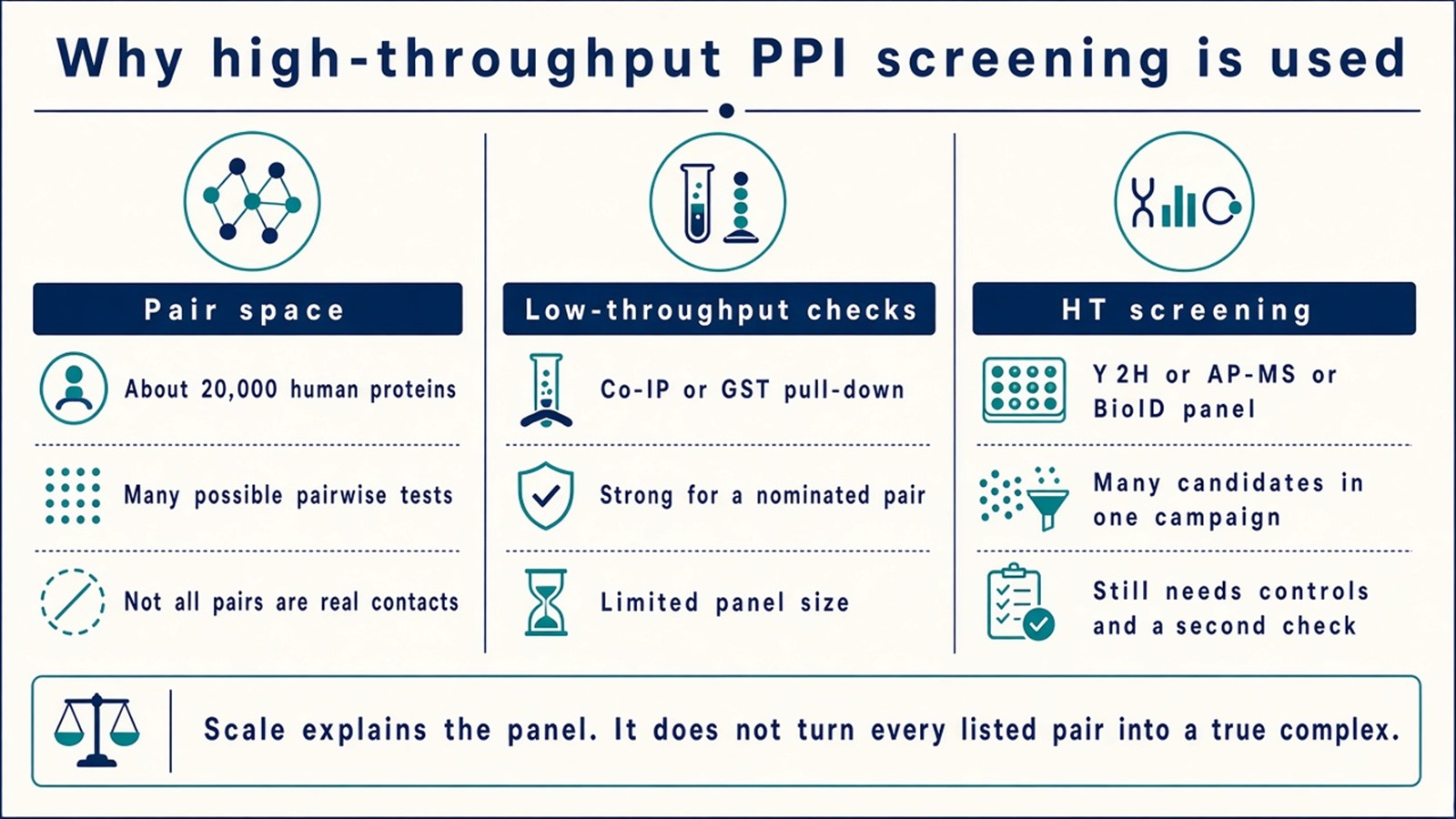
Figure 1. Scale explains why a Y2H, AP-MS, or BioID panel is used; it does not convert every listed pair into a true complex.
Pair space justifies a screen. It does not set the number of true interactions the screen is allowed to claim.
Current Experimental Approaches for High-Throughput PPI Screening
Screening strategies split into experimental measurement and computational prediction. The experimental families below are the ones most often asked to generate the first candidate table. Method-by-method advantages still have to be read against the event each assay reports. For a wider high-throughput comparison that also includes arrays and chips, Advantages and Disadvantages of High-throughput PPI Detection provides a more detailed evidence-class map.
1. Yeast two-hybrid system (Y2H)
Y2H remains one of the earliest and most scalable binary screens. Bait and prey are fused to the DNA-binding domain and activation domain of a transcription factor. Interaction in the yeast nucleus reconstitutes reporter expression.
Advantages include relatively low cost and the ability to build large libraries. Reporter amplification can return some binary pairs that would be lost in a harsh wash. The assay is still a nuclear yeast reporter. False-positive and false-negative rates are both material. Membrane proteins and many modification-dependent mammalian contacts are a poor fit. Y2H does not, as a class, specialize in weak or transient signaling contacts in their native compartment.
2. Affinity purification–mass spectrometry (AP-MS)
A tagged bait is expressed, complexes are enriched, and LC-MS/MS identifies proteins that remain associated under the stated lysis and wash. The useful product is a control-filtered partner inventory.
AP-MS keeps the bait in a cellular background that Y2H cannot provide and can compare the same capture chemistry across conditions when quantification is added. Near-physiological lysis is not the same as preserved native conformation of every subunit, and an identified neighborhood is not a resolved assembly state. The method depends on enrichment quality and on empty-tag, bead-only, or unrelated-bait controls. Background is expected. For AP-MS versus proximity-labeling design, How to Identify Protein–Protein Interactions Using Mass Spectrometry provides a more detailed explanation of evidence type.
3. Proximity biotinylation: BioID and TurboID
BioID fuses the bait to a promiscuous biotin ligase so that proteins within a labeling radius are biotinylated in living cells. Streptavidin capture and mass spectrometry then identify those proteins. TurboID is a faster engineered ligase and shortens the labeling window, which can help when the question is a defined time or treatment interval.
The class reports proximity, not wash-stable binding. It is often more practical than AP-MS for some membrane or organelle neighborhoods. The labeling radius is broad, so promiscuous biotinylation raises a second background class. Distinguishing bait-proximal proteins from ligase or streptavidin artifacts is a design problem, not a later software option.
4. Split fluorescent protein and FRET (BiFC / FRET)
BiFC reconstitutes a split fluorescent protein when the fused partners interact. FRET reports energy transfer between paired fluorophores when they approach within a few nanometers. Both can show a closed pair in a live cell and can add subcellular context.
These formats are supporting visualization tools more often than true high-throughput screens. Microscopy throughput, reconstitution efficiency, irreversible complementation in some BiFC designs, and background fluorescence all limit library-scale use. A fluorescent signal is not a partner inventory.
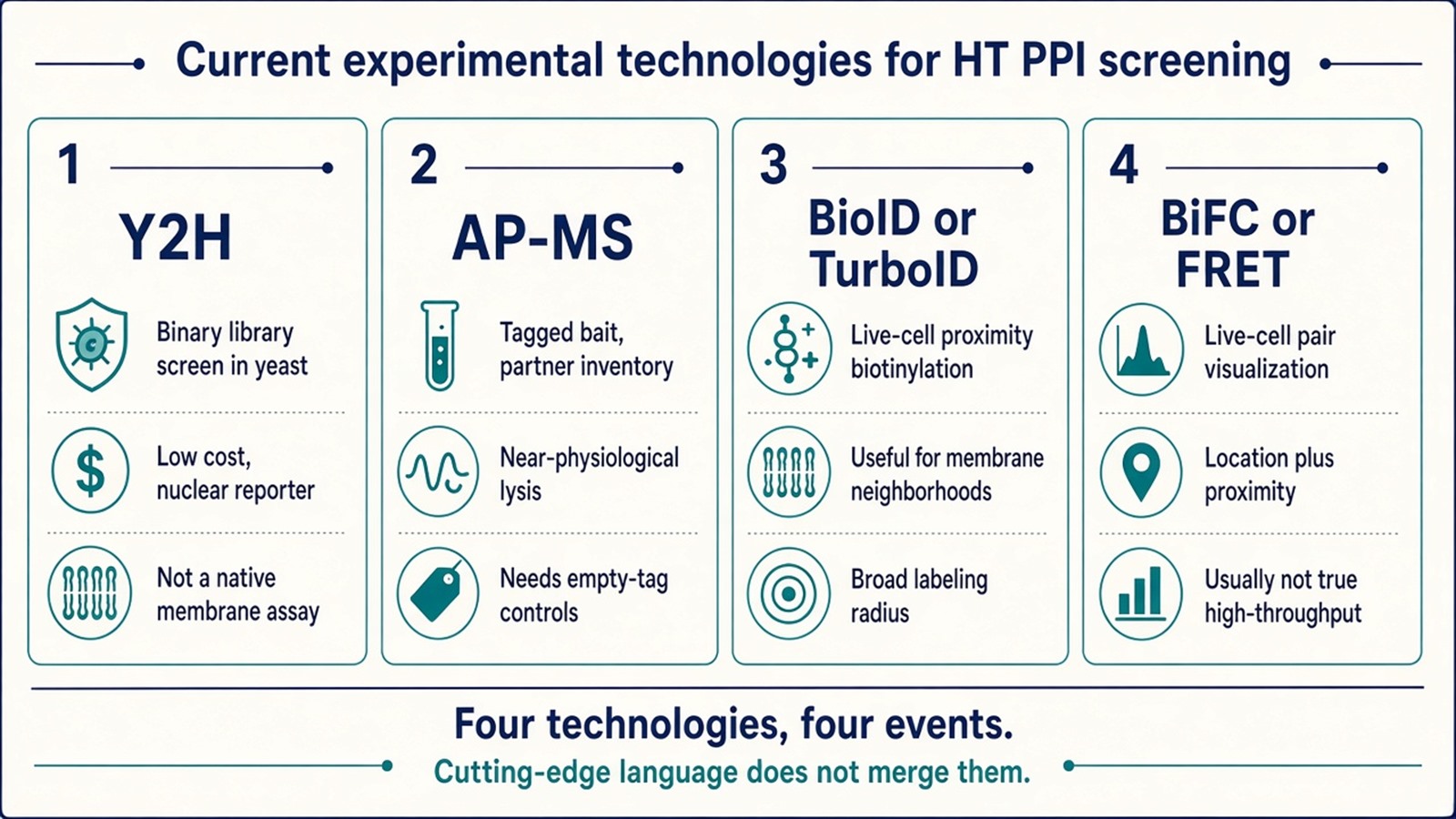
Figure 2. Current screening technologies report different events: yeast binary hits, AP-MS inventories, live-cell proximity labels, and pair visualization that is usually not library-scale.
Supporting Role of Computational Interaction Prediction
Structural models and machine-learning predictors can rank pairs before or after a wet-lab screen. Common examples include AlphaFold-Multimer for complex geometry, sequence- or topology-based predictors such as DeepPPI-class models, and STRING as a mixed experimental, text-mined, and predicted overlay.
Computation cannot replace experimental validation. A predicted complex is a model. A STRING edge is prior knowledge plus inference. Both can prioritize which bait to clone or which AP-MS prey to test by Co-IP. They should not be merged unmarked into the measured table. For how measurement and prediction should be looped, Experimental vs Computational Methods for Protein Interaction Detection provides a more detailed comparison of allowed claims.
Emerging Directions, Not Default Panels
Several research directions are expanding what a later project might ask. They are not the current default definition of a high-throughput PPI screen.
1. Single-cell or spatially resolved interaction analysis
Spatial omics and single-cell mass spectrometry are being explored to ask how neighborhoods change across cell states. Coverage, input amount, and interaction-specific controls remain limiting. This is a research direction, not a routine screening product.
2. Time-resolved and condition-specific labeling
Inducible systems and faster ligases such as TurboID can restrict biotinylation to a defined window or treatment. The gain is temporal control of a proximity table. The table is still a proximity table.
3. AI-assisted network reconstruction
Structure prediction, topology scores, and enrichment tools can turn a closed experimental table into a working model. The model is only as strong as the experimental layer underneath it. AI does not raise the resolution of an unscored eluate.
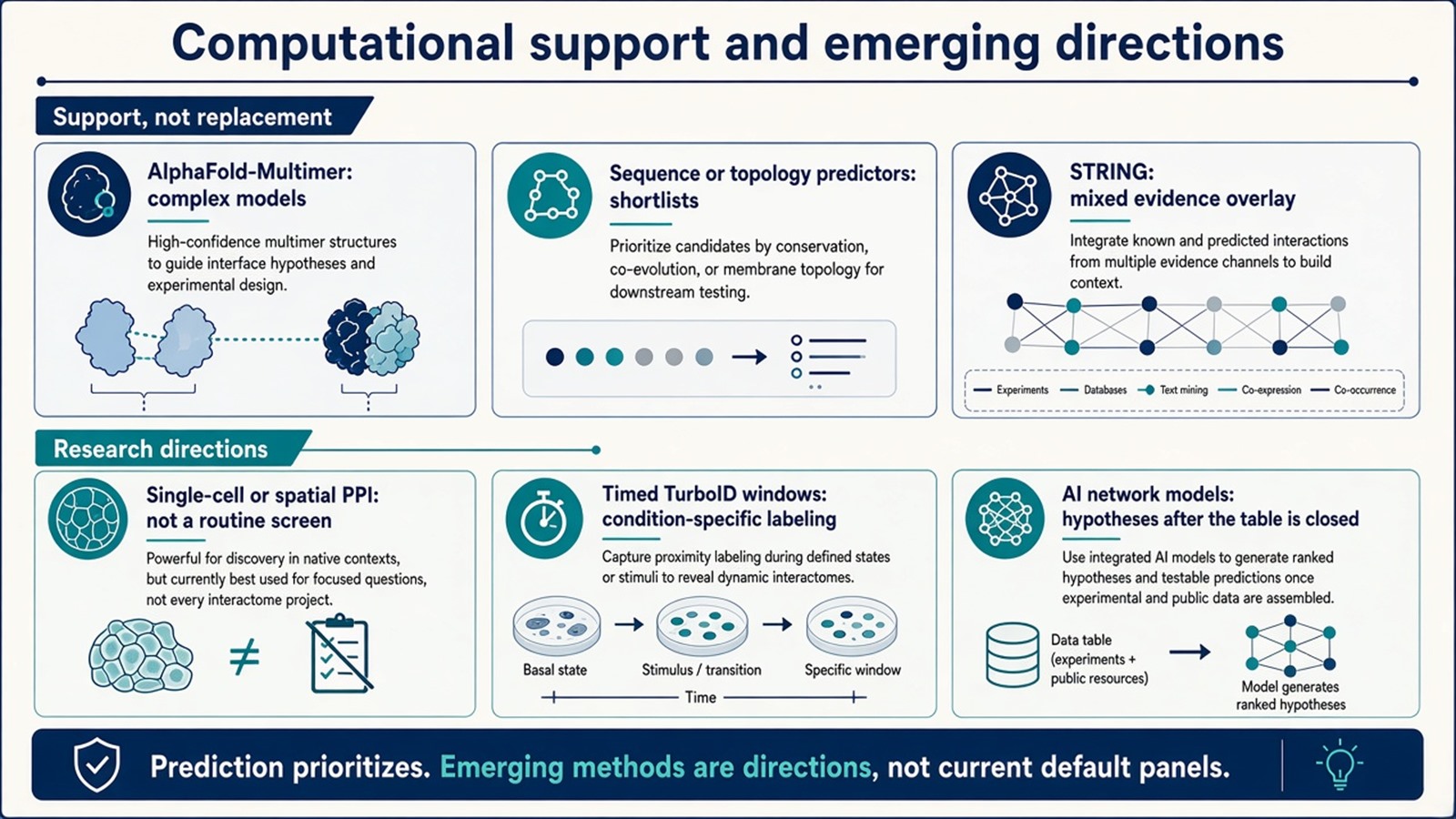
Figure 3. Predictors and STRING overlays prioritize candidates; single-cell, timed TurboID, and AI network models are directions that still sit on an experimental table.
Prediction ranks pairs. Emerging methods change the next question. Neither replaces matched controls on the samples in hand.
Experimental Limits and Design Boundaries
Y2H maps nuclear reconstitution. AP-MS maps wash-stable co-purification. BioID and TurboID map live-cell proximity. BiFC and FRET map a closed pair. Computation maps plausibility. Calling the campaign high-throughput or cutting-edge does not merge those layers. Human-interactome language and disease-network language remain hypotheses until the edge type and the orthogonal check are stated. Diagnostic claims sit outside ordinary research screening unless a separately validated assay framework is in place.
Project Planning and Service Scope
A usable screening plan names the library or bait panel, the evidence class, the control set, and which hits will be closed by Co-IP or a second capture chemistry. MtoZ Biolabs scopes affinity-tag strategies, including FLAG, HA, Strep, and GFP, across common cell systems, Orbitrap-class LC-MS/MS for AP-MS or proximity-labeling tables, and pairwise follow-up after a Y2H or visualization hit. Recovery of membrane or transient partners still depends on whether the chosen class can see them, not on screening vocabulary.
Once the panel, technology family, and validation path are defined, the project can be scoped as a high-throughput PPI screen. Researchers can review the MtoZ Biolabs Protein-Protein Interaction Analysis Service for project-specific sample evaluation, feasibility assessment, and workflow planning.
Frequently Asked Questions
1. What is high-throughput PPI screening?
It is a controlled campaign that tests many candidate pairs or neighborhoods under one method and control plan. It is not an automatic census of true cellular complexes.
2. Does the size of pairwise combination space mean most pairs interact?
No. About 20,000 human proteins create a large test space. Only a subset of those pairs are biological contacts, and only a further subset will be recovered by a given screen.
3. Are BioID and TurboID higher-throughput replacements for AP-MS?
No. They report proximity in living cells. AP-MS reports proteins that survive enrichment. The two tables answer different sentences.
4. Are BiFC and FRET high-throughput screening methods?
Usually not. They visualize a closed pair and add location or timing. Library-scale screening more often starts with Y2H, AP-MS, or proximity labeling.
5. Can AlphaFold-Multimer or STRING replace a wet-lab screen?
No. They prioritize or annotate. Experimental edges still need the assay and controls that produced them.
Reference
- Fields S., Song O. (1989). A novel genetic system to detect protein-protein interactions. Nature, 340, 245-246. https://doi.org/10.1038/340245a0
- Gingras A.C., Gstaiger M., Raught B., Aebersold R. (2007). Analysis of protein complexes using mass spectrometry. Nat. Rev. Mol. Cell Biol., 8, 645-654. https://doi.org/10.1038/nrm2208
- Roux K.J., Kim D.I., Raida M., Burke B. (2012). A promiscuous biotin ligase fusion protein identifies proximal and interacting proteins in mammalian cells. J. Cell Biol., 196, 801-810. https://doi.org/10.1083/jcb.201112098
- Branon T.C., Bosch J.A., Sanchez A.D., et al. (2018). Efficient proximity labeling in living cells and organisms with TurboID. Nat. Biotechnol., 36, 880-887. https://doi.org/10.1038/nbt.4201
- Evans R., O'Neill M., Pritzel A., et al. (2022). Protein complex prediction with AlphaFold-Multimer. bioRxiv. https://doi.org/10.1101/2021.10.04.463034
- Szklarczyk D., Gable A.L., Lyon D., et al. (2019). STRING v11: protein-protein association networks with increased coverage, supporting functional discovery in genome-wide experimental datasets. Nucleic Acids Res., 47, D607-D613. https://doi.org/10.1093/nar/gky1131
