



Co-IP-MS and in-cell crosslinking MS need different control families because they measure different events. Co-immunoprecipitation–mass spectrometry (Co-IP-MS) asks which proteins are enriched with a bait after lysis and capture. Its required arms are input lysate, a matched IgG or isotype, at least one resin background (beads-only or no-antibody), and biological replicates; knockout, knockdown, or tag-only arms are added when the bait system allows. In-cell crosslinking MS asks which residues were close enough to be covalently linked in living cells. Its required arms are a no-crosslinker sample, a quenched-reagent check during method setup, a dose and time series, a viability or cell-state check, and a declared crosslink-level false-discovery rule. Planning those arms before harvest is what makes a hit list interpretable. Adding them after a single bait IP, or a single crosslinked injection, cannot reconstruct the missing baseline.
A protein can appear in Co-IP-MS because it binds the bait, the antibody, the beads, or because it is abundant. A crosslinked peptide can appear because two residues were proximal, because the reagent or the search created an artifact, or because damaged cells exposed non-physiological surfaces. Neither table should be read from one condition.
Researchers who already have a bait antibody or an in-cell crosslinker plan can also review the MtoZ Biolabs Co-IP-MS Protein Interaction Analysis Service for control-aware discovery planning.
Why the Two Workflows Do Not Share One Control Set
Co-IP-MS ranks enrichment against capture background. In-cell crosslinking MS ranks reagent-dependent proximity against a no-linker baseline. Shared LC-MS/MS does not make IgG a substitute for a quenched crosslinker, or a no-crosslinker arm a substitute for beads-only. For which workflow to run before these controls are built, Co-IP-MS vs XL-MS: Which Protein Interaction Workflow Should You Choose? provides a complementary choice discussion.
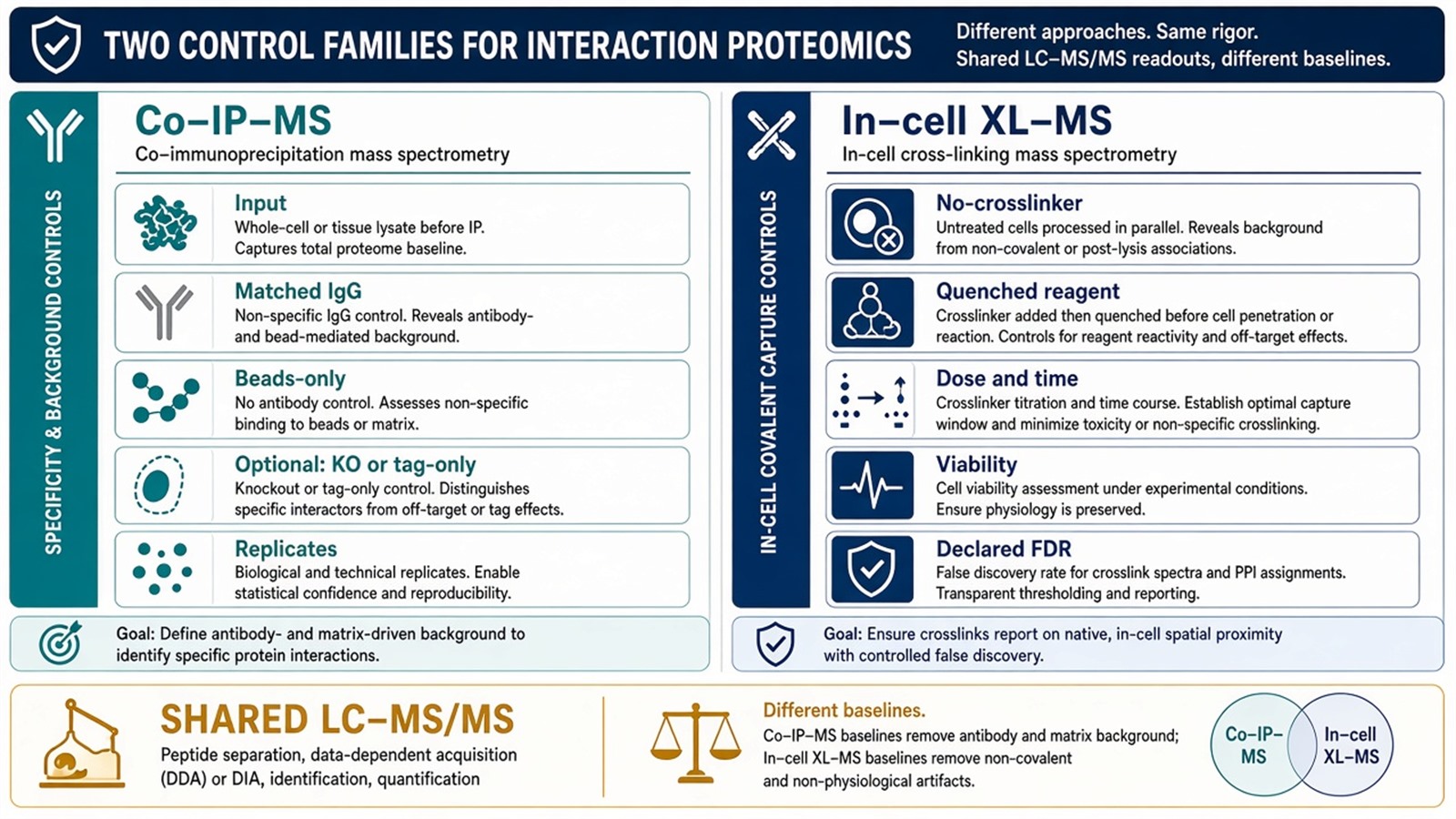
Figure 1. Co-IP-MS needs input, isotype, and resin arms. In-cell crosslinking MS needs no-linker, quench, dose, and viability arms. Replicates belong to both.
Name the physical event first. A control answers only the background that event creates.
Core Controls for Co-IP-MS
These arms define the baseline used to rank candidate interactors. They are not optional decorations on a discovery IP.
Input lysate
Input shows what was present before capture. It separates enrichment from high starting abundance, documents bait expression, and flags degradation or proteome shifts between treatment groups. Collect input from the same material as the IP. When conditions are compared, each condition needs its own input. Input supports interpretation. It does not replace IgG or beads-only.
IgG or isotype
A species- and isotype-matched non-immune IgG estimates scaffold and Fc background. Process it with the same lysate mass, incubation, wash, digestion, and LC-MS/MS injections as the bait IP. A weaker IgG arm underestimates background. Matching micrograms is part of this control, not a later software trick. For what happens when the isotype is overconcentrated, How to Handle Overconcentrated Negative Control IgG in Co-Immunoprecipitation? provides a complementary dose discussion.
Beads-only or no-antibody
These arms estimate resin, tube, and wash binders: cytoskeletal proteins, ribosomes, chaperones, and abundant enzymes. Discovery projects need at least one capture-background arm. Both are not required in every targeted follow-up.
Knockout, knockdown, or tag-only
If a candidate falls when the bait is absent, bait dependence is easier to claim. Tag-only reports proteins that bind the epitope or the overexpression construct. Use these when genetic removal does not itself rewrite cell state. A lethal or differentiating knockout needs a rescue or an orthogonal check before lost preys are called interactors.
Replicates and processing order
Biological replicates support ranking. Technical injections test the instrument; they do not replace independent cultures. Three biological IPs per arm are common practice. They are not a guarantee if the control was processed on a different day. Randomize digestion and injection order so that batch is not mistaken for enrichment.
For how a scored file is read after these arms exist, How to Analyze IP Mass Spectrometry Results? provides a complementary analysis order. For tagged AP-MS negative-control language, AP-MS Controls: Which Negative Controls Do You Need? provides a complementary capture-control discussion.
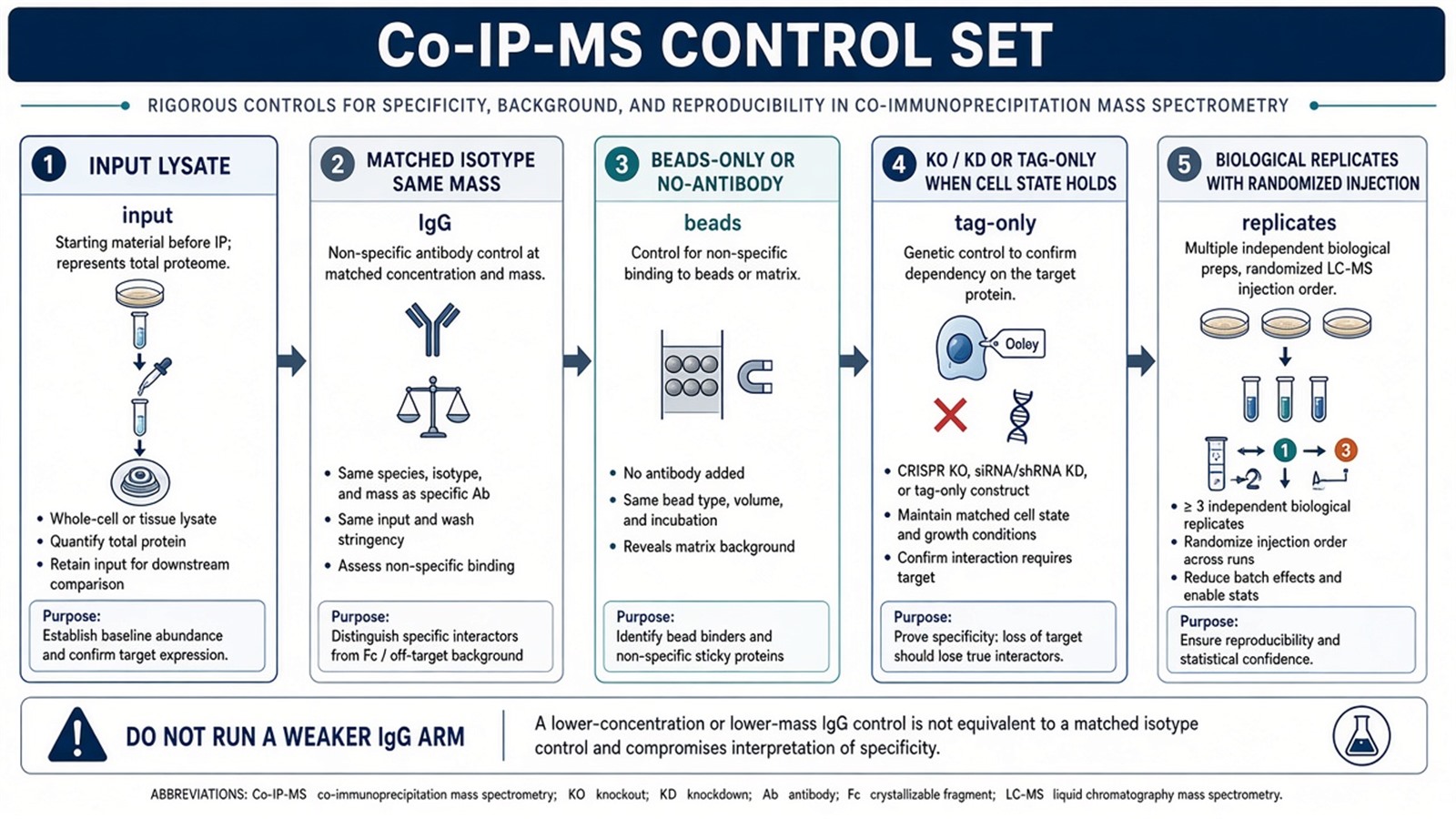
Figure 2. Rank Co-IP-MS preys against input, a matched IgG, and a resin arm. Knockout or tag-only tests bait dependence when the cell state still holds.
Core Controls for In-Cell Crosslinking MS
In-cell reagents change permeability, solubility, and digestion. Controls must test chemistry inside living cells, not only a later search setting.
1. No-crosslinker control
This arm is the baseline without active reagent. It flags ordinary peptides, carryover, and search artifacts that look like links when the pair space is large. Handle, lyse, digest, enrich if used, and acquire it like the treated sample. Omit only the active crosslinker.
2. Quenched-crosslinker control
Inactivate the reagent before it meets the cells. Residual link-like IDs then point to impurities, handling artifacts, or search false positives. Use this during method setup and when identifications cluster on abundant proteins without a dose response.
3. Dose and time series
Too little reagent yields few informative links. Too much lowers viability, distorts complexes, and over-crosslinks material that digests poorly. A short series, read with protein recovery, digestion quality, morphology or viability, and confident link rate, finds a workable window. Maximizing the raw link count is not the aim.
Cell viability and state
Damaged cells expose interiors that were not the intended in-cell neighborhood. Pair stimulation or drug arms with untreated or vehicle cells so that a contact change is not a handling effect.
Search and FDR
Pair-search space grows quickly. Declare the decoy rule, the crosslink-level false-discovery threshold, and whether spectra are reviewed. LC-MS blanks and injection QC belong in the same record. Replicate-consistent links that also fit known domain topology are stronger candidates. Topology fit is supporting context. It is not a substitute for a declared FDR.
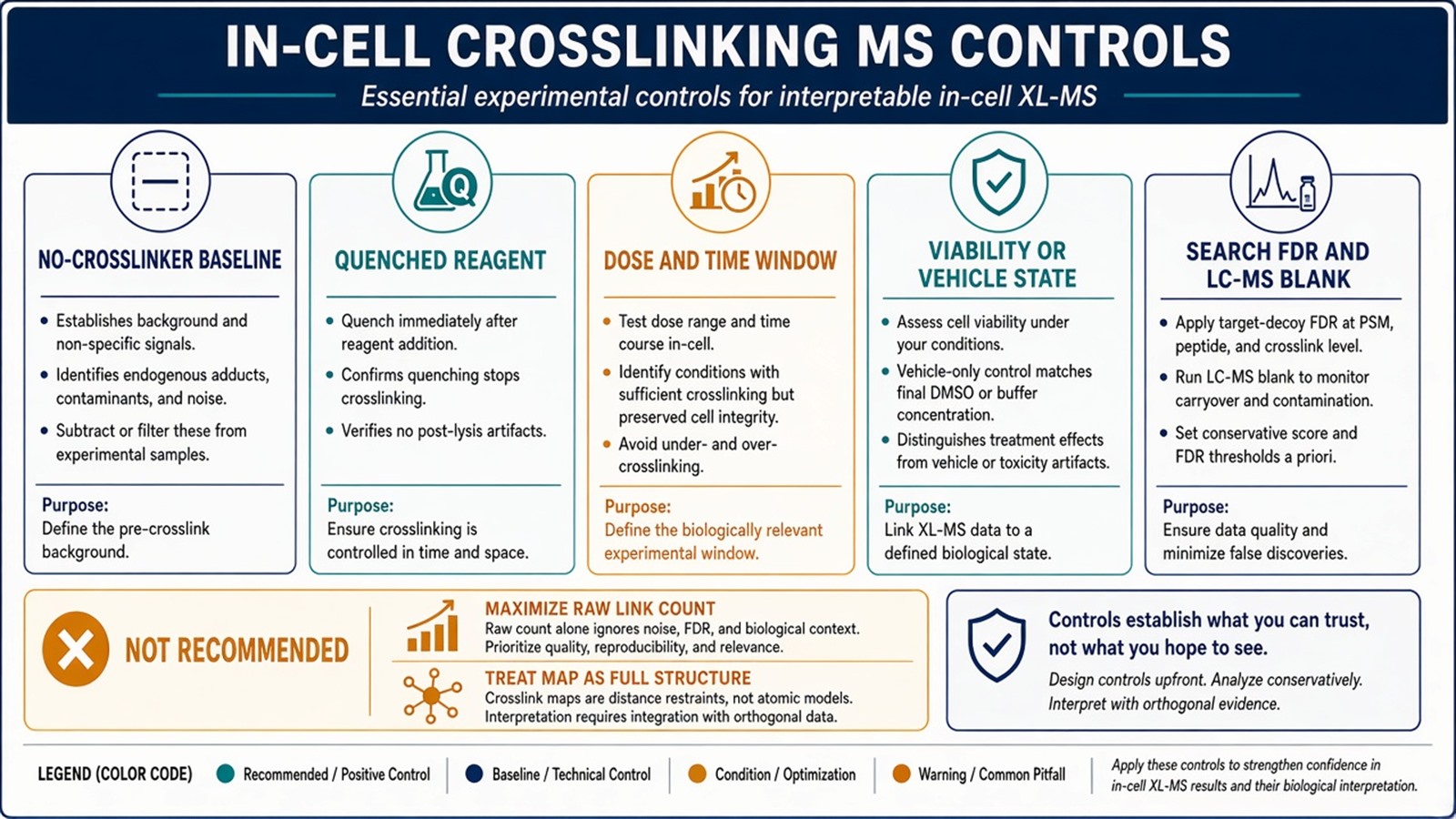
Figure 3. In-cell crosslinking MS needs a no-linker baseline, a quench check, a dose window that keeps cells intact, and a written false-discovery rule.
Which Controls Take Priority
Control |
Co-IP-MS |
In-cell crosslinking MS |
Question it answers |
|---|---|---|---|
Input lysate |
High |
Medium |
What was present before enrichment? |
IgG or isotype |
High |
Low |
What binds the antibody scaffold? |
Beads-only |
High |
Low |
What binds resin or tubes? |
No-crosslinker |
Low |
High |
What appears without active chemistry? |
Quenched reagent |
Low |
High |
Do signals require active reagent? |
Biological replicates |
High |
High |
Does the finding repeat across cultures? |
LC-MS blank and injection QC |
Medium |
Medium |
Are carryover and acquisition controlled? |
A targeted confirmation can use fewer arms than an open discovery. A new in-cell reagent needs more chemistry controls than a mature Co-IP-MS protocol.
How to Read a Controlled Table
In Co-IP-MS, a candidate is stronger when it is enriched versus IgG, resin, and input-normalized background, and when it repeats. Intensity or spectral counts rank recovery. They do not prove direct binding.
In in-cell crosslinking MS, a candidate contact is stronger when it is absent or strongly reduced without reagent, repeats across cultures, and is chemically plausible. Proximity is not a stable direct interface. Crowding and transient neighbors can be linked.
Common Mistakes
Calling every protein in a single bait IP an interactor inflates false positives.
Running the IgG arm with less input or fewer injections makes background look smaller than it is.
Choosing the in-cell condition with the most links, without viability or digestion checks, favors over-reaction.
Treating a crosslink map as a complete structure over-reads sparse restraints.
Experimental Limits
Controls reduce, rather than remove, false assignment. Three replicates do not repair an unmatched wash. A no-crosslinker arm does not repair a search without a decoy rule. Diagnostic language sits outside ordinary research reporting unless a separately validated assay framework is in place.
Project Planning and Service Scope
A usable control plan names the event, the matched arms, the replicate rule, and how hits will be ranked before the first file is opened. MtoZ Biolabs scopes Co-IP-MS with input, isotype, and resin arms, and in-cell XL-MS with no-linker, quench, and dose windows, on Orbitrap-class LC-MS/MS. Interpretability still follows those arms, not the instrument name.
Once the control set is written, the project can be scoped as Co-IP-MS or in-cell crosslinking MS. Researchers who need residue-proximity controls after a defined in-cell plan can review the MtoZ Biolabs Crosslinking Mass Spectrometry Protein Interaction Analysis Service for project-specific sample evaluation, feasibility assessment, and workflow planning.
Frequently Asked Questions
1. Are IgG controls enough for Co-IP-MS?
They are required for antibody-class background. Discovery work usually also needs input and a resin arm, and may need tag-only or knockout when the bait system allows.
2. Does Co-IP-MS prove direct protein binding?
No. It reports enrichment under the stated capture. Direct contact needs an orthogonal assay.
3. What is the most important control for in-cell crosslinking MS?
The no-crosslinker arm is the usual baseline. Quench, dose, time, and viability belong in method setup.
4. How many replicates are needed?
Three biological replicates per arm are common. More may be needed for small effects or heterogeneous samples. Technical injections do not replace those cultures.
5. Should crosslinking MS replace Co-IP-MS?
No. Co-IP-MS ranks partners. In-cell crosslinking MS adds residue proximity. They are complementary chemistries, not substitutes.
Reference
- Mellacheruvu D., Wright Z., Couzens A.L., et al. (2013). The CRAPome: a contaminant repository for affinity purification-mass spectrometry data. Nat. Methods, 10, 730-736. https://doi.org/10.1038/nmeth.2557
- Choi H., Larsen B., Lin Z.Y., et al. (2011). SAINT: probabilistic scoring of affinity purification-mass spectrometry data. Nat. Methods, 8, 70-73. https://doi.org/10.1038/nmeth.1541
- Gingras A.C., Gstaiger M., Raught B., Aebersold R. (2007). Analysis of protein complexes using mass spectrometry. Nat. Rev. Mol. Cell Biol., 8, 645-654. https://doi.org/10.1038/nrm2208
- Leitner A., Walzthoeni T., Kahraman A., et al. (2010). Probing native protein structures by chemical cross-linking, mass spectrometry, and bioinformatics. Mol. Cell. Proteomics, 9, 1634-1649. https://doi.org/10.1074/mcp.R000089-MCP201
- O'Reilly F.J., Rappsilber J. (2018). Cross-linking mass spectrometry: methods and applications in structural, molecular and systems biology. Nat. Struct. Mol. Biol., 25, 1000-1008. https://doi.org/10.1038/s41594-018-0147-0
