



The specific steps for DSS protein crosslinking are two written routes, not one general list. Route A treats a protein or a lysate that is already in an amine-free buffer. Route B treats intact cells, then opens them after the quench. Disuccinimidyl suberate is already an N-hydroxysuccinimide (NHS) ester. It is not activated at room temperature. Lysis is not step 1 when the proteins are still inside the cell. Dithiothreitol (DTT) does not hold proteins in a native state for crosslinking.
The original six headings remain the purified-or-lysate sequence once those errors are removed. DMSO stock, immediate use, an amine quench, and a named assay are kept. Hours-long incubations, a spin that is said to remove leftover DSS, and a second heading that repeats mass spectrometry are not. For what the chemistry is allowed to report, DSS Protein Crosslinking Experiment provides a complementary reagent page.
Researchers who already have a DSS route written and need a residue-pair table can also review the MtoZ Biolabs Crosslinking Mass Spectrometry Protein Interaction Analysis Service for project-specific feasibility and analysis planning.
Name the Route Before Step 1
DSS is membrane-permeable. Adding it to a culture or a washed cell suspension is a different first move from adding it to a purified complex. BS3 is the sulfonated analog that stays outside membranes; it does not replace DSS on Route B. A two-protein tube is Route A. For what that tube must contain, What Reagents Are Required for In Vitro Cross-Linking of Two Purified Proteins provides a complementary in-vitro reagent page.
If the proteins are intracellular and the claim is an in-cell link, do not extract them before the pulse. Lysis after an unquenched NHS ester continues the reaction in a new solvent. For whether lysis is even the next move, Is Cell Lysis the Next Step After Protein Crosslinking? What Is the Best Lysis Buffer to Use provides a complementary lysis page.
A no-DSS arm is processed through the same buffer, quench, and assay. Changing only the treated sample mixes a handling effect with a reagent effect.
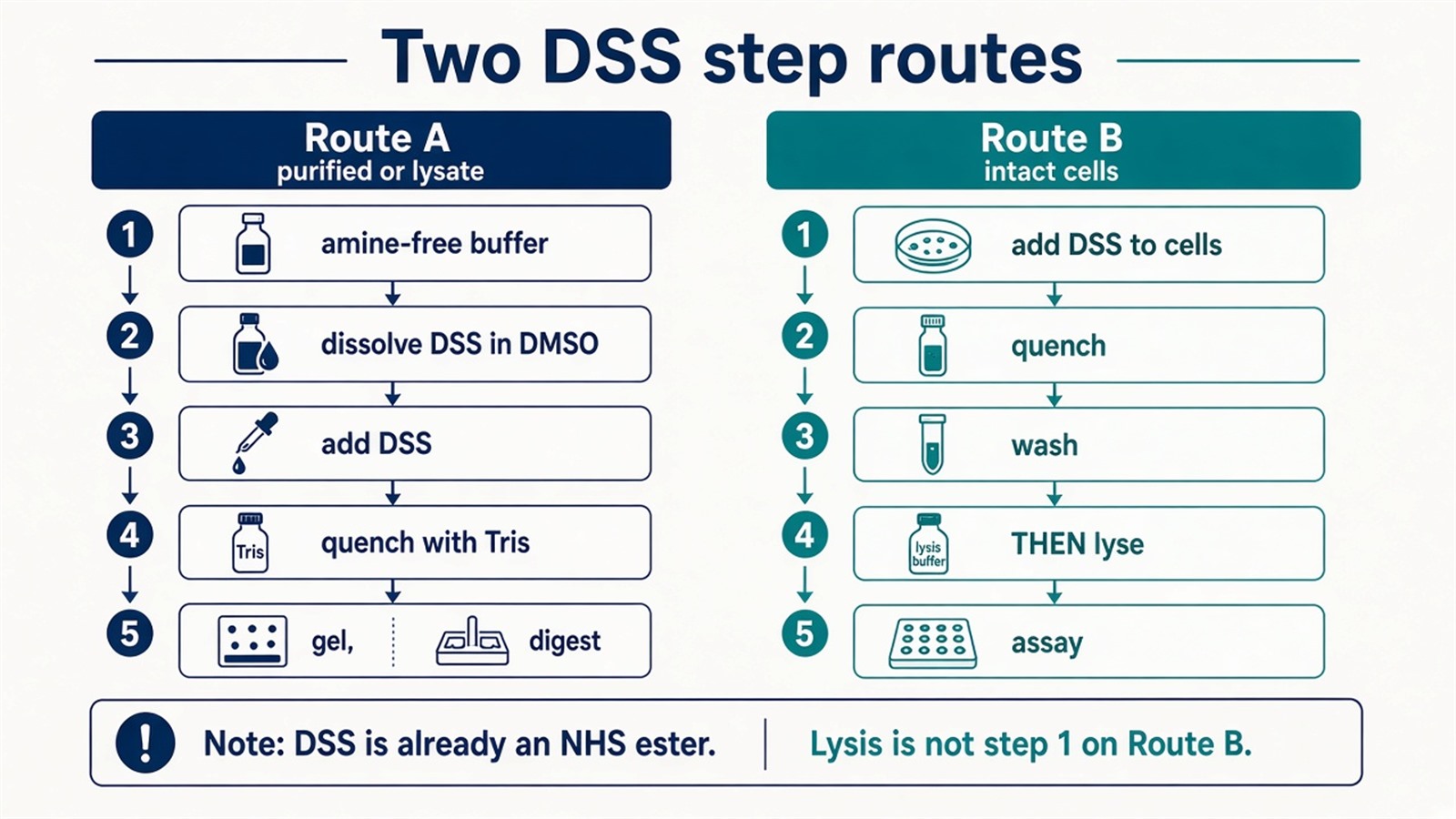
Figure 1. Route A starts from an amine-free protein or lysate. Route B adds DSS to intact cells and lyses after the quench. DSS is already an NHS ester.
Write Route A or Route B before dissolving the solid. A general procedure that starts with cell lysis is the wrong first page for in-cell DSS.
Route A: The Original Six Headings, Corrected
These headings stay in order. The verbs inside them change.
1. Protein preparation
Exchange the protein or the already-open lysate into an amine-free buffer near pH 7–8, typically HEPES or phosphate, not Tris and not glycine. Residual imidazole from a His-tag elution consumes NHS ester. DTT is not added here to maintain a native state. Reducing disulfides unfolds them. If a later gel uses reductant, that is electrophoresis after the quench, not step 1.
2. DSS preparation
Dissolve the solid in dry DMSO and dilute into the aqueous sample immediately. The ester hydrolyzes in water. Final DMSO is kept low so that the solvent spike is not the main denaturant. A molar excess relative to protein is one dosing style. A written micromolar-to-millimolar titration is the other. Neither is a universal excess.
3. Crosslinking reaction
Add the dissolved DSS, mix, and incubate. Room temperature for about thirty minutes is a common starting window. Ice-cold pulses are used when hydrolysis and over-linking need to be slowed. Minutes-to-hours is the wrong range. Leftover time in water is hydrolysis, not a more complete architecture.
4. Reaction quenching
Add Tris or another amine in excess to consume leftover NHS ester. The quench stops further amine marking. It does not prevent unintended sites that already formed during the pulse. For that stop-then-store order, How to Handle Samples After Adding Crosslinkers in Protein Crosslinking provides a complementary handling page.
5. Cleanup, not a clarifying spin
Unreacted DSS and hydrolyzed NHS products are removed by buffer exchange, precipitation, or a later digest cleanup. Centrifugation pellets debris or cells. It does not subtract leftover crosslinker from a clear supernatant. A stained gel is optional. Many residue-pair files are built from an in-solution digest.
6. One named assay
The last heading is the readout, not a second copy of mass spectrometry. A gel shift, an immunoblot, or liquid chromatography–tandem mass spectrometry (LC-MS/MS) of linked peptides are different tables. Searching the digest as ordinary peptides names proteins. It does not report DSS pairs.
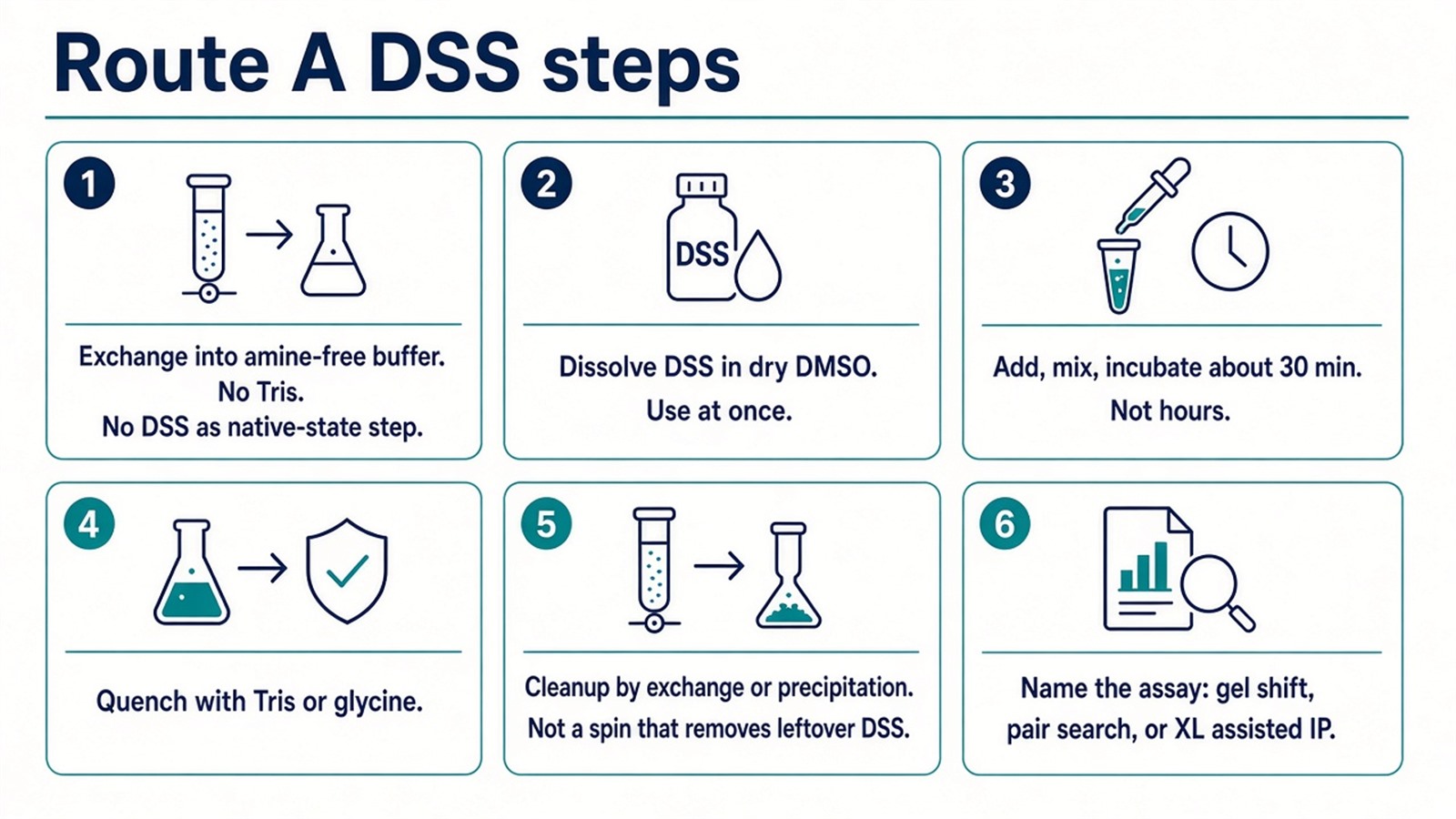
Figure 2. Route A order. DTT is not a native-state step. A spin does not remove leftover DSS. The last step names one assay.
Route B: Intact Cells, Then the Shared Stop
On cells the first written move is a washed suspension or an adherent monolayer in an amine-poor medium or buffer, not a lysate. DSS is added from the DMSO stock, incubated, and quenched. The pellet is then washed and lysed. The detergent is chosen for the next assay. Over-linking that kills the monolayer is a pulse failure, not a more complete interactome. For the shared later order after the pulse, What Is the Protocol for Crosslinking-Based Protein Interaction Analysis? provides a complementary protocol page.
What the Original Wording Cannot Support
DSS does not become an NHS ester when the room is warm. The solid is already that ester. Room temperature is an incubation choice, not an activation. The steps do not grant a native-state conformation or a complete interface. A band that became larger is a mass shift. It is not a site.
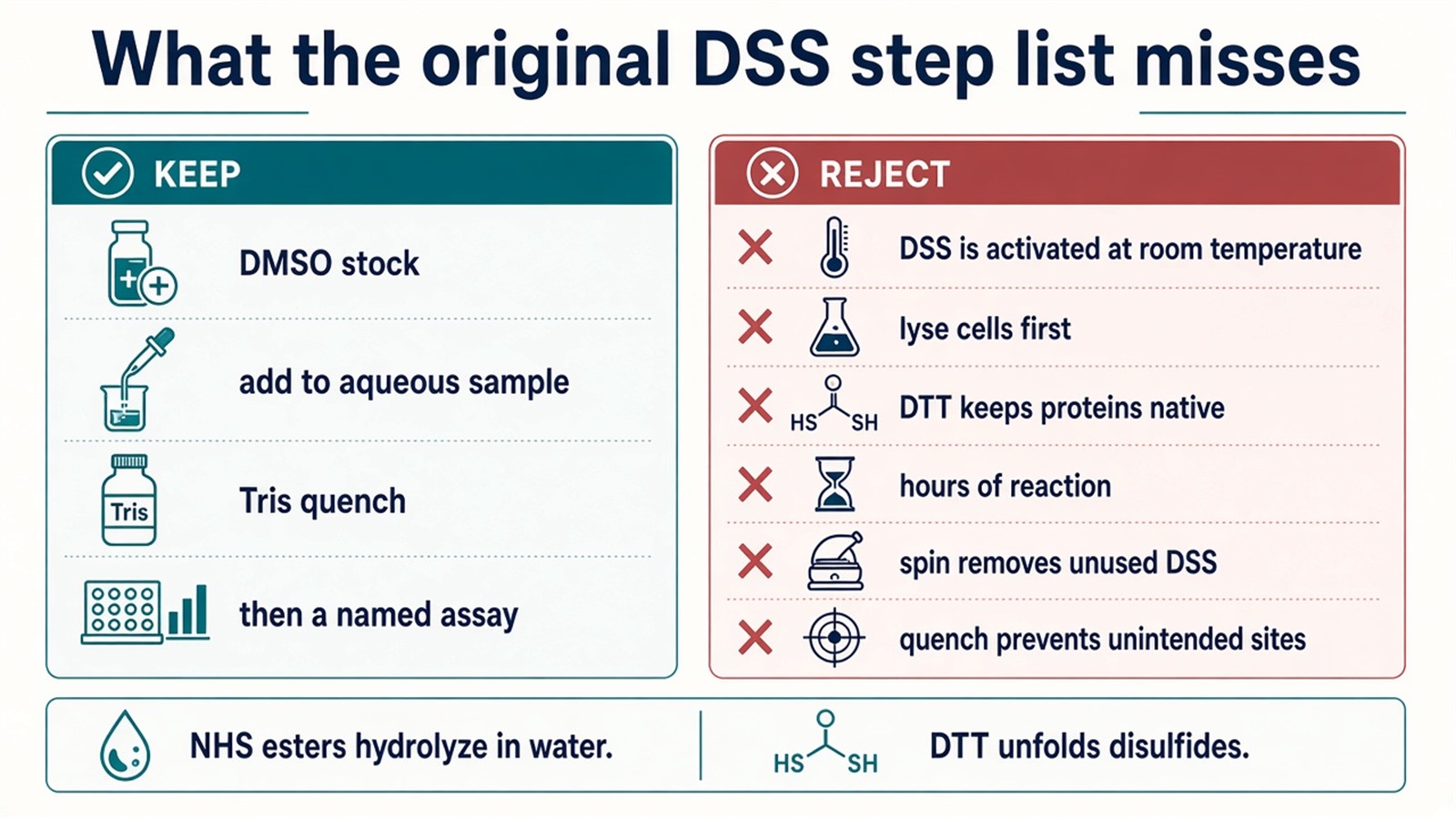
Figure 3. Keep: DMSO stock, aqueous pulse, amine quench, named assay. Not granted: activation at room temperature, lyse first, DTT as native, hours, spin cleanup.
Experimental Limits
A DSS step list reduces a sample to one route, one dose, one quench, and one assay. Diagnostic completeness of every amino-group contact sits outside ordinary research reporting. Changing the route after the first failed gel does not convert Route A into Route B.
Project Planning and Service Scope
A usable DSS plan names the route, the amine-free or in-cell condition, the quench, and the assay that will read the pulse, before the first DMSO spike. MtoZ Biolabs scopes crosslinking MS with Orbitrap-class LC-MS/MS. Interpretability still follows those arms, not a general six-step slogan.
Once the next sentence is a cellular partner list rather than a DSS pair or a shift, the project should not be forced through this step list. Researchers who need that pellet can review the MtoZ Biolabs Protein-Protein Interaction Analysis Service for project-specific sample evaluation, feasibility assessment, and workflow planning.
Frequently Asked Questions
1. What are the specific steps for DSS protein crosslinking?
Two routes. Route A: amine-free protein or lysate, DMSO stock, pulse, quench, cleanup, named assay. Route B: add DSS to intact cells, quench, then lyse.
2. Should intracellular proteins be lysed before DSS is added?
Not on the in-cell route. Lysis is after the quench.
3. Does DTT keep proteins native for DSS crosslinking?
No. Reducing disulfides unfolds them. That is a perturbation.
4. Does a Tris quench prevent unintended crosslinking sites?
No. It consumes leftover NHS ester. Sites that already formed remain.
5. Can centrifugation remove unreacted DSS?
No. A spin pellets debris. Leftover reagent is removed by exchange, precipitation, or later cleanup.
Reference
- Leitner A., Walzthoeni T., Kahraman A., et al. (2014). Probing native protein structures by chemical cross-linking, mass spectrometry, and bioinformatics. Nat. Protoc., 9, 120-135. https://doi.org/10.1038/nprot.2013.168
- Merkley E.D., Rysavy S., Kahraman A., et al. (2014). Distance restraints from crosslinking mass spectrometry: mining a molecular dynamics database to evaluate lysine-lysine distances. Protein Sci., 23, 747-759. https://doi.org/10.1002/pro.2458
- O'Reilly F.J., Rappsilber J. (2018). Cross-linking mass spectrometry: methods and applications in structural, molecular and systems biology. Nat. Struct. Mol. Biol., 25, 1000-1008. https://doi.org/10.1038/s41594-018-0147-0
- Yu C., Huang L. (2018). Cross-linking mass spectrometry: an emerging technology for interactomics and structural biology. Anal. Chem., 90, 144-165. https://doi.org/10.1021/acs.analchem.7b04431
- Sinz A. (2018). Cross-linking/mass spectrometry for studying protein structures and protein-protein interactions: where are we now and where should we go from here? Angew. Chem. Int. Ed., 57, 6390-6396. https://doi.org/10.1002/anie.201709559
