



The specific experimental methods for cross-linking protein interaction analysis are distinguished by the readout, not by a five-step chemical recipe. A reagent covalently links nearby residues. The methods are what is done with that covalent pair: a crosslinking-assisted immunoprecipitation read by Western blot, a crosslinking-assisted immunoprecipitation read by liquid chromatography–tandem mass spectrometry (LC-MS/MS) as a partner list, or an XL-MS residue-pair search. Those three methods share a pulse and a quench. They do not share a table.
Chemical cross-linking is the strategy, not one of the methods. Sample preparation, reagent choice, incubation, quench, and extraction are the shared wet order. Listing those five moves as a standalone approach is why a protocol page and a methods page get confused. Photo-activatable or MS-cleavable reagents still feed the same three readouts. They are reagent classes, not additional experimental methods. For the shared order, What Is the Protocol for Crosslinking-Based Protein Interaction Analysis? provides a complementary protocol page. Fluorescence resonance energy transfer (FRET) and proximity ligation assay (PLA) detect proximity by fluorescence or by an antibody-templated amplicon. They are not cross-linking methods.
Researchers who already know which readout they need can also review the MtoZ Biolabs Crosslinking Mass Spectrometry Protein Interaction Analysis Service for project-specific feasibility and analysis planning.
Three Methods That Use a Cross-Link
Crosslinking-assisted Co-IP, read by Western blot
After the pulse and a matched quench, an antibody captures the bait from the lysate. A Western blot asks whether a nominated prey or a shifted bait species is in that pellet. The original Co-IP heading remains this method. It identifies a band, not a residue pair, and not an open partner list. The covalent links can hold a contact through a wash that would empty an uncrosslinked Co-IP. They do not convert the blot into proof of a direct interface.
Crosslinking-assisted Co-IP, read by LC-MS/MS
The same capture is digested and searched as proteins. The table is a partner list that survived the pulse, the lysis, and the wash. It is still enrichment against an isotype or beads-only arm, not a structural organization map. For when that partner list versus a residue pair is the next sentence, Co-IP-MS vs XL-MS: Which Protein Interaction Workflow Should You Choose? provides a complementary workflow page.
XL-MS residue-pair analysis
The extract, or an enriched complex, is digested and searched for covalently linked peptides. The original mass-spectrometry heading remains this method only when the identification is the pair, not “the cross-linked proteins.” A protein name in a digest of a stained band is not XL-MS. The pair can constrain a model. It does not provide functional interfaces by interpretation of the file.
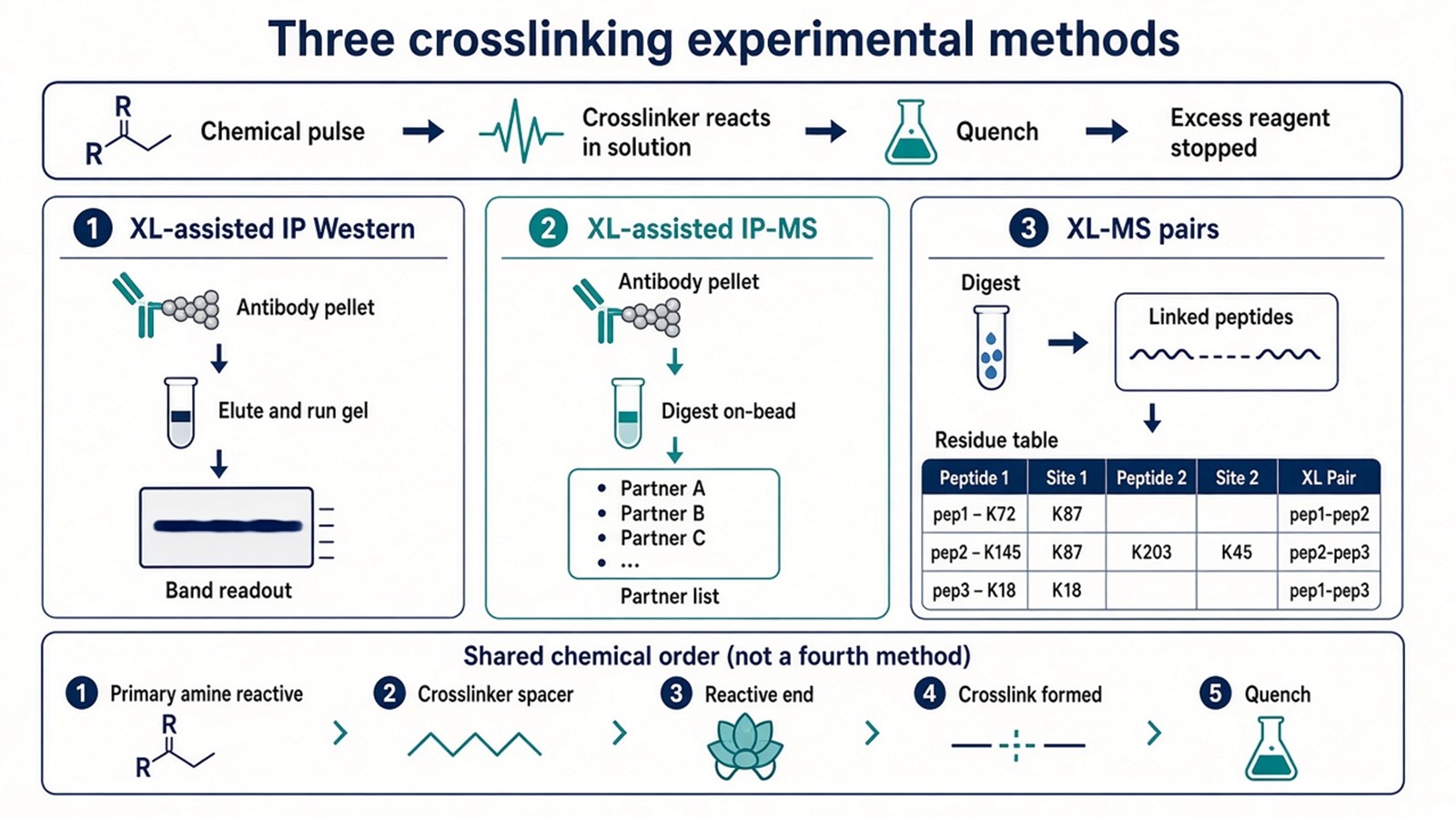
Figure 1. One pulse, three readouts. A band, a partner list, and a residue pair are different methods. Shared quench does not make them one protocol.
Name the readout before listing formaldehyde or BS3. A five-step chemical cartoon is not a method menu.
Site Is a Choice Inside Those Methods
The original chemical-cross-linking list treats cells or tissues as the sample and formaldehyde or BS3 as the reagent. In-cell or in-tissue work, a lysate pulse, and a purified-complex pulse are site choices. They can be used with any of the three methods. BS3 is membrane-impermeable and belongs on a lysate or a surface. Formaldehyde and DSS enter cells. For that decision, How to Select a Crosslinker for XL-MS Structural Studies provides a complementary selection page. For the stop that follows the pulse, How to Handle Samples After Adding Crosslinkers in Protein Crosslinking provides a complementary handling page.
Incubation under defined temperature and time does not allow efficient cross-linking as a property of the method name. Extraction and purification do not deliver a complex ready for any downstream analysis. Western blot and mass spectrometry are the readouts already named above, not a fifth extraction step.
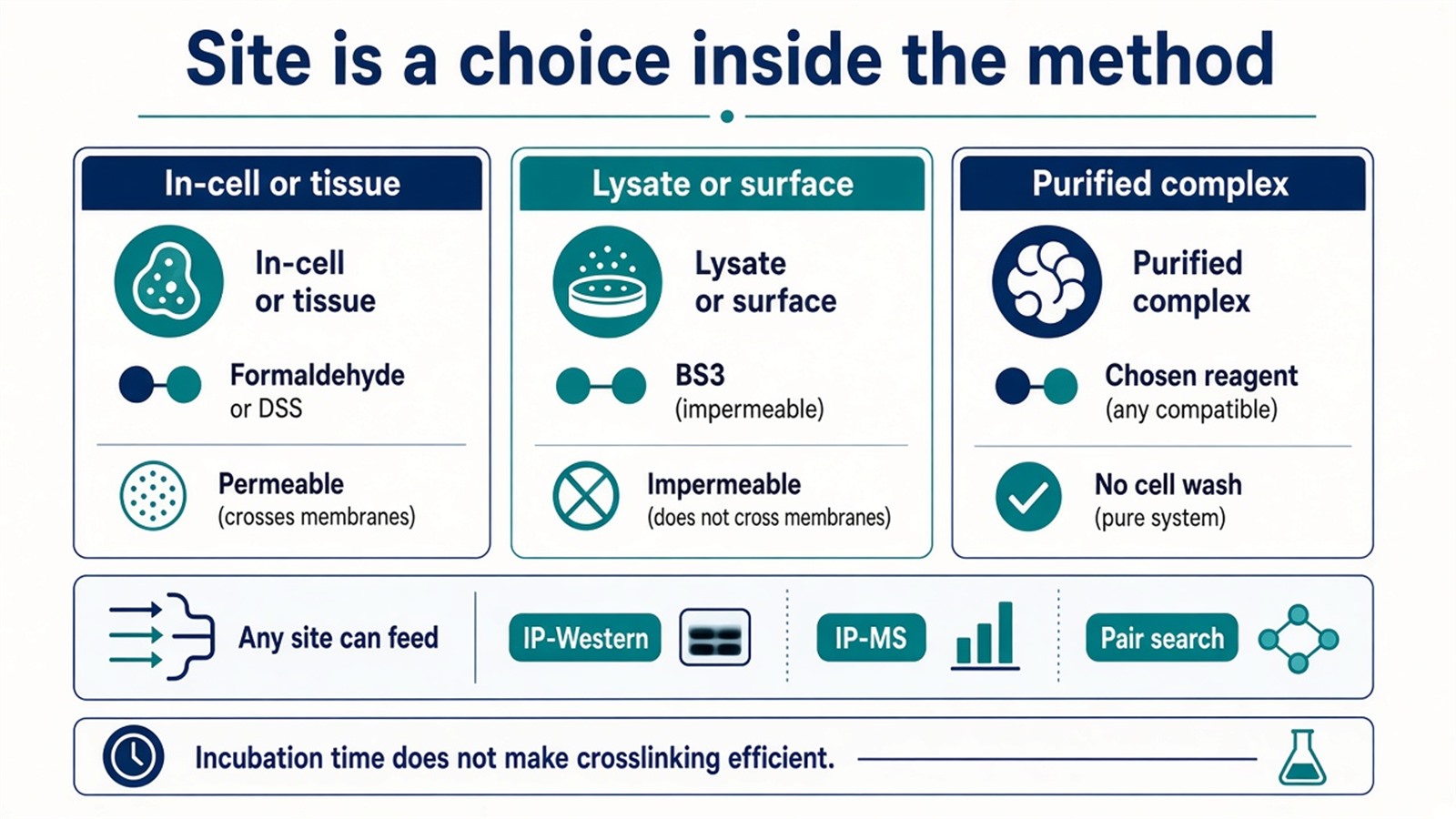
Figure 2. Formaldehyde or DSS on intact cells. BS3 on a lysate or surface. A purified complex is a third site. The method is still the readout.
What FRET, PLA, and Knockout Are Not
FRET reports energy transfer between two fluorophores that are close enough in a living cell. PLA reports an amplified DNA product when two antibodies sit near each other. Both can support a proximity claim. Neither writes a covalent protein–protein link, and PLA is not a high-throughput quantification of interactions at high spatial resolution by default.
Gene knockout and site-directed mutagenesis can test a nominated pair or a nominated surface after one of the three methods has produced a candidate. They do not integrate with cross-linking to yield a more comprehensive interaction network. Disease-mechanism, proteomics, and structural-biology sentences are later overlays. Cross-linking is not a highly versatile tool that elucidates those areas by being adaptable.
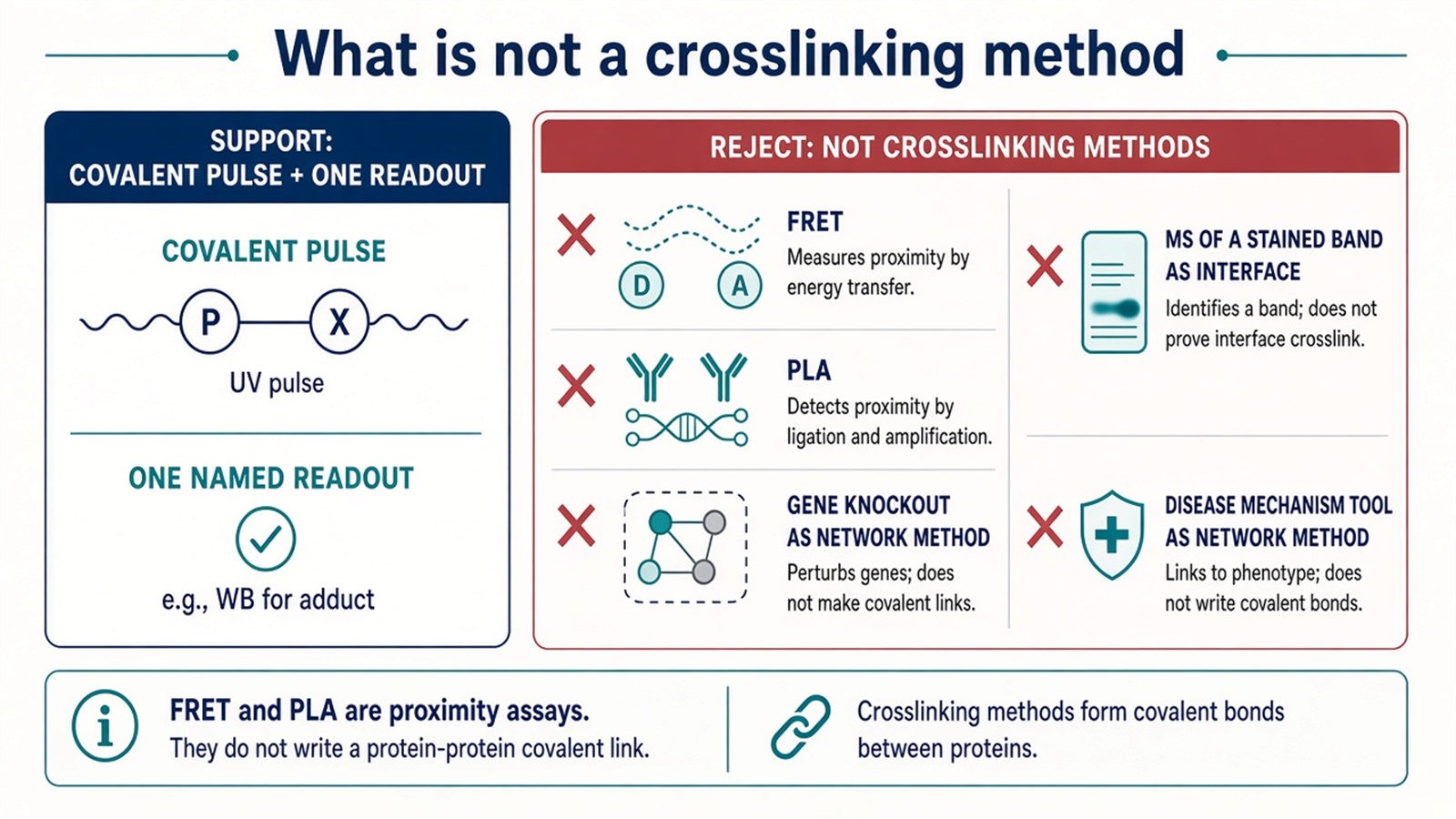
Figure 3. Supported: three covalent-readout methods. Not granted: FRET or PLA as crosslinking, knockout as a network method, or MS of a band as a functional interface.
Experimental Limits
A method name reduces the experiment to one pulse class and one readout. Diagnostic or complete-network language sits outside ordinary research reporting unless a separately validated assay is in place.
Project Planning and Service Scope
A usable methods plan names crosslinking-assisted IP-Western, crosslinking-assisted IP-MS, or XL-MS pairs, the site, and the claim that will be allowed, before the first dose. MtoZ Biolabs scopes crosslinking MS with Orbitrap-class LC-MS/MS. Interpretability still follows that readout, not a versatile-tool slogan.
Once the next sentence is a wash-stable partner list without a residue pair, the project can stay on crosslinking-assisted capture. Researchers who need that pellet can review the MtoZ Biolabs Co-IP-MS Protein Interaction Analysis Service for project-specific sample evaluation, feasibility assessment, and workflow planning.
Frequently Asked Questions
1. What are the specific experimental methods for crosslinking PPI analysis?
Crosslinking-assisted IP-Western, crosslinking-assisted IP-MS, and XL-MS residue-pair analysis. The five-step chemical list is the shared order, not a fourth method.
2. Is Co-IP a crosslinking method?
Co-IP after a pulse is crosslinking-assisted capture. Uncrosslinked Co-IP is a different method.
3. Does mass spectrometry after crosslinking always report interfaces?
Only an XL-MS pair search reports residue proximity. A protein name from a digested band does not.
4. Are FRET and PLA crosslinking methods?
No. They report fluorescence or an antibody-templated product. They do not write a covalent protein link.
5. Does adding knockout make the network complete?
No. Knockout or mutagenesis tests a nominated pair. It does not complete an interactome.
Reference
- Leitner A., Walzthoeni T., Kahraman A., et al. (2014). Probing native protein structures by chemical cross-linking, mass spectrometry, and bioinformatics. Nat. Protoc., 9, 120-135. https://doi.org/10.1038/nprot.2013.168
- O'Reilly F.J., Rappsilber J. (2018). Cross-linking mass spectrometry: methods and applications in structural, molecular and systems biology. Nat. Struct. Mol. Biol., 25, 1000-1008. https://doi.org/10.1038/s41594-018-0147-0
- Yu C., Huang L. (2018). Cross-linking mass spectrometry: an emerging technology for interactomics and structural biology. Anal. Chem., 90, 144-165. https://doi.org/10.1021/acs.analchem.7b04431
- Leitner A., Faini M., Stengel F., Aebersold R. (2016). Crosslinking and mass spectrometry: an integrated technology to understand the structure and function of molecular machines. Trends Biochem. Sci., 41, 20-32. https://doi.org/10.1016/j.tibs.2015.10.008
- Söderberg O., Gullberg M., Jarvius M., et al. (2006). Direct observation of individual endogenous protein complexes in situ by proximity ligation. Nat. Methods, 3, 995-1000. https://doi.org/10.1038/nmeth947
