



Co-IP and IP-MS ask which proteins remain with an endogenous bait after antibody capture, Input and IgG contrast, and either targeted detection or LC-MS/MS identification. GST pull-down asks which proteins remain with an immobilized GST-fusion bait from a lysate or a purified partner under defined chemistry. Both return candidate co-recovery, not proof of binary direct binding (Hein et al. 2015). Prefer Co-IP when an IP-competent antibody exists and the claim is native association. Prefer GST pull-down when no such antibody exists, or when a recombinant domain must be tested. Reassess either route when the handle control is missing or bait recovery is undocumented.
Researchers who already have a named bait, a GST construct or antibody status, and a written interaction claim can also review the MtoZ Biolabs Protein-Protein Interaction Analysis and IP-Mass Spectrometry Service for project-specific method feasibility.
What Co-IP and GST Pull-Down Are Designed to Answer
The main difference is the capture handle and the biological context, not whether a blot or a mass spectrometer is used afterward. Co-IP recovers a native bait with an antibody from cells or tissues. GST pull-down presents a glutathione S-transferase fusion on glutathione resin and asks what is retained from a lysate or a purified prey.
Co-IP fits an endogenous co-recovery claim when tagging would disturb localization or stoichiometry. GST pull-down fits a reconstituted-retention claim: a defined domain, mutant, or purified pair can be tested when no IP-grade antibody exists, or when a Co-IP shortlist needs an orthogonal in-vitro check. A GST result still has to return to a cellular system before it is written as native biology. Broader tagged versus antibody AP-MS choice is covered in Endogenous IP-MS vs. Tagged Pull-Down MS and AP-MS vs IP-MS: How to Choose the Right Interactome Workflow.
Both endings can be western blot or LC-MS/MS. Co-IP-MS ranks proteins that survive antibody capture. GST pull-down MS ranks proteins that survive GST-resin capture. Identification depth in a Co-IP-style eluate is typically hundreds to about a thousand proteins, depending on the sample. A GST eluate is not a deeper interactome because the list is longer.
Co-IP reports native antibody capture. GST pull-down reports reconstituted retention on a GST handle. Neither certifies a direct cellular contact.
Antibody Specificity Versus GST-Handle Specificity
Co-IP specificity is antibody specificity. The reagent must recover the intended native bait without a dominant off-target that then looks like a partner. Application-specific IP testing remains necessary because a Western-only clone can fail native capture (Uhlen et al. 2016). How to qualify that reagent is covered in How to Choose the Right Antibody for Co-IP Assays?.
GST pull-down specificity is handle and bait quality. The GST fusion must be soluble, correctly folded enough to present the intended surface, and not occupied by the tag itself. GST can adsorb lysate proteins. A prey retained on GST-only resin is not a bait-specific partner. Truncations, mutations, and domain constructs change what can be claimed. They also change how much GST-only background appears.
Do not treat a commercial GST antibody as a Co-IP substitute for the endogenous protein. That is still a tagged-handle experiment. Do not treat an IP-grade antibody as a reason to skip a GST-only control if the follow-up is a pull-down.
Input, IgG, and GST-Only Controls
The control that matches the handle is the second main difference. Co-IP needs Input and IgG or bead arms processed with the same lysis, wash, and elution. GST pull-down needs Input from the prey source and a GST-only or empty-resin arm processed with the same immobilization and wash. Empty-tag or GST-only lanes do not replace IgG in an antibody Co-IP. IgG does not replace GST-only in a pull-down.
Input is taken before capture in both designs. For Co-IP it shows that the endogenous bait was present. For GST pull-down it shows that the prey was available in the lysate or the purified fraction. If Input lacks the prey, a missing pull-down band is an expression or integrity problem, not a finished negative interaction.
|
Check |
Co-IP or IP-MS |
GST pull-down |
Common failure |
|---|---|---|---|
|
Capture handle |
IP-competent antibody |
Soluble GST-fusion bait |
Western-only antibody, or aggregated GST bait |
|
Input |
Endogenous bait present before capture |
Prey present in lysate or purified fraction |
Eluate interpreted with no starting material |
|
Handle control |
IgG or bead |
GST-only or empty resin |
Using GST-only as if it were IgG, or the reverse |
|
Enrichment efficiency |
Bait higher in bait IP than in IgG |
GST bait recovered; prey higher than GST-only |
Weak bait, long partner story |
|
Result credibility |
Filtered co-recovery versus IgG |
Filtered retention versus GST-only |
Either list written as direct-binding proof |
A practical choice sequence is:
- Write whether the claim is native co-recovery or reconstituted retention.
- If an IP-competent antibody exists, design Co-IP with Input and IgG.
- If no such antibody exists, or a domain must be isolated, design GST pull-down with GST-only.
- Hold wash chemistry constant inside each method before comparing arms.
- Keep any overlapping names for an orthogonal assay, not as finished mechanism.
Co-IP arm design is covered in Designing an Efficient Co-immunoprecipitation (Co-IP) Protocol. Immobilized GST follow-up is scoped through the GST Pull Down Assay Service and Fusion Protein Interaction Analysis Service | Pull-Down and MS.
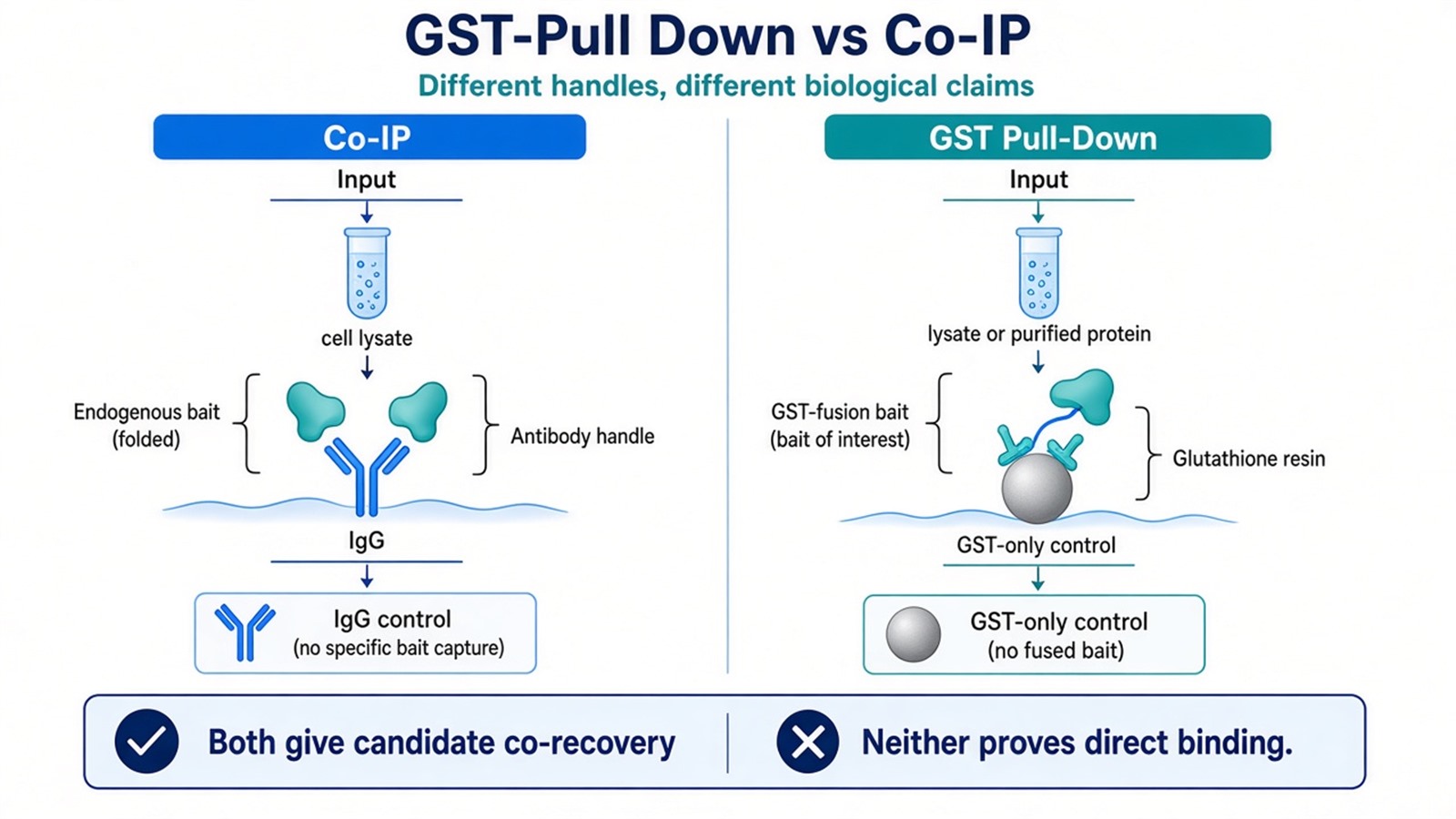
Figure 1. Co-IP and GST pull-down differ in handle and biological context. Both still need a handle-matched control before any partner is ranked.
Enrichment Efficiency and Mass Spectrometry Credibility
Enrichment efficiency is bait-first on both sides. If the Co-IP bait is weak versus Input, or the GST fusion is barely recovered from the resin, a long identification table is not a stronger interaction result. Relative intensity can compare the same protein across Input, handle control, and bait capture. It does not rank unrelated proteins as tighter binders, and a GST intensity cannot be subtracted from a Co-IP intensity as if they were one scale.
For Co-IP-MS, antibody chains and bead proteins can dominate sampling. For GST pull-down MS, GST peptides, glutathione-resin binders, and bacterial carryover from the fusion prep can dominate. Identification of a protein in either eluate is not a confidence call. Ranking requires bait recovery, Input-aware enrichment, and a declared contrast against the matched handle control. Probabilistic scoring such as SAINT uses bait versus control counts to assign a probability that a prey is specifically co-purified (Choi et al. 2011). A contaminant catalog such as the CRAPome is a prior on control frequency (Mellacheruvu et al. 2013). Neither score converts a GST-only failure into a Co-IP partner.
After those gates, a Co-IP value can support: protein B is enriched with endogenous bait A versus matched IgG inside this capture recipe. A GST pull-down value can support: protein B is retained with GST-A versus GST-only inside this immobilization recipe. Pathway maps do not repair a missing handle control.
Readout choice for the antibody route is compared in IP-MS vs Co-IP Western Blot: Which Method Fits Your Study?.
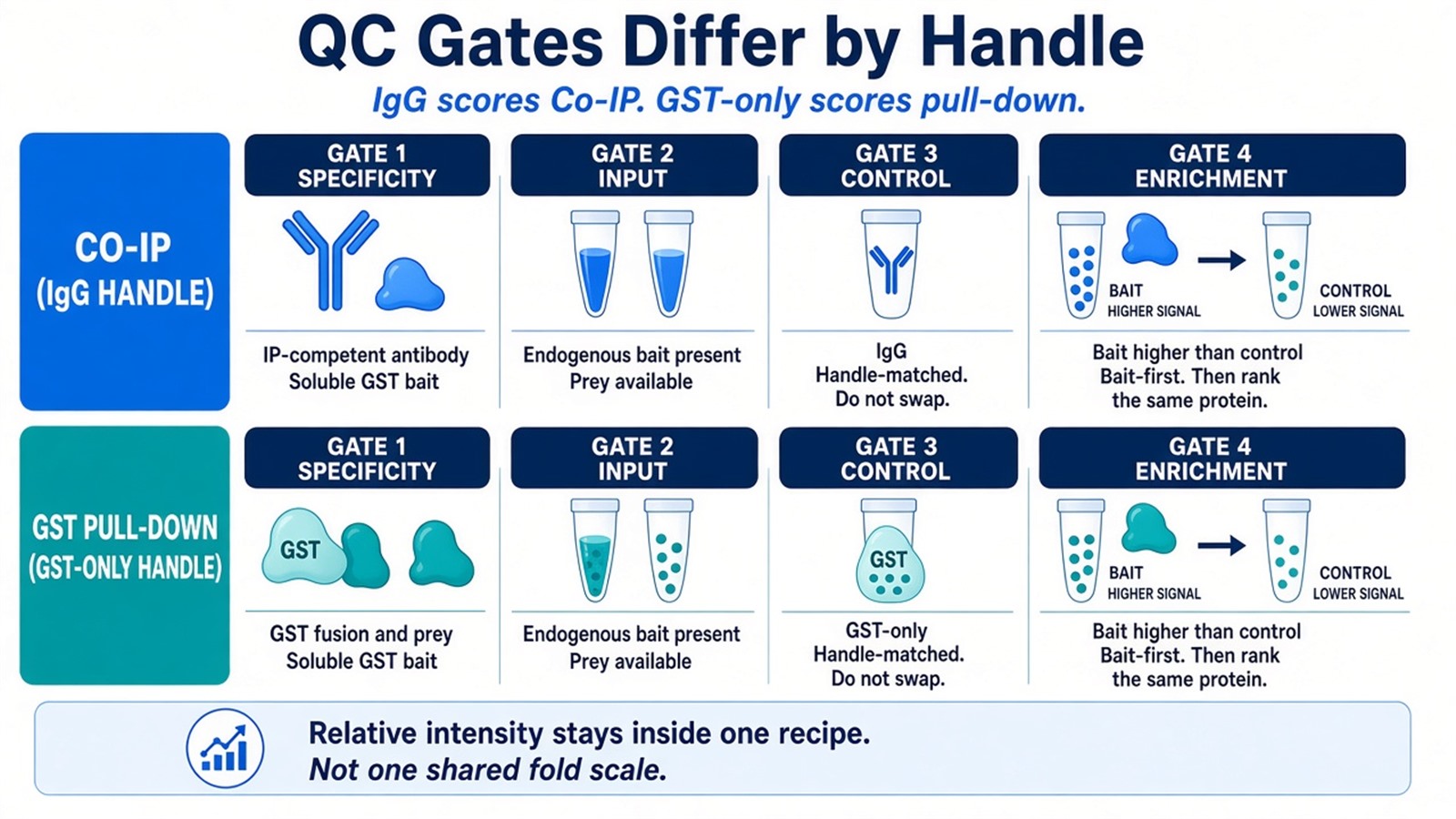
Figure 2. Mass spectrometry credibility follows the handle. IgG does not score a GST pull-down, and GST-only does not score a Co-IP.
Common Biases and Result Boundaries
The common bias is writing GST pull-down as the in-vitro proof that Co-IP could not provide, or writing Co-IP as physiological proof that a GST result already assumed. GST can create tag-driven retention. Co-IP can recover indirect complex members. A protein present in both lists is still a candidate. A protein present in only one list can be a true context difference or a handle artifact.
Do not write a GST-positive, Co-IP-negative pair as proof that the interaction is only in vitro, unless Input, antibody, and wash were qualified. Do not write a Co-IP-positive, GST-negative pair as proof of an indirect-only complex, unless the GST bait was soluble and the prey was present in Input. Do not transfer fold changes between the two methods.
Prefer Co-IP or IP-MS when the endogenous bait can be recovered and the claim is cellular co-recovery. Prefer GST pull-down when the antibody does not exist, a domain or mutant must be isolated, or a Co-IP shortlist needs reconstituted retention. Prefer both when the program needs one native list and one defined-bait check. Screening-level maps are covered in Measuring Protein-Protein Interactions. Mixed enrichment-MS projects can be reviewed under the MS-Based Protein-Protein Interaction Analysis Service.
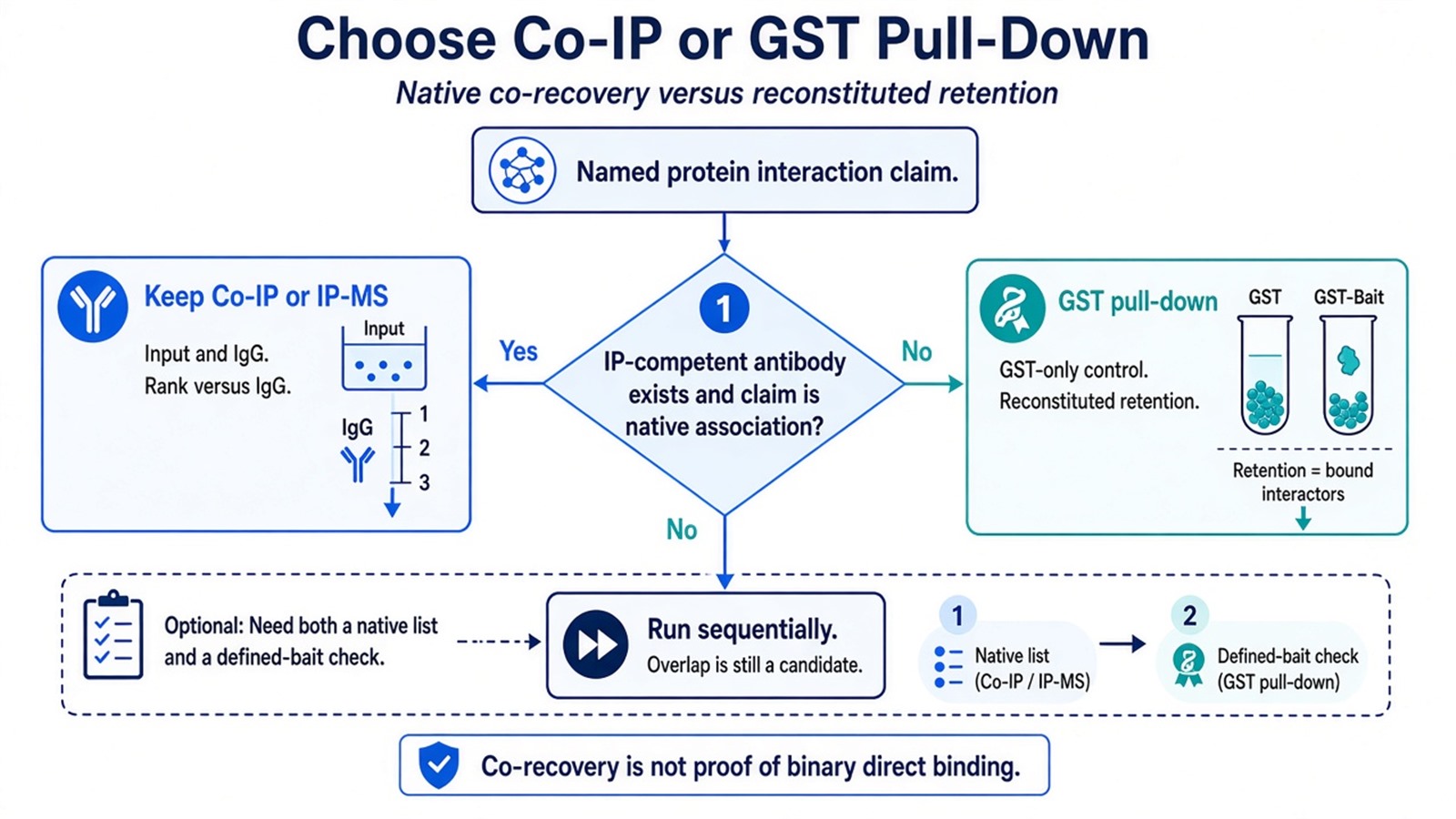
Figure 3. Method fit follows the handle and the claim. A GST result does not replace Input and IgG on the Co-IP side.
Co-IP and GST pull-down support candidate co-recovery or reconstituted retention after handle-matched controls. They do not certify a binary interactome.
Once the claim, antibody or GST-bait status, handle-matched controls, and the intended blot or MS readout are defined, the project can be scoped as Co-IP, GST pull-down, or a sequential pair. Researchers can review the MtoZ Biolabs IP-Mass Spectrometry Service or GST Pull Down Assay Service for sample evaluation and method planning.
Frequently Asked Questions
1. Does a positive GST pull-down prove two proteins bind in the cell?
No. It supports reconstituted retention on a GST handle. A cellular Co-IP or another orthogonal assay is still required for a native claim.
2. Can GST pull-down replace Co-IP when no IP-grade antibody exists?
It can test reconstituted retention. It cannot replace native co-recovery. Write the result as a GST-handle experiment, not as endogenous Co-IP.
3. Does a GST-only control replace IgG?
No. GST-only estimates tag- and resin-driven background. IgG estimates antibody-driven background. Each belongs to its own handle.
4. Can GST pull-down and Co-IP intensities be compared as one fold change?
No. Relative intensity compares the same protein inside one recipe. The two handles are not one quantitative scale.
5. When should both methods be run?
Run Co-IP first when the antibody works and the claim is native. Add GST pull-down when a domain, mutant, or antibody-free check is the next written sentence.
Reference
- M. Uhlen, A. Bandrowski, S. Carr, A. Edwards, J. Ellenberg, E. Lundberg, D. L. Rimm, H. Rodriguez, T. Hiltke, M. Snyder, T. Yamamoto (2016). A proposal for validation of antibodies. Nat. Methods, 13, 823-827. https://doi.org/10.1038/nmeth.3995
- M.Y. Hein, N.C. Hubner, I. Poser, J. Cox, N. Nagaraj, Y. Toyoda, I.A. Gak, I. Weisswange, J. Mansfeld, F. Buchholz, et al. (2015). A human interactome in three quantitative dimensions organized by stoichiometries and abundances. Cell, 163, 712-723. https://doi.org/10.1016/j.cell.2015.09.053
- H. Choi, B. Larsen, Z.Y. Lin, A. Breitkreutz, D. Mellacheruvu, D. Fermin, Z.S. Qin, M. Tyers, A.C. Gingras, A.I. Nesvizhskii (2011). SAINT: probabilistic scoring of affinity purification-mass spectrometry data. Nat. Methods, 8, 70-73. https://doi.org/10.1038/nmeth.1541
- D. Mellacheruvu, Z. Wright, A.L. Couzens, J.P. Lambert, N.A. St-Denis, T. Li, Y.V. Miteva, S. Hauri, M.E. Sardiu, T.Y. Low, et al. (2013). The CRAPome: a contaminant repository for affinity purification-mass spectrometry data. Nat. Methods, 10, 730-736. https://doi.org/10.1038/nmeth.2557
