



Detection methods for a direct interaction between two proteins have to answer a narrower question than “do these proteins appear in the same experiment.” Direct means the pair can meet without a required bridging protein. Co-immunoprecipitation (Co-IP) from lysate, two-hybrid screens, affinity chromatography, and fluorescence resonance energy transfer (FRET) are the methods most often used around that question. They do not all report the same event. Co-IP reports wash-stable co-enrichment and can include indirect complex members. Two-hybrid reports binary reconstitution in yeast or another engineered host. Affinity chromatography reports retention on an immobilized bait; the result is closer to direct when both proteins are purified. FRET reports nanometer-scale proximity of a labeled pair. The yeast three-hybrid format listed on many method pages is an RNA–protein or ternary assay and does not detect a binary protein–protein contact.
Direct-pair work matters for mechanism and for later interface hypotheses in drug research. It does not, by itself, complete target validation. Combining methods helps only when each layer keeps its own claim.
Researchers who already have a nominated pair or a project objective can also review the MtoZ Biolabs Protein-Protein Interaction Analysis Service for project-specific feasibility and analysis planning.
What Counts as a Direct Two-Protein Interaction
A direct claim needs a format in which a third protein is not required for the readout. Purified-pair binding and binary two-hybrid come closest. Lysate Co-IP and FRET are supporting layers: the first can be bridged, the second is proximity. For how Co-IP sits among other assessment assays that are not restricted to direct contact, Common Methods for Assessing Protein-Protein Interactions provides a complementary map.
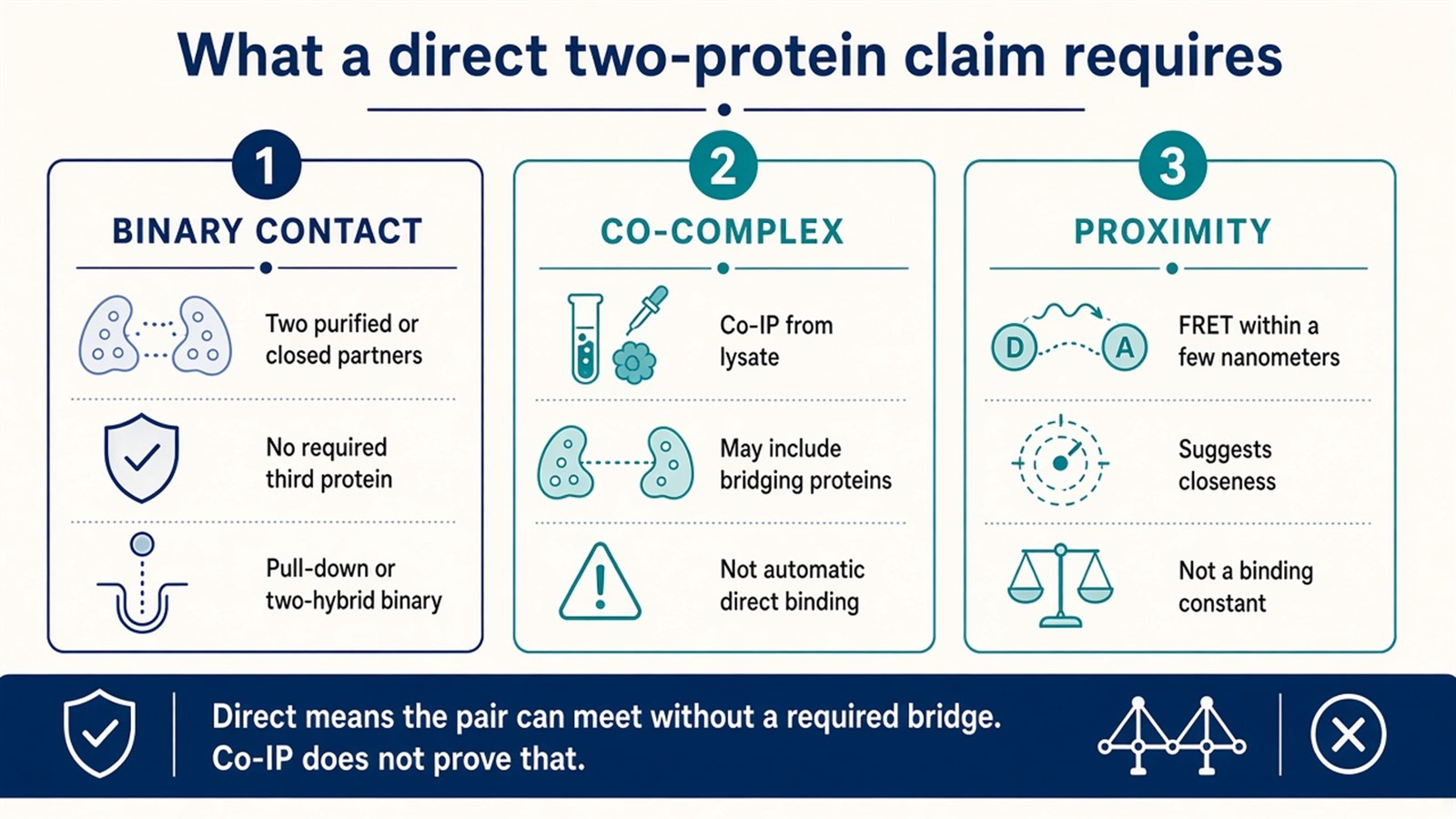
Figure 1. Direct binding is a binary contact. Co-IP can recover bridged complexes, and FRET reports closeness. Those results are not interchangeable proofs.
Name whether the next sentence needs binary contact, co-complex membership, or proximity. The method list cannot decide that.
Methods Commonly Used Around a Direct-Pair Question
1. Co-Immunoprecipitation (Co-IP)
Co-IP uses an antibody to precipitate a target protein from cell or tissue lysate, then a Western blot to test a nominated prey. It is not a liquid-culture-only method. A co-precipitated band suggests that the two proteins remain associated after the stated lysis and wash. A third protein in the same complex can produce the same band. Co-IP is therefore a first complex-level check, not a completed direct-binding assay. Isotype and bead-only controls are required. Reciprocal Co-IP strengthens the complex claim, not the direct claim.
2. Two-hybrid systems
When only one partner is known, a two-hybrid screen can search for binary preys. Yeast two-hybrid (Y2H) is the most common. Related systems exist in insect and mammalian cells. The assay reports reconstitution of a split transcription factor or a related reporter when bait and prey interact in that host. It is a cellular genetic context, but not the original tissue context. False positives are common, and membrane proteins are often a poor fit. A Y2H hit is a binary hypothesis that still needs an orthogonal biochemical or proximity check.
3. Affinity chromatography
One protein is immobilized on a solid support and offered a mixture that may contain the partner. If the prey is a purified protein, retention is stronger evidence of direct binding than a lysate pull-down, where bridging proteins can still travel with the bait. Wash stringency, tag effects, and folding on the resin all limit interpretation. This format is the in vitro companion to Co-IP, not a more accurate version of Co-IP.
4. Yeast three-hybrid
The yeast three-hybrid system used for RNA–protein work places an RNA as the bridge between two fusion proteins, or otherwise reads an RNA-binding event. That is a useful RNA assay. It is not a method for detecting a direct interaction between two proteins. A different three-hybrid design can test a ligand-bridged ternary complex. Neither design should be listed as a binary PPI detector.
5. Fluorescence Resonance Energy Transfer (FRET)
FRET measures energy transfer between two fluorophores when they approach within a few nanometers. It can show that a closed, labeled pair comes together in a cell and can add timing. It does not report a binding constant, and overexpression or linker geometry can create both missed and false proximity signals. Physiological-condition language applies only when expression and localization of the fusions are shown to match the native pair.
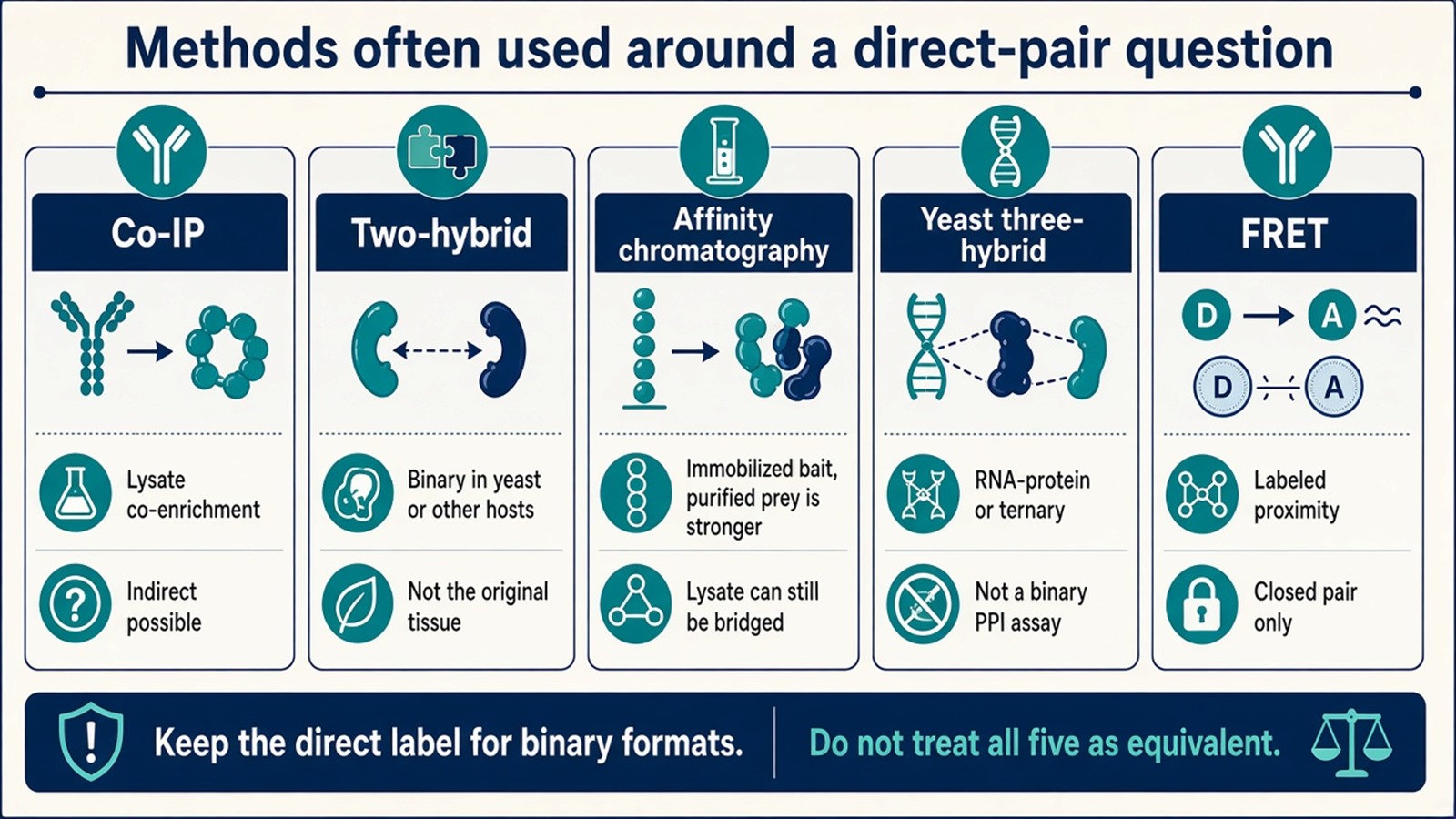
Figure 2. Two-hybrid and purified-pair affinity chromatography are the closer binary formats. Co-IP and FRET support, and yeast three-hybrid does not answer a two-protein direct claim.
For a wider experimental set that includes pull-down, crosslinking, and kinetic assays after the pair is closed, How to Analyze Protein–Protein Interactions: Key Experimental Approaches provides a complementary method overview.
How to Choose a Method for a Direct Claim
If the job is to find unknown binary partners of one bait, start with a two-hybrid screen, then close selected hits with a purified-pair pull-down or an orthogonal cellular assay.
If both proteins can be produced, immobilize one and offer the other as a defined reagent.
If the pair is already named and the question is live-cell closeness, FRET can be added. It does not replace a biochemical binary check.
If only lysate and antibodies are available, run Co-IP first, then add a binary or purified-pair experiment before writing “direct.”
Do not use yeast three-hybrid to support a two-protein direct sentence.
Surface plasmon resonance or related biophysical assays on defined reagents can later report affinity. They are not required to start, and they still do not prove the pair in untagged cells.
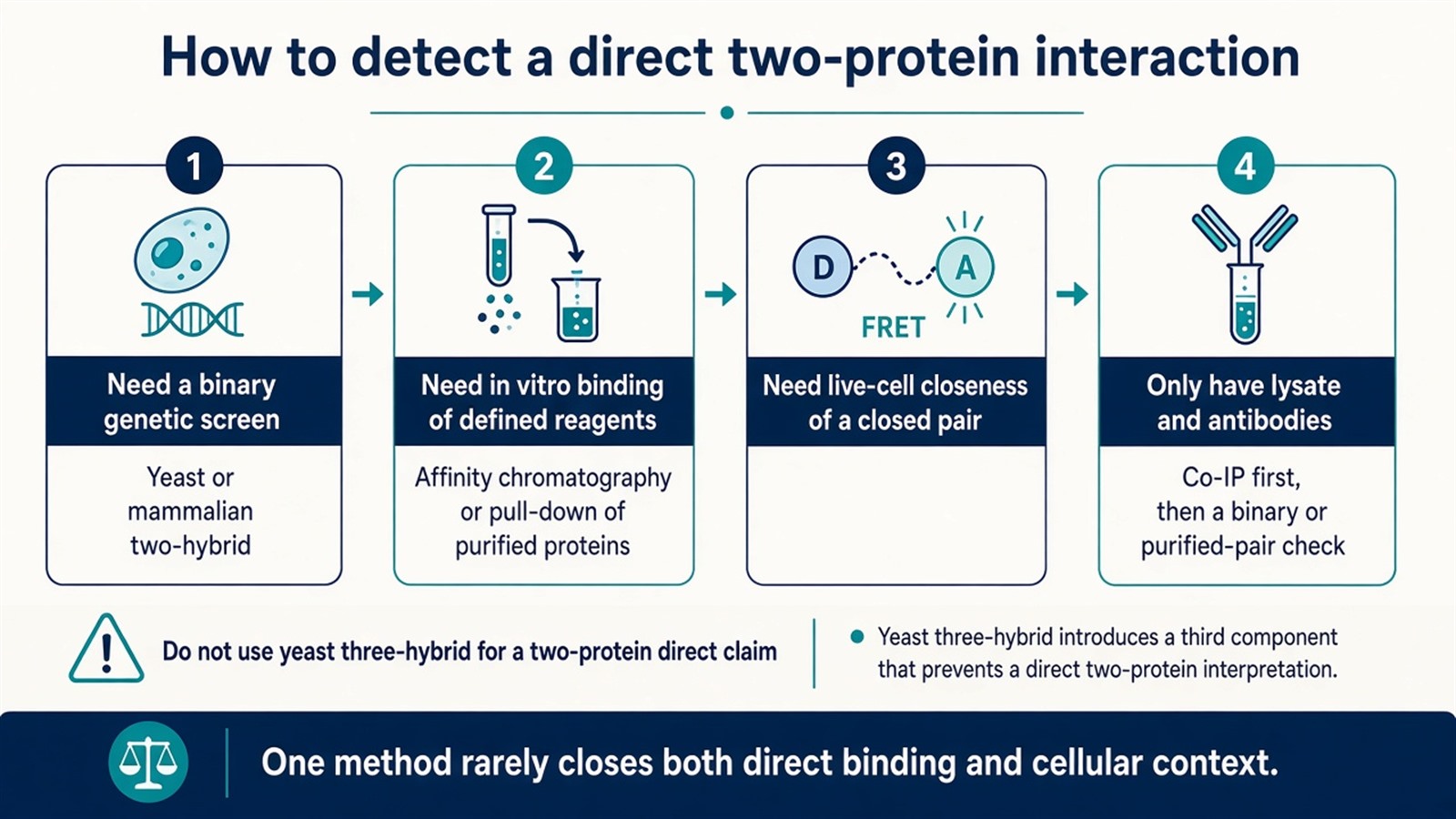
Figure 3. Binary two-hybrid or purified-pair affinity chromatography carry the direct label more cleanly; Co-IP and FRET are added as separately labeled layers.
Experimental Limits and Design Boundaries
Co-IP from lysate cannot exclude a bridge. Two-hybrid cannot place the pair in the original organelle. Immobilized bait can denature or hide an interface. FRET watches fusions. Integrating methods does not automatically raise accuracy. Diagnostic or drug-development claims sit outside ordinary research detection unless a separately validated assay framework is in place.
Project Planning and Service Scope
A usable direct-pair plan names the two proteins, whether the first assay is binary, co-complex, or proximity, and which orthogonal check will follow. MtoZ Biolabs scopes antibody or tag strategies, pull-down and Co-IP workflows, and Orbitrap-class LC-MS/MS when an eluate must be identified. Recovery of a weak direct pair still depends on purification quality and wash stringency, not on listing five method names.
Once the direct claim, method, and follow-up check are defined, the project can be scoped as a pairwise PPI study. Researchers can review the MtoZ Biolabs Protein-Protein Interaction Analysis Service for project-specific sample evaluation, feasibility assessment, and workflow planning.
Frequently Asked Questions
1. Does Co-IP prove that two proteins bind directly?
No. It shows that they remain associated after a stated wash. A bridging protein can produce the same result.
2. Is yeast two-hybrid a direct-interaction method?
It is a binary genetic assay in an engineered host. That is closer to a two-protein claim than lysate Co-IP, but it is not the original cellular complex.
3. When does affinity chromatography support a direct claim?
When the prey is a defined, preferably purified protein. A lysate pull-down can still be indirect.
4. Can yeast three-hybrid detect a direct protein–protein interaction?
Not in the RNA–protein format. That assay reads an RNA bridge or an RNA-binding event.
5. Does FRET quantify interaction dynamics under physiological conditions?
FRET can add timing for a labeled pair. Physiological language requires that the fusions match native level and location. The signal is still proximity, not a Kd.
Reference
- Fields S., Song O. (1989). A novel genetic system to detect protein-protein interactions. Nature, 340, 245-246. https://doi.org/10.1038/340245a0
- Berggard T., Linse S., James P. (2007). Methods for the detection and analysis of protein-protein interactions. Proteomics, 7, 2833-2842. https://doi.org/10.1002/pmic.200700131
- Phizicky E.M., Fields S. (1995). Protein-protein interactions: methods for detection and analysis. Microbiol. Rev., 59, 94-123. https://doi.org/10.1128/mr.59.1.94-123.1995
- SenGupta D.J., Zhang B., Kraemer B., et al. (1996). A three-hybrid system to detect RNA-protein interactions in vivo. Proc. Natl. Acad. Sci. U.S.A., 93, 8496-8501. https://doi.org/10.1073/pnas.93.16.8496
- Sekar R.B., Periasamy A. (2003). Fluorescence resonance energy transfer (FRET) microscopy imaging of live cell protein localizations. J. Cell Biol., 160, 629-633. https://doi.org/10.1083/jcb.200210140
- Masters S.C. (2004). Co-immunoprecipitation from transfected cells. Methods Mol. Biol., 261, 337-350. https://doi.org/10.1385/1-59259-762-9:337
