



Types of interactions between proteins and small molecules are force classes that can operate at a written contact. The original list remains usable: electrostatic attraction or repulsion, hydrophobic burial, hydrogen bonds, van der Waals contacts, aromatic stacking, and metal coordination. Those classes often coexist in one pocket. Naming them does not determine affinity or specificity, and it does not grant a drug mechanism, an enzyme-substrate proof, or a signaling sentence.
A force name is a chemical description. It is not a binding table. Surface plasmon resonance (SPR), isothermal titration calorimetry (ITC), or a ligand-immobilized pull-down can later report whether a named compound was retained or produced an isotherm. Researchers who already have a soluble protein and a compound and need that binding file can review the MtoZ Biolabs Protein Ligand Binding Assay Service for project-specific format matching.
Six Force Types at One Contact
Electrostatic interactions
Opposite charges attract. Like charges repel. A carboxylate on the protein and a protonated amine on the ligand can form a salt bridge. Two anions in the same pocket can raise the energetic cost of that pose. Electrostatics can contribute to a measured affinity. The word significant is not a measurement, and a charge pair does not, by itself, set the dissociation constant.
Hydrophobic interactions
Non-polar patches can come together in water because the solvent around them is costly. A ligand aliphatic or aromatic surface can pack against a non-polar pocket and stabilize that pose. Folding and ligand burial share solvent physics. They are not the same claim, and “many drugs” is a catalog remark, not an experimental class.
Hydrogen bonds
A hydrogen bond is a directional contact between a donor hydrogen and an electronegative acceptor, commonly oxygen or nitrogen. In a protein–small-molecule complex it can lock a pose or be replaced by water. Hydrogen bonds can stabilize a written geometry. They do not guide molecular recognition as a general program, and they overlap with the electrostatic term rather than sitting in a fully separate physical box.
Van der Waals forces
The original three-way split remains chemically usable. London dispersion is an instantaneous dipole–dipole term. Debye forces are permanent-dipole–induced-dipole terms. Keesom forces are permanent dipole–dipole terms. Each contribution is short-range. A packed interface can accumulate many such contacts. That sum is not, by itself, essential for a stable complex, and the same atoms are often already counted as hydrophobic burial or hydrogen-bond geometry.
π–π interactions and aromatic stacking
Two aromatic rings can stack or offset-stack when their electron clouds approach. Phenylalanine, tyrosine, tryptophan, or histidine can face a ligand ring. That geometry is common among aromatic ligands. It is not required of every pair. Cation–π contact is a related possibility at the same rings, not a seventh force added to the original list.
Metal coordination
A metal ion can accept ligands from protein side chains and from a small molecule in one inner sphere. Histidine, cysteine, aspartate, and glutamate are common protein ligands. Metalloprotein active sites and metal-binding drugs use this geometry. Coordination is vital only for that written metal site. It is not a general sixth force for every compound, and a protein–metal-ion complex is not automatically a protein–organic-ligand complex.
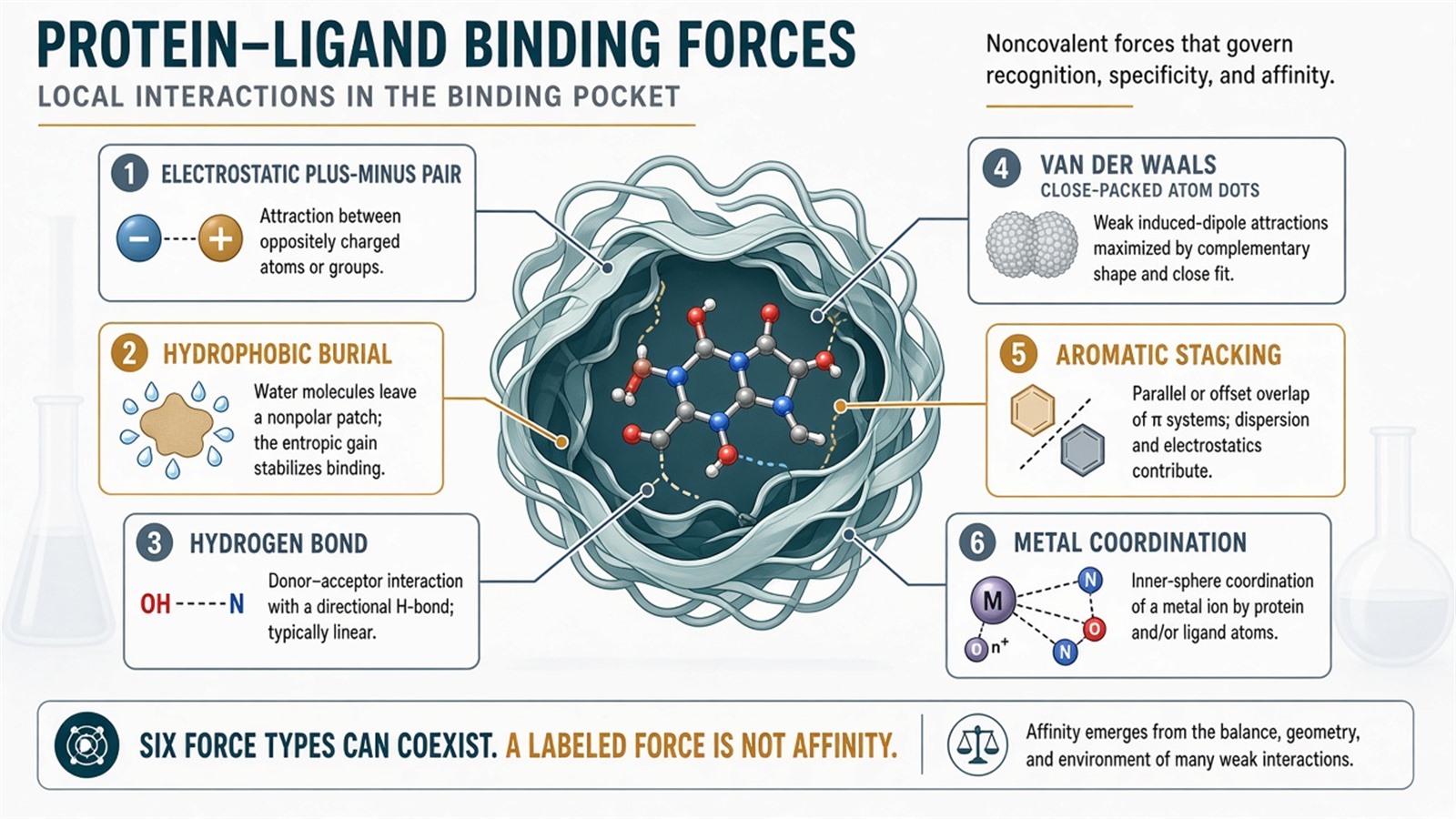
Figure 1. Electrostatics, hydrophobic burial, hydrogen bonds, van der Waals packing, aromatic stacking, and metal coordination can coexist. A labeled force is not affinity or specificity.
Write the pocket residues and the ligand functional groups before any sentence that one force determined the complex.
Naming a Force Is Not an Affinity
These classes often occupy the same interface. A salt bridge can sit next to a stacked ring and a buried methyl. Coexistence is expected. Collective determination of affinity and specificity is not. Affinity is a later number from a written assay. Specificity is a later comparison across ligands or proteins.
A structure can show which atoms are close. Close atoms are consistent with a force class. They are not a decomposition of the binding free energy into six additive terms. ITC can report an enthalpy and an entropy under the cell conditions. Those thermodynamic numbers still do not assign a unique force. SPR can report an association and a dissociation rate for an immobilized partner. The sensorgram does not name electrostatics or stacking.
A small-molecule pull-down asks a different question: which proteins remain on an immobilized compound after a written wash. Retention is not a force assignment. For the ligand-class logic of that format, Affinity Pull-Down Assay is the complementary bead page.
Covalent attachment is outside this force list. A warhead that forms a bond to a nucleophilic residue creates a new chemical species. That event is not an electrostatic or van der Waals subtype. It needs its own chemistry and its own control.
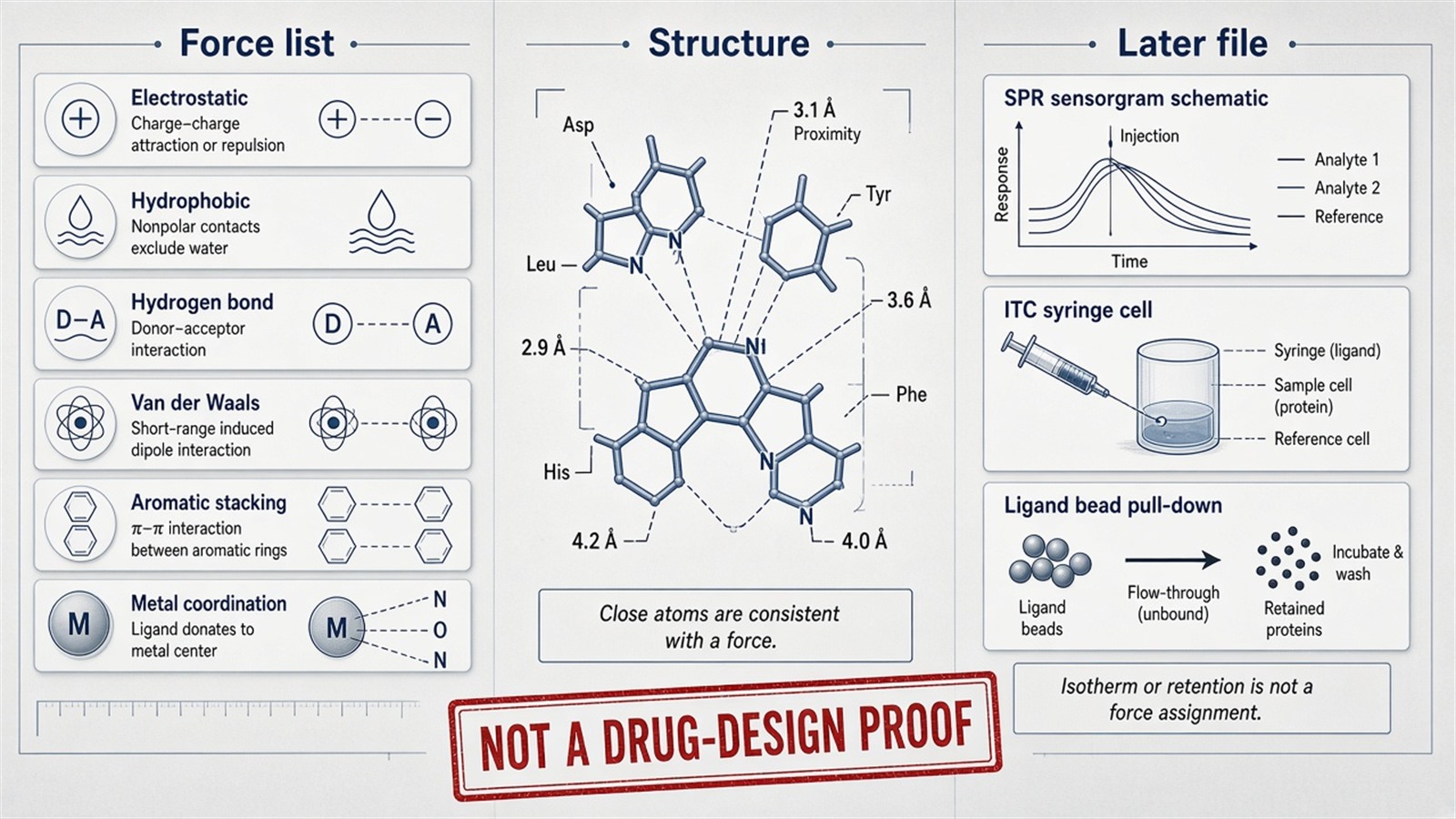
Figure 2. The force list describes possible contacts. A structure shows proximity. SPR, ITC, or a ligand bead reports a later file. None of those files is a drug-design proof.
What This List Does Not Buy
Drug mechanisms, enzyme-substrate recognition, and signal transduction remain allowable study backgrounds. Listing pocket forces does not explain a mechanism, certify a substrate, or map a pathway. Changing a charged or aromatic residue tests that residue. It does not turn the force list into a design engine.
A protein–protein contact can use the same physical classes. That overlap does not make this page a protein–protein method page. Mass-spectrometry recovery of proteins that traveled with a bait is a different file. Pointing a force taxonomy at protein–protein interaction mass spectrometry misnames the next experiment.
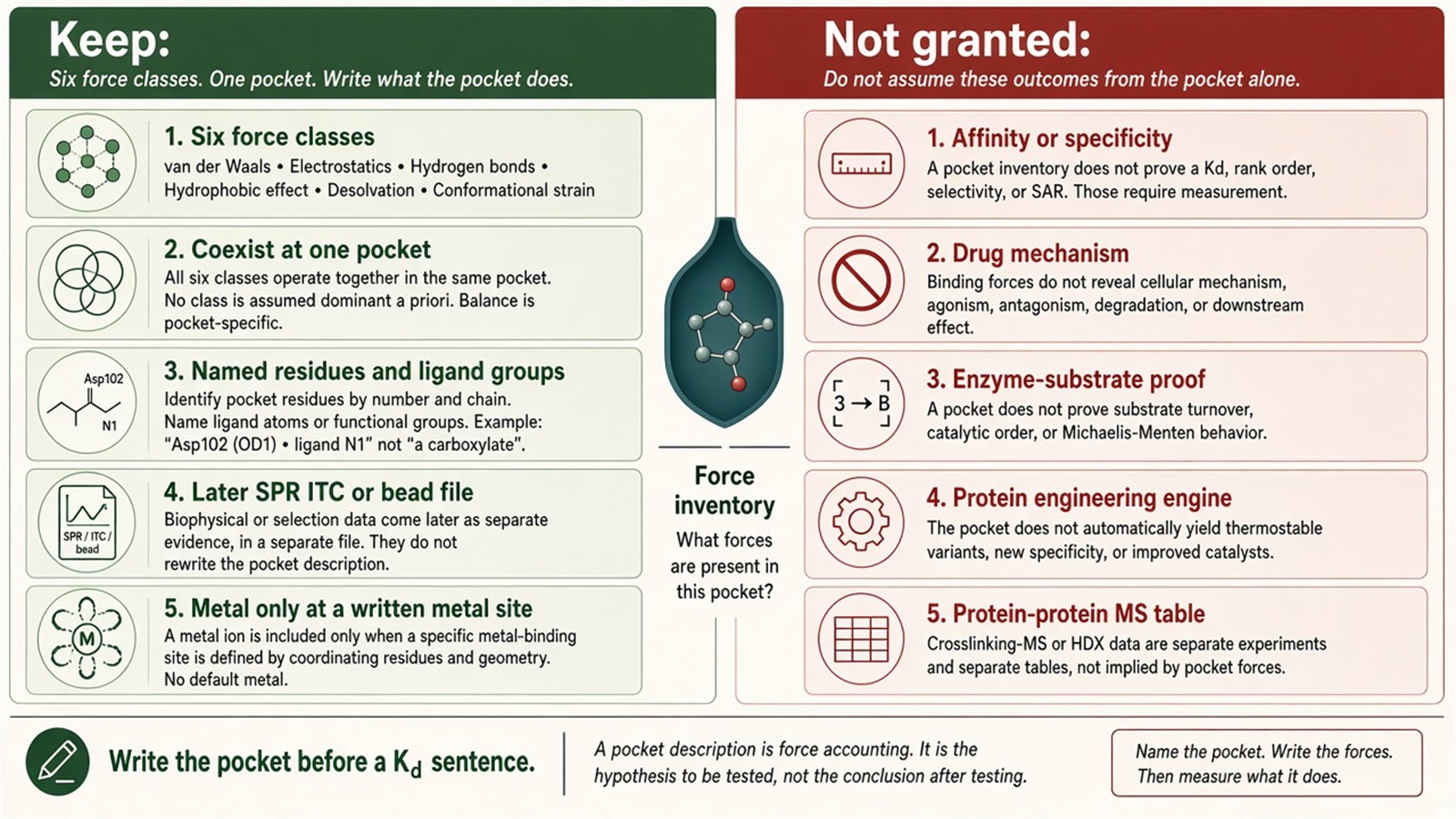
Figure 3. Keep: six force classes that can coexist at a written contact. Not granted: affinity, specificity, drug design, protein engineering, or a protein–protein mass-spectrometry table.
Experimental Limits
This page reduces protein–small-molecule interaction types to a force inventory. Understanding and utilizing those forces is not an essential step in drug design. Decomposition of a measured Kd into six additive force terms sits outside ordinary research reporting unless a separately validated energy model is already named.
Project Planning and Service Scope
A usable request names the protein, the compound class, whether a metal is part of the contact, and the file that would be allowed after the force sentence: an isotherm, a heat trace, or a bead-retained protein list. MtoZ Biolabs scopes ligand-binding formats on SPR-, ITC-, or mass-spectrometry-based arms when those arms match the written question. Interpretability still follows that arm, not a force-taxonomy heading.
Once the next sentence is a labeled or label-free binding menu rather than a force name, this taxonomy page should hand off. Researchers who need that menu can review the MtoZ Biolabs Ligand Binding Assay Service for project-specific sample evaluation, feasibility assessment, and workflow planning.
Frequently Asked Questions
1. Do these six forces determine affinity and specificity?
They can coexist at a contact. Affinity and specificity are later measurements.
2. Are hydrophobic interactions the same as protein folding?
They share solvent physics. Ligand burial is not a tertiary-structure proof.
3. Do hydrogen bonds guide specific recognition?
They can lock a written geometry. Guidance is not a granted function.
4. Is metal coordination a general protein–small-molecule force?
It applies when a metal ion is part of the written site. It is not a default sixth term for every ligand.
5. Does a force list replace SPR, ITC, or a pull-down?
No. The list names possible contacts. Those assays report later files.
Reference
- Bissantz C., Kuhn B., Stahl M. (2010). A medicinal chemist’s guide to molecular interactions. J. Med. Chem., 53, 5061-5084. https://doi.org/10.1021/jm100112j
- Ferreira de Freitas R., Schapira M. (2017). A systematic analysis of atomic protein–ligand interactions in the PDB. Med. Chem. Commun., 8, 1970-1981. https://doi.org/10.1039/C7MD00381A
- Hunter C.A., Sanders J.K.M. (1990). The nature of π–π interactions. J. Am. Chem. Soc., 112, 5525-5534. https://doi.org/10.1021/ja00170a016
- Holm R.H., Kennepohl P., Solomon E.I. (1996). Structural and functional aspects of metal sites in biology. Chem. Rev., 96, 2239-2314. https://doi.org/10.1021/cr9500390
