



Operate tandem mass tag (TMT) quantitative proteomics as a fixed multiplex sequence: extract and digest under one protocol, label each channel at peptide amines, quench and remove free tag, pool equal amounts into one closed plex, optionally fractionate, then acquire liquid chromatography-tandem mass spectrometry (LC-MS/MS) with reporter-ion readout at MS2 or synchronous precursor selection MS3 (SPS-MS3). Channels stay isobaric at MS1 and separate as reporter ions after fragmentation (Thompson et al. 2003). MS3 can reduce ratio compression from co-isolation in complex digests, but it does not repair unmatched loads, incomplete labeling, or a broken channel map (Ting et al. 2011; McAlister et al. 2014). The workflow supports relative ratios inside that plex, not absolute concentration without matched standards.
Researchers who already have defined samples, comparison groups, or a specific project objective can also review the MtoZ Biolabs TMT Quantitative Proteomics Analysis Service for project-specific feasibility and workflow planning.
Multiplex Workflow Step by Step
A workable TMT design follows preparation order. Later software cannot invent biology that never entered the pool.
1. Match digestion and protein load
Extract, reduce, alkylate, and digest samples under one recipe. Assay protein and normalize loading before labeling. Unequal digests become permanent channel bias after pooling.
2. Label, quench, and clean up
Assign each sample to one commercial TMT channel. Keep residual amine buffers low enough for NHS-style chemistry. Quench excess reagent and remove free tag so leftover label does not dominate spectra.
3. Freeze the plex map and pool
Combine labeled peptides only after the channel map is locked. Spare channels should not force unrelated samples into leftover tags. Multi-plex programs need bridge or reference channels before the first pool is mixed.
4. Fractionate when the matrix is dense
High-pH reversed-phase or related fractionation lowers co-elution density and reduces how often nontarget precursors share the isolation window. Fractionation complements MS3; it is not optional noise for complex tissues.
5. Acquire MS2 for sequence and MS2 or MS3 for reporters
Identify peptides from fragment spectra. Quantify from reporter-ion intensities at MS2, or after SPS-MS3 on compatible instruments when co-isolation is the main accuracy risk. Search, normalize, and summarize ratios with declared false discovery rate (FDR) and QC rules.
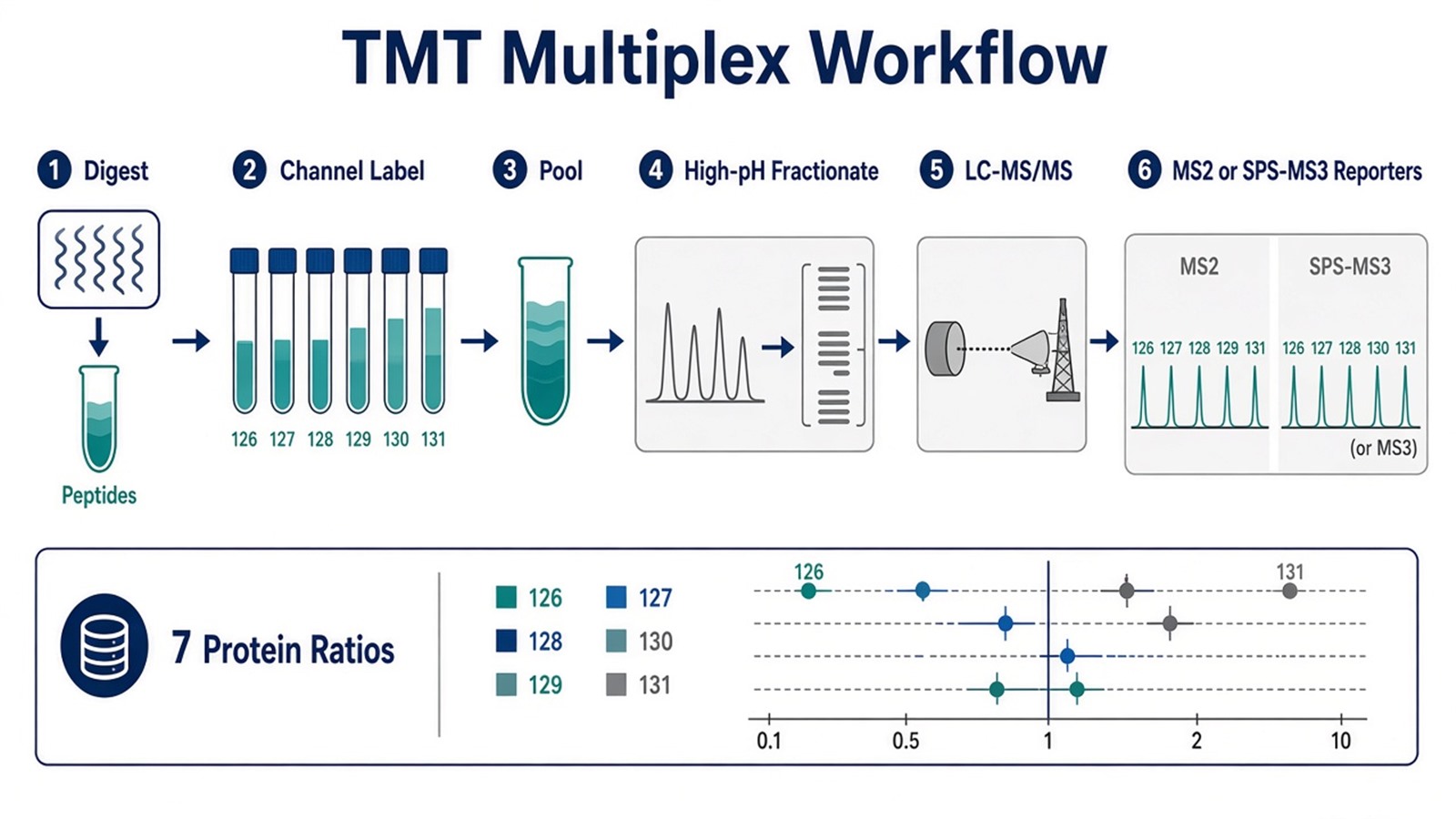
Figure 1. TMT multiplexing is executed as label, pool, fractionate, and reporter readout; relative ratios appear only after the plex is frozen.
If digestion or channel assignment is confounded, MS3 cannot invent a clean biological contrast.
MS3 Accuracy Inside Workflow Design
At MS2, co-isolated peptides can mix reporters and compress fold changes toward unity. SPS-MS3 re-isolates selected fragment ions and measures reporters after a further fragmentation step, which can reduce that mixing in complex digests (McAlister et al. 2014). Cycle-time cost may lower identification depth, so fractionation and gradient still matter.
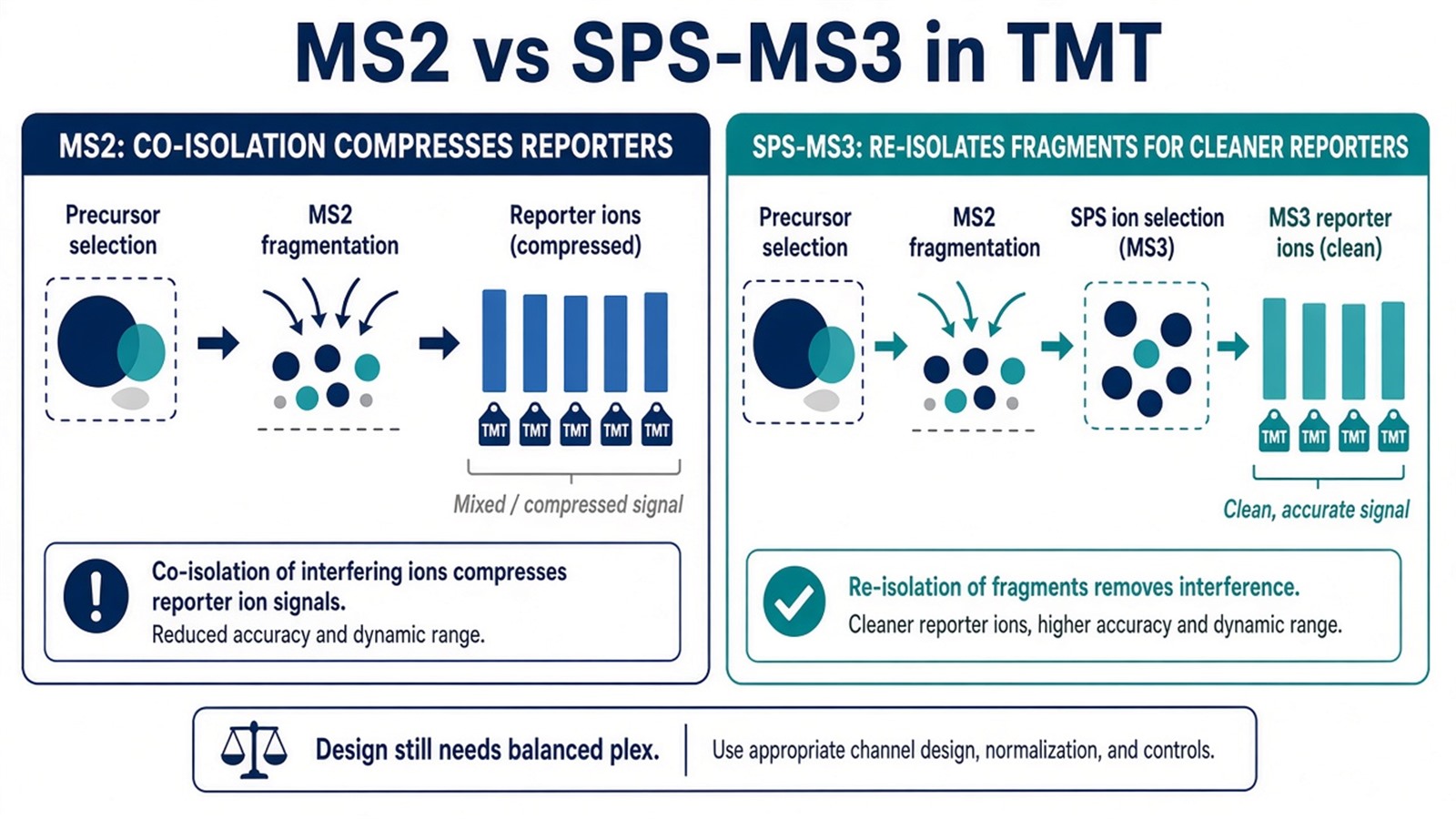
Figure 2. MS3 improves reporter accuracy when co-isolation dominates; balanced plex design and fractionation remain required.
For compression mechanism detail, see How Does Ratio Compression Arise in TMT-Based Quantitative Proteomics and Why Is It Limited to Relative Quantification?. For SPS-MS3 operations, see How Can SPS-MS3 Be Utilized to Optimize TMT Workflows and Minimize Ratio Compression? and TMT MS3 and SPS-MS3: How to Mitigate Ratio Compression and Enhance Quantitative Accuracy. For the full experimental sequence, see A Detailed Workflow of TMT-Based Quantitative Proteomics.
Judgment Criteria: When This Multiplex Design Fits
Study need |
TMT multiplex workflow often fits |
Reassess before labeling |
|---|---|---|
Design |
Groups and replicates fit one kit; channel map closed |
Samples still arriving after pooling |
Chemistry |
Clean amine labeling at N-termini and lysines |
Blocking buffers or failed digestion |
Accuracy plan |
MS2 acceptable, or SPS-MS3 plus fractionation planned |
Expect MS3 alone to fix unmatched loads |
Claim |
Relative same-run ratios inside one plex |
Absolute concentration or diagnostic cutoff |
Scale |
One plex or bridged multi-plex design ready |
Many disconnected plexes without bridging |
Alternative |
Labeling preferred over independent LFQ injections |
Open enrollment or labeling impractical |
Prefer this TMT workflow when multiplex same-run comparison is the scarce resource and chemistry fits. Prefer label-free quantification (LFQ) or unlabeled DIA when samples must stay independent. Prefer PRM, MRM, or AQUA when targets are closed or amount units are required.
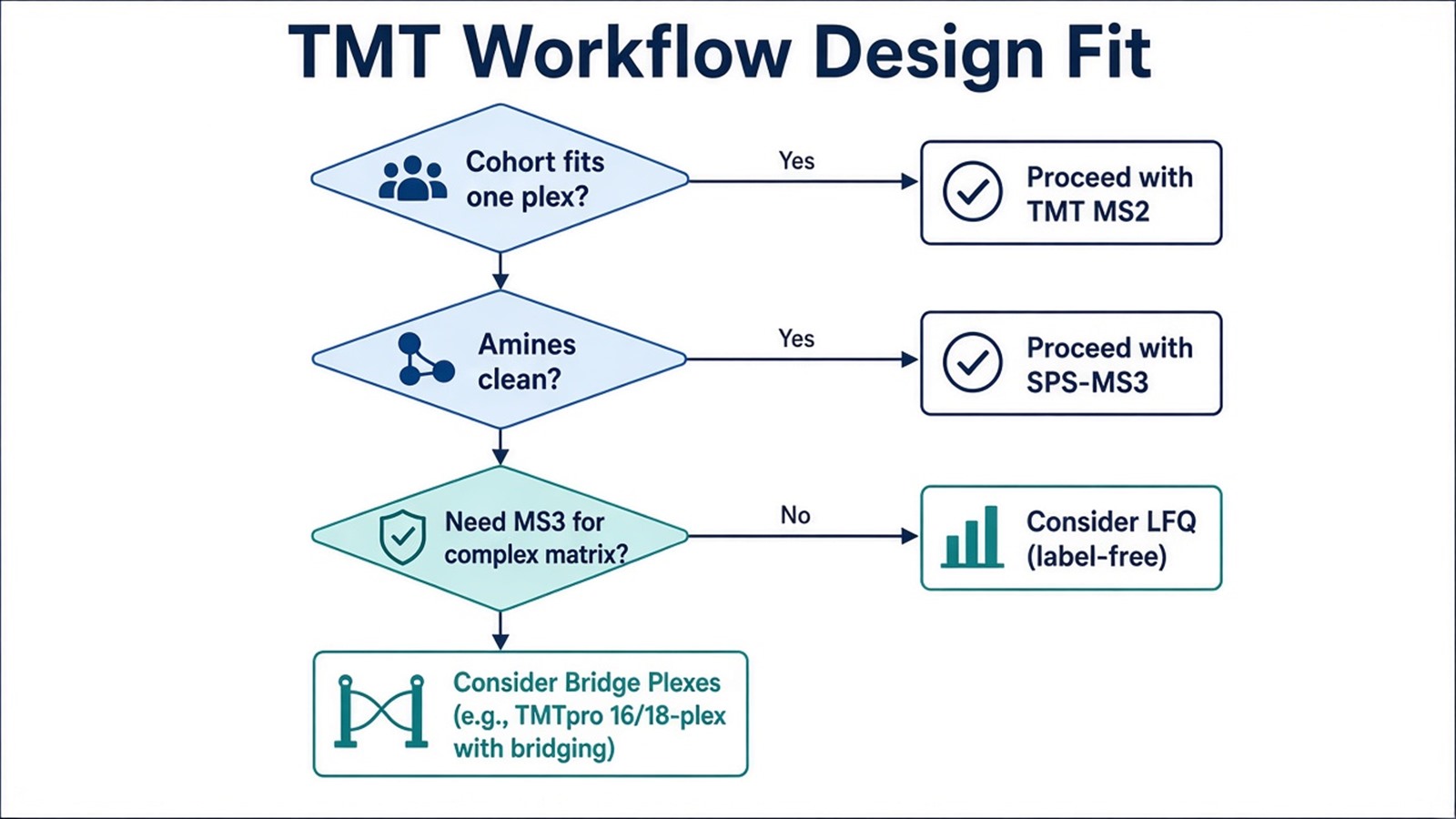
Figure 3. Workflow design starts from plex closure and amine chemistry, then chooses MS2 or SPS-MS3, or changes claim to unlabeled or absolute routes.
For method selection against LFQ, see TMT vs Label Free Quantitative Proteomics and Comparing LFQ and Isobaric Labeling Strategies in Proteomics Quantification. For reporter-ion definitions, see Introduction to TMT Reporter Ions and Mass Spectrometry Analysis. For labeling chemistry, see Mechanism of TMT Labeling in Mass Spectrometry.
Limits and Application Boundaries
TMT multiplexing does not remove finite channel count. Cross-plex comparison needs bridging. Incomplete labeling and swapped channel maps remain chemistry failures. Calling MS3 universally more accurate without stating fractionation and plex layout overstates acquisition class alone.
Typical applications for this workflow design:
- Multi-condition drug, genotype, or dose panels that fit one commercial kit.
- Time-course designs that can freeze all time points before mixing.
- Biomarker discovery lists that need relative ranking inside a frozen plex, then optional targeted follow-up.
- Complex tissue cohorts where SPS-MS3 and fractionation are planned together.
Diagnostic cutoffs and regulatory assay claims sit outside ordinary research TMT reporting unless a separately validated framework is in place.
Once the channel map, fractionation depth, MS2 versus MS3 plan, and relative-ratio claim are defined, the project can be evaluated as a TMT multiplex study. Researchers can review the MtoZ Biolabs TMT Quantitative Proteomics Analysis Service for sample evaluation, feasibility assessment, and workflow planning. For design trade-offs, see Advantages and Disadvantages of TMT-Based Quantitative Proteomics Analysis.
Frequently Asked Questions
1. What is the core operation order in a TMT multiplex workflow?
Digest and match loads, label channels, pool the closed plex, fractionate if needed, then acquire reporter-ion LC-MS/MS and summarize ratios.
2. Does MS3 make TMT absolute?
No. MS3 can reduce reporter mixing. Absolute amount still needs matched standards and calibration.
3. When should a workflow stay on MS2 reporters?
When the matrix is simpler, fractionation already controls co-isolation, or instrument cycle time cannot support SPS-MS3 without unacceptable depth loss.
4. How do I handle more samples than one kit?
Plan bridging or reference channels across plexes before the first mix. Do not casually merge unbridged reporter matrices.
5. Can unlabeled DIA replace the TMT multiplex workflow?
Not as a drop-in. DIA keeps independent unlabeled injections. TMT freezes a labeled plex for same-run ratios.
Reference
- A. Thompson, J. Schaefer, K. Kuhn, S. Kienle, J. Schwarz, G. Schmidt, T. Neumann, C. Hamon (2003). Tandem mass tags: a novel quantification strategy for comparative analysis of complex protein mixtures by MS/MS. Anal. Chem., 75, 1895-1904. https://doi.org/10.1021/ac0262560
- L. Ting, R. Rad, S.P. Gygi, W. Haas (2011). MS3 eliminates ratio distortion in isobaric multiplexed quantitative proteomics. Nat. Methods, 8, 937-940. https://doi.org/10.1038/nmeth.1714
- G.C. McAlister, D.P. Nusinow, M.P. Jedrychowski, M. Wuhr, E.L. Huttlin, B.K. Erickson, R. Rad, W. Haas, S.P. Gygi (2014). MultiNotch MS3 enables accurate, sensitive, and multiplexed detection of differential expression across cancer cell line proteomes. Anal. Chem., 86, 7150-7158. https://doi.org/10.1021/ac502040v
