



Yes, if the next assay reads a covalent pair or a detergent-resistant pellet that the antibody can survive. After an in-cell reagent such as formaldehyde or disuccinimidyl suberate (DSS), the cells still have to be opened. RIPA buffer can do that job because it is a harsh mix of ionic and non-ionic detergent plus salt. It solubilizes membranes and releases protein. It does not preserve the integrity of crosslinked complexes. The covalent links hold the pairs. RIPA is not a gentler extraction that keeps those complexes native.
RIPA is not the typical or required lysis after every crosslinking pulse. A milder NP-40 or Triton buffer is often the first choice when the next step is immunoprecipitation. An SDS-rich lysis is often the first choice when the next step is a residue-pair search and the antibody is not in the path. Alternative lysis buffers exist because the downstream claim changes. For the written route that comes before lysis, What Is the Protocol for Crosslinking-Based Protein Interaction Analysis? provides a complementary protocol page.
Researchers who already have an in-cell pulse and need a residue-proximity or crosslinking-assisted table can also review the MtoZ Biolabs Crosslinking Mass Spectrometry Protein Interaction Analysis Service for project-specific feasibility and analysis planning.
What RIPA Does After a Crosslink
RIPA disrupts membranes and solubilizes proteins, including many that remain in a pellet after a milder detergent. A typical recipe combines SDS, sodium deoxycholate, a non-ionic detergent, and salt. That mix is why it is used when extraction completeness is the problem. Crosslinked cells can be harder to lyse than untreated cells. RIPA can raise yield. Yield is not complex integrity. Some commercial RIPA recipes already contain Tris. Residual amine in the bottle is not a substitute for a written NHS quench before the pellet is opened.
The original formaldehyde and DSS examples remain the usual in-cell reagents. They do not share a lysis default. DSS is an NHS ester. It is quenched, often with an amine buffer, before lysis. Formaldehyde is a short, partly reversible chemistry. Some formaldehyde workflows later use heat or higher detergent to reverse the links. RIPA is not a reverse-crosslinking buffer. For which reagent was used in the pulse, How to Select a Crosslinker for XL-MS Structural Studies provides a complementary selection page.
A no-crosslinker arm is lysed in the same buffer. Changing the lysis only on the crosslinked sample mixes a detergent effect with a reagent effect.
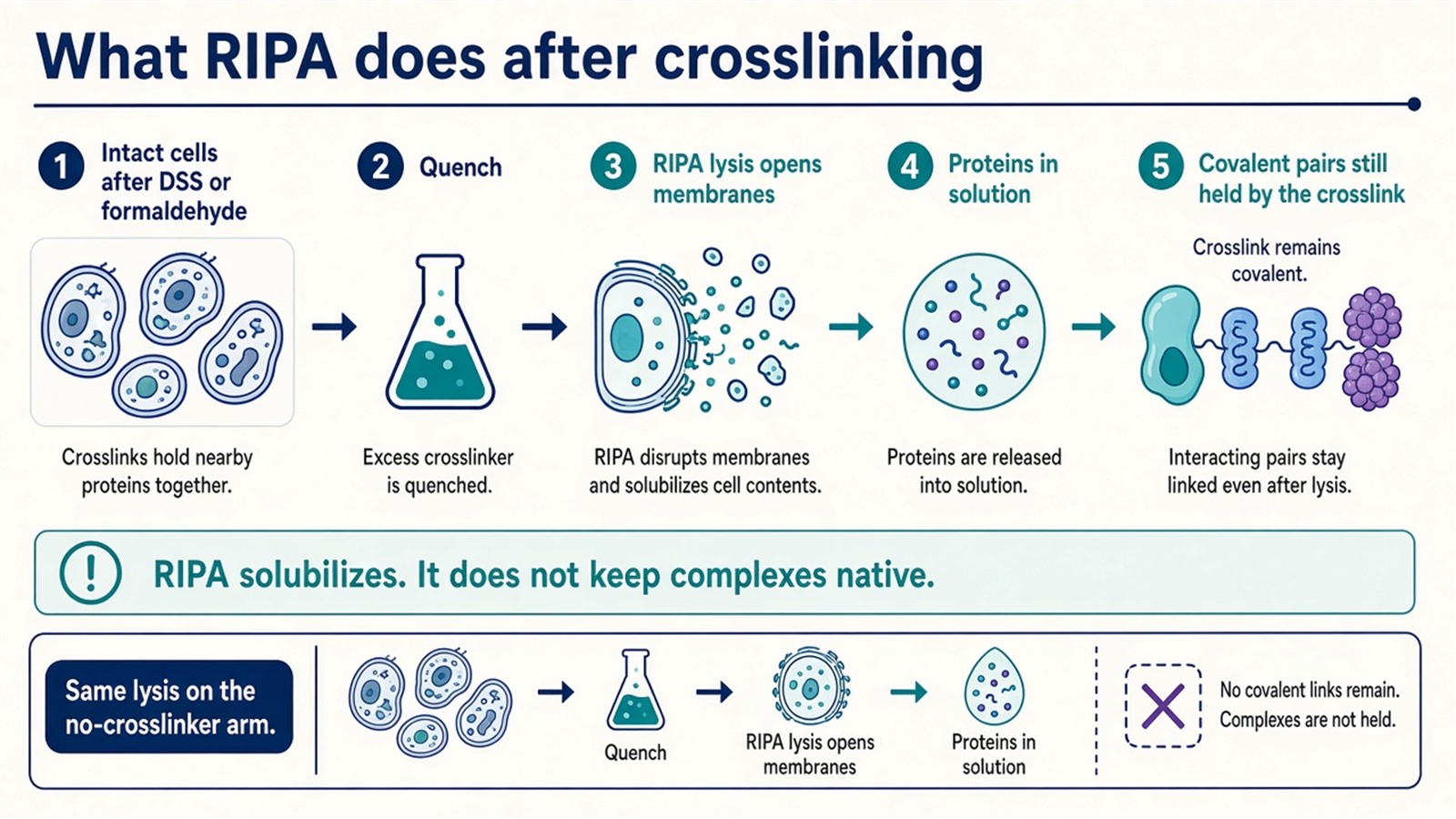
Figure 1. After quench, lysis opens the cell. RIPA is a harsh detergent mix. Crosslinks, not RIPA, hold covalent pairs.
Name the next assay before pouring RIPA. A buffer that extracts more protein is not a buffer that preserves a complex.
When RIPA Is the Better First Lysis
These uses hold only with the condition in the same sentence.
RIPA is useful for an XL-MS residue-pair table if the claim is the covalent link and the digest can tolerate that detergent after cleanup. Harsh lysis is then a feature. Non-covalent leftovers that would have survived a mild buffer are stripped. The pair that remains is more likely to be reagent-dependent. It is still proximity, not proof of direct binding. For that limit, Can Crosslinking MS Prove a Direct Protein Interaction? provides a complementary proof page.
RIPA is useful for a Western blot of a shift if the epitope survives the detergent and the question is whether a species became larger after the pulse. A smear or a stacked band is not a site.
RIPA is a poor first lysis for crosslinking-assisted immunoprecipitation if the antibody fails in SDS or deoxycholate. Many IP-grade antibodies were qualified in NP-40 or Triton. After DSS or formaldehyde, those milder buffers are often enough because the covalent links already hold the pellet through a wash that would empty an uncrosslinked Co-IP. Switching to RIPA to “protect the complex” can empty the bait instead.
For the no-crosslinker and quench arms that must travel through whichever lysis is chosen, What Controls Are Needed for Co-IP-MS and In-Cell Crosslinking MS? provides a complementary control page.
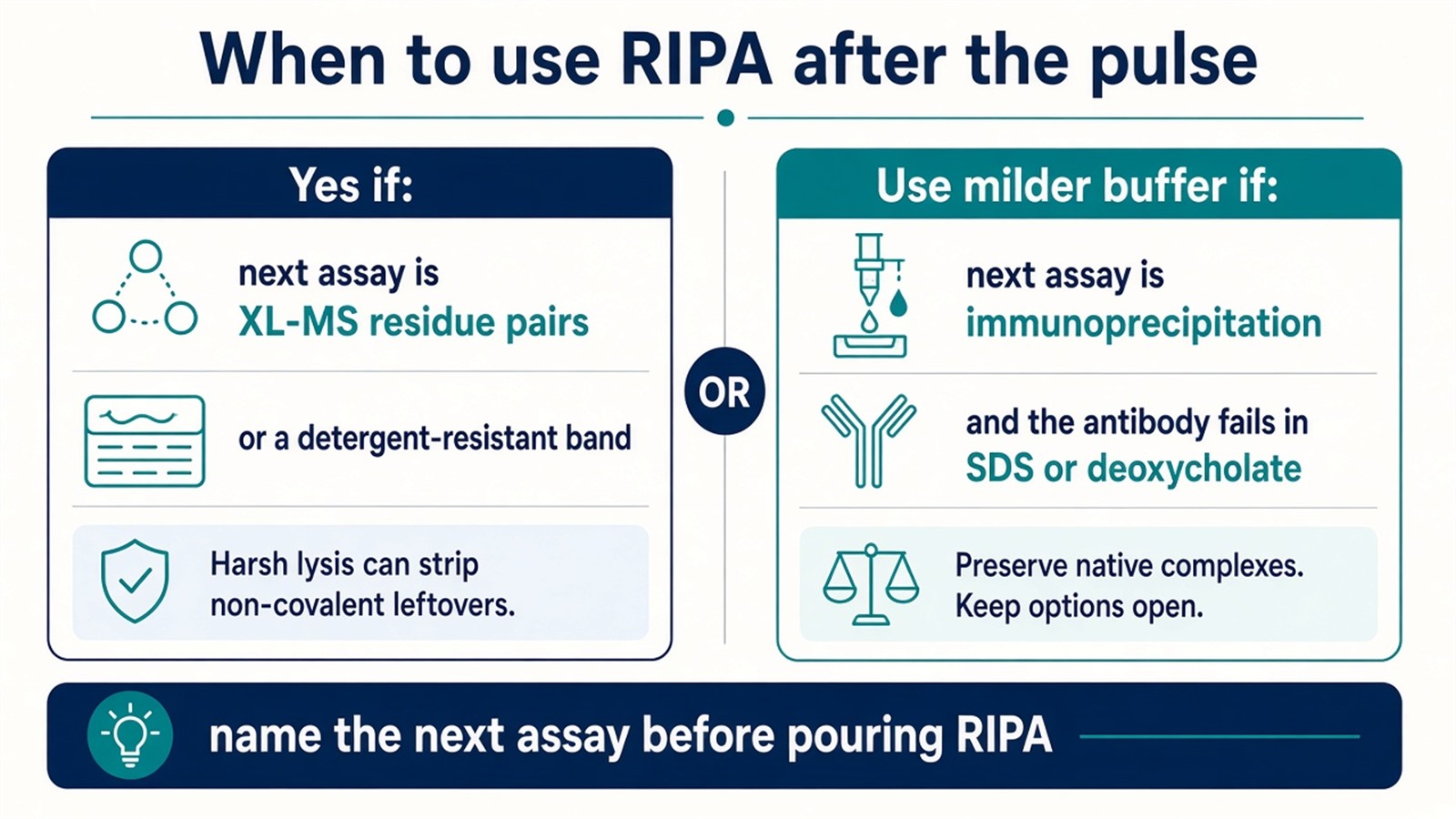
Figure 2. XL-MS can use a harsh lysis. Crosslinking-assisted IP usually keeps a milder detergent if the antibody requires it. Same pulse, different lysis.
What the Original “Typically RIPA” Sentence Misses
Detection in downstream analyses is not one method. Liquid chromatography–tandem mass spectrometry (LC-MS/MS) of linked peptides, an IP–Western, and a stained gel ask for different solubilization.
Preserving integrity is the wrong verb for RIPA. Ionic detergent unfolds proteins and breaks non-covalent contacts. That is the point of a harsh buffer after a covalent pulse. Calling RIPA particularly effective at both extraction and preservation collapses those two jobs.
Tissue lysis with RIPA is a homogenization choice. It is not evidence that the same recipe should follow every DSS or formaldehyde treatment of cultured cells.
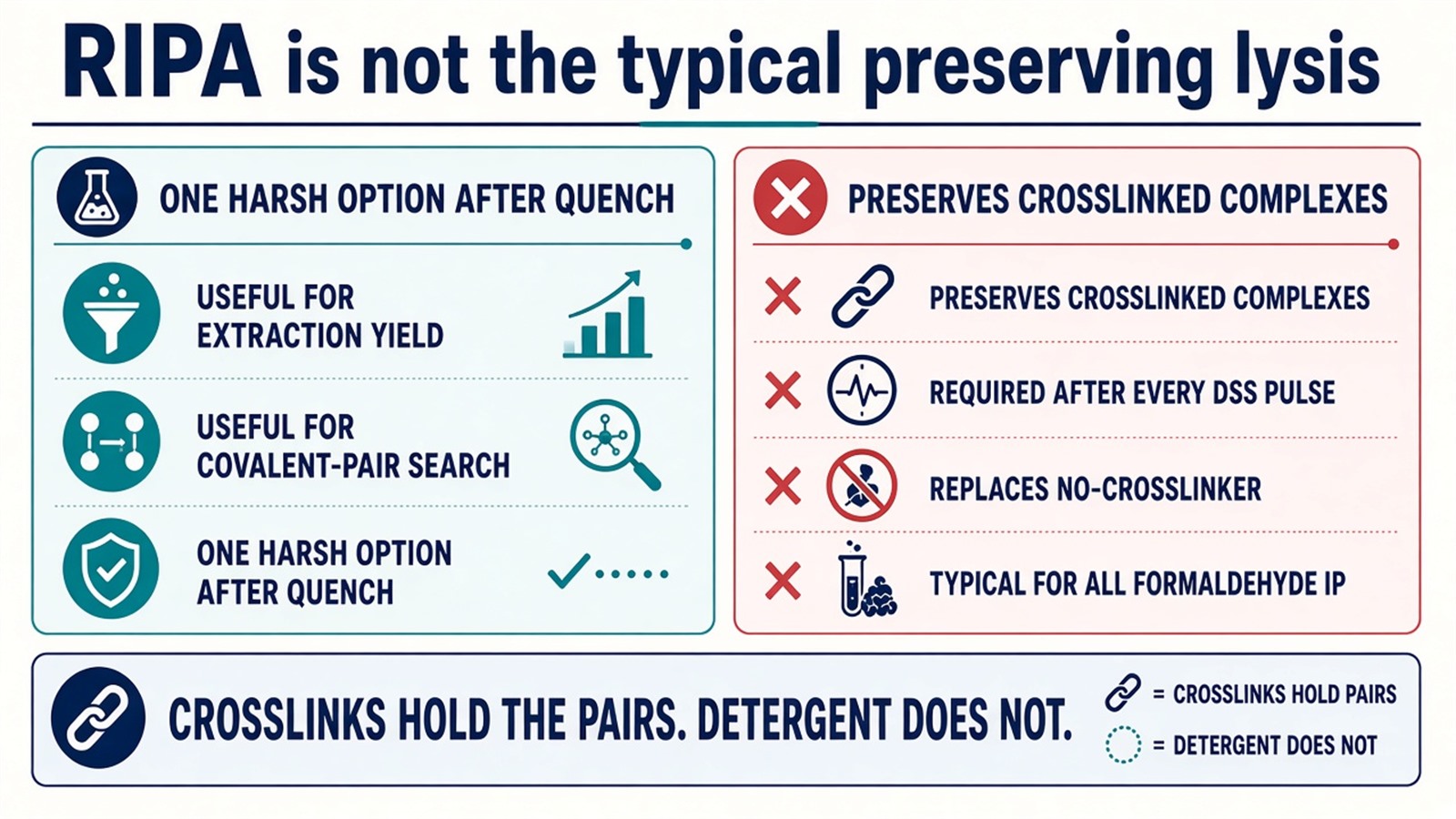
Figure 3. Supported: RIPA when the next readout is a covalent pair or a detergent-resistant band. Not granted: a default lysis that keeps crosslinked complexes intact.
Experimental Limits
Lysis after crosslinking reduces a cell pellet to what one detergent mix, one quench, and the next assay can report. Diagnostic language sits outside ordinary research reporting unless a separately validated assay is in place.
Project Planning and Service Scope
A usable lysis plan names the pulse, the quench, RIPA or a milder buffer, and the claim that will be allowed, before the first pellet is opened. MtoZ Biolabs scopes crosslinking MS with Orbitrap-class LC-MS/MS. Interpretability still follows those arms, not a RIPA-preserves-complexes slogan.
Once the next sentence is a wash-stable IP after a milder lysis rather than a residue pair, the project is crosslinking-assisted capture. Researchers who need that pellet can review the MtoZ Biolabs Co-IP-MS Protein Interaction Analysis Service for project-specific sample evaluation, feasibility assessment, and workflow planning.
Frequently Asked Questions
1. Should cells be lysed with RIPA after crosslinking?
Yes, if the next assay reads a covalent pair or a band that survives that detergent. No, if the next assay is an antibody capture that fails in RIPA.
2. Does RIPA preserve crosslinked complexes?
No. The covalent links hold the pairs. RIPA solubilizes and denatures.
3. Is RIPA the typical lysis after formaldehyde or DSS?
It is one common harsh buffer. Milder detergents are often used when an IP follows the pulse.
4. Can RIPA replace a no-crosslinker arm?
No. The same lysis must be used on both arms.
5. Should leftover DSS be quenched before RIPA?
Yes. An amine quench is written for NHS esters before the pellet is opened.
Reference
- Leitner A., Walzthoeni T., Kahraman A., et al. (2014). Probing native protein structures by chemical cross-linking, mass spectrometry, and bioinformatics. Nat. Protoc., 9, 120-135. https://doi.org/10.1038/nprot.2013.168
- O'Reilly F.J., Rappsilber J. (2018). Cross-linking mass spectrometry: methods and applications in structural, molecular and systems biology. Nat. Struct. Mol. Biol., 25, 1000-1008. https://doi.org/10.1038/s41594-018-0147-0
- Yu C., Huang L. (2018). Cross-linking mass spectrometry: an emerging technology for interactomics and structural biology. Anal. Chem., 90, 144-165. https://doi.org/10.1021/acs.analchem.7b04431
- Klockenbusch C., Kast J. (2010). Optimization of formaldehyde cross-linking for protein interaction analysis of non-tagged integrin beta1. J. Biomed. Biotechnol., 2010, 927585. https://doi.org/10.1155/2010/927585
- Smith A.L., Friedman D.B., Yu H., Carnahan R.H., Reynolds A.B. (2011). ReCLIP (reversible cross-link immuno-precipitation): an efficient method for interrogation of labile protein complexes. PLoS One, 6, e16206. https://doi.org/10.1371/journal.pone.0016206
