



No. After a protein-crosslinking pulse, the next written move is to stop the reagent. Cell lysis is the next step only when the following assay needs a lysate. A quenched pellet can be frozen first. A two-protein tube never needed a cell lysis. There is no best lysis buffer. The detergent is matched to the next readout, not ranked as a general extractant for every cell type.
The original purpose sentence remains when lysis is chosen: the membrane is opened so that protein can be recovered. That purpose does not make lysis automatic. Formaldehyde and disuccinimidyl suberate (DSS) keep reacting until they are quenched. Pouring detergent onto an unquenched pellet continues the chemistry in a new solvent. For that stop-then-store order, How to Handle Samples After Adding Crosslinkers in Protein Crosslinking provides a complementary handling page.
Researchers who already have a quenched in-cell pellet and need a residue-pair table can also review the MtoZ Biolabs Crosslinking Mass Spectrometry Protein Interaction Analysis Service for project-specific feasibility and analysis planning.
Lysis Is Conditional, Not Typical
Crosslinking inside cells is meant to write covalent links before the compartment is destroyed. Opening the cell too early, or opening it while leftover reagent is still active, mixes a lysis effect with a pulse effect. A no-crosslinker arm is opened in the same buffer, after the same quench. Changing only the treated pellet mixes detergent with chemistry.
A purified-protein or lysate crosslinking reaction is already open. The next steps there are quench, cleanup, and the assay. Asking which cell-lysis buffer is best is the wrong question for that tube.
When the sample is intact cells, the written sequence is pulse, quench, wash if the cells are still whole, then freeze or lyse. For that shared order, What Is the Protocol for Crosslinking-Based Protein Interaction Analysis? provides a complementary protocol page.
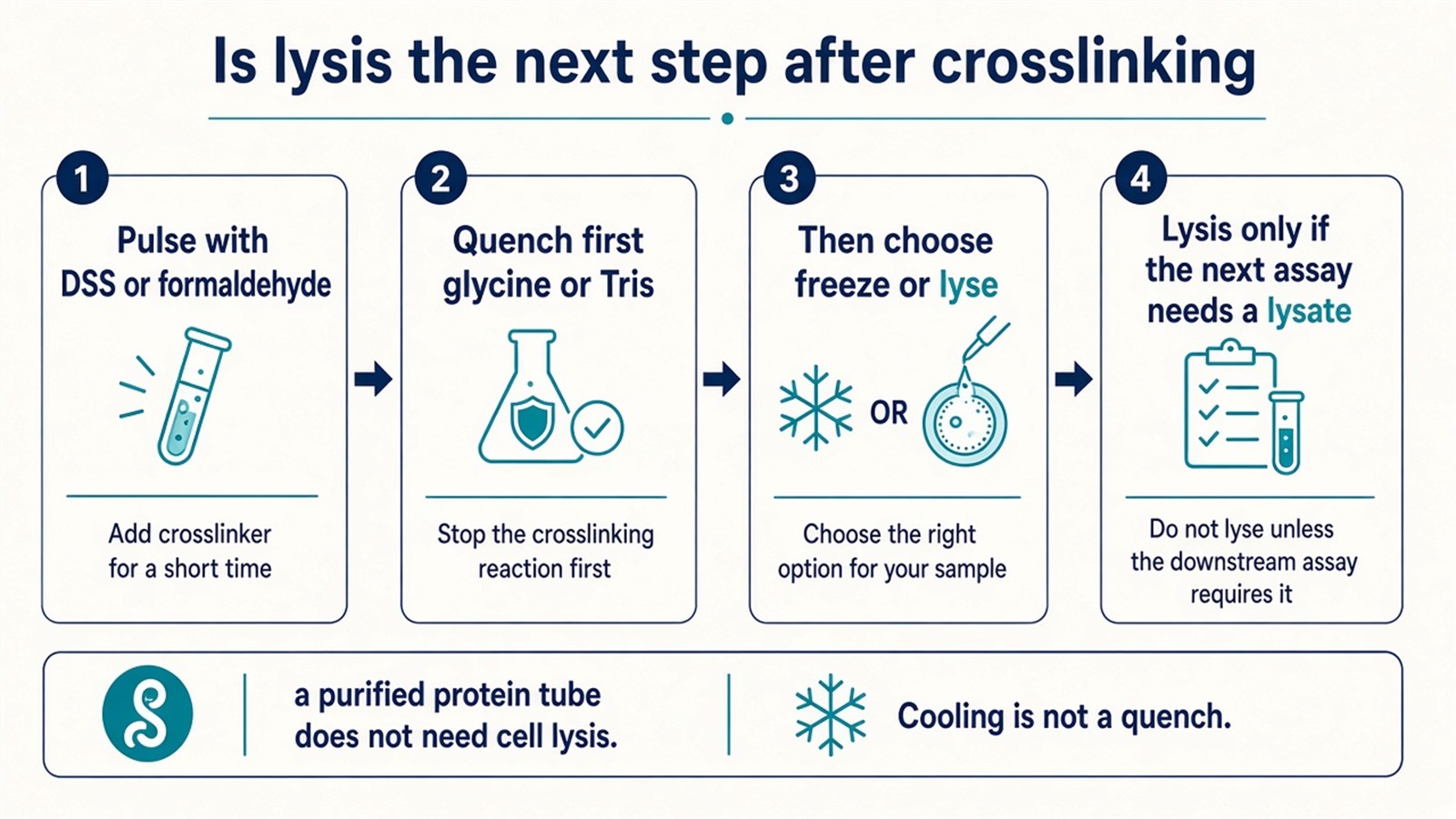
Figure 1. Pulse, then quench. Freeze or lyse after the stop. A purified-protein tube does not need a cell lysis.
Name the next assay before naming a lysis buffer. A recipe that extracts more protein is not a default after every pulse.
Match the Buffer to the Next Readout
The original list of buffers is kept as a menu. It is not a ranking. Cell type changes how hard the pellet is to open. The next assay decides which contacts may be destroyed.
RIPA buffer remains a harsh mix of NP-40, sodium deoxycholate, and SDS plus salt. It solubilizes membranes and many proteins that stay in a milder pellet, including membrane-associated species. It does not extract a complete proteome from every tissue, and it does not preserve crosslinked complexes. The covalent links hold the pairs. For the Yes-if on this one recipe, Should Cells Be Lysed with RIPA Buffer Following Crosslinking in Protein Interaction Analysis? provides a complementary RIPA page.
NP-40 or Triton buffer remains the milder first choice when the next step is immunoprecipitation. After DSS or formaldehyde, that milder detergent is often enough because the links already hold a contact through a wash that would empty an uncrosslinked Co-IP. It is less effective than RIPA on some membrane proteins. That is a recovery trade, not a reason to pour SDS into every IP.
SDS lysis remains a denaturing extract. It disrupts non-covalent protein–protein interactions. It does not completely lyse all protein types. Insoluble pellets, chromatin, and heavily crosslinked assemblies can still remain after SDS. The usual use after a pulse is a shift Western or an XL-MS digest that can tolerate that detergent after cleanup. An antibody that was qualified in NP-40 often fails here.
High-salt lysis remains a tool for proteins with salt-sensitive occupancy, including some chromatin-associated species. It is an extra extraction, not a crosslinking default. High salt after a covalent pulse can strip partners that were never linked. It does not prove that what remains was a direct contact.
The three experimental methods that use a cross-link do not share one buffer. For that readout split, What Are the Specific Experimental Methods for Cross-Linking Protein Interaction Analysis provides a complementary methods page.
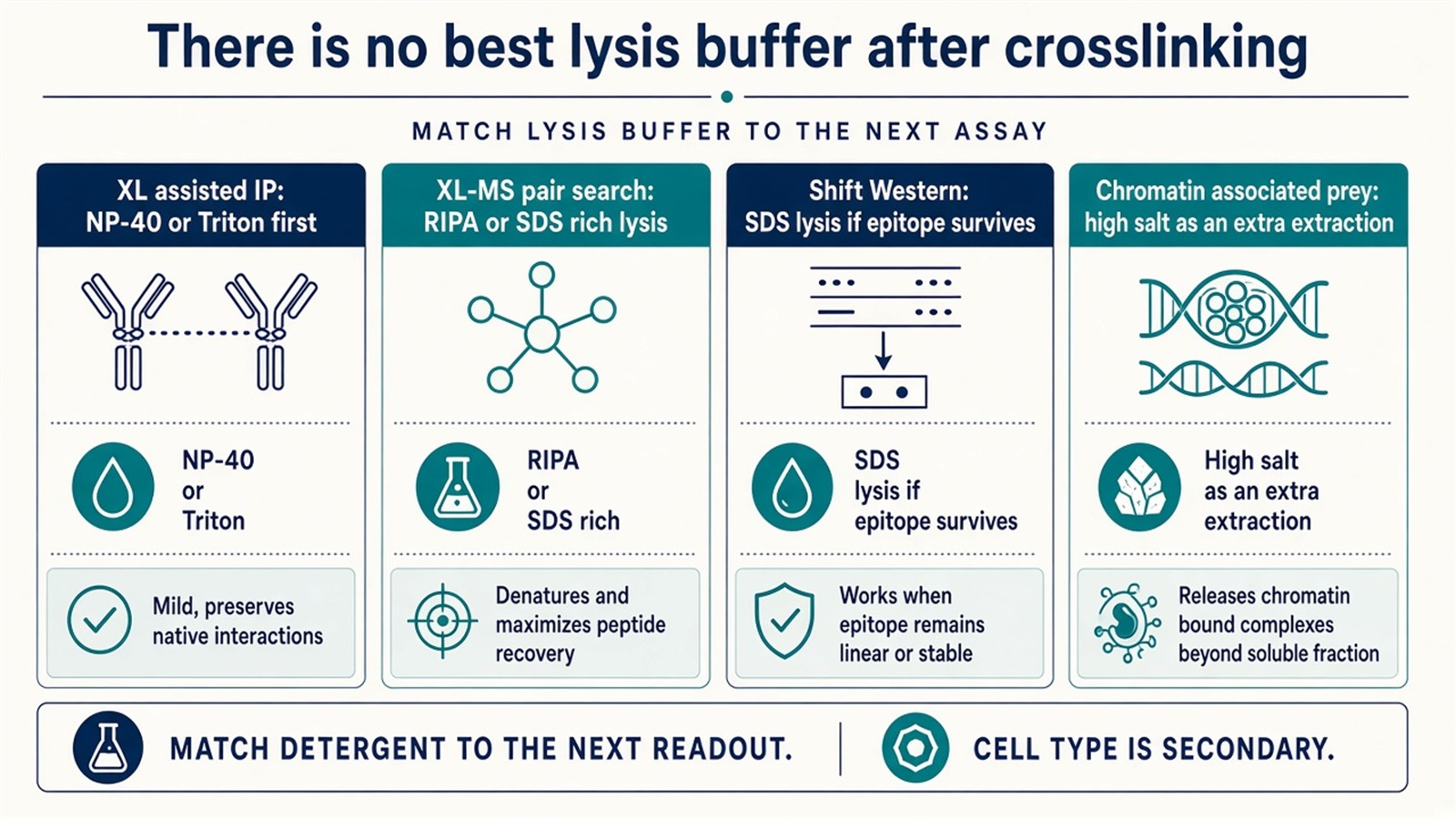
Figure 2. XL-assisted IP often starts with NP-40. A pair search can use RIPA or SDS. High salt is an extra extraction. The assay chooses.
What the Original Add-ons Do Not Fix
Protease and phosphatase inhibitors still go into the lysis buffer immediately before use. They protect against degradation and against loss of some modifications during extraction. They do not replace a quench, and they do not choose the detergent.
pH and ionic strength still matter. A commercial RIPA that already contains Tris is not a dedicated NHS quench. Residual amine in the bottle is leftover buffer, not a written stop.
Reducing agents such as DTT or β-mercaptoethanol are not a general stabilizer of interaction integrity after crosslinking. They unfold disulfide-dependent folds. They also cleave disulfide-containing reagents such as DSP. If the pulse used a thiol-cleavable linker, reductant is a chemistry decision, not a protection step.
Trichloroacetic acid precipitation is not a lysis buffer. TCA crashes protein from a solution that already exists. It does not open cells, it does not remove phosphorylation as a purpose, and it is not a method for enriching low-abundance interactors after a pulse. Phosphoproteins are often recovered in a TCA pellet, not stripped by it. Using TCA as item 5 on a lysis-buffer list answers a different laboratory job.
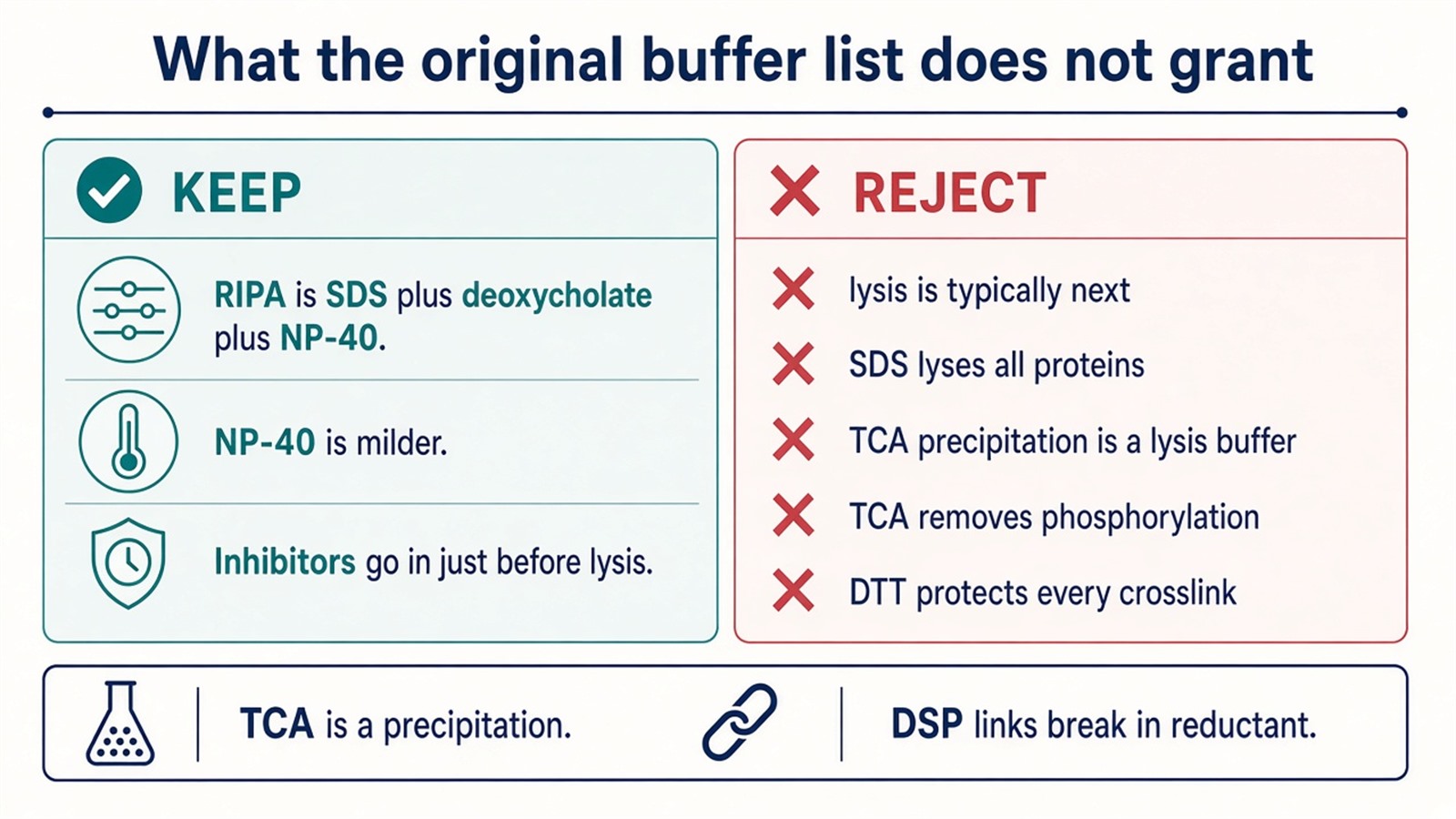
Figure 3. Keep: RIPA composition, milder NP-40, inhibitors just before lysis. Not granted: lysis as the typical next step, SDS as complete, TCA as a buffer.
Experimental Limits
Choosing a lysis after crosslinking reduces a pellet to what one quench, one detergent mix, and one next assay can report. A best-buffer sentence sits outside ordinary research reporting. Diagnostic completeness of the extract is not granted by naming RIPA, SDS, or high salt.
Project Planning and Service Scope
A usable plan names the pulse, the quench, whether the pellet will be frozen or lysed, and the claim that the detergent is allowed to destroy, before the first cells are opened. MtoZ Biolabs scopes crosslinking MS with Orbitrap-class LC-MS/MS. Interpretability still follows those arms, not a typical-lysis slogan.
Once the next sentence is an antibody pellet after a milder lysis rather than a residue-pair table, the project is crosslinking-assisted capture. Researchers who need that pellet can review the MtoZ Biolabs Co-IP-MS Protein Interaction Analysis Service for project-specific sample evaluation, feasibility assessment, and workflow planning.
Frequently Asked Questions
1. Is cell lysis the next step after protein crosslinking?
No. Quench first. Lyse only if the next assay needs a lysate. A purified-protein reaction does not need cell lysis.
2. What is the best lysis buffer after crosslinking?
There is not one. Match the detergent to the next readout.
3. When is NP-40 better than RIPA?
When the next step is an immunoprecipitation and the antibody fails in SDS or deoxycholate.
4. Is TCA precipitation a lysis buffer?
No. TCA crashes protein from a solution. It does not open cells.
5. Should DTT be added to protect crosslinked complexes?
Not as a default. Reductant can cleave disulfide-based linkers such as DSP.
Reference
- Leitner A., Walzthoeni T., Kahraman A., et al. (2014). Probing native protein structures by chemical cross-linking, mass spectrometry, and bioinformatics. Nat. Protoc., 9, 120-135. https://doi.org/10.1038/nprot.2013.168
- O'Reilly F.J., Rappsilber J. (2018). Cross-linking mass spectrometry: methods and applications in structural, molecular and systems biology. Nat. Struct. Mol. Biol., 25, 1000-1008. https://doi.org/10.1038/s41594-018-0147-0
- Yu C., Huang L. (2018). Cross-linking mass spectrometry: an emerging technology for interactomics and structural biology. Anal. Chem., 90, 144-165. https://doi.org/10.1021/acs.analchem.7b04431
- Klockenbusch C., Kast J. (2010). Optimization of formaldehyde cross-linking for protein interaction analysis of non-tagged integrin beta1. J. Biomed. Biotechnol., 2010, 927585. https://doi.org/10.1155/2010/927585
- Smith A.L., Friedman D.B., Yu H., Carnahan R.H., Reynolds A.B. (2011). ReCLIP (reversible cross-link immuno-precipitation): an efficient method for interrogation of labile protein complexes. PLoS One, 6, e16206. https://doi.org/10.1371/journal.pone.0016206
