



High background in a co-immunoprecipitation (Co-IP) assay is leftover signal that also appears, or would appear, in a matched control arm. It shows up as extra Western bands, a smear that hides the prey, or an IgG heavy chain that sits on the same molecular weight as the protein being read. Reducing that background is a diagnosis problem first. The useful first decision is which class of leftover signal is present: bead or tag binders, antibody-derived bands, the ~50 kDa IgG heavy chain, or collision artifacts from too much input or overexpression. Changing wash, antibody, and lysis at the same time makes the cleaner blot uninterpretable.
Protein–protein interactions (PPIs) still have to be recovered as wash-stable associations if Co-IP is the assay. A darker control lane is not proof that the interaction is false, and a cleaner bait lane after 500 mM NaCl is not proof that the remaining band is specific. Harsher chemistry removes weak true partners as well as bead binders. The optimization should change one variable, keep an IgG, bead-only, or empty-tag arm in the same batch, and stop when the prey disappears with the background.
Researchers who already have a Co-IP blot with a crowded control lane, an IP-grade antibody question, or a later mass-spectrometry plan can also review the MtoZ Biolabs Co-Immunoprecipitation Protein Interaction Analysis Service for project-specific feasibility and analysis planning.
What Constitutes Co-IP Background Signal?
Co-IP background signals primarily arise from four sources that should not be merged into one “nonspecific” label.
Nonspecific binding includes proteins that stick to the antibody, Protein A/G beads, the empty vector, or the epitope tag rather than to the bait.
Antibody-derived contamination includes serum proteins in unpurified polyclonal preparations and heavy-chain leakage from beads that were not covalently coupled.
IgG heavy-chain interference is a Western problem: the ~50 kDa heavy chain often migrates near the prey or the bait and is read as a specific band when the secondary antibody recognizes the IP antibody.
Non-physiological associations appear when input protein is excessive or when a strongly overexpressed tag creates collision partners that do not exist at endogenous occupancy.
A fifth class appears only after Co-IP-MS: recurrent contaminants that dominate an open identification list. Those proteins belong in a CRAPome-class annotation, not in a Western troubleshooting paragraph. For how the open list is generated after Co-IP, How to Combine Co-IP with Mass Spectrometry for Protein Interaction Analysis? provides a complementary coupling discussion.
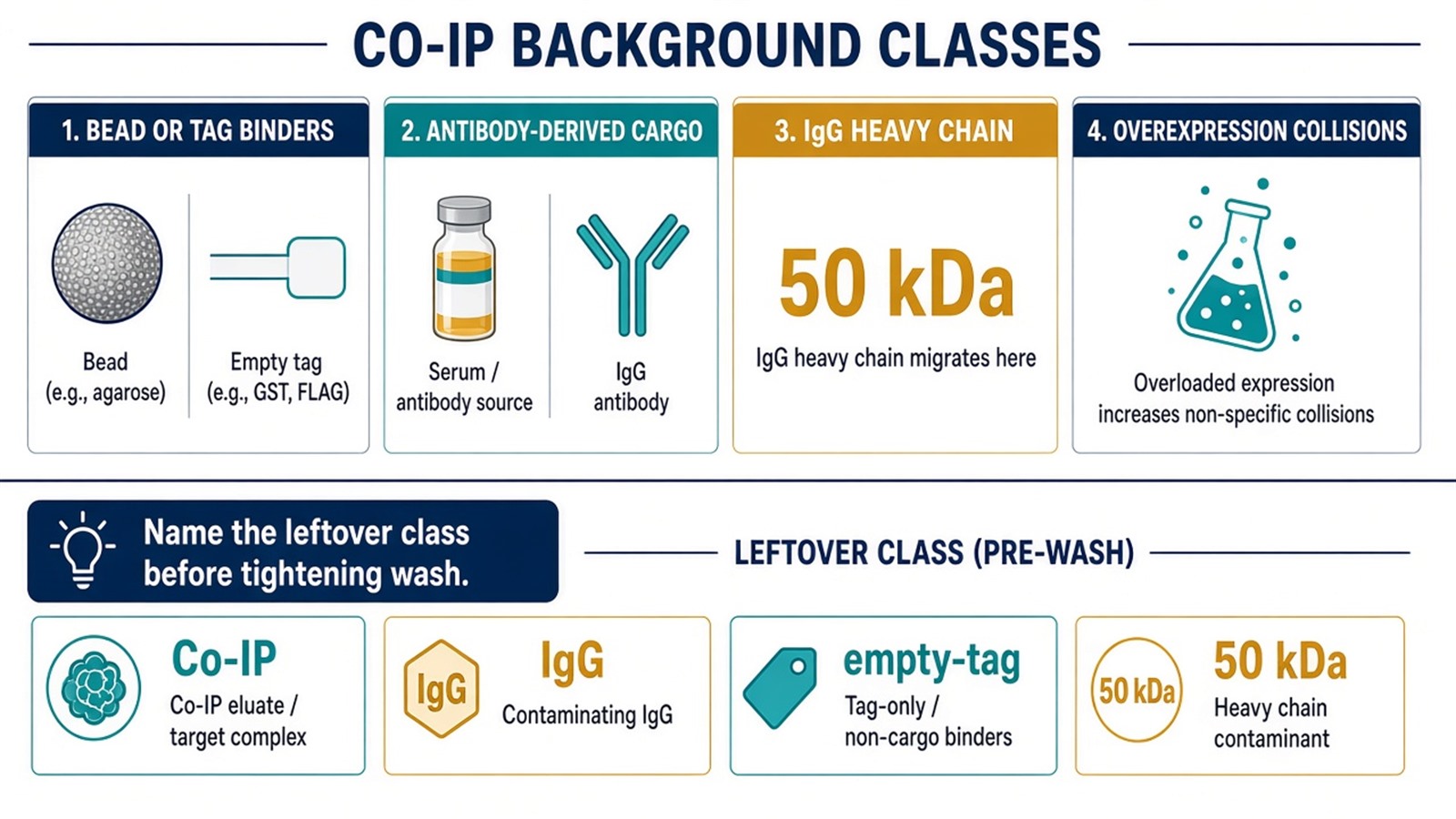
Figure 1. High background is leftover signal in a control-matched class: resin or tag binders, antibody cargo, the IgG heavy chain, or overexpression collisions.
Name the leftover class before tightening the wash. A harsher buffer cannot diagnose a heavy-chain band.
Optimization Across Five Experimental Levers
The live troubleshooting set below is retained. Each lever is a trade-off, not a specificity upgrade.
1. Antibody selection and quality control
Antibodies with weak affinity and unpurified sera generate extra bands because the resin is loaded with irrelevant IgG and serum proteins. Prefer an IP-validated monoclonal antibody or a purified preparation. Crosslinking the antibody to Protein A/G beads, for example with DMP or a similar coupling chemistry, reduces heavy-chain leakage into the eluate and is useful when the Western target sits near 50 kDa. An IgG isotype control processed with the bait assesses that antibody class. It models background. It does not eliminate nonspecific binding.
2. Inadequate or overly mild washing
Low salt and too few washes leave weak resin binders on the beads. Increasing NaCl toward 300–500 mM, adding 0.1–0.5% NP-40 or Triton X-100, and using more wash cycles, for example five or six times for several minutes, can clear those binders. The same steps also release wash-sensitive true partners. Raise ionic strength in steps and inspect bait and prey together. Wash temperature should stay near 4°C unless a separate stability check exists; a warmer wash is not a background method by itself.
3. Suboptimal lysis buffer
A buffer that is too mild, or that lacks protease and phosphatase inhibitors, can increase debris, degradation fragments, and sticky fragments that look like extra bands. NP-40–class lysis is the usual Co-IP starting point when the claim is a native-like complex. RIPA can lower some background and will also strip more true associations. Choose the buffer for the complex, not for the cleanest empty lane. Keep lysis on ice and keep the time short, commonly within 30 minutes, so that proteolysis does not create new fragments.
4. Excessive input or overexpression artifacts
High protein load and tag overexpression create collision partners and saturate the resin. Whenever the antibody allows it, repeat the Co-IP at endogenous expression. If a tag must be used, reduce transfection dose or move to a lower, stable expression model, and include an empty-vector or empty-tag arm. Swapping tags tests whether the extra band follows the fusion rather than the bait. For what remains an endogenous claim after those changes, How Can Endogenous Interactions Between Two Proteins Be Verified? provides a complementary native-versus-tagged discussion.
5. Inappropriate Western blot detection
A secondary antibody from the same species as the IP antibody will light up the IgG heavy chain. Light-chain-specific secondaries reduce that 50 kDa band. Direct HRP-conjugated tag antibodies, such as anti-HA-HRP, avoid a second layer when the bait is tagged. Stronger blocking, including 5% BSA when milk is dirty on that blot, can lower membrane background. Signal-enhancing reagents increase intensity of both specific and leftover bands; they are not a specificity tool.
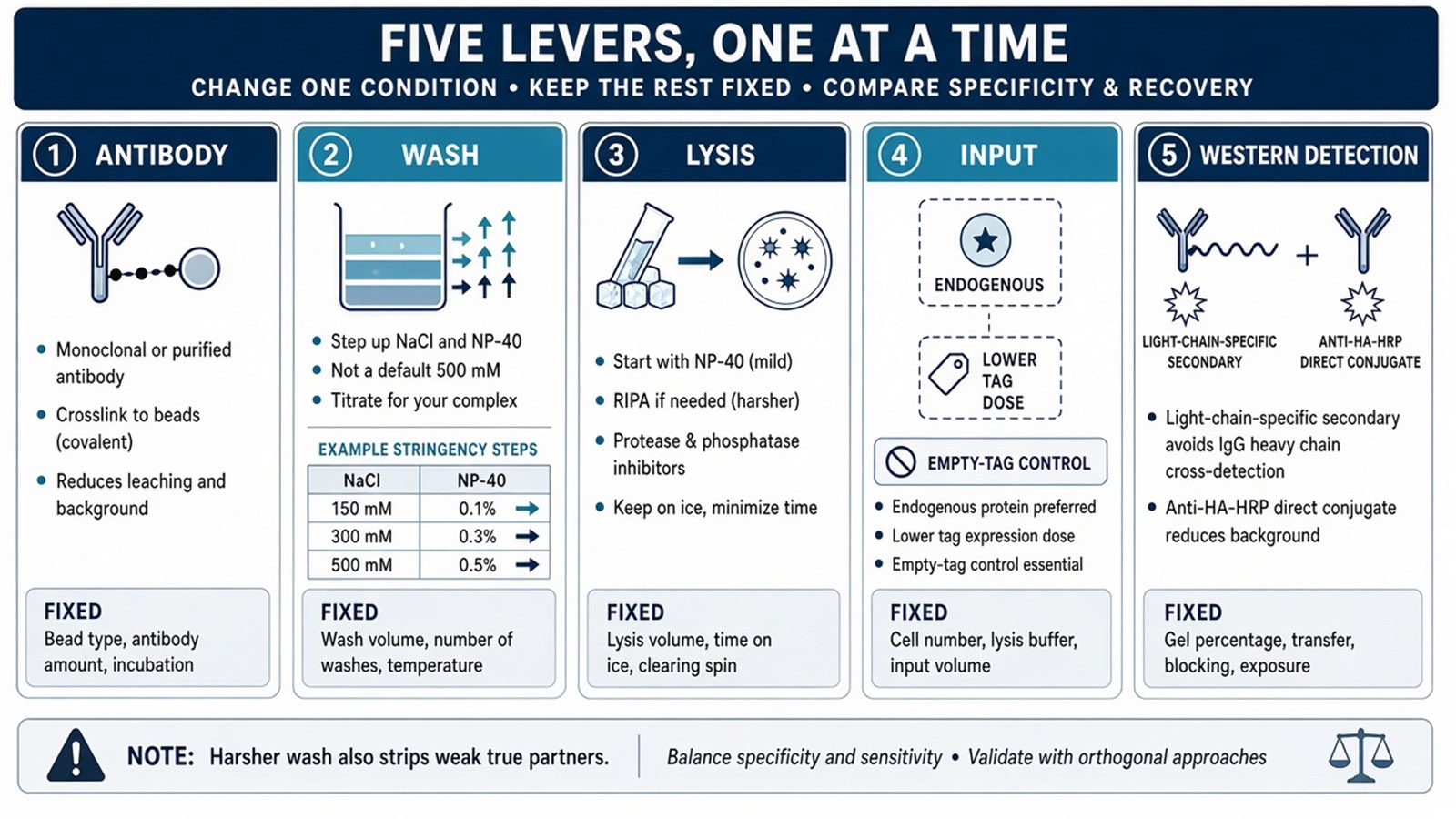
Figure 2. Antibody quality, wash stringency, lysis class, input amount, and blot detection each change a different leftover class. They should not be moved together.
Recommended Systematic Workflow for Reducing Co-IP Background
The empty workflow section on the original page is filled here as a single-variable loop.
Photograph or scan the bait IP, the prey blot, and the matched IgG, bead-only, or empty-tag arm on the same exposure.
Assign the leftover signal to one class: resin or tag binder, antibody cargo, heavy chain at ~50 kDa, or overexpression collision.
Change one lever that matches that class. Crosslink or replace the antibody for heavy-chain leakage. Step up salt or detergent for resin binders. Drop input or expression for collision bands. Switch to a light-chain-specific secondary for a 50 kDa Western artifact.
Repeat the same control arm in the same batch. If the prey vanishes with the background, the lost band may have been a wash-sensitive partner. Record that limit instead of calling the interaction disproven.
Pre-clearing lysates on empty beads can reduce some resin binders before the antibody is added. It does not replace the control lane.
Common Misconceptions and Practical Recommendations
Misconception 1: more washing will remove all proteins, so washes must stay mild.
Reality: some stable complexes survive higher salt. Many true partners do not. A blot that becomes empty after 500 mM NaCl is a stringency result, not a cleaner interactome.
Misconception 2: more tags make Co-IP more specific.
Reality: stacked tags add surface and can promote aggregation or extra bead contacts. One small tag plus an empty-tag control is usually clearer than a multi-tag stack.
Misconception 3: moving the eluate to IP-MS removes Western background.
Reality: IP-MS replaces a nominated blot with an open list. Bead binders become identifications rather than bands. Mass spectrometry is useful when the next table should be an inventory. It does not, by itself, make the capture more specific.
For control language that belongs with any affinity assay, How to Improve Reliability and Reproducibility of PPI Experimental Results provides a more detailed design discussion.
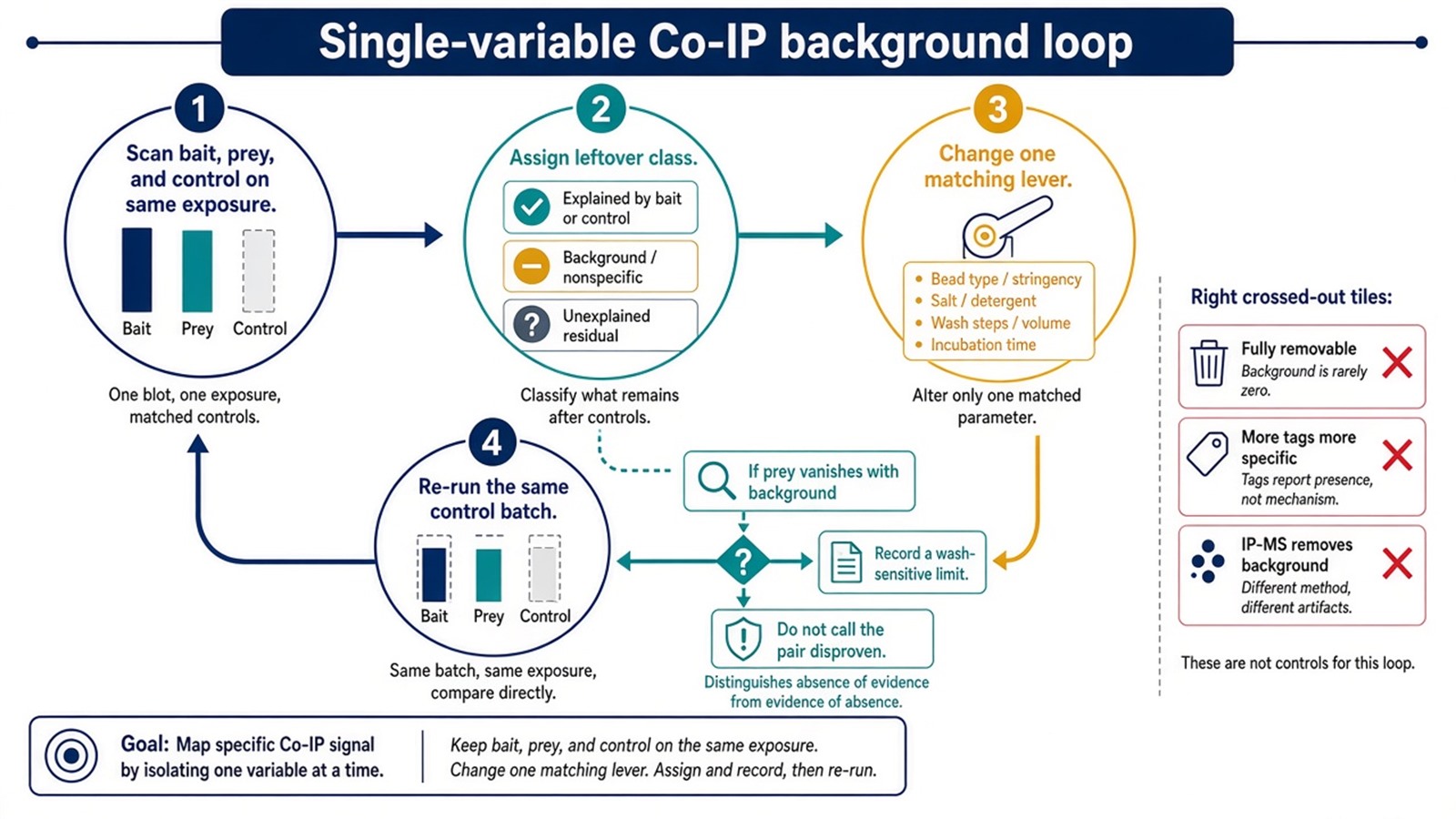
Figure 3. Classify the leftover signal, change one matching lever, and stop if the prey leaves with the background. A cleaner control lane is not automatic proof of a specific pair.
Experimental Limits
Background can be reduced. It is not fully removable. Some true interactions live inside the same intensity range as bead binders. RIPA, 500 mM NaCl, and multi-tag constructs each buy a cleaner lane at a cost. Diagnostic language sits outside ordinary Co-IP troubleshooting unless a separately validated assay framework is in place.
Project Planning and Service Scope
A usable background plan names the leftover class, the one lever to change, the matched control, and whether the readout stays Western or moves to Co-IP-MS. MtoZ Biolabs scopes antibody or tag Co-IP, wash and lysis matching, and Orbitrap-class LC-MS/MS when an open list is the next need. Recovery of a weak true partner still depends on not over-washing, not on calling the background problem solved.
Once the leftover class and the next lever are defined, the project can be scoped as a Co-IP optimization or a Co-IP-MS follow-up. Researchers can review the MtoZ Biolabs Co-Immunoprecipitation Protein Interaction Analysis Service for project-specific sample evaluation, feasibility assessment, and workflow planning.
Frequently Asked Questions
1. What is a high background signal in Co-IP?
It is leftover signal that belongs to a control-matched class: resin or tag binders, antibody cargo, the IgG heavy chain, or overexpression collisions. It is not every extra band on a long exposure.
2. Will 300–500 mM NaCl make the Co-IP specific?
It can clear some weak resin binders. It can also strip wash-sensitive true partners. Raise salt in steps and read bait, prey, and control together.
3. Does an IgG control eliminate nonspecific binding?
No. It models the antibody and bead background when it is processed with the bait. It reduces misreading. It does not erase contaminants.
4. Is RIPA better than NP-40 for lowering background?
RIPA is harsher. It often yields a cleaner empty lane and a smaller true-complex set. Use it when the remaining association is known to survive that buffer.
5. Does IP-MS solve Western heavy-chain background?
No. Heavy-chain interference is a blot-detection problem. IP-MS answers a different question: which proteins remain in the eluate as an open list.
Reference
- Lin J.S., Lai E.M. (2017). Protein-protein interactions: co-immunoprecipitation. Methods Mol. Biol., 1615, 211-219. https://doi.org/10.1007/978-1-4939-7033-9_17
- Bonifacino J.S., Dell'Angelica E.C., Springer T.A. (2001). Immunoprecipitation. Curr. Protoc. Immunol., Chapter 8, Unit 8.3. https://doi.org/10.1002/0471142735.im0803s41
- Mellacheruvu D., Wright Z., Couzens A.L., et al. (2013). The CRAPome: a contaminant repository for affinity purification-mass spectrometry data. Nat. Methods, 10, 730-736. https://doi.org/10.1038/nmeth.2557
- Gingras A.C., Gstaiger M., Raught B., Aebersold R. (2007). Analysis of protein complexes using mass spectrometry. Nat. Rev. Mol. Cell Biol., 8, 645-654. https://doi.org/10.1038/nrm2208
- Dunham W.H., Mullin M., Gingras A.C. (2012). Affinity-purification coupled to mass spectrometry: basic principles and strategies. Proteomics, 12, 1576-1590. https://doi.org/10.1002/pmic.201100523
