



Interpreting a pull-down result means deciding whether a prey was recovered with a tagged bait on an affinity resin, not whether two proteins bind in the cell. A pull-down uses glutathione S-transferase (GST), His, Strep, biotin, or another handle on beads. It is not an immunoprecipitation. Antibody capture is Co-IP or IP and is read by a different control set. The useful first decision is whether the bait is on the resin and whether the prey is reduced in a matched tag-only or empty-bead arm. Reading every Western band, or every mass-spectrometry (MS) identification, as an interactor is how a pull-down file is over-interpreted.
Band intensity is recovery under the stated wash. It is not interaction strength. An MS identification is a peptide-supported protein group in the eluate. It is not a functional annotation.
Researchers who already have a GST, His, or biotin pull-down blot or search file can also review the MtoZ Biolabs Pull-Down Assay Service for project-specific feasibility and analysis planning.
1. Verifying Experimental Conditions
Before ranking a prey, confirm that the experiment was a pull-down and that the bait was recovered. The resin must match the tag: GSH for GST, Ni-NTA or equivalent for His, streptavidin for biotin. A GST-only, empty-His, or bead-only arm must have been processed with the same prey and the same wash. Untreated cell extract is not a negative control. It is a missing-bait sample and cannot estimate tag or resin background.
Replicates test whether the same prey returns. They do not repair an unmatched wash or a missing tag-only lane. Input from the same lysate must show that bait and, for a nominated pair, prey were present. An empty input makes an empty pull-down uninterpretable. For how that assay is run before this reading step, What Is the General Procedure for GST Pull-Down Analysis of Protein–Protein Interactions? provides a complementary GST procedure. For the 293T transfection variant, Can GST Pull-Down and Western Blot Be Effectively Performed Following Transfection in 293T Cells? provides a complementary design check.
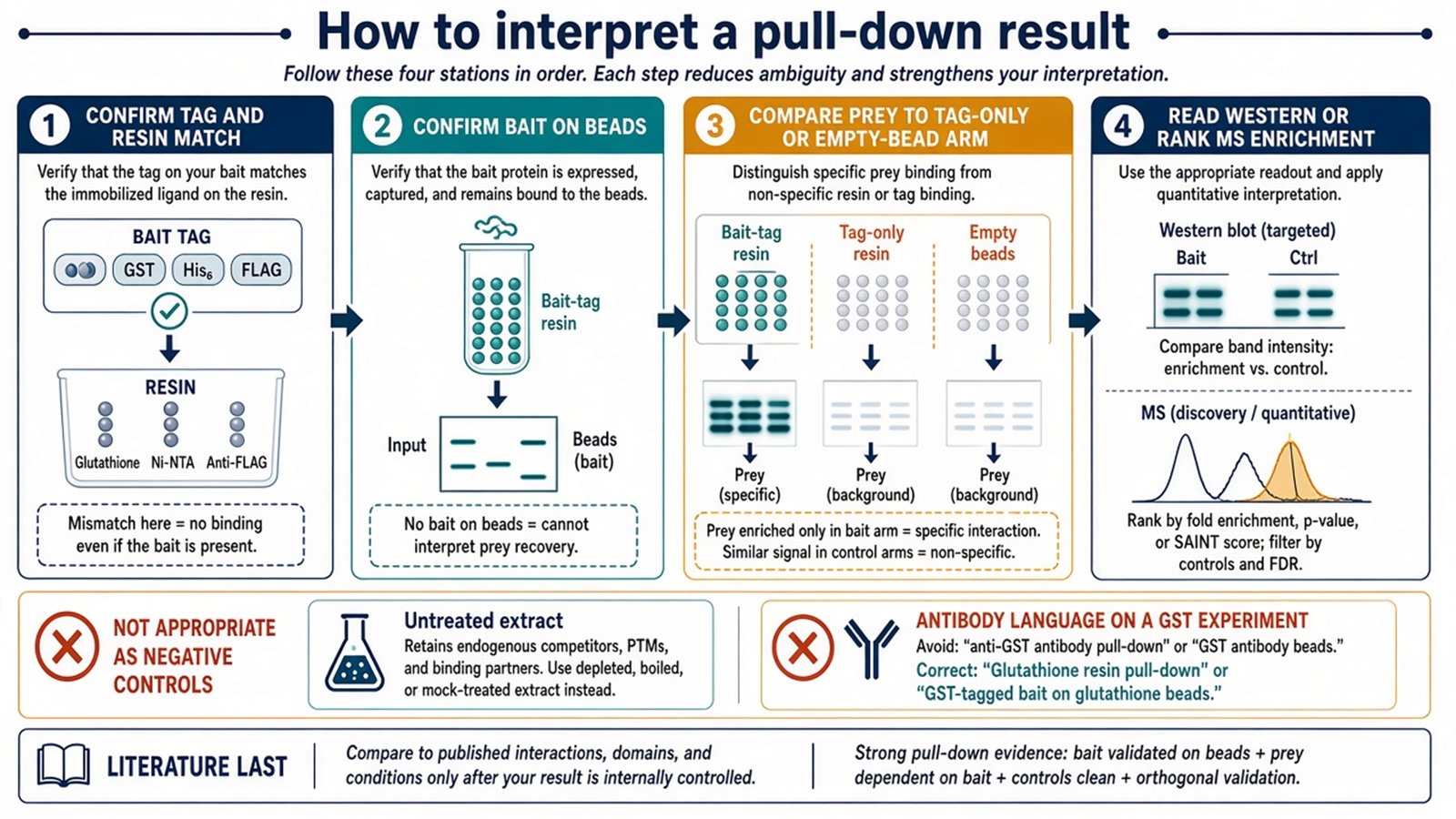
Figure 1. First confirm the tag, the resin, bait on the beads, and a tag-only or empty-bead arm. Then read the Western or the MS table. Literature comes last.
Inspect bait recovery first. A prey band without the bait is not a pull-down result.
2. Analyzing Experimental Results
Western blotting
Load input, bait pull-down, and tag-only (or empty-bead) eluate on one gel. The bait antibody or anti-tag blot must show recovery in the bait lane. The prey antibody is then compared across those lanes. A prey band in the bait lane and reduced or absent in tag-only, with both inputs positive, is bead-retained association. Comparing “banding patterns” does not measure a Kd. A darker band can mean more bait on the bead, more prey in the lysate, or a harsher elution, not a tighter contact.
Mass spectrometry
Digestion and LC-MS/MS open the eluate as protein groups with optional intensities. Rank prey by enrichment against the tag-only or bead-only arm. Do not delete every protein that appears in the control; some true partners have residual control intensity. Do not treat every bait-lane ID as a partner. MS reports identity in the eluate. It does not report function, pathway membership, or a complete complex. For a general enrichment-then-score order on an affinity-MS table, How to Analyze IP Mass Spectrometry Results? provides a complementary analysis sequence. For MS on a pull-down eluate as a service path, Pull Down based Protein Analysis Service with Mass Spectrometry provides a complementary identification discussion.
Other methods
Protein microarrays and structural assays are different measurements. They do not interpret the pull-down in hand. Use them only when the next sentence has already left the bead.
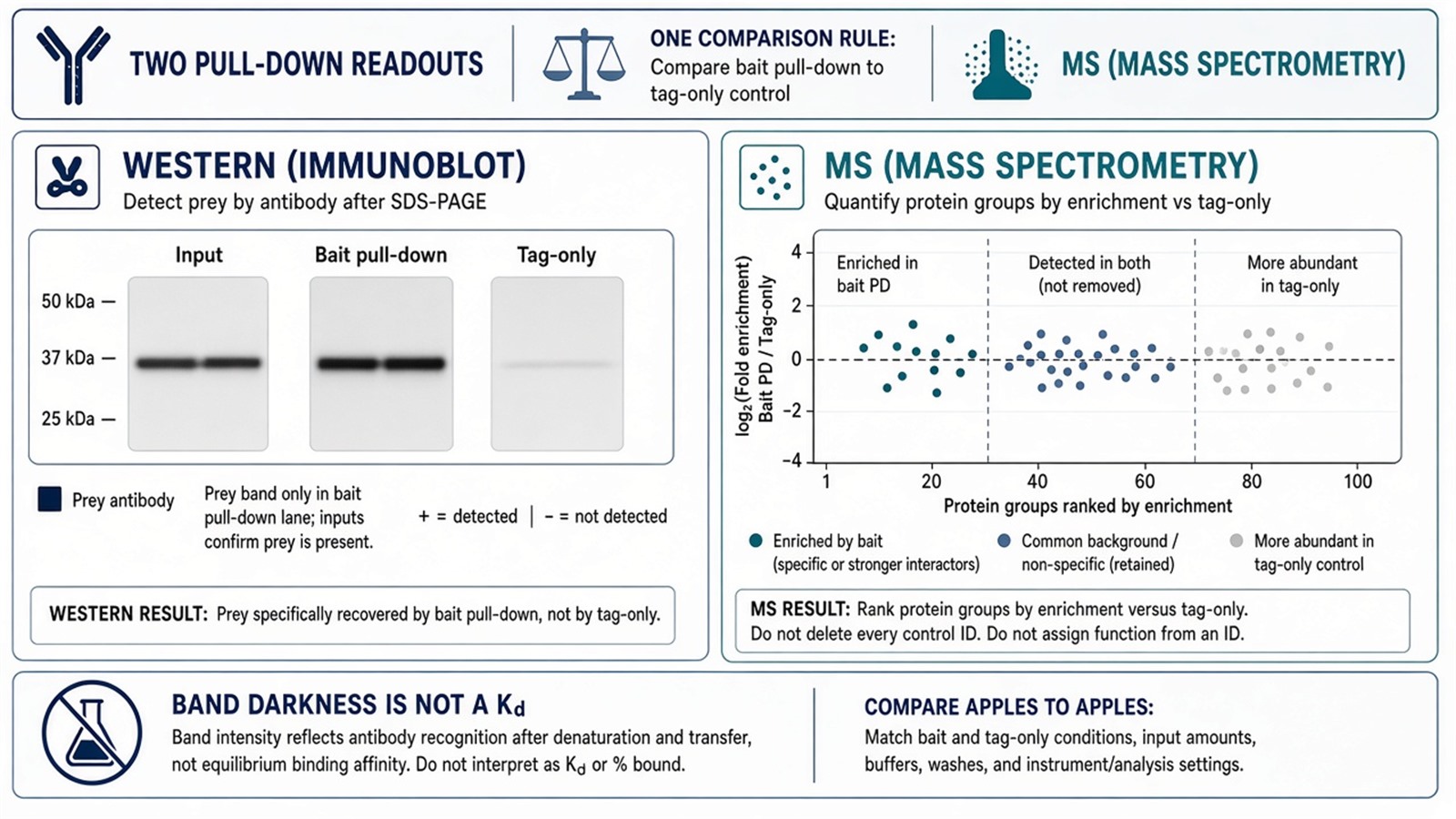
Figure 2. A nominated blot is a three-lane comparison. An open MS list is bait-versus-tag-only enrichment. Neither readout is interaction strength.
3. Confirming Result Specificity
Specificity in a pull-down is tag-dependence, not antibody-independence. Repeating the capture with a second antibody is Co-IP language. The matching pull-down checks are a second tag on the same bait, a GST-only or empty-handle arm, and empty beads.
A known partner used as a positive control shows that the bait can recover something. It does not validate every other band on that gel. Reciprocal pull-down or an endogenous Co-IP is an orthogonal capture. Colocalization shows overlap in a micrograph. It does not interpret the bead. For how Co-IP judges a different pellet, Workflow of Co-Immunoprecipitation for Protein Interaction Analysis provides a complementary cellular readout.
A lysate prey can be bridged. A purified prey is the stricter binary reading. Write which prey class was used before calling the result direct.
4. Integrating Literature and Biological Context
Literature is an overlay after the shortlist exists. A protein that is a known neighbor in a database is a hypothesis for the next assay. It is not confirmation that the current band was specific. Pathway annotation of an unfiltered MS list recreates the background as biology. Annotate after enrichment.
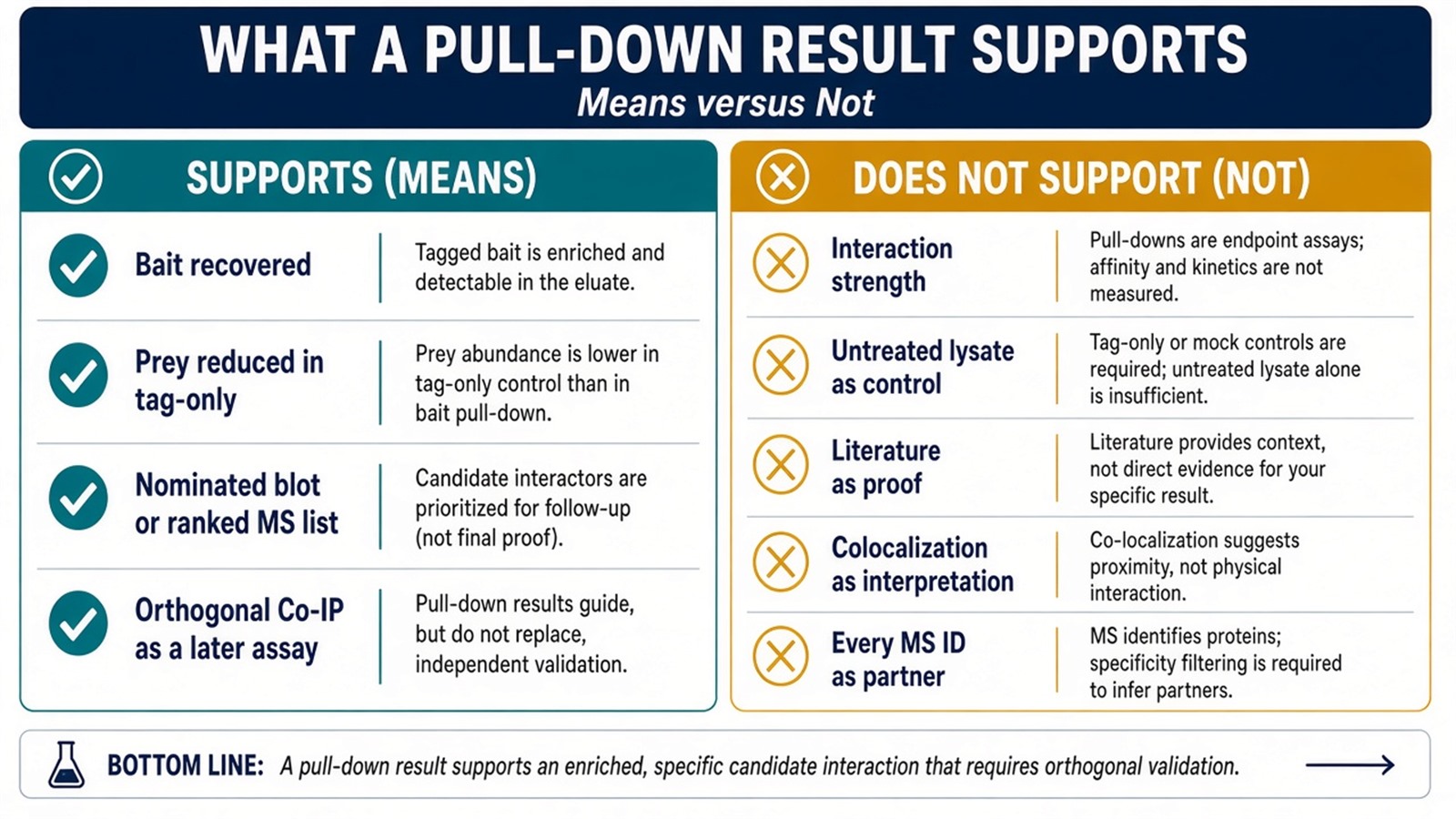
Figure 3. What a readable result supports: bait on resin, prey reduced in tag-only. What it does not: binding strength, in-cell proof, or validation by a pathway map.
Common Interpretation Mistakes
Calling the method a pull-down and then using IgG language, or the reverse.
Using untreated lysate as the negative arm.
Reading band darkness as affinity.
Treating every MS ID as a functional partner.
Using a known interactor to bless the rest of the gel.
Placing STRING or a review article ahead of the tag-only lane.
Experimental Limits
Interpretation reduces, rather than removes, tag and resin background. Three replicates do not repair a missing GST-only. Diagnostic language sits outside ordinary research reporting unless a separately validated assay framework is in place.
Project Planning and Service Scope
A usable interpretation plan names the tag, the control arm, the prey class, the readout (nominated Western or open MS), and the claim that will be allowed, before the file is opened. MtoZ Biolabs scopes GST and other tag pull-downs, Western, and LC-MS/MS on the eluate. Interpretability still follows bait recovery and the tag-only comparison, not the instrument name.
Once those lanes or that table exist, the project can be a nominated confirmation or an open partner list. Researchers who need GST-fusion capture after that reading rule can review the MtoZ Biolabs GST Pull Down Assay Service for project-specific sample evaluation, feasibility assessment, and workflow planning.
Frequently Asked Questions
1. How do I interpret a pull-down Western blot?
Confirm bait in the eluate, then ask whether the prey band is reduced in the tag-only lane while both inputs are positive. That is bead-retained association, not a Kd.
2. What is the correct negative control?
GST-only, empty-His, empty-Strep, or empty beads processed with the same prey. Untreated extract is not that control.
3. Does MS of a pull-down identify interacting proteins?
It identifies proteins in the eluate. Interaction language starts after enrichment against the tag-only arm.
4. Is a pull-down the same as Co-IP?
No. Pull-down is a tagged affinity capture. Co-IP is antibody capture. The control arms are not interchangeable.
5. Can literature confirm my pull-down?
It can prioritize the next assay. It cannot replace the tag-only comparison on this experiment.
Reference
- Vikis H.G., Guan K.L. (2004). Glutathione-S-transferase-fusion based assays for studying protein-protein interactions. Methods Mol. Biol., 261, 175-186. https://doi.org/10.1385/1-59259-762-9:175
- Einarson M.B., Pugacheva E.N., Orlinick J.R. (2007). GST Pull-down. CSH Protoc., 2007, pdb.prot4757. https://doi.org/10.1101/pdb.prot4757
- Phizicky E.M., Fields S. (1995). Protein-protein interactions: methods for detection and analysis. Microbiol. Rev., 59, 94-123. https://doi.org/10.1128/mr.59.1.94-123.1995
- Berggård T., Linse S., James P. (2007). Methods for the detection and analysis of protein-protein interactions. Proteomics, 7, 2833-2842. https://doi.org/10.1002/pmic.200700131
- Mellacheruvu D., Wright Z., Couzens A.L., et al. (2013). The CRAPome: a contaminant repository for affinity purification-mass spectrometry data. Nat. Methods, 10, 730-736. https://doi.org/10.1038/nmeth.2557
