



Reliability and reproducibility in protein–protein interaction (PPI) experiments are improved by treating non-specific binding, expression mismatch, and unmatched processing as design problems, not as after-the-fact software issues. Overexpressed baits can create non-physiological partners. Weak expression can hide real contacts. Lysis, wash, and storage drift can dissolve complexes that were present at harvest. Affinity assays such as co-immunoprecipitation (Co-IP) accumulate background that looks like signal if empty-vector, tag-only, or bead-only arms are missing. Yeast two-hybrid (Y2H) and affinity purification–mass spectrometry (AP-MS) also capture different interaction landscapes, so low cross-method overlap is expected until the claim and the scoring rule are aligned.
PPIs remain central to cellular signaling, metabolic regulation, and disease-mechanism work. Omics-scale screens make those networks easier to list and easier to over-read. A prey that appears once without a matched control, a SAINT-class score, or an orthogonal check is not yet a reproducible edge. The practical task is to write a design that another laboratory can repeat: the same bait format, the same lysis class, the same control set, and a declared confidence rule.
Researchers who already have a defined bait, control plan, or project objective can also review the MtoZ Biolabs Protein-Protein Interaction Analysis Service for project-specific feasibility and analysis planning.
Why PPI Experiments Often Fail to Reproduce
Five sources of failure recur across Co-IP, AP-MS, and Y2H. Inconsistent expression is the first. Overexpression of an exogenous bait can recruit partners that do not bind the endogenous protein, while insufficient expression yields weak or undetectable recovery. Sample-processing variability is the second. Small changes in lysis buffer, centrifugation, or storage temperature alter complex stability before any spectrometer is started. Non-specific binding is the third, especially on antibodies and affinity resins, where background can obscure genuine partners.
Method limitation is the fourth. Y2H reports pairwise reconstitution in a yeast nuclear environment. AP-MS reports proteins that survive capture and washing after lysis. Limited overlap between those tables is a chemistry difference, not automatic proof that one laboratory failed. The fifth source is analysis. Binary presence-or-absence calls, without a shared scoring system or a written threshold, produce lists that cannot be compared across sites.
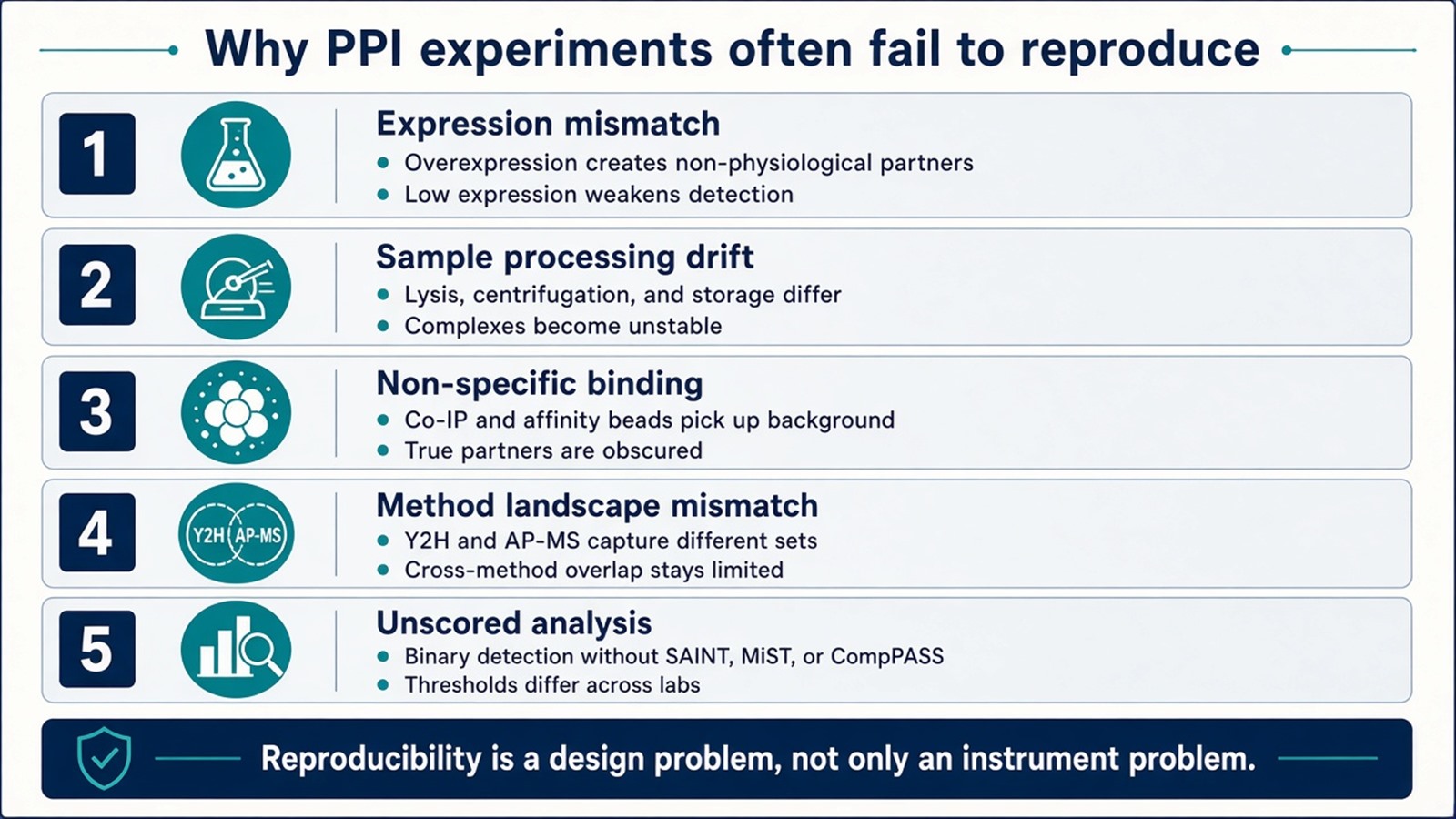
Figure 1. PPI reproducibility usually fails at expression, handling, background binding, method mismatch, or unscored analysis, not at the instrument name.
A PPI result is reproducible only when the bait format, processing, controls, and scoring rule can be restated and repeated.
Method-Specific Challenges That Affect Reliability
Method |
What a reproducible result can claim |
Typical reliability failure |
|---|---|---|
Co-IP |
Selected pairs that survive antibody capture and wash |
Antibody background; missing isotype or bead-only controls |
AP-MS |
Control-filtered co-purified proteins after LC-MS/MS |
Empty-tag or bead binders scored as interactors |
Y2H |
Pairwise reconstitution in yeast |
False positives; missing PTM- or membrane-dependent contacts |
BiFC or related cellular reporters |
Proximity or complementation in cells |
Overexpression artifacts; limited orthogonal MS support |
Database overlay (STRING, BioGRID, IntAct) |
Literature or predicted context |
Treating a database edge as sample-level proof |
These methods should not be forced into one interactome without stating what each captured. Cross-method validation is useful for priority candidates. It is a poor global quality metric when the landscapes were never designed to overlap.
Practical Strategies to Improve Reliability and Reproducibility
1. Optimization of experimental design
Small tags such as FLAG, HA, or Strep reduce the chance that the fusion itself creates a new surface. Systems that keep bait abundance closer to the endogenous level, including BAC-based expression, better approximate physiological occupancy than strong overexpression. Empty vectors, tag-only expression, known interacting pairs, and known non-interacting pairs are required to see non-specific binding rather than to decorate a figure. Independent biological replicates, commonly three, each processed separately, support statistical ranking. Three replicates improve robustness. They do not guarantee it if the control arm is unmatched or processed on a different day.
For which negative-control arms belong in an AP-MS design, researchers can refer to AP-MS Controls: Which Negative Controls Do You Need? for more detailed guidance.
2. Strict control of sample handling
Mild detergents that can preserve complexes, such as NP-40 or CHAPS, are preferred for native enrichment. SDS is generally avoided before capture unless the design is a denaturing step after crosslinking or a separate elution chemistry. Work is typically held at 4°C with protease inhibitors so that complexes are not digested during handling. Pre-clearing, higher-specificity antibodies or beads, and a written wash-and-elution series reduce background. Controls must share the same lysis, wash, bead lot, and timing as the bait arm. An unmatched control is not a background model.
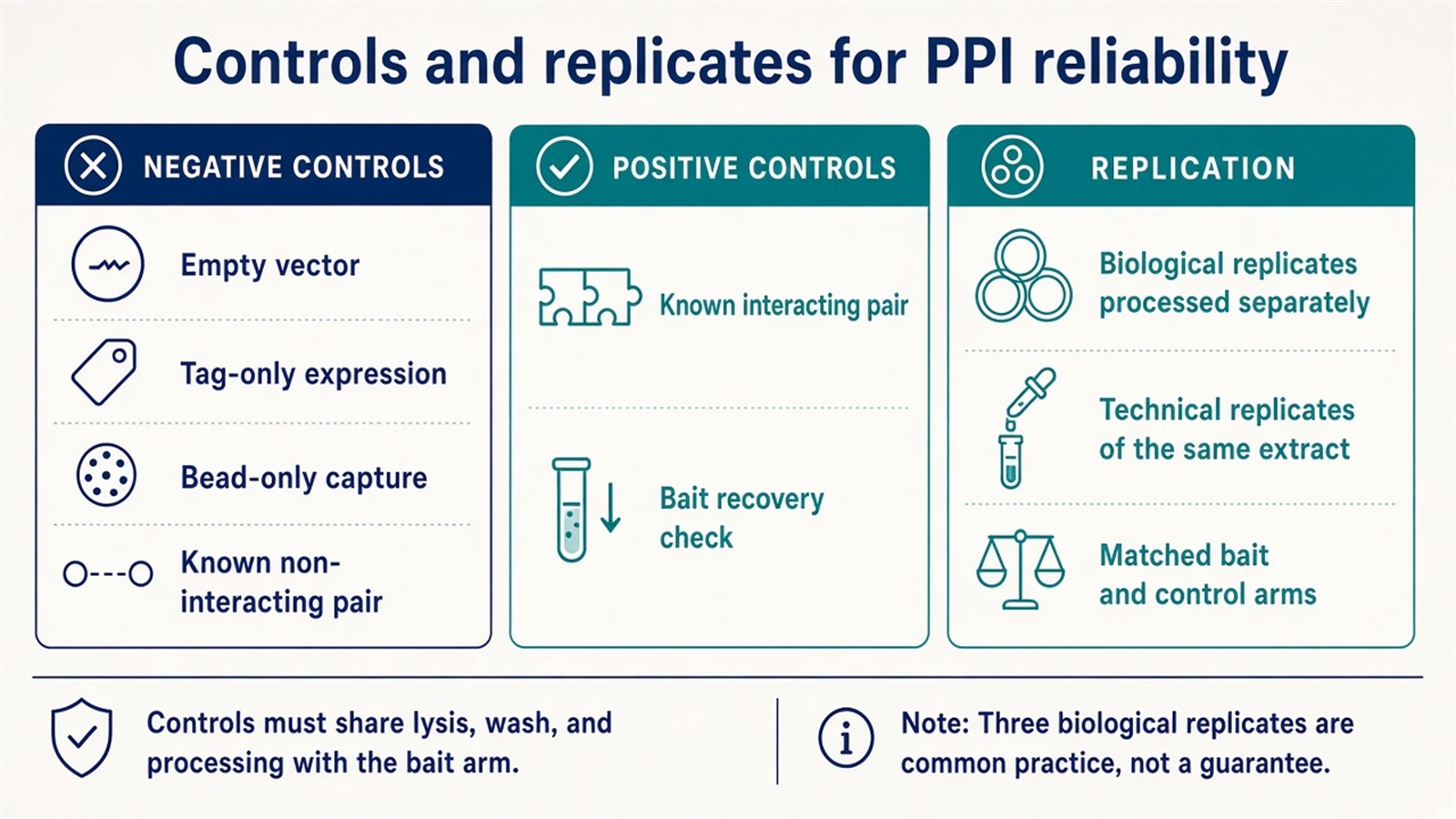
Figure 2. Empty-vector, tag-only, and bead-only arms must be processed with the bait; biological replicates are common practice, not a substitute for matched controls.
3. Multi-omics filtering and orthogonal checks
Mass spectrometry tables should be scored, not read as binary detection. SAINT, MiST, and CompPASS estimate interaction confidence against control distributions (Choi et al. 2011; Sowa et al. 2009). Proteins with extremely low or absent expression in the same cellular context are more likely to be contaminants or misassigned IDs. Transcriptomic or proteomic abundance can support that filter. It cannot rescue a missing control. Priority edges should then be checked by an orthogonal method, such as AP-MS followed by BiFC or Y2H, rather than by expanding one unscored list.
When background proteins dominate an AP-MS table, Why AP-MS Has Background Proteins: Controls and Filters provides a more detailed explanation of matched controls and enrichment filters.
Data Analysis and Visualization Recommendations
A usable processing path is sequential: clean identifications, quantify bait and prey, subtract or model background, score interactions, then build a network. Cytoscape can display the scored table. GO or KEGG enrichment can flag modules for follow-up. Enrichment against a pathway database is not independent proof that every edge in the module was recovered from the bait.
BioGRID, STRING, and IntAct are reference layers for consistency checks, not substitutes for the experimental score. A laboratory may write a project rule such as recovery in more than three independent replicates plus a SAINT probability above 0.9. That rule improves internal consistency when it is declared in advance. It is not a universal binding proof, and other score cutoffs are used when control depth or bait class changes.
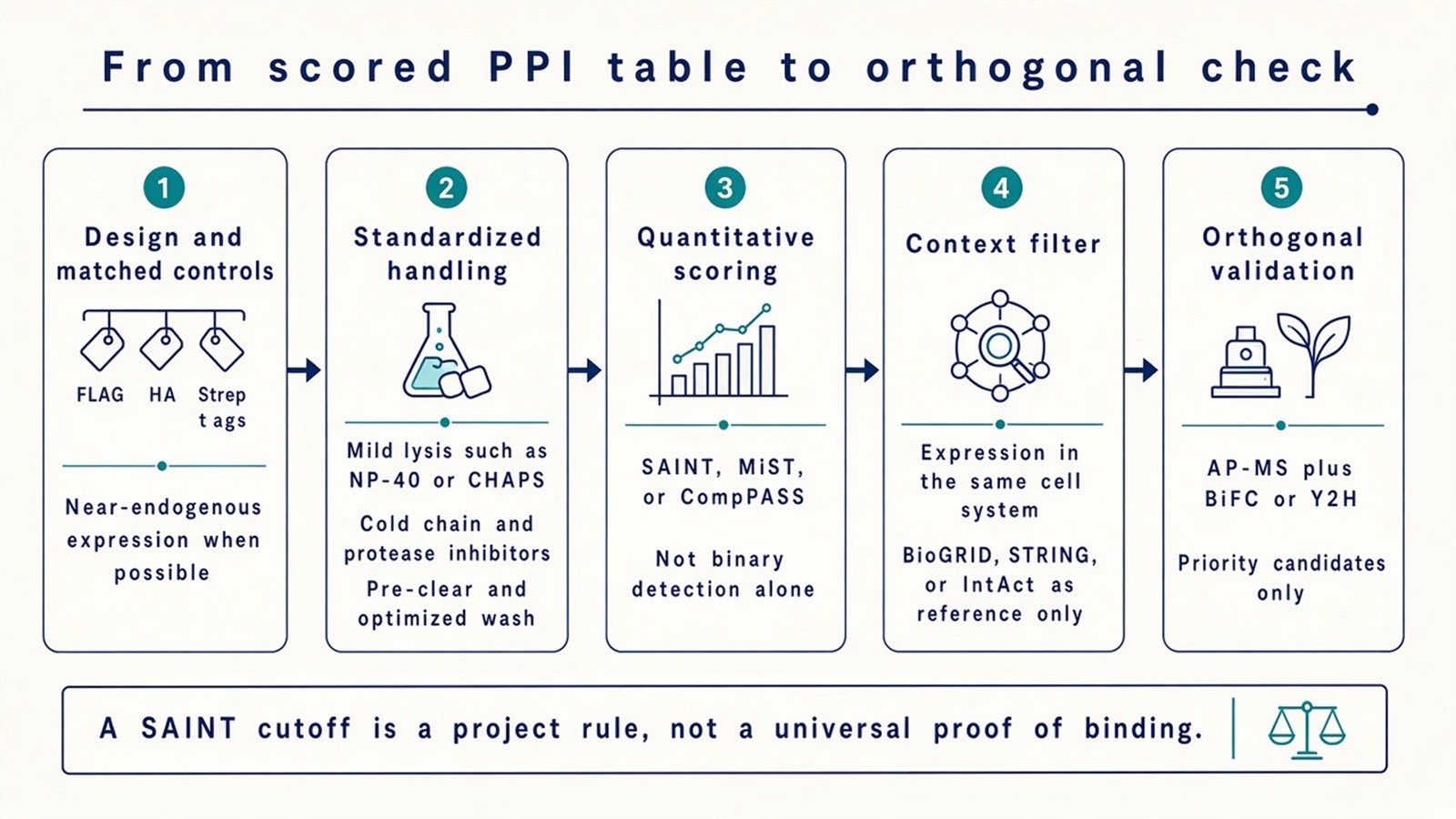
Figure 3. Reliability is built from matched controls and quantitative scoring; a SAINT cutoff is a project rule, and orthogonal checks stay reserved for priority candidates.
For how method families differ before a reproducibility plan is written, How to Analyze Protein–Protein Interactions provides a more detailed explanation of analysis claims and method fit.
Experimental Limits
No tag, detergent, or scoring algorithm removes every false positive. Near-endogenous expression can still miss low-stoichiometry partners. Harsh wash improves specificity and deletes weak true interactors. Cross-platform agreement will remain incomplete when Y2H, AP-MS, and BiFC measure different physical events. Database overlap can confirm that an edge was reported elsewhere. It cannot certify that the same edge existed in the lysate on the bench.
Diagnostic or companion-diagnostic claims sit outside ordinary research PPI reporting unless a separately validated assay framework is in place.
Project Planning and Service Scope
A high-confidence PPI plan names the bait format, expression level, control set, replicate structure, lysis class, scoring method, and which candidates will enter orthogonal validation. MtoZ Biolabs can scope that path from sample preparation and affinity purification through LC-MS/MS and scored interpretation. Platform resolution does not replace unmatched controls or an undeclared threshold.
Once the control set and scoring rule are defined, the project can be scoped as a reproducibility-focused PPI study. Researchers can review the MtoZ Biolabs Protein-Protein Interaction Analysis Service for project-specific sample evaluation, feasibility assessment, and workflow planning.
Frequently Asked Questions
1. Does running three biological replicates make a PPI list reliable?
Three separately processed biological replicates are common practice and support ranking. They do not repair an unmatched control arm or a binary, unscored table.
2. Why do Y2H and AP-MS lists overlap poorly even in careful laboratories?
The methods capture different physical events. Limited overlap is expected until priority candidates are tested by a method that matches the intended claim.
3. Is a SAINT score above 0.9 required for every AP-MS study?
No. Some groups use that value as an internal rule together with replicate recovery. The cutoff must match control depth and bait class. It is not a universal proof of binding.
4. Should SDS be banned from every PPI lysis?
SDS is generally avoided when the goal is to keep native complexes intact before capture. Denaturing steps can still appear after crosslinking or during a declared elution chemistry.
5. Can STRING or BioGRID replace experimental controls?
No. Those databases help interpret and prioritize. Sample-level confidence still comes from matched controls, scores, and orthogonal checks.
Reference
- Choi H., Larsen B., Lin Z.Y., et al. (2011). SAINT: probabilistic scoring of affinity purification-mass spectrometry data. Nat. Methods, 8, 70-73. https://doi.org/10.1038/nmeth.1541
- Sowa M.E., Bennett E.J., Gygi S.P., Harper J.W. (2009). Defining the human deubiquitinating enzyme interaction landscape. Cell, 138, 389-403. https://doi.org/10.1016/j.cell.2009.04.042
- Mellacheruvu D., Wright Z., Couzens A.L., et al. (2013). The CRAPome: a contaminant repository for affinity purification-mass spectrometry data. Nat. Methods, 10, 730-736. https://doi.org/10.1038/nmeth.2557
