



After a crosslinker is added, the next written move is to stop the reaction, then decide whether the pellet is frozen or lysed. Cooling the cells to 4 °C slows kinetics. It does not quench formaldehyde or an NHS ester such as disuccinimidyl suberate (DSS). Flash-freezing an unquenched pellet stores a reaction that is still running. The original glycine example remains a formaldehyde-handling sequence. It is not the common protocol for every protein-crosslinking experiment.
Formaldehyde is one in-cell reagent. DSS is the other reagent that appears in most residue-pair work. Glycine consumes leftover formaldehyde. An amine buffer such as Tris consumes leftover NHS ester. The two quenches are not interchangeable slogans. A purified-protein or lysate sample follows the same stop-then-store rule. There the wash step is often a buffer exchange or a spin, not a cell rinse. Leaving an NHS ester in the tube to hydrolyze is not a written quench. For the route that comes before this handling block, What Is the Protocol for Crosslinking-Based Protein Interaction Analysis? provides a complementary protocol page.
Researchers who already have a quenched pellet and need a residue-proximity or partner table can also review the MtoZ Biolabs Protein-Protein Interaction Analysis Service for project-specific feasibility and analysis planning.
Stop the Reagent Before the Pellet Is Stored
The handling order is quench, wash if the cells are still intact, then freeze or lyse. A no-crosslinker arm is handled with the same quench, the same wash, and the same freeze-or-lyse choice. Changing only the crosslinked sample mixes a handling effect with a reagent effect. For those arms, What Controls Are Needed for Co-IP-MS and In-Cell Crosslinking MS? provides a complementary control page.
Glycine after formaldehyde remains the original example. Glycine is added, leftover formaldehyde is consumed, and the cells are washed to remove residual glycine and formaldehyde. The wash is a residual-reagent step. It is not a purification of complexes.
Tris after DSS is the matching NHS-ester stop. Some laboratories use glycine for DSS as well because it is also an amine. Rapid cooling can sit next to either quench. It does not replace either quench. For which reagent was added in the first place, How to Select a Crosslinker for XL-MS Structural Studies provides a complementary selection page.
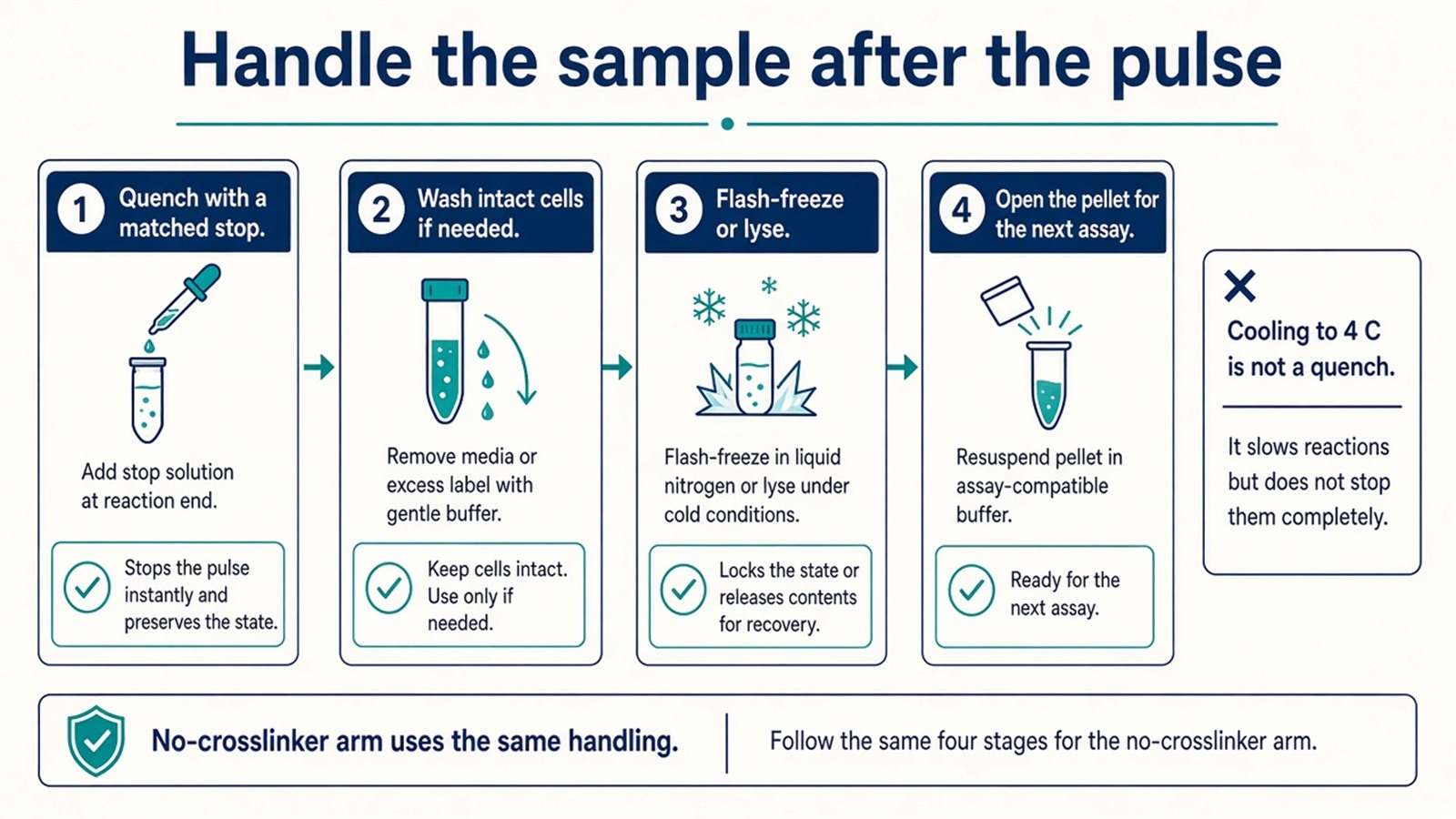
Figure 1. Quench first. Formaldehyde uses glycine. DSS uses an amine such as Tris. Cooling slows the reaction. Flash-freeze only after the stop.
Write the quench before the freezer. A 4 °C transfer is not a stop.
Freeze or Lyse, Then Open the Pellet
Once the reagent is stopped, the cells can be flash-frozen or lysed immediately. Both options are handling choices. They are not two biological states. A frozen quenched pellet can be lysed later in the same buffer that would have been used on the fresh pellet.
The original RIPA-or-NP-40 sentence remains a lysis decision, not a handling default. RIPA is a harsh mix. NP-40 is milder. The next assay decides. For that Yes-if, Should Cells Be Lysed with RIPA Buffer Following Crosslinking in Protein Interaction Analysis? provides a complementary lysis page.
Mechanical disruption or sonication can help open a crosslinked pellet that resists detergent. Sonication also heats. Heat is a variable for formaldehyde, which is partly reversible. A short, cooled burst is a disruption step. It is not a homogenization that guarantees a complete extract.
Centrifugation after lysis clarifies debris. The supernatant is not automatically the protein sample. Crosslinked assemblies can pellet. Discarding the debris without a written check can discard the pairs the pulse was meant to capture. For liquid chromatography–tandem mass spectrometry (LC-MS/MS) of residue pairs, the extract that is searched is the one that was kept, not the one that looked clearer. If the next assay is an immunoprecipitation, the same spin is a clarification, not a proof that leftover reagent has been removed. Residual formaldehyde or NHS ester in a cloudy supernatant can still mark proteins after the cells are already open.
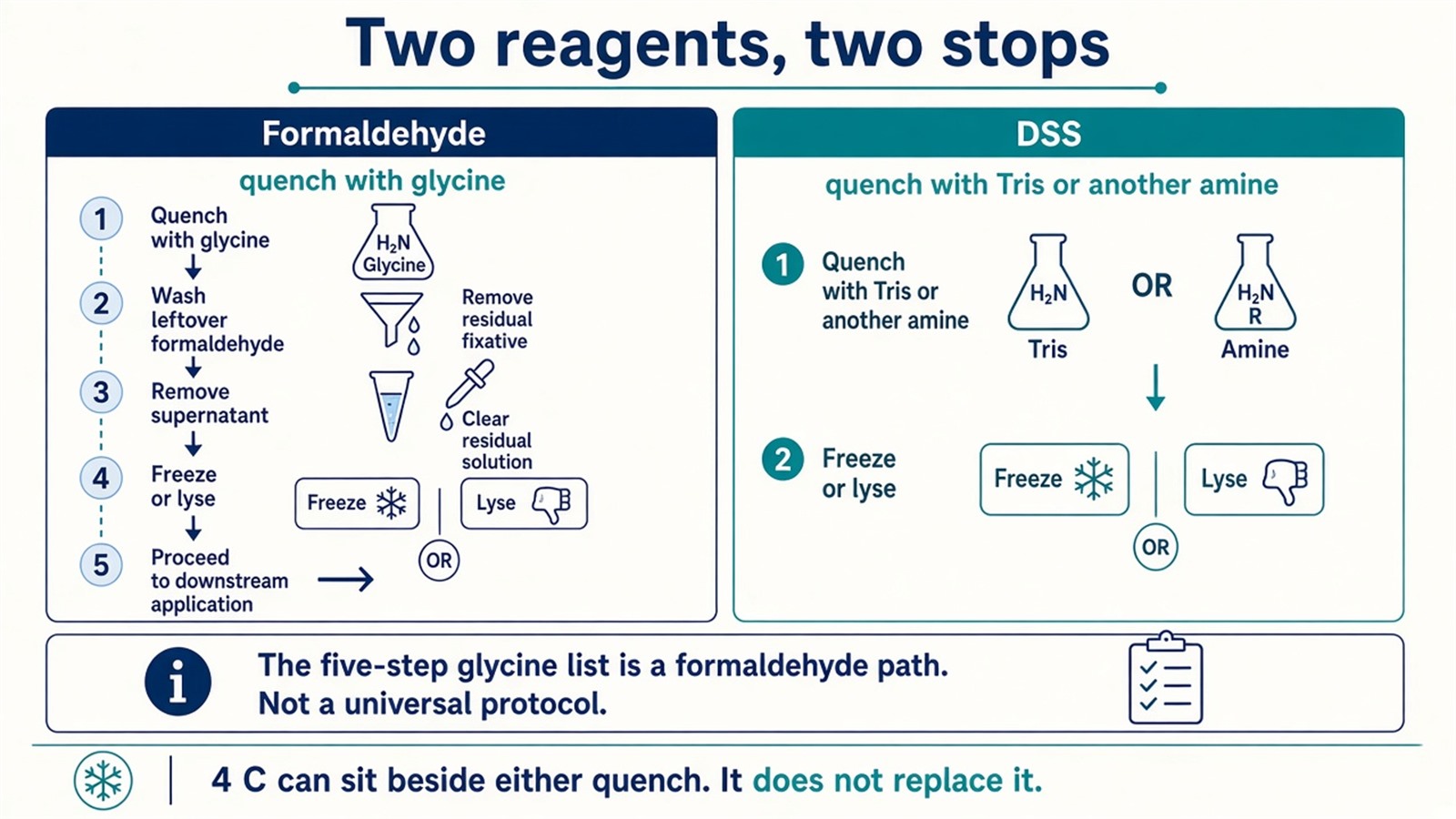
Figure 2. Two chemistries, two stops. The five-step glycine list is a formaldehyde sequence. DSS does not become formaldehyde by adding glycine later.
What the Original Five Steps Can Support
The original numbered list is kept as a formaldehyde-then-glycine handling path:
- Add glycine to consume leftover formaldehyde.
- Wash to remove residual glycine and formaldehyde.
- Resuspend in a lysis buffer chosen for the next assay.
- Disrupt the pellet if detergent alone does not open it.
- Clarify, then keep the fraction that will be searched or captured.
Those five steps are not a commonly used protocol for every design. A DSS pulse that is cooled, frozen unquenched, lysed in RIPA because RIPA is listed, sonicated until clear, and spun hard enough to drop large assemblies is a different experiment.
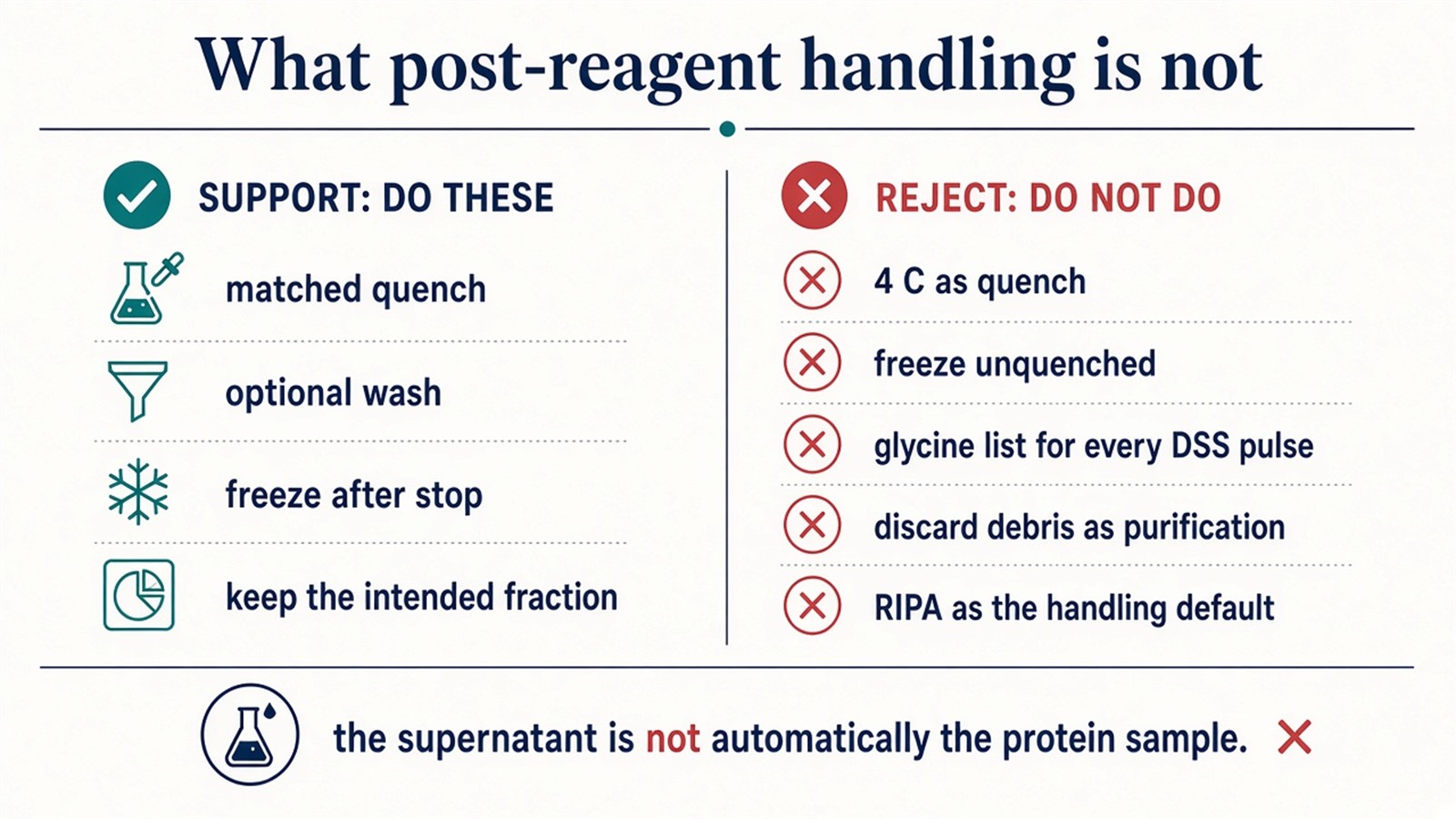
Figure 3. Supported: matched quench, optional wash, freeze or lyse, keep the intended fraction. Not granted: 4 °C as quench, unquenched freeze, or supernatant as the complete proteome.
Experimental Limits
Post-reagent handling reduces a pulse to what one quench, one wash, and one freeze-or-lyse choice can report. Diagnostic language sits outside ordinary research reporting unless a separately validated assay is in place.
Project Planning and Service Scope
A usable handling plan names the reagent, the matched quench, whether the pellet is frozen, and the claim that will be allowed, before the first stop. MtoZ Biolabs scopes crosslinking and interaction MS with Orbitrap-class LC-MS/MS. Interpretability still follows those arms, not a glycine-or-cool slogan.
Once the next sentence is a residue-pair table rather than a handling note, the project is crosslinking MS. Researchers who need that table can review the MtoZ Biolabs Crosslinking Mass Spectrometry Protein Interaction Analysis Service for project-specific sample evaluation, feasibility assessment, and workflow planning.
Frequently Asked Questions
1. What should be done immediately after adding a crosslinker?
Stop the reagent with a matched quench. Then wash if the cells are intact, then freeze or lyse.
2. Does cooling to 4 °C quench the reaction?
No. It slows the reaction. Formaldehyde still needs glycine. DSS still needs an amine.
3. Can cells be flash-frozen after crosslinking?
Yes, after the quench. An unquenched frozen pellet continues to react.
4. Is the glycine five-step list the standard protocol?
It is a formaldehyde-handling path. DSS is stopped with Tris or another amine and does not become that list.
5. Should the debris pellet always be discarded?
No. Crosslinked assemblies can sediment. Keep the fraction that the next assay will read.
Reference
- Leitner A., Walzthoeni T., Kahraman A., et al. (2014). Probing native protein structures by chemical cross-linking, mass spectrometry, and bioinformatics. Nat. Protoc., 9, 120-135. https://doi.org/10.1038/nprot.2013.168
- Klockenbusch C., Kast J. (2010). Optimization of formaldehyde cross-linking for protein interaction analysis of non-tagged integrin beta1. J. Biomed. Biotechnol., 2010, 927585. https://doi.org/10.1155/2010/927585
- O'Reilly F.J., Rappsilber J. (2018). Cross-linking mass spectrometry: methods and applications in structural, molecular and systems biology. Nat. Struct. Mol. Biol., 25, 1000-1008. https://doi.org/10.1038/s41594-018-0147-0
- Yu C., Huang L. (2018). Cross-linking mass spectrometry: an emerging technology for interactomics and structural biology. Anal. Chem., 90, 144-165. https://doi.org/10.1021/acs.analchem.7b04431
- Smith A.L., Friedman D.B., Yu H., Carnahan R.H., Reynolds A.B. (2011). ReCLIP (reversible cross-link immuno-precipitation): an efficient method for interrogation of labile protein complexes. PLoS One, 6, e16206. https://doi.org/10.1371/journal.pone.0016206
