



How to detect protein and small molecule interactions is a method-choice question. The original five routes remain usable if each is read as a different physical file: mass spectrometry (MS), a precipitation or bead recovery, surface plasmon resonance (SPR), nuclear magnetic resonance (NMR), and Förster resonance energy transfer (FRET). Those files can report a mass shift, a retained protein, a refractive-index change, a chemical-shift or saturation transfer, or energy transfer between two labels. They do not form one ranked menu of advantages, and they do not, as a set, study protein–small-molecule interactions.
A force name is a different page. Electrostatics, hydrogen bonds, and stacking describe what can operate in a pocket. They are not detection methods. Researchers who already have a soluble protein and a compound and need a kinetic file can review the MtoZ Biolabs Surface Plasmon Resonance (SPR) Analysis Service for project-specific immobilization and sensorgram planning.
Five Routes, Five Files
Mass spectrometry
The original MS paragraph mixes two experiments. Cross-linking mass spectrometry (XL-MS), as used on this site for protein–protein work, reports residue proximity after a bifunctional reagent. It is not particularly useful as a default map of protein–small-molecule contact points. A photoaffinity or ligand-directed covalent mark is a different chemistry and still names a modified peptide, not a non-covalent site.
A mass change of an intact protein can be read when the complex survives ionization. That is a native or intact-mass file. Occupancy in that file is not binding information in the kinetic sense, and a missing adduct does not prove that the compound failed to bind in solution. For the intact-mass arm, Native Mass Spectrometry Analysis Service is the complementary mass-shift page.
Co-precipitation analysis
Mixing a protein and a small molecule does not, by itself, isolate a complex. SDS-PAGE and Western blot detect proteins. They do not detect the compound. An immobilized ligand on a bead is a pull-down. An antibody that pellets the protein is an immunoprecipitation. Neither blot is a small-molecule detection. A retained protein band after a ligand bead is recovery under that wash. It is not proof that the free compound bound the same protein in solution.
Surface plasmon resonance
A protein can be immobilized on a gold film. Polarized light at a resonance angle reports a local refractive-index change when an analyte flows over that surface. A small molecule produces a small response unit (RU) shift. Immobilization, molecular weight, and residual solvent can dominate that shift. SPR can return association and dissociation rates for a written pair. It does not detect interactions by measuring light waves in the abstract.
Nuclear magnetic resonance
A sample in a magnetic field can be probed with radiofrequency pulses. Protein-observed chemical-shift perturbations map residues whose environment changed. Ligand-observed saturation transfer or WaterLOGSY reports whether the compound experienced the protein. Those readouts are residue or ligand NMR files. They are not detailed insights into the interaction as a class. Protein-observed work usually needs isotope labeling and has a practical size limit. Fast exchange and intermediate exchange can erase or broaden the very peaks that were meant to report binding.
Förster resonance energy transfer
FRET reports energy transfer between two fluorophores that sit within a short distance. Both the protein and the small molecule usually have to carry a label, or one partner has to be paired with a labeled probe. Intensity or lifetime changes can support a proximity of those labels. They do not determine interaction details. A label that alters the pocket is a different molecule from the unlabeled compound.
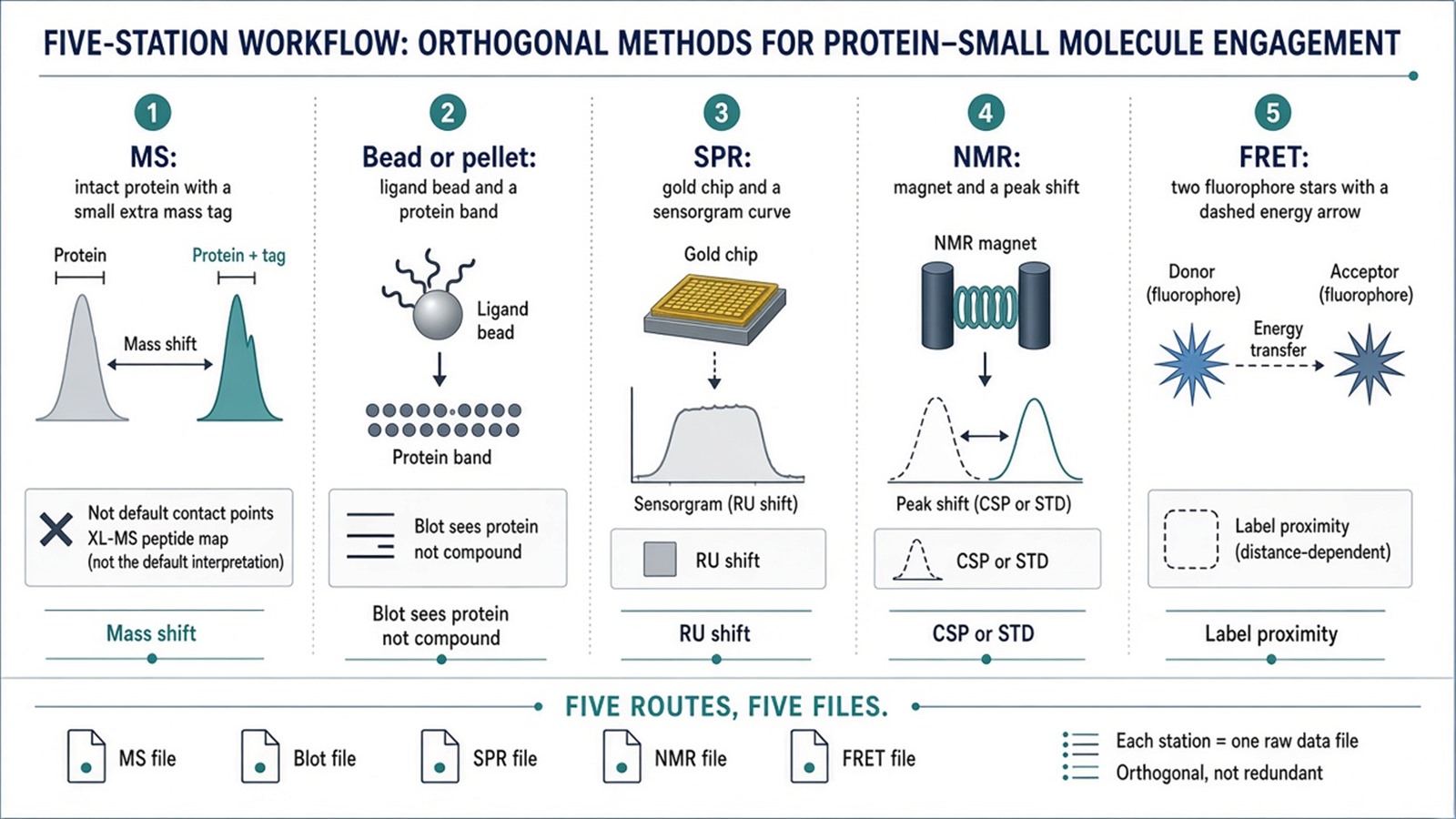
Figure 1. MS can be a mass shift or a covalent peptide. A bead or pellet recovers protein. SPR writes a sensorgram. NMR writes a shift or a transfer. FRET writes label proximity.
Name the file before the first run. Do not treat the five names as interchangeable detectors.
What Each File Is Allowed to Say
A mass shift says an adduct was present in the ion population. A pull-down band says a protein survived a wash on a ligand bead. An SPR sensorgram says the refractive index near the chip changed under that flow. An NMR perturbation says a nucleus changed environment. A FRET change says two labels exchanged energy. None of those sentences is a force assignment. For the force inventory that this detection page should not absorb, Types of Interactions Between Proteins and Small Molecules is the complementary chemistry page.
Isothermal titration calorimetry (ITC) and microscale thermophoresis (MST) are allowable later formats. They are not hidden sixth and seventh methods on this list. ITC reports heat under a titration. MST reports a motion of a fluorescent species in a temperature gradient. Adding them to a “various methodologies” sentence does not make the original five complete.
Far-Western blotting probes a membrane with a bait protein. It is a protein–protein format. It is not the related service for a protein–small-molecule detection question.
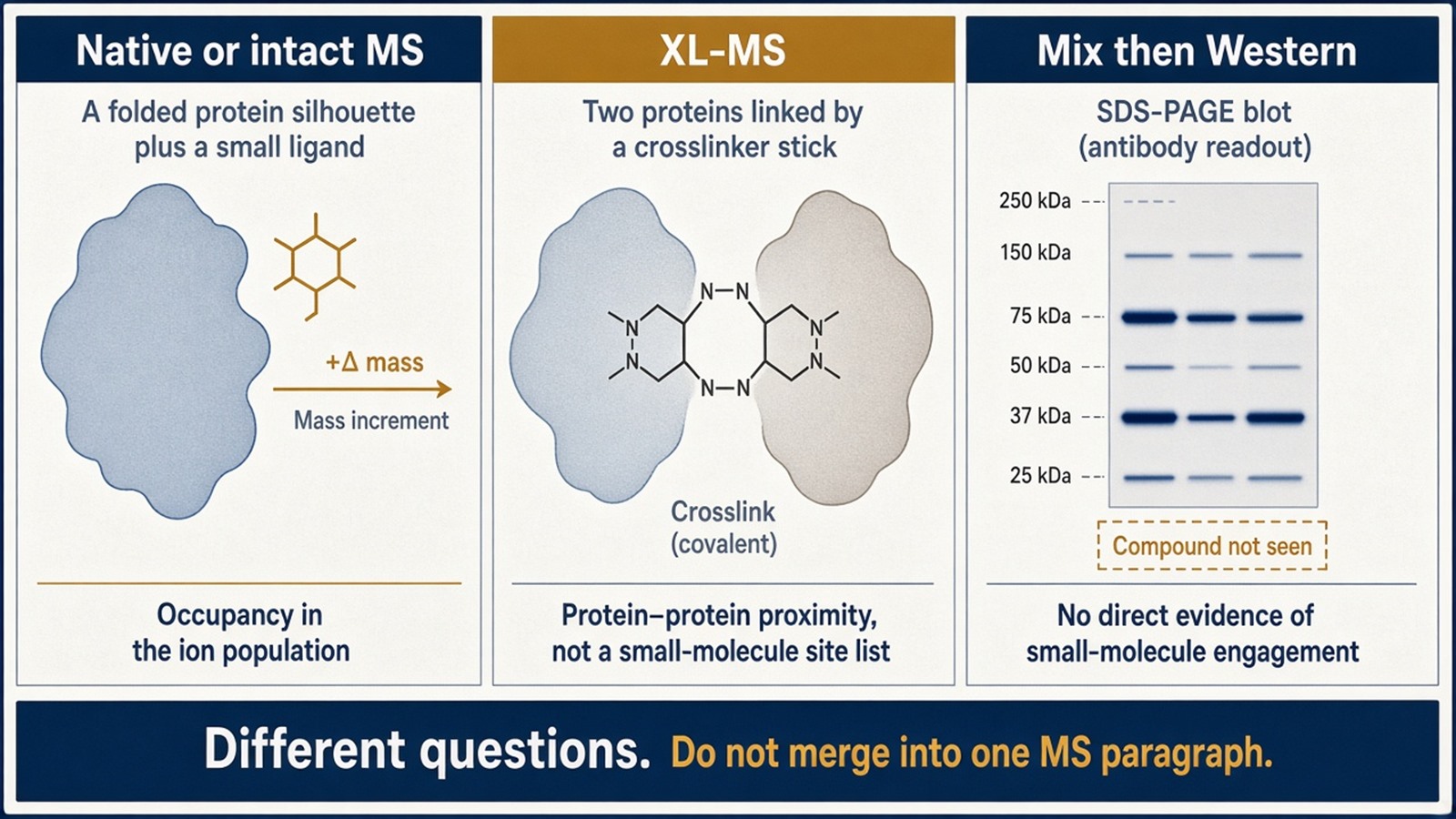
Figure 2. Intact-mass occupancy is not a contact map. Protein–protein XL-MS is not a small-molecule site list. A Western blot after mixing does not see the compound.
Experimental Limits
This page reduces detection to one named physical event per method. Advantages and limitations cannot be ranked in the abstract. Choosing a method based on experimental objectives is empty until the objective names the file: occupancy, kinetics, a residue shift, or label proximity. Drug screening, mechanism elucidation, and a complete interaction picture sit outside ordinary research reporting unless that file is already written.
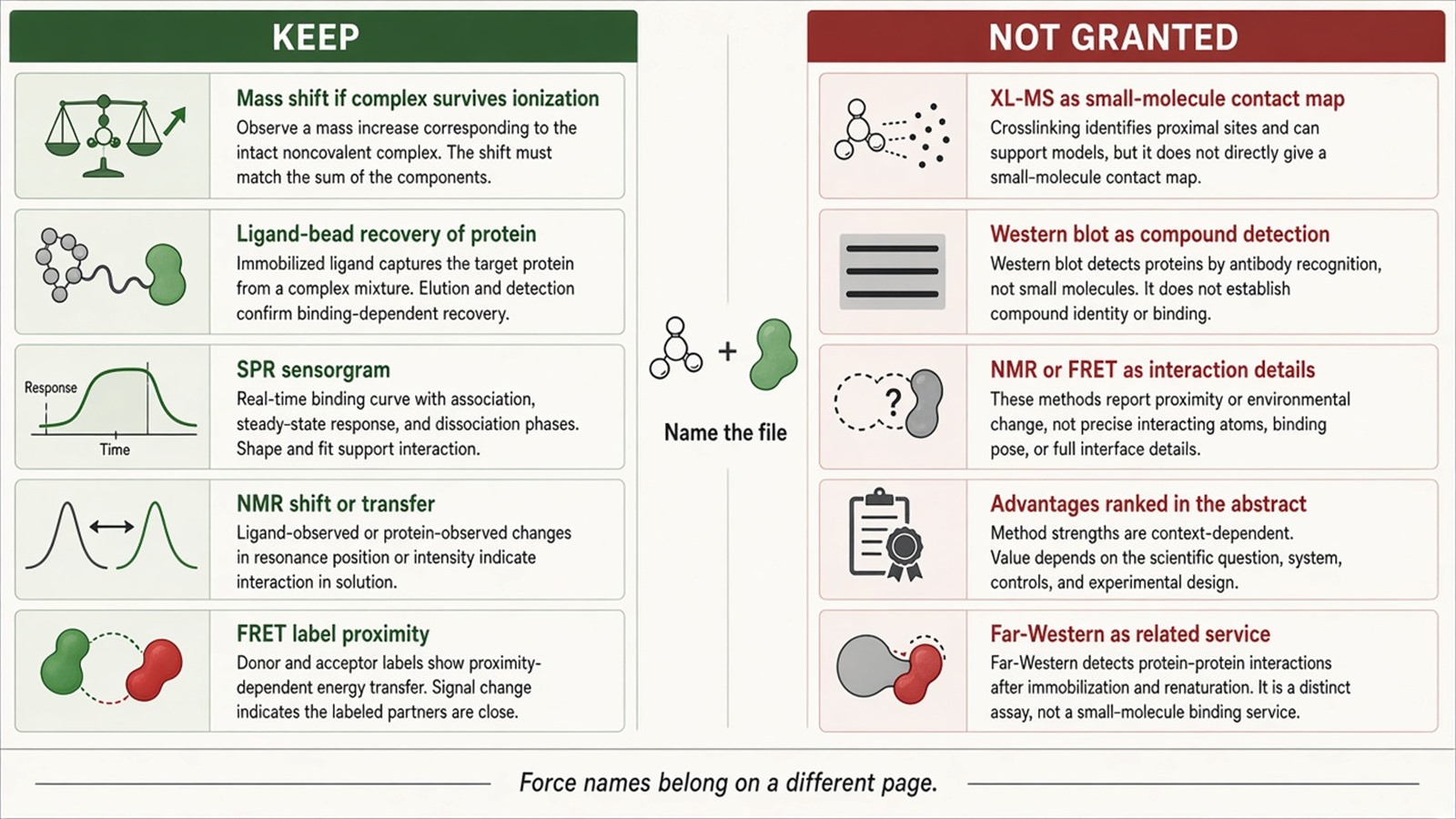
Figure 3. Keep: five named files. Not granted: XL-MS as a small-molecule contact map, a blot as compound detection, NMR or FRET as interaction details, or Far-Western as the next service.
Project Planning and Service Scope
A usable request names the protein, the compound, whether a label or an immobilization is acceptable, and which file would be allowed after a positive result. MtoZ Biolabs scopes SPR, ligand-binding, and intact-mass arms when those arms match the written question. Interpretability still follows that arm, not a common-methods heading.
Once the next sentence is a labeled or label-free binding menu rather than a single detector name, this chooser page should hand off. Researchers who need that menu can review the MtoZ Biolabs Ligand Binding Assay Service for project-specific sample evaluation, feasibility assessment, and workflow planning.
Frequently Asked Questions
1. Does XL-MS map protein–small-molecule contact points?
Standard XL-MS maps protein–protein proximity. A photoaffinity mark is a different experiment and still names a peptide.
2. Does a mass change prove binding?
It can show an adduct in the ion population. That is not a solution Kd.
3. Does co-precipitation plus Western blot detect the small molecule?
The blot detects protein. The compound is not the stained species.
4. Does SPR detect small-molecule binding by a refractive-index change?
It can, when the RU shift exceeds noise. Immobilization and solvent artifacts remain part of the file.
5. Do NMR and FRET reveal interaction details?
NMR reports a shift or a transfer. FRET reports label proximity. Details is not a granted output.
Reference
- Renaud J.P., Chung C.W., Danielson U.H., et al. (2016). Biophysics in drug discovery: impact, challenges and opportunities. Nat. Rev. Drug Discov., 15, 679-698. https://doi.org/10.1038/nrd.2016.123
- Heck A.J.R. (2008). Native mass spectrometry: a bridge between interactomics and structural biology. Nat. Methods, 5, 927-933. https://doi.org/10.1038/nmeth.1265
- Meyer B., Peters T. (2003). NMR spectroscopy techniques for screening and identifying ligand binding to protein receptors. Angew. Chem. Int. Ed., 42, 864-890. https://doi.org/10.1002/anie.200390099
- Homola J. (2008). Surface plasmon resonance sensors for detection of chemical and biological species. Chem. Rev., 108, 462-493. https://doi.org/10.1021/cr068107d
