



Co-IP and IP-MS in plant tissues ask which proteins remain with an endogenous bait after antibody capture, Input and IgG contrast, and either targeted detection or LC-MS/MS identification. The plant matrix changes extraction and background, not that scientific sentence. The design fits leaves, seedlings, or other organs when an IP-competent antibody exists, a protein reference database is available, and the claim is co-recovery, not binary direct binding (Hein et al. 2015). Prefer this route when native bait recovery can be shown versus Input. Reassess when the antibody is Western-only, phenolics block capture, or enrichment is too weak for a credible list.
Researchers who already have a plant bait, tissue type, and a written interaction claim can also review the MtoZ Biolabs IP-Mass Spectrometry Service and Protein-Protein Interaction Analysis for project-specific plant Co-IP feasibility.
What Plant-Tissue Co-IP and IP-MS Can Answer
A plant Co-IP experiment is still an antibody capture of a native bait and the proteins that remain with it. Cell walls, phenolics, tannins, and polysaccharides make lysis and antibody access harder. They do not change the claim the eluate is allowed to support. Typical systems include Arabidopsis seedlings or leaves, Nicotiana benthamiana when tagging is planned, and crop tissues such as rice or maize when an IP-competent antibody and a searchable protein database exist.
The design is a poor first system when no IP-grade antibody exists and tagging is not allowed, when the organ yields too little bait after native extraction, or when the written claim is reconstituted binding of a purified domain. Transient overexpression can raise bait amount. It also creates a tagged or non-native complex and should be treated as an AP-MS-style design, not as a more sensitive version of endogenous Co-IP. Method choice among plant IP-MS, Co-IP-MS, and proximity labeling is covered in Plant Protein Interaction Analysis: When to Use IP-MS, Co-IP-MS, or Proximity Labeling.
Grind tissue in liquid nitrogen to break walls before native lysis. Phenolic-rich organs such as roots or seeds often need a phenolic adsorbant in the extraction mix so that polyphenols do not occupy the antibody or the bait. Pilot the lysis that recovers the bait in this organ and developmental state, rather than transferring a leaf recipe to a seed extract.
Plant-tissue Co-IP supports candidate co-recovery after native bait capture. It does not prove that two plant proteins contact each other.
Antibody Specificity in Plant Extracts
Antibody specificity in plant Co-IP still means the reagent recovers the intended native bait from the planned lysate. Plant work adds two failure modes. Many commercial antibodies were validated on blot or on a different species, so application-specific IP testing remains necessary (Uhlen et al. 2016). Phenolics and polysaccharides can mask epitopes or inactivate the antibody even when the same clone worked in a cleaner leaf lysate.
An IP-grade antibody supplied by the study is the default capture reagent for endogenous plant baits. How to qualify that reagent is covered in How to Choose the Right Antibody for Co-IP Assays?. If no such antibody exists and tagging is acceptable, a FLAG, HA, Myc, or GFP handle can move the project onto tagged capture. That switch is compared in AP-MS vs IP-MS: How to Choose the Right Interactome Workflow. It is not a cleanup step for a failed plant antibody.
Do not raise tissue input only to compensate for a Western-only antibody. Extra biomass increases phenolic load and sticky background faster than it creates bait-specific enrichment. Record species, organ, antibody clone, lot, and bead chemistry, because a rice-root clone may fail in a maize leaf under the same catalog number.
Input and IgG Controls in Plant Tissues
Input and IgG must be written into a plant Co-IP before the first incubation. Plant papers often substitute an empty-vector or untagged lane. Those arms belong to tagged capture. They do not replace IgG when the handle is an antibody against an endogenous bait.
Input is taken before capture from the same organ, developmental stage, and extraction batch. It shows whether the bait survived wall disruption and phenolic cleanup, and it provides a baseline for enrichment. If Input lacks the bait, a missing IP signal is an extraction or expression problem, not a finished interaction result.
IgG or bead controls must use the same tissue batch, lysis, phenolic adsorbant, wash, and elution as the bait IP. Plant extracts carry abundant photosynthetic or storage proteins that bind resin and antibody handles. Matched IgG is how those binders are seen. Asymmetric grinding, clarifying, or wash salt between bait IP and IgG makes plant specificity look better or worse than it is.
Plant protocol arm |
Design job |
What it cannot do |
|---|---|---|
Antibody plus bead pairing |
Recover the native plant bait without a dominant off-target |
Convert a Western-only or cross-species blot reagent into IP-grade capture |
Input from the same organ |
Show that the bait survived extraction |
Prove the IP antibody works |
IgG or bead |
Estimate handle-driven background in this plant lysate |
Replace Input, or replace IgG with empty vector in endogenous Co-IP |
Empty-tag or untagged, when tagged |
Estimate tag-driven background |
Replace IgG in antibody IP |
Wash and elution |
Set retention versus plant background |
Rescue a failed antibody or a phenolic-blocked epitope |
A practical plant sequence is:
- Write the co-recovery claim and whether the ending is blot or IP-MS.
- Confirm bait presence in Input from the same organ and extraction.
- Test native IP recovery versus that Input.
- Process matched IgG with the same phenolic and wash recipe.
- Only then rank co-enriched names or bands.
Generic placement of those arms is covered in Designing an Efficient Co-immunoprecipitation (Co-IP) Protocol. Sample-prep parity after elution is covered in How to Prepare Immunoprecipitation Samples for Mass Spectrometry.
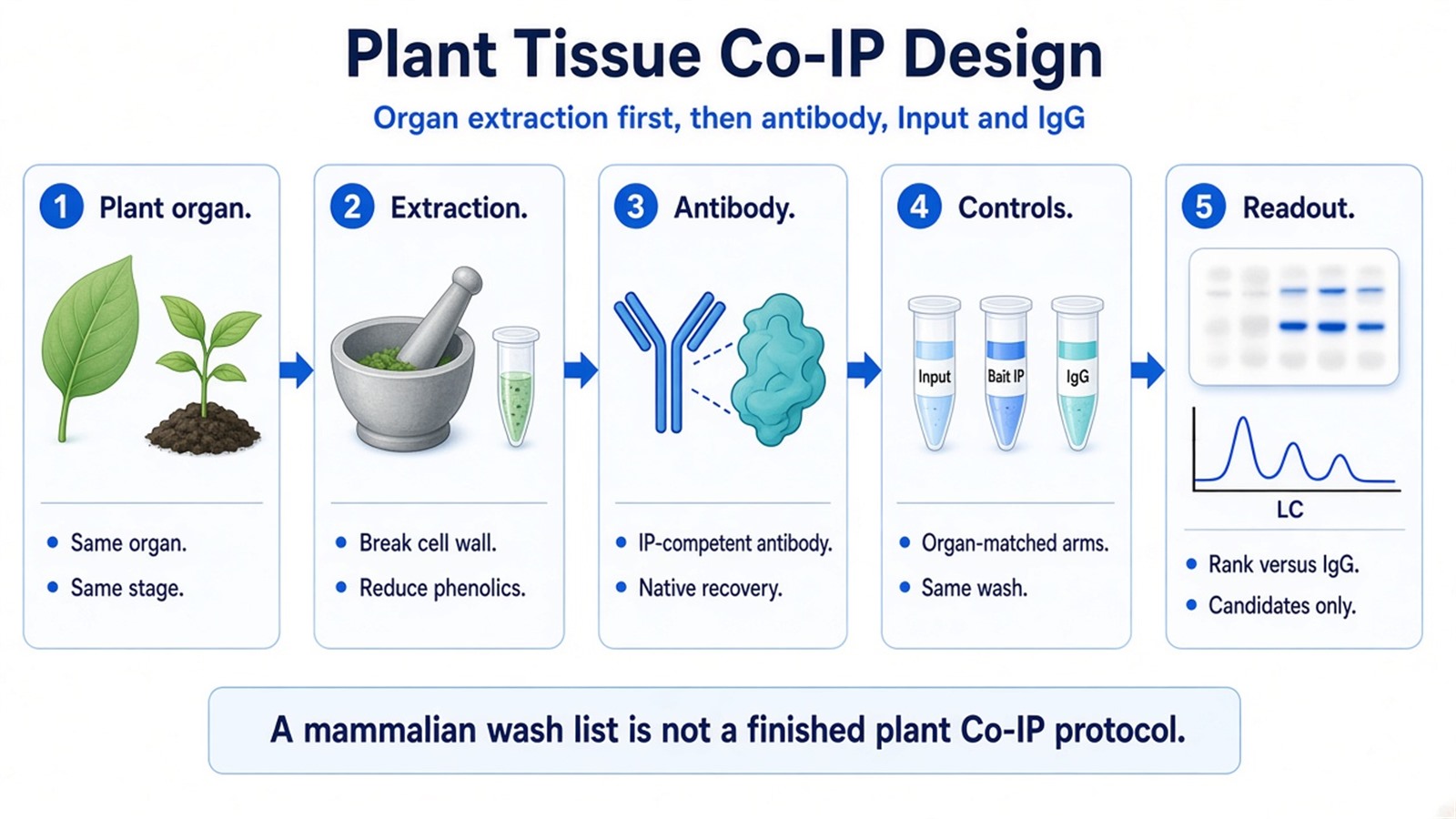
Figure 1. Plant Co-IP design starts with organ-matched extraction and an IP-competent antibody. A mammalian wash list is not a finished plant protocol.
Enrichment Efficiency and Mass Spectrometry Credibility
Enrichment efficiency is bait-first in plant tissues as well. Low endogenous abundance, incomplete wall disruption, and phenolic occlusion all look like failed interactions if Input is skipped. Relative intensity can compare the same protein across Input, IgG, and bait IP. It does not rank unrelated plant proteins as tighter binders, and a stronger Rubisco-like band is not a stronger protocol.
For a blot ending, chain bands and abundant plant proteins can hide a prey of similar mass. For an IP-MS ending, antibody chains, bead proteins, and high-abundance leaf or seed proteins can dominate sampling when bait recovery is weak. Identification depth in a Co-IP-style eluate is typically hundreds to about a thousand proteins, depending on the sample. Depth without bait enrichment is background, including in Arabidopsis or crop extracts.
Identification of a protein in the plant eluate is not a confidence call. Ranking requires bait recovery, Input-aware enrichment, and a declared contrast against IgG. Probabilistic scoring such as SAINT uses bait versus control counts to assign a probability that a prey is specifically co-purified (Choi et al. 2011). A contaminant catalog such as the CRAPome is a prior on control frequency (Mellacheruvu et al. 2013). It does not replace organ-matched IgG, because plant-specific sticky proteins may be under-represented in mammalian control collections.
After those gates, a protein-level value can support a relative statement: protein B is enriched with bait A versus matched IgG inside this plant extraction and capture recipe. Peptide support, organ, antibody clone, and wash chemistry belong next to that statement. Pathway maps of plant signaling do not repair a missing Input.
Readout choice between open MS and a named-pair blot is compared in IP-MS vs Co-IP Western Blot: Which Method Fits Your Study?.
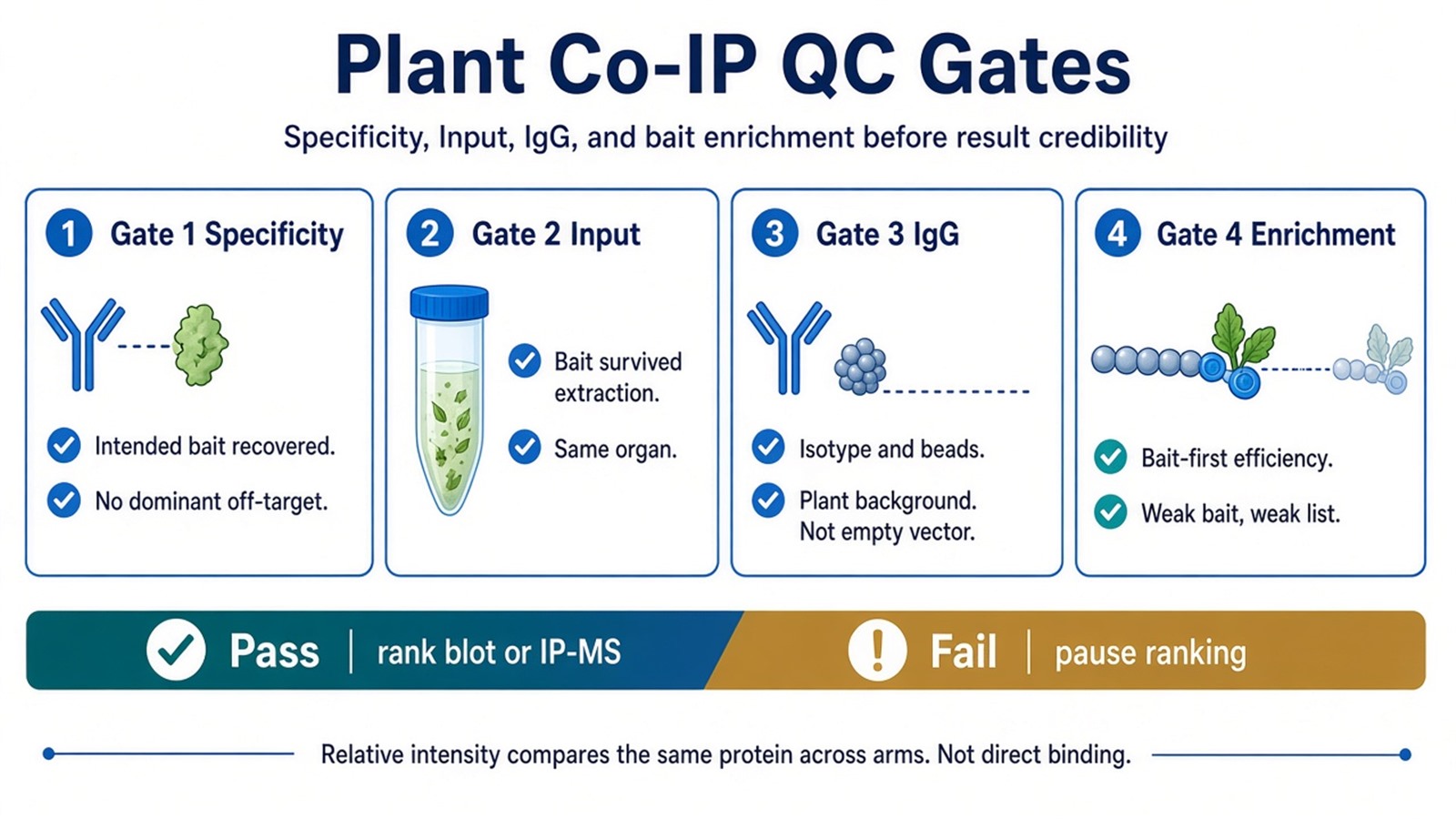
Figure 2. Mass spectrometry credibility in plant Co-IP starts after bait enrichment is shown versus organ-matched Input and IgG.
Common Biases and Result Boundaries
The common plant bias is copying a mammalian Co-IP protocol and treating the first green extract as an interactome. Another bias is using transient overexpression in N. benthamiana to rescue a weak endogenous antibody, then writing the result as native Arabidopsis biology. Empty-vector lanes do not replace IgG in endogenous plant Co-IP. Extra wash salt can strip weak plant associations while leaving photosynthetic or storage proteins on the beads.
Do not write a successful plant bait IP as proof that every co-enriched protein contacts the bait. Do not write a failed plant Co-IP as proof that no interaction exists in the cell. Absence of bait recovery can mean the wrong antibody, a phenolic-blocked epitope, incomplete wall disruption, over-washing, or a bait that is not expressed in that organ.
Revise grinding, phenolic cleanup, antibody, or wash when Input is positive and IP recovery is not. Prefer tagged AP-MS when no IP-competent plant antibody exists and tagging is acceptable. Prefer proximity labeling when the association is too weak or transient to survive native plant lysis. Mixed enrichment-MS projects can be reviewed under the MS-Based Protein-Protein Interaction Analysis Service. Screening-level method maps are covered in Measuring Protein-Protein Interactions.
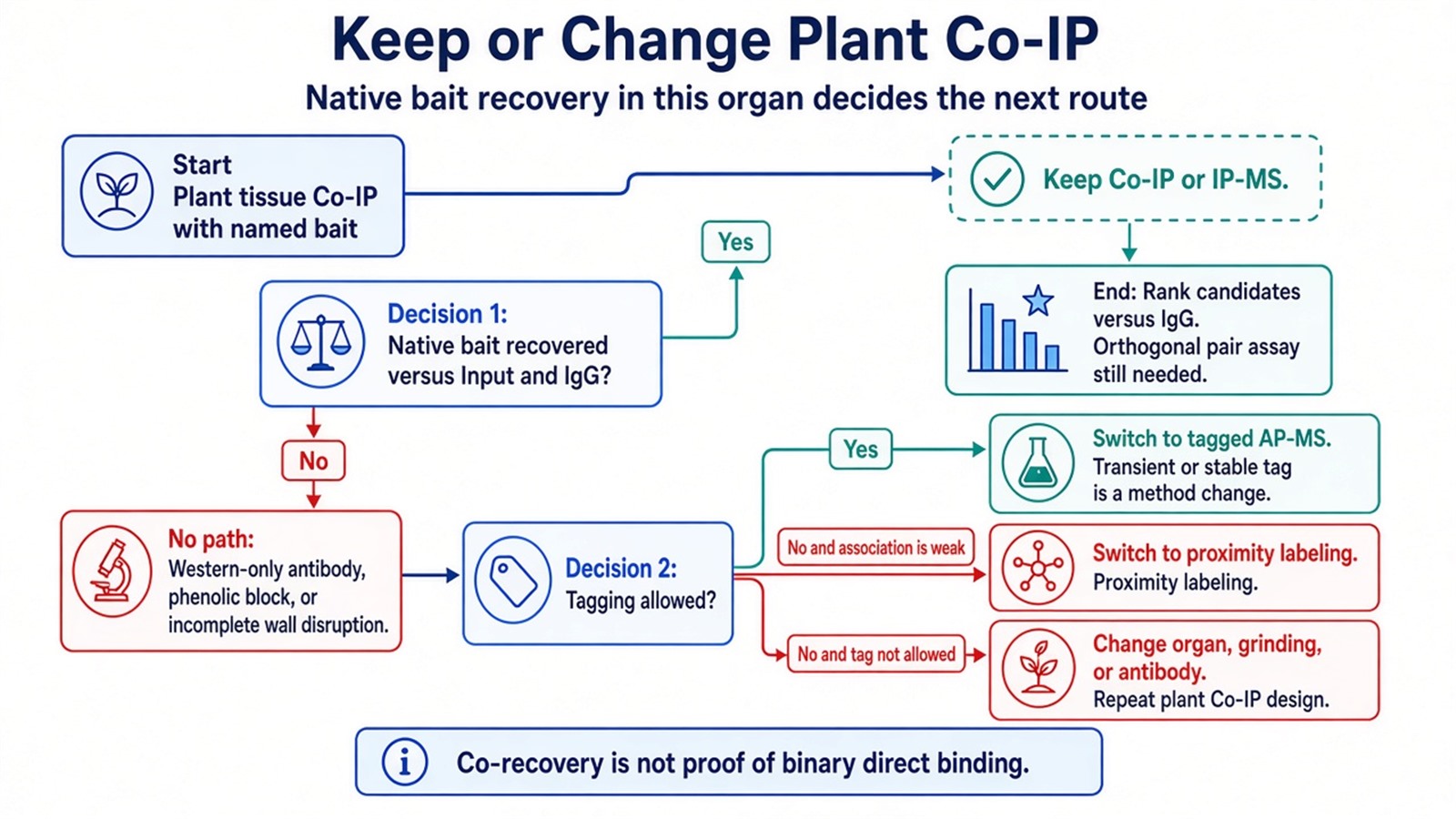
Figure 3. Stay with plant Co-IP only while native bait recovery is documented in that organ. Transient overexpression is a method change.
A plant-tissue Co-IP or IP-MS result supports candidate co-recovery after antibody, Input, IgG, and bait enrichment are shown. It does not certify a binary plant interactome.
Once the organ, antibody status, Input and IgG plan, enrichment checks, and the intended blot or IP-MS readout are defined, the project can be scoped as a plant Co-IP or IP-MS study. Researchers can review the MtoZ Biolabs IP-Mass Spectrometry Service for sample evaluation and plant-protocol planning.
Frequently Asked Questions
1. Can I transfer a mammalian Co-IP protocol to Arabidopsis leaves?
Only after native bait recovery is re-shown versus Input in that leaf extract. Wall disruption and phenolic load change antibody access even when the clone is unchanged.
2. Does transient overexpression in N. benthamiana replace an IP-grade antibody for the endogenous protein?
No. Transient tagging raises bait amount and changes the complex. Treat it as tagged capture, not as a more sensitive endogenous Co-IP.
3. Can an empty-vector lane replace IgG in plant Co-IP?
No. Empty-vector or untagged arms belong to tagged designs. Endogenous antibody Co-IP still needs organ-matched Input and IgG.
4. If phenolics are high, should I skip Input and only read the eluate?
No. Input is how you learn whether the bait survived extraction. Skipping it turns a phenolic extraction failure into a false-negative interaction.
5. When should plant Co-IP move to tagged AP-MS or proximity labeling?
Move to tagged AP-MS when no IP-competent antibody recovers the native bait and tagging is acceptable. Move to proximity labeling when the association does not survive native plant lysis.
Reference
- M. Uhlen, A. Bandrowski, S. Carr, A. Edwards, J. Ellenberg, E. Lundberg, D. L. Rimm, H. Rodriguez, T. Hiltke, M. Snyder, T. Yamamoto (2016). A proposal for validation of antibodies. Nat. Methods, 13, 823-827. https://doi.org/10.1038/nmeth.3995
- M.Y. Hein, N.C. Hubner, I. Poser, J. Cox, N. Nagaraj, Y. Toyoda, I.A. Gak, I. Weisswange, J. Mansfeld, F. Buchholz, et al. (2015). A human interactome in three quantitative dimensions organized by stoichiometries and abundances. Cell, 163, 712-723. https://doi.org/10.1016/j.cell.2015.09.053
- H. Choi, B. Larsen, Z.Y. Lin, A. Breitkreutz, D. Mellacheruvu, D. Fermin, Z.S. Qin, M. Tyers, A.C. Gingras, A.I. Nesvizhskii (2011). SAINT: probabilistic scoring of affinity purification-mass spectrometry data. Nat. Methods, 8, 70-73. https://doi.org/10.1038/nmeth.1541
- D. Mellacheruvu, Z. Wright, A.L. Couzens, J.P. Lambert, N.A. St-Denis, T. Li, Y.V. Miteva, S. Hauri, M.E. Sardiu, T.Y. Low, et al. (2013). The CRAPome: a contaminant repository for affinity purification-mass spectrometry data. Nat. Methods, 10, 730-736. https://doi.org/10.1038/nmeth.2557
