



Combining co-immunoprecipitation with mass spectrometry (Co-IP-MS) means using an antibody, or a tag handle, to capture a bait and the proteins that survive the stated wash, then reading that eluate as an open peptide-identified list. Co-IP supplies the physical enrichment. Mass spectrometry (MS) supplies identification and, when a label or matched runs are added, a relative occupancy table. The combination does not, by itself, map an endogenous interactome, prove a direct contact, or convert a STRING drawing into a sample-level network.
Protein–protein interactions (PPIs) organize signal transduction, metabolic pathways, and transcriptional control. Expression of a protein is not a substitute for knowing which partners remain with it after lysis. Western blotting after Co-IP can only test nominated pairs. Co-IP-MS is used when the next table should be an open partner inventory around one bait. The useful first decision is whether the bait is captured with a native antibody or with a Flag, HA, Myc, or GFP tag. Only the untagged antibody route can support an endogenous-complex sentence.
Researchers who already have an IP-grade antibody, a tagged line, or a treatment contrast can also review the MtoZ Biolabs Co-IP-MS Protein Interaction Analysis Service for project-specific feasibility and analysis planning.
What the Combination Can Report
Co-IP isolates a target protein together with proteins that remain bound on Protein A/G beads after a written wash. Coupling that eluate to LC-MS/MS can identify previously unnominated partners and can carry label-free or TMT comparison across conditions. The table is a wash-stable neighborhood. It is suitable for inspecting complex assemblies that survive non-denaturing lysis. It is not an unbiased census. Antibody epitope, bead chemistry, wash stringency, and bait abundance all decide who remains.
Non-denaturing buffers such as NP-40 can keep some complexes together. That is a lysis class, not proof that the recovered set is the physiological landscape. Tagged systems improve reproducibility when the antibody is weak. They are not endogenous Co-IP. For how native antibody work differs from tagged AP-MS, How Can Endogenous Interactions Between Two Proteins Be Verified? provides a complementary native-versus-tagged discussion. For how Co-IP-MS sits among AP-MS, crosslinking MS, and proximity labeling, How to Identify Protein–Protein Interactions Using Mass Spectrometry provides a complementary evidence-type map.
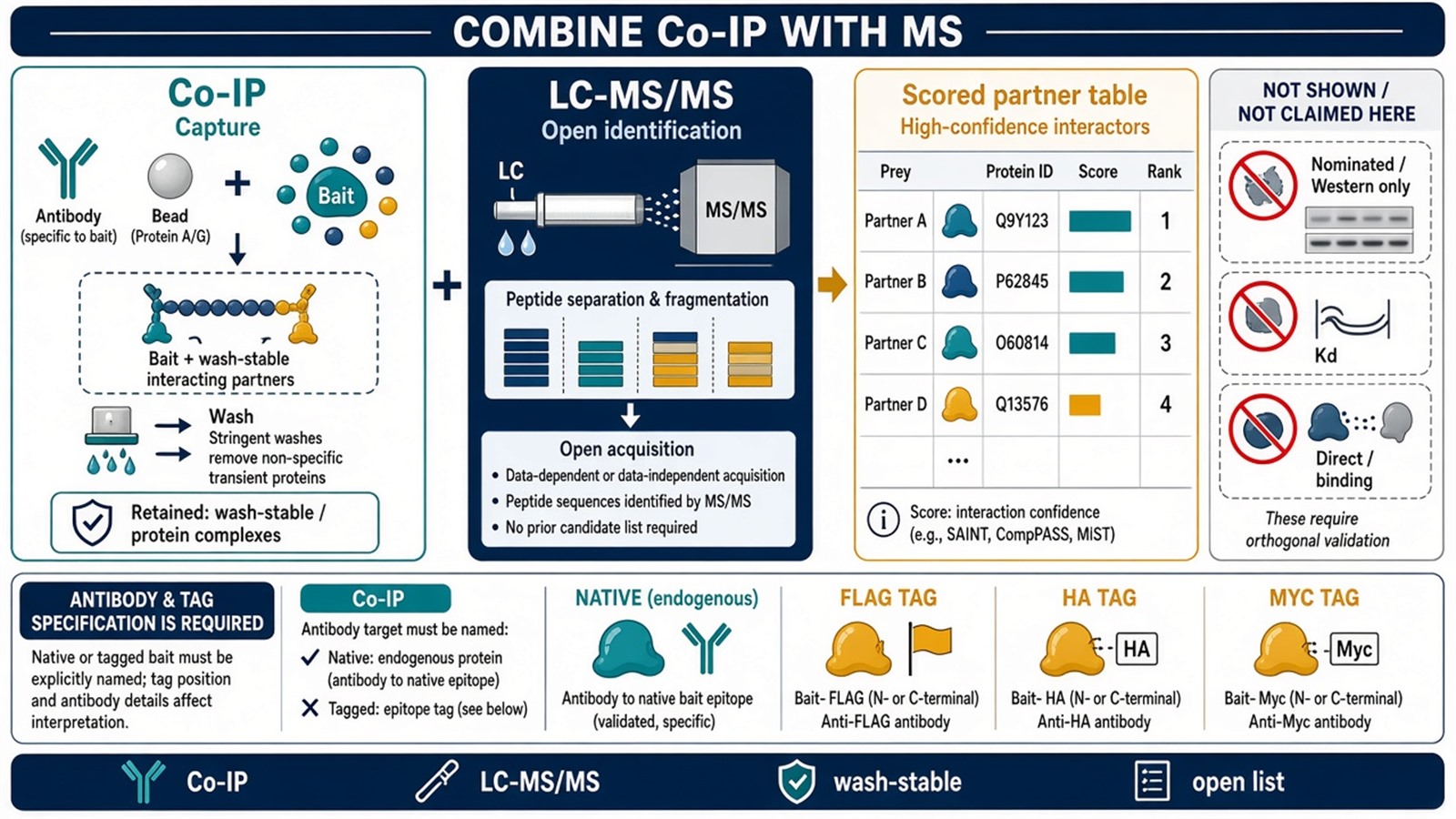
Figure 1. Co-IP enriches wash-stable partners. MS identifies the open list. Western still tests nominated pairs. The combination does not report a binding constant.
Write the capture handle and the control arm before the first lysis. MS cannot invent an IgG or empty-tag sample that was not processed.
Experimental Workflow of Co-IP-MS
The coupling follows five steps. Each step has a decision that later network software cannot undo.
1. Sample lysis
Proteins are extracted from cells or tissues in a non-denaturing buffer, commonly NP-40 or a similar mild detergent, so that some interactions remain intact. Protease and phosphatase inhibitors are included to limit degradation and to keep phosphorylation available for later inspection. Harsh sonication or SDS before capture can raise total protein yield and still dissolve the complex the antibody was meant to keep. Input amount should be matched across bait and control arms.
2. Co-immunoprecipitation
The lysate is incubated with Protein A/G magnetic beads bound to an IP-validated antibody against the target, or with a tag resin when Flag, HA, Myc, or GFP is the handle. Specificity and reproducibility depend on three written choices: an antibody or resin that is qualified for IP, a negative-control arm processed in parallel, and an incubation time and temperature that do not empty the complex. IgG isotype controls belong with antibody Co-IP. Bead-only and empty-vector or empty-tag arms belong with tagged capture. Controls reduce, rather than eliminate, nonspecific binding.
3. Elution and proteolytic digestion
Captured proteins are eluted under acidic or denaturing conditions, then reduced, alkylated, and digested with trypsin. On-bead digestion is an alternative when elution is inefficient; bait and control must use the same route. Peptide cleanup such as S-Trap can improve recovery when the protein input and the trap capacity are matched. It does not rescue an unmatched IP.
4. LC-MS/MS analysis
High-resolution instruments, typically Orbitrap-class or a trapped-ion-mobility Q-TOF such as timsTOF Pro, acquire peptide spectra in data-dependent (DDA) or data-independent (DIA) mode. DDA and DIA trade identification style against run-to-run completeness. The instrument name does not decide which proteins are specific interactors. Depth still follows bait recovery, wash, and peptide load.
5. Data processing and what may be drawn afterward
Raw files are searched in MaxQuant, Proteome Discoverer, or an equivalent pipeline for identifications and, when designed, quantities. Background subtraction and statistical filtering against the control arm come before any picture. STRING and Cytoscape can display the filtered table. GO or KEGG enrichment can prioritize follow-up. Those drawings do not construct the interaction evidence. They annotate a list that was already scored.
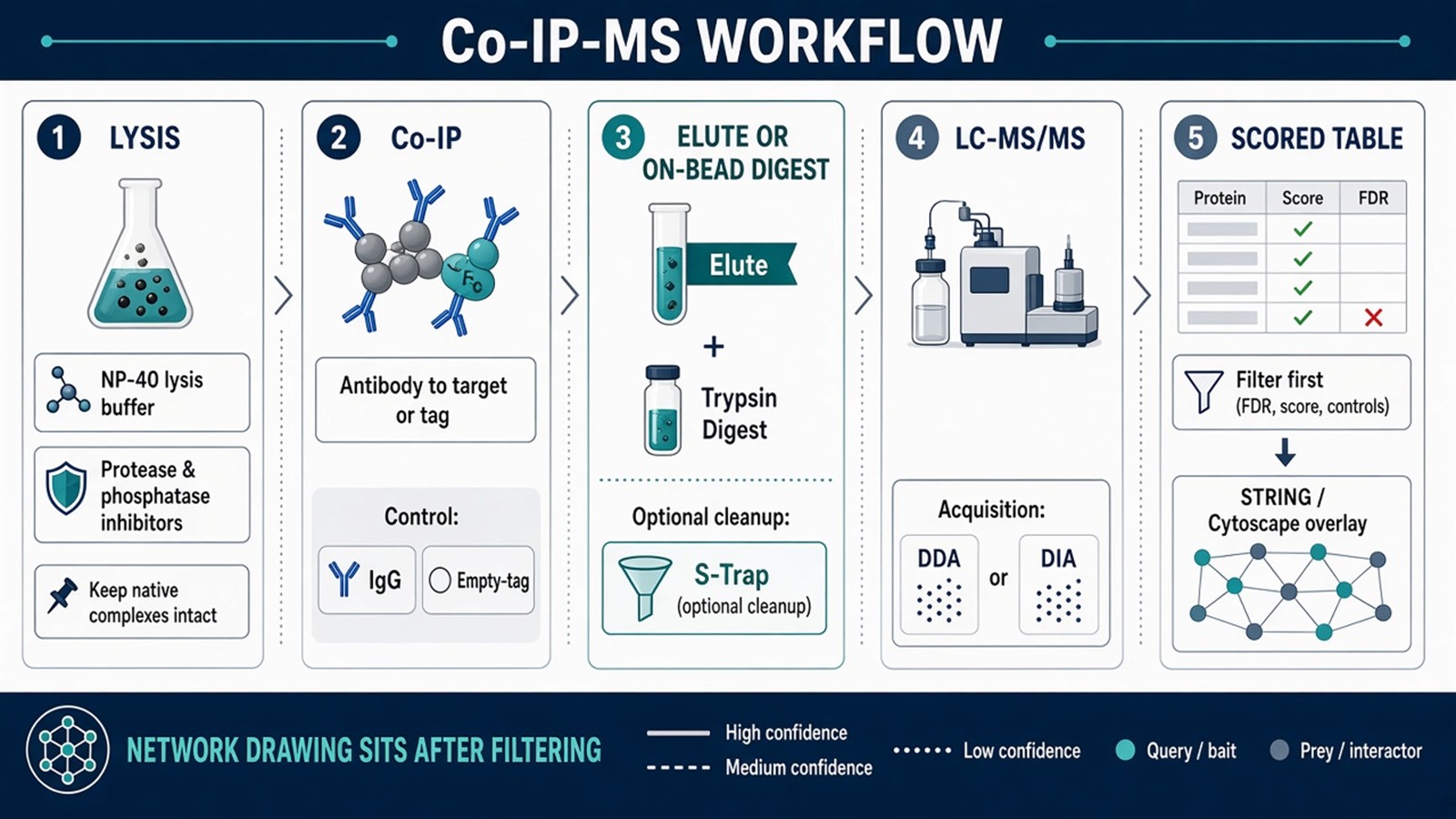
Figure 2. The combination is lysis, matched Co-IP, elution or on-bead digest, LC-MS/MS, then a control-filtered table. STRING and Cytoscape sit after that filter.
Critical Considerations for a Usable Co-IP-MS Table
Antibody specificity remains the first limit. Prefer IP-validated monoclonal antibodies for endogenous capture, or a small tag such as Flag, HA, or Myc when the native antibody is not IP-grade. GFP tags are larger and more often change trafficking; they should be labeled as GFP-fusion Co-IP, not as native capture.
Control design should include the arm that matches the handle: IgG for antibody IPs, bead-only and empty-vector or empty-tag for fusions. Three unmatched controls processed on another day are not a background model.
Quantification is optional and must match the question. TMT or iTRAQ can compare several IPs in one run when enrichment stays matched. Label-free comparison fits exploratory or few-arm designs. Neither label turns occupancy into a Kd. TMT is not automatically required for every comparative study.
Peptide input and cleanup should be held constant so that missing values are not created by unequal recovery. CRAPome and related contaminant catalogs help flag recurrent bead or antibody binders (Mellacheruvu et al. 2013). They annotate background risk. They do not license deletion of every abundant protein that is also a true complex member.
For control language that belongs with any affinity-MS record, How to Improve Reliability and Reproducibility of PPI Experimental Results provides a more detailed design discussion.
When Combining Co-IP with MS Is the Wrong First Route
Choose a different coupling when the interaction is expected to be wash-sensitive or when the next sentence needs a residue pair. Crosslinking MS reports spatial contacts, not a Co-IP neighborhood. For that fork, Co-IP-MS vs XL-MS: Protein Interaction Workflow Guide provides a complementary workflow comparison. Yeast two-hybrid remains the pairwise library screen when no antibody or tag is available. Proximity labeling is the usual path when the partner must be marked before lysis.
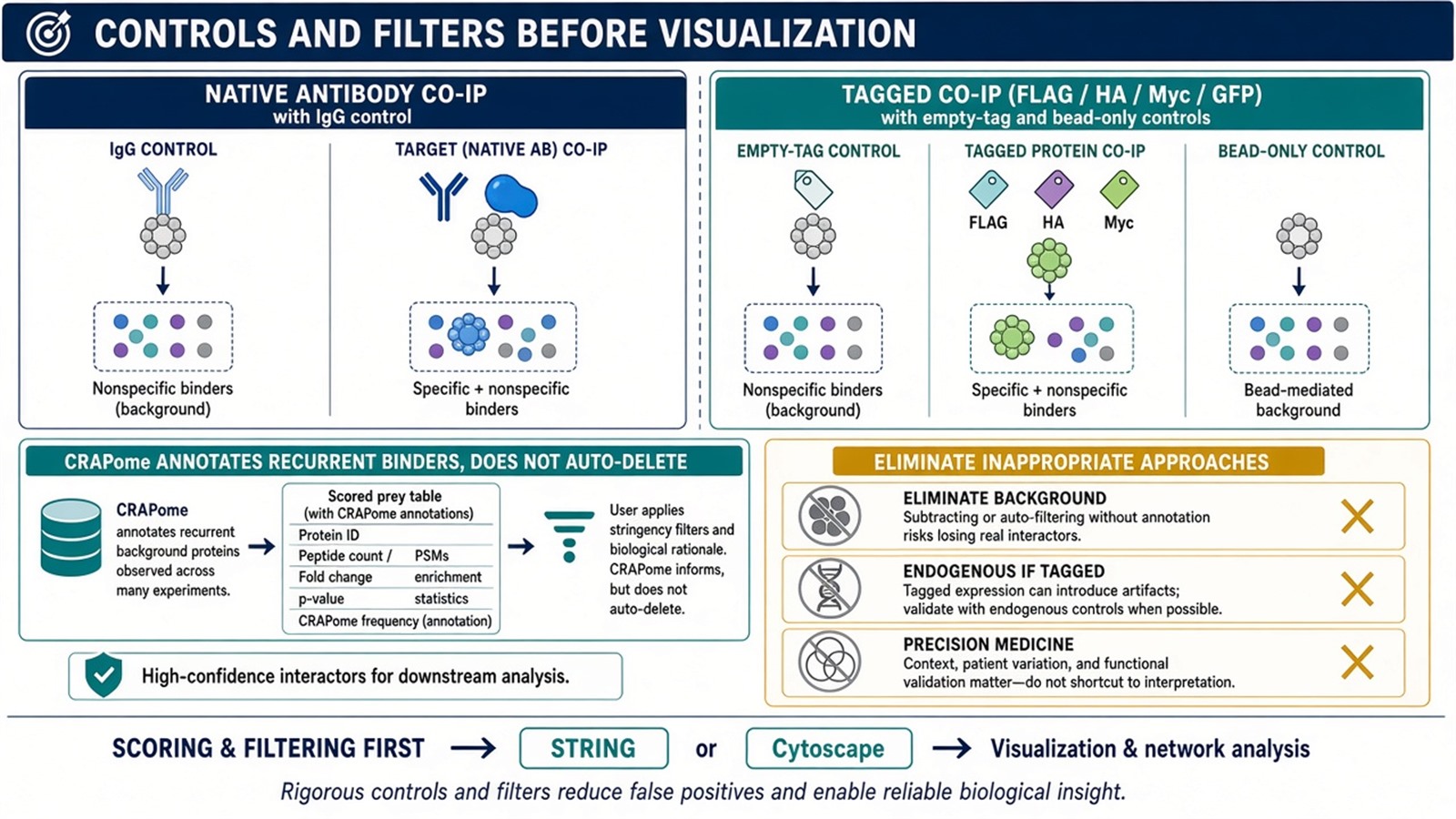
Figure 3. Native antibody and tagged handles are different experiments. IgG, bead-only, or empty-tag arms and a contaminant catalog filter the table before visualization.
Experimental Limits
Co-IP-MS loses many transient or low-affinity partners during wash. It recovers bridged complex members and recurrent contaminants along with bait-dependent proteins. Overexpressed tags can create non-physiological neighbors. IgG and CRAPome filters reduce, rather than erase, that background. Instrument lists such as Orbitrap Exploris or timsTOF Pro support acquisition depth. They do not create ultra-high-throughput true complexes. Diagnostic, companion-diagnostic, or precision-medicine language sits outside ordinary research Co-IP-MS unless a separately validated assay framework is in place.
Project Planning and Service Scope
A usable combination plan names the bait, the antibody or tag, the control arm, the digest route, and whether the MS table is identification-only or quantitative. MtoZ Biolabs scopes antibody or Flag, HA, and GFP-tag Co-IP, Orbitrap Exploris or timsTOF-class LC-MS/MS, and control-filtered reporting. Tag construction, stable-line generation, and phosphoproteomics can be added only when those steps are required by the claim. Recovery of low-abundance or membrane partners still depends on capture chemistry, not on calling the workflow standardized.
Once the handle, controls, and readout are defined, the project can be scoped as a Co-IP-MS study. Researchers can review the MtoZ Biolabs Co-IP-MS Protein Interaction Analysis Service for project-specific sample evaluation, feasibility assessment, and workflow planning.
Frequently Asked Questions
1. What does it mean to combine Co-IP with mass spectrometry?
Co-IP captures the bait and wash-stable partners. MS identifies those proteins as peptides and can compare them across matched conditions. The product is a scored list, not a Western of one nominated pair.
2. Does Co-IP-MS map endogenous interaction networks by default?
Only when the bait is captured with a native antibody at endogenous expression. Flag, HA, Myc, or GFP capture is a tagged experiment and should be labeled as such.
3. Do IgG controls eliminate nonspecific binding?
No. They model antibody and bead background when processed with the bait. They reduce, rather than eliminate, contaminants.
4. Should every Co-IP-MS study use TMT?
No. TMT fits multi-arm comparison after matched IPs. Label-free comparison is usable for few-arm or exploratory designs. The label does not replace the control arm.
5. Can STRING or Cytoscape replace statistical filtering?
No. Those tools display a table that has already been filtered against controls. Drawing the unfiltered identification list does not construct an interaction network.
Reference
- Gingras A.C., Gstaiger M., Raught B., Aebersold R. (2007). Analysis of protein complexes using mass spectrometry. Nat. Rev. Mol. Cell Biol., 8, 645-654. https://doi.org/10.1038/nrm2208
- Mellacheruvu D., Wright Z., Couzens A.L., et al. (2013). The CRAPome: a contaminant repository for affinity purification-mass spectrometry data. Nat. Methods, 10, 730-736. https://doi.org/10.1038/nmeth.2557
- Dunham W.H., Mullin M., Gingras A.C. (2012). Affinity-purification coupled to mass spectrometry: basic principles and strategies. Proteomics, 12, 1576-1590. https://doi.org/10.1002/pmic.201100523
- Vermeulen M., Hubner N.C., Mann M. (2008). High confidence determination of specific protein-protein interactions using quantitative mass spectrometry. Curr. Opin. Biotechnol., 19, 331-337. https://doi.org/10.1016/j.copbio.2008.06.001
- Choi H., Larsen B., Lin Z.Y., et al. (2011). SAINT: probabilistic scoring of affinity purification-mass spectrometry data. Nat. Methods, 8, 70-73. https://doi.org/10.1038/nmeth.1541
- Smits A.H., Vermeulen M. (2016). Characterizing protein-protein interactions using mass spectrometry: challenges and opportunities. Trends Biotechnol., 34, 825-834. https://doi.org/10.1016/j.tibtech.2016.02.014
