



Choose the crosslinker from the claim, the compartment, and the residue class, not from a list of generally preferable reagents. In crosslinking-based protein interaction analysis the reagent writes a covalent pair between two compatible side chains. Liquid chromatography–tandem mass spectrometry (LC-MS/MS) then names that pair. The spacer length is a reach estimate. It is not a distance you pick to match a known interface. High residue selectivity is chemistry, not more accurate structural interpretation. A chemically stable, non-cleavable bond is not always better. MS-cleavable spacers such as DSSO are chosen because the linker is meant to break in the spectrometer.
The original four factors remain the right headings. The original advice under them does not. Reactivity, spacer, stability, and selectivity are decision questions. They are not a checklist that yields effective covalent links inside the target structure. For what a named pair is allowed to support, Can Crosslinking MS Prove a Direct Protein Interaction? provides a complementary proof page.
Researchers who already know the claim and need a reagent-matched XL-MS table can also review the MtoZ Biolabs Crosslinking Mass Spectrometry Protein Interaction Analysis Service for project-specific feasibility and analysis planning.
Write the Reaction Site Before the Reagent Name
In-cell or in-tissue work needs a membrane-permeable reagent. DSS is the usual amine-reactive, cell-permeable NHS ester. Formaldehyde is a short, permeable option with a different chemistry. BS3 is the sulfonated analog of DSS. It is used on lysates, isolated complexes, or cell surfaces because the sulfo groups keep it out of intact membranes. Naming BS3 for an in-cell structural study, or DSS for a strictly extracellular surface, is a site error, not a spacer error.
For when a residue-proximity table versus a partner list is the next sentence, Co-IP-MS vs XL-MS: Which Protein Interaction Workflow Should You Choose? provides a complementary workflow page.
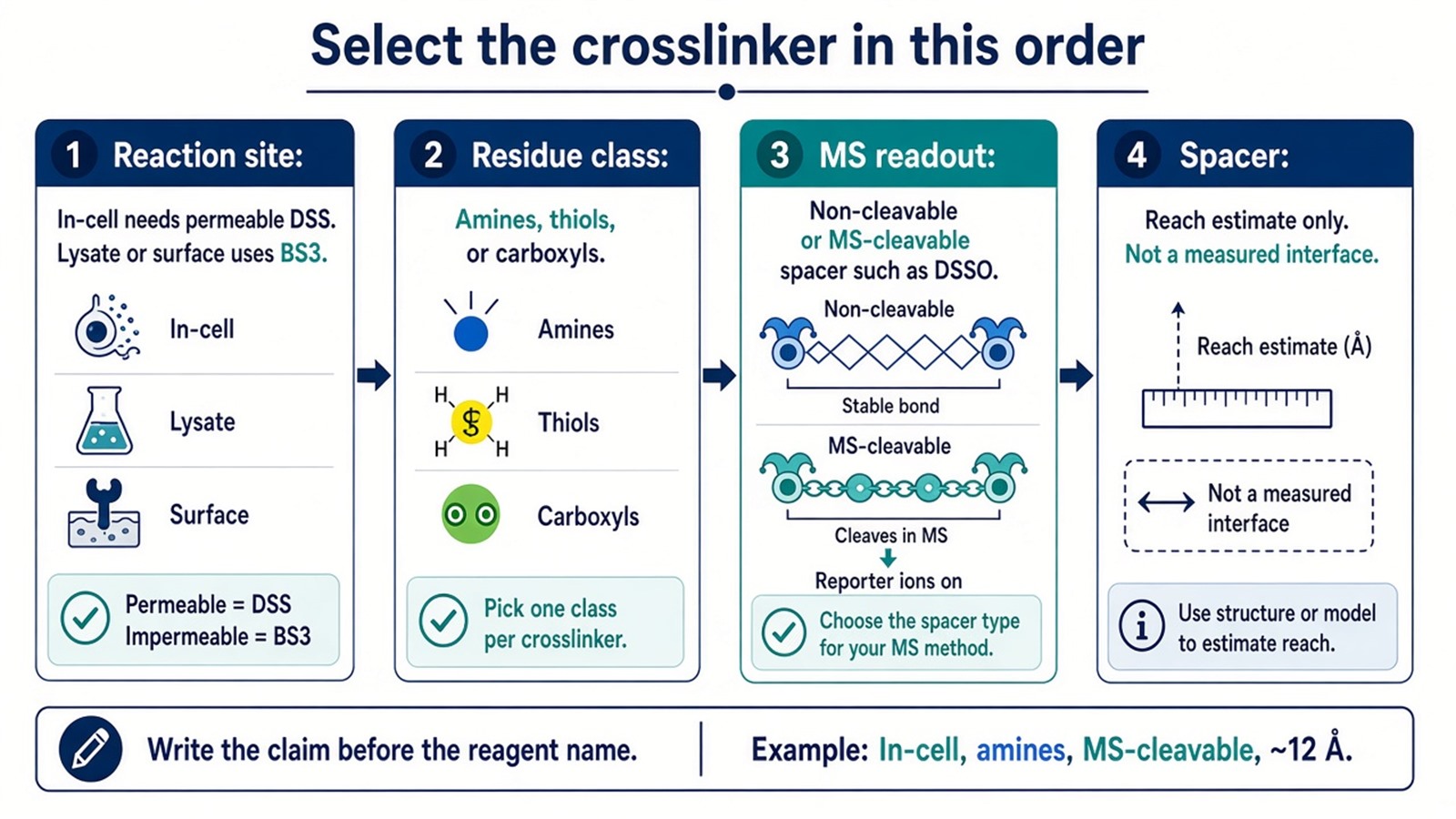
Figure 1. Site first: permeable DSS for in-cell work, impermeable BS3 for lysate or surface. Residue class and MS-cleavable spacer come next. Spacer length is not a measured interface.
Name where the reaction must occur before naming DSS, BS3, or EDC. A generally stable reagent does not fix a permeability mismatch.
The Four Factors, Recast as Decisions
Reactivity
Amine-reactive NHS esters, including DSS, BS3, and DSSO, mark lysines and N-termini. Thiol-reactive maleimides mark cysteines. Carboxyl-directed reagents such as DMTMM, or zero-length EDC chemistry, mark acidic residues paired with an amine. The original amino, carboxyl, and thiol split remains. Reactivity is which atoms can form the bond. It is not a menu that guarantees links inside the fold you care about.
Spacer arm length
DSS and BS3 share a spacer near 11 Å. That number is a chemical reach, not the Cα–Cα distance in a finished model, and not a length you choose so that the reagent spans the distance necessary inside the target. If the residues are farther than the reagent can reach, or closer but unreactive, no link forms. A missing link is not a wrong spacer. For how a named pair is read as proximity rather than architecture, How to Identify Protein–Protein Interactions Using Mass Spectrometry provides a complementary evidence map.
Chemical stability
NHS esters hydrolyze in water. Some spacers are built to break: DSP is thiol-cleavable during sample workup; DSSO and DSBU are MS-cleavable during fragmentation. Cleavage is a design choice for identification, not a compromised outcome. Preferring a chemically stable crosslinker in every structural study deletes those XL-MS reagents.
Residue selectivity
Selectivity is the side-chain preference already named under reactivity. Choosing a reagent that is highly specific for residues of interest does not enhance the accuracy of a structural model. It only changes which pairs can appear. Sparse lysine coverage is still sparse after a more selective NHS ester.
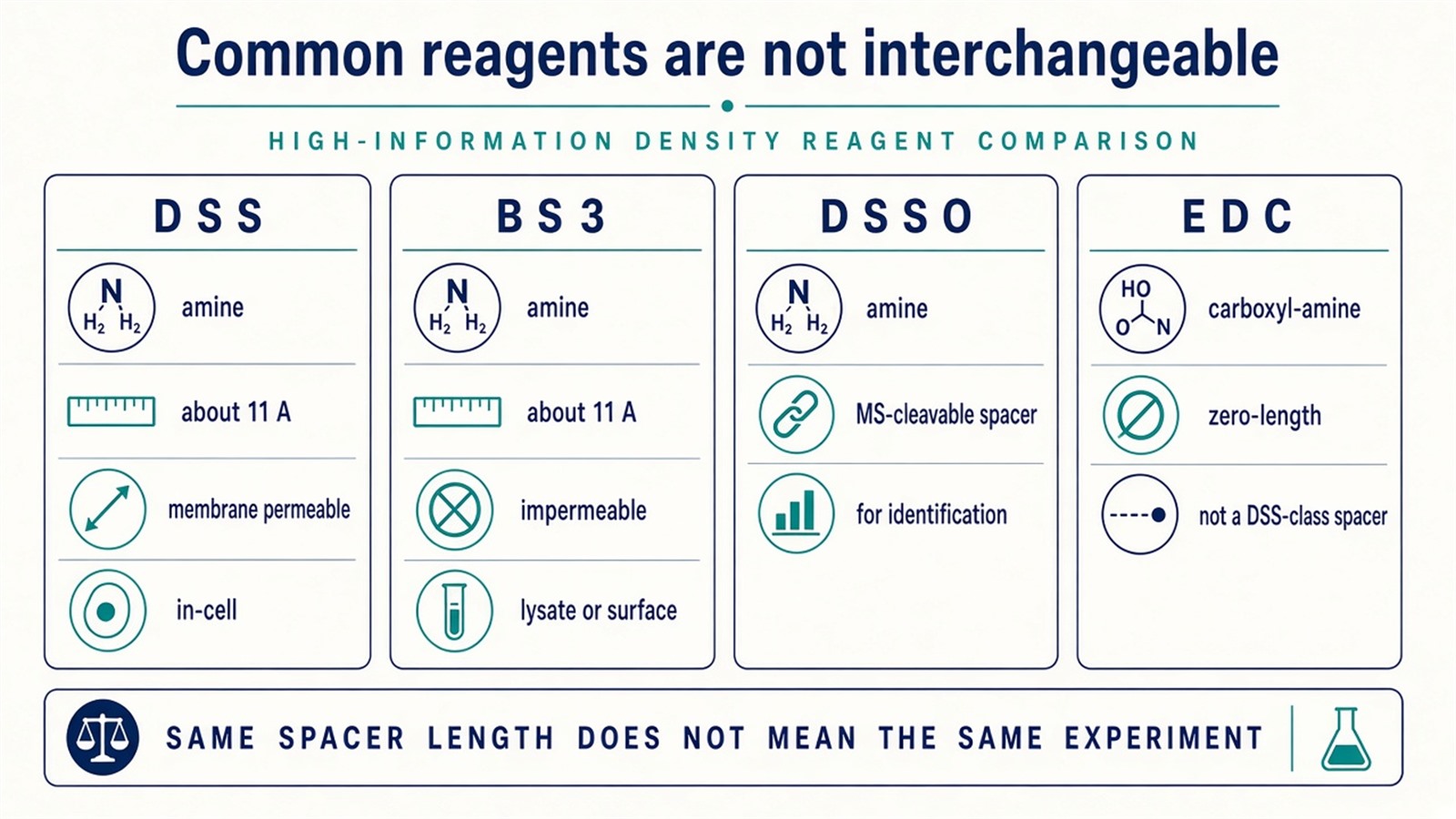
Figure 2. DSS: in-cell amines. BS3: lysate or surface amines. DSSO: MS-cleavable amines. EDC: zero-length carboxyl–amine chemistry, not a DSS-class spacer.
Common Reagents and What They Are For
The original three names remain. They are not interchangeable common options.
Reagent |
Reactive class |
Typical use |
What it is not |
|---|---|---|---|
DSS |
Amine, NHS ester, membrane-permeable |
In-cell lysine XL-MS |
A shorter or more specific BioID-like label |
BS3 |
Amine, sulfo-NHS, membrane-impermeable |
Lysate, surface, or purified complex |
An in-cell default |
DSSO or DSBU |
Amine, MS-cleavable spacer |
XL-MS identification of the pair |
A more accurate structure reagent |
EDC |
Zero-length carboxyl–amine |
Conjugation or very short links |
A DSS/BS3-class spacer for XL-MS |
A no-crosslinker arm, and a dose series, still belong with whichever reagent is chosen. For those arms, What Controls Are Needed for Co-IP-MS and In-Cell Crosslinking MS? provides a complementary control page.
XL-MS integrates the chemical link with LC-MS/MS. It can constrain a complex model when the pairs are reproducible and control-filtered. It does not elucidate protein-complex architectures or characterize protein–protein interactions by adding a reagent name.
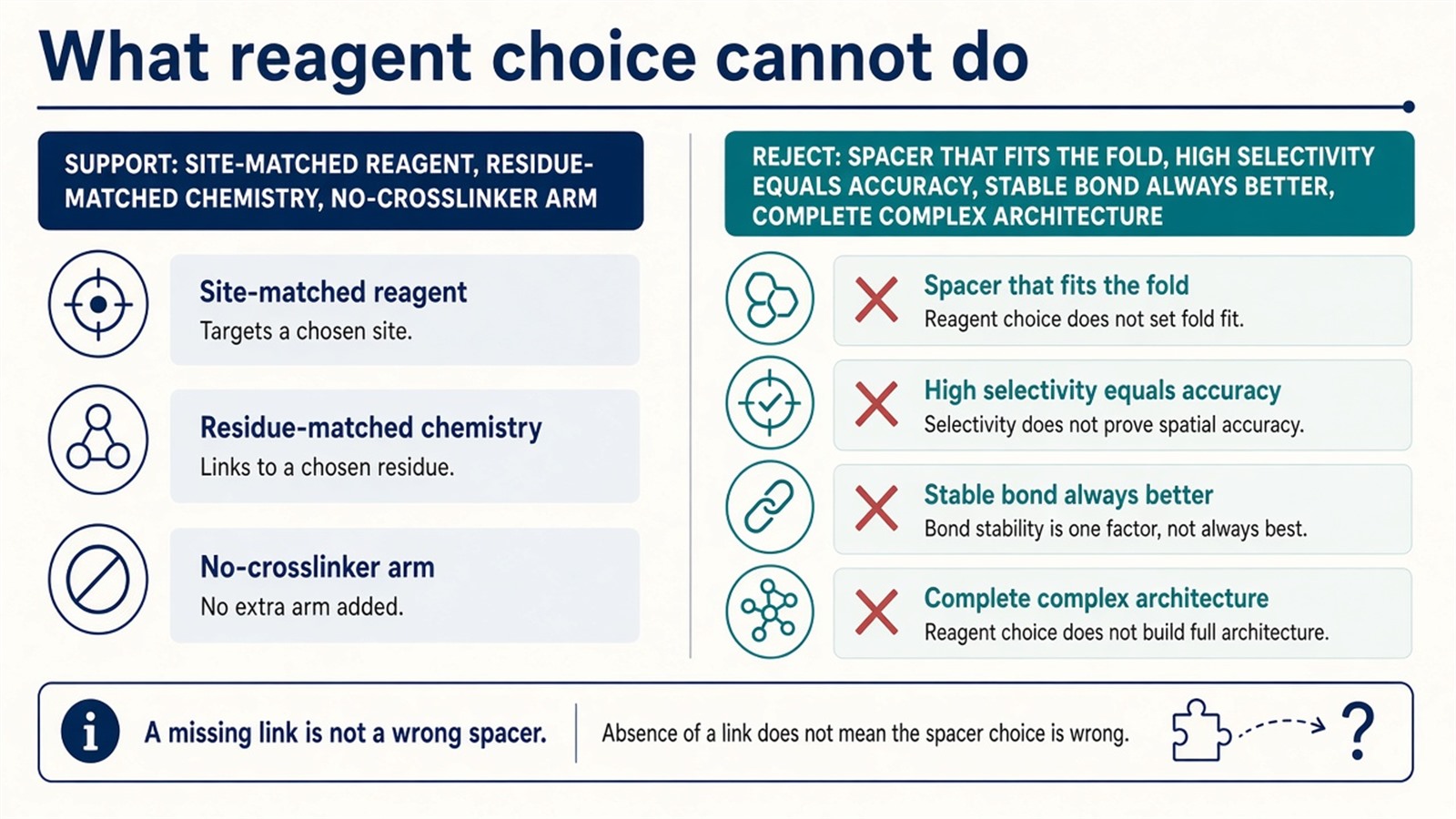
Figure 3. Supported: a site-matched, residue-matched, search-matched reagent. Not granted: a spacer that fits the fold, higher structural accuracy from selectivity, or a complete architecture.
Experimental Limits
Crosslinker selection reduces a structural claim to what one reagent class, one spacer reach, one digestion, and one search can report. Diagnostic or complete-architecture language sits outside ordinary research reporting unless a separately validated structural method is in place.
Project Planning and Service Scope
A usable reagent plan names the reaction site, the residue class, whether the spacer must be MS-cleavable, and the claim that will be allowed, before the first dose. MtoZ Biolabs scopes crosslinking MS with Orbitrap-class LC-MS/MS. Interpretability still follows those choices, not a generally stable reagent slogan.
Once the next sentence is a wash-stable partner list rather than a residue pair, the project should not be forced through a longer spacer. Researchers who need that pellet can review the MtoZ Biolabs Co-IP-MS Protein Interaction Analysis Service for project-specific sample evaluation, feasibility assessment, and workflow planning.
Frequently Asked Questions
1. How should a crosslinker be selected for XL-MS structural work?
From the reaction site, the residue class, and whether the spacer must break in the spectrometer. Not from a list of generally preferable reagents.
2. Are DSS and BS3 the same except for solubility?
They share an amine-reactive spacer near 11 Å. DSS enters cells. BS3 does not. That is a site decision.
3. Should a chemically stable crosslinker always be preferred?
No. MS-cleavable spacers are used because they are meant to break during fragmentation.
4. Does a more selective reagent give a more accurate structure?
No. Selectivity changes which residues can react. Accuracy is the control-filtered, distance-compatible pair.
5. Is EDC a standard XL-MS spacer like DSS?
No. EDC is zero-length carboxyl–amine chemistry. It is not a DSS/BS3-class spacer.
Reference
- Leitner A., Faini M., Stengel F., Aebersold R. (2016). Crosslinking and mass spectrometry: an integrated technology to understand the structure and function of molecular machines. Trends Biochem. Sci., 41, 20-32. https://doi.org/10.1016/j.tibs.2015.10.008
- O'Reilly F.J., Rappsilber J. (2018). Cross-linking mass spectrometry: methods and applications in structural, molecular and systems biology. Nat. Struct. Mol. Biol., 25, 1000-1008. https://doi.org/10.1038/s41594-018-0147-0
- Kao A., Chiu C.L., Vellucci D., et al. (2011). Development of a novel cross-linking strategy for fast and accurate identification of cross-linked peptides of protein complexes. Mol. Cell. Proteomics, 10, M110.002212. https://doi.org/10.1074/mcp.M110.002212
- Yu C., Huang L. (2018). Cross-linking mass spectrometry: an emerging technology for interactomics and structural biology. Anal. Chem., 90, 144-165. https://doi.org/10.1021/acs.analchem.7b04431
- Merkley E.D., Rysavy S., Kahraman A., et al. (2014). Distance restraints from crosslinking mass spectrometry: mining a molecular dynamics database to evaluate lysine-lysine distances. Protein Sci., 23, 747-759. https://doi.org/10.1002/pro.2458
