



Endogenous SUMO Co-IP and IP-MS ask which proteins remain with a native SUMO-related bait after antibody capture, Input and IgG contrast, and either targeted detection or LC-MS/MS identification. The antibody must recover endogenous SUMO1, SUMO2/3, or a SUMOylated protein without a dominant off-target. Isopeptidases must be controlled so conjugates are not lost before capture. The design fits cells or tissues when an IP-competent antibody exists and the claim is co-recovery or conjugate enrichment, not binary direct binding or a mapped SUMO site (Hein et al. 2015). Prefer this route when Input shows the bait and conjugates survive lysis. Reassess when the antibody is Western-only, isopeptidase inhibition is omitted, or overexpression stands in for the endogenous state.
Researchers who already have a SUMO or substrate antibody, a written SUMO claim, and planned Input and IgG arms can also review the MtoZ Biolabs IP-Mass Spectrometry Service and Protein-Protein Interaction Analysis for project-specific SUMO Co-IP feasibility.
What Endogenous SUMO Co-IP Is Designed to Answer
Endogenous SUMO Co-IP is not a 12-step blot recipe. Write the claim first. A native Co-IP asks which proteins remain with endogenous SUMO or with a SUMOylated bait under non-denaturing lysis. A conjugate-enrichment IP asks which proteins carry SUMO after capture with a SUMO antibody, and that route is often run under denaturing conditions so non-covalent partners are stripped (Tatham et al. 2009). Mixing those claims turns every co-eluting name into an apparent SUMO substrate.
Transient overexpression of SUMO or of a substrate is not an endogenous Co-IP. It can raise conjugate abundance for a pilot. It also creates a tagged or non-native pool and should be read as a tagged capture, not as native SUMO biology. How tagged versus antibody interactomes diverge is covered in AP-MS vs IP-MS: How to Choose the Right Interactome Workflow.
The ending can be Co-IP western blot or IP-MS. Both still need bait recovery and matched controls. Readout choice is compared in IP-MS vs Co-IP Western Blot: Which Method Fits Your Study?. Site-level SUMOylation identification is a different experiment and is scoped through the Protein Sumoylation Identification Service.
Endogenous SUMO Co-IP supports candidate co-recovery or conjugate enrichment after native capture. It does not map a SUMO site or prove a direct contact.
Antibody Specificity for SUMO1, SUMO2/3, or a SUMOylated Bait
Antibody specificity decides whether the eluate is a SUMO1 list, a SUMO2/3 list, a mixed conjugate list, or an off-target capture. SUMO2 and SUMO3 are closely related. A clone that works on a denatured blot may not immunoprecipitate the native conjugate, and a SUMO1 antibody may not report SUMO2/3 chains (Uhlen et al. 2016). How to qualify an IP reagent is covered in How to Choose the Right Antibody for Co-IP Assays?.
Record which paralog the antibody is claimed to recognize, the clone, lot, host species, and bead pairing. If the bait is a substrate protein rather than SUMO itself, the antibody must recover that endogenous protein under the planned lysis, including any isopeptidase inhibitor. A smear above the unmodified mass on blot is a candidate conjugate pattern. It is not a site assignment and it is not proof that every slower band is SUMO.
Do not raise antibody input only to chase a faint high-mass smear. Extra IgG increases chain carryover and can hide low-abundance conjugates in IP-MS. Free SUMO is often more abundant than conjugates. An antibody that prefers free SUMO can fill the eluate without recovering the modified substrates the claim needed.
Input and IgG Must Share Isopeptidase Control
Input and IgG are the tests that make a SUMO Co-IP readable. They must receive the same lysis chemistry as the bait IP, including the same isopeptidase inhibition. N-ethylmaleimide and related cysteine-directed inhibitors are commonly used to block SUMO proteases during lysis (Tatham et al. 2009). An Input prepared without that block cannot explain a missing conjugate in the IP.
Input is taken before capture. It shows whether unmodified bait, free SUMO, and any high-mass conjugate pattern were present after lysis. If Input lacks the conjugate ladder, the problem is expression, extraction, or deconjugation, not a missing interaction.
IgG or bead controls must use the same lysate batch, inhibitor panel, wash, and elution. SUMO-associated lists are rich in nuclear and sticky proteins. Matched IgG is how those binders are seen. Empty-tag controls from overexpressed SUMO do not replace IgG in an endogenous antibody design. Preclearing can lower some bead binders. It does not replace Input or IgG.
SUMO protocol arm |
Design job |
What it cannot do |
|---|---|---|
SUMO or substrate antibody |
Recover the intended endogenous bait or conjugate class |
Convert a Western-only or cross-paralog clone into IP-grade capture |
Input with the same inhibitor |
Show free SUMO, unmodified bait, and surviving conjugates |
Prove the IP antibody works |
IgG or bead with the same inhibitor |
Estimate handle-driven background in this SUMO lysis |
Replace Input, or replace IgG with an overexpression empty-tag |
Isopeptidase block |
Slow loss of conjugates during lysis |
Create SUMOylation that was not present in the cell |
Wash and elution |
Set retention versus background for blot or MS |
Rescue a failed antibody or a deconjugated Input |
A practical endogenous sequence is:
- Write whether the claim is native partners, conjugate enrichment, or a later site test.
- Confirm the antibody paralog and native recovery versus Input.
- Lyse bait IP, Input, and IgG with the same isopeptidase block.
- Confirm bait or conjugate recovery before scaling LC-MS/MS.
- Rank remaining names against matched IgG, not against a high-mass smear alone.
Generic placement of those arms is covered in Designing an Efficient Co-immunoprecipitation (Co-IP) Protocol. Sample-prep parity after elution is covered in How to Prepare Immunoprecipitation Samples for Mass Spectrometry.
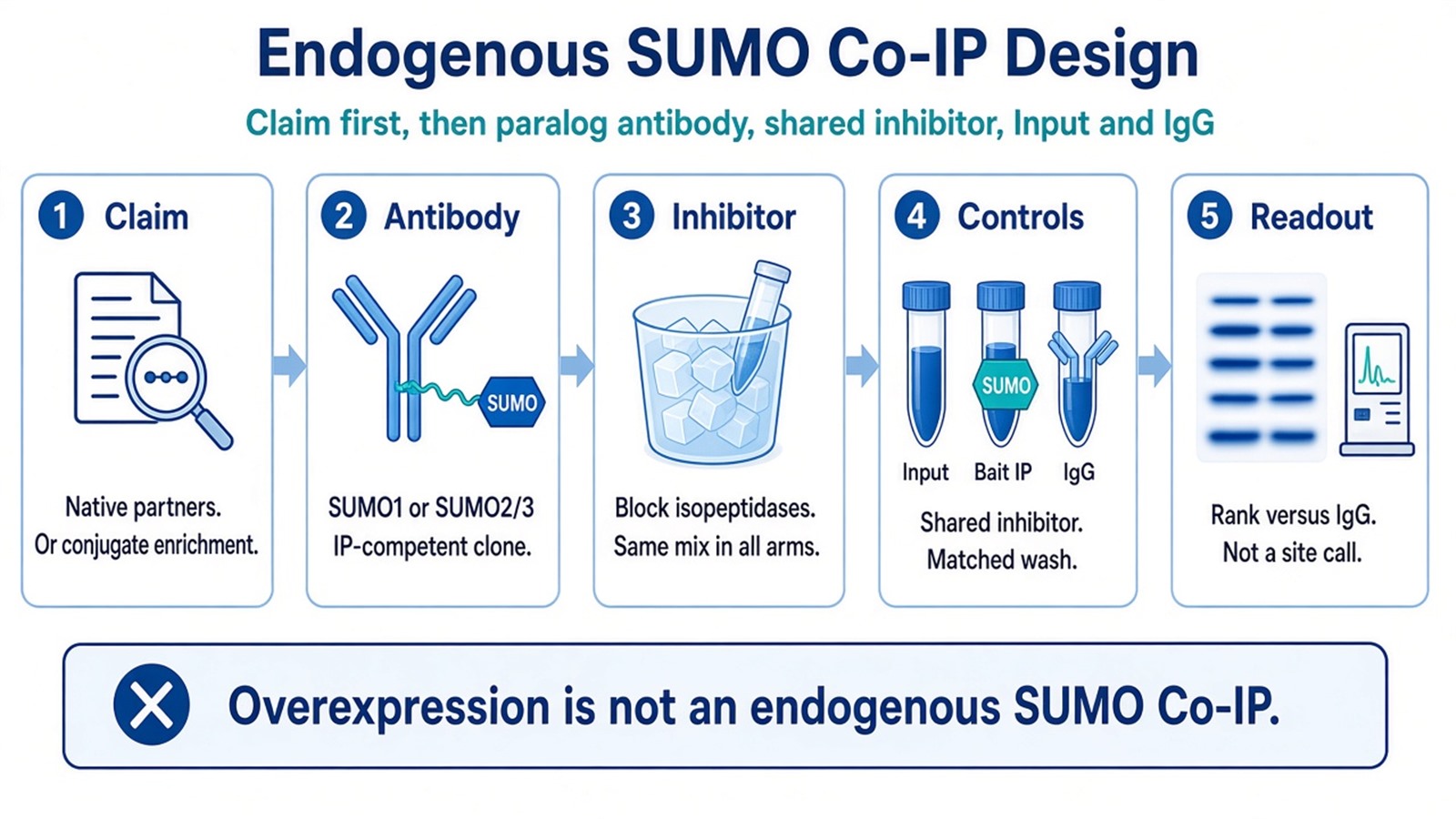
Figure 1. Endogenous SUMO Co-IP starts with the claim and the paralog. An overnight blot recipe is not a finished design.
Enrichment Efficiency and Mass Spectrometry Credibility
Enrichment efficiency is bait-first. If free SUMO is recovered and the high-mass conjugate pattern is not, the eluate is not a SUMOylome. Relative intensity can compare the same protein across Input, IgG, and bait IP, or across treatments that used one antibody and one inhibitor recipe. It does not rank unrelated proteins as preferred SUMO substrates, and a darker smear is not a higher site occupancy.
For blot endings, antibody heavy chain near 50 kDa can hide unmodified SUMO or a small substrate. For IP-MS endings, antibody chains, free SUMO, and abundant nuclear proteins can dominate sampling. Identification depth in a Co-IP-style eluate is typically hundreds to about a thousand proteins, depending on the sample. Depth without conjugate or bait recovery is background.
SUMO proteomics compilations show that candidate lists depend on enrichment chemistry and should not be read as a complete SUMOylome (Hendriks and Vertegaal 2016). Identification of a protein in a SUMO IP is not a site call. Ranking still requires bait or conjugate recovery and a declared contrast against IgG. Probabilistic scoring such as SAINT uses bait versus control counts to assign a probability that a prey is specifically co-purified (Choi et al. 2011). That probability is not proof of covalent SUMO attachment.
After those gates, a protein-level value can support: protein B is enriched with endogenous SUMO, or with a SUMOylated bait A, versus matched IgG inside this lysis and inhibitor recipe. Peptide support, paralog antibody, and whether the IP was native or denaturing belong next to that statement. A later site experiment is required before writing that a specific lysine is SUMOylated.
If the intended SUMO or substrate is missing after capture, diagnose recovery before ranking prey, as in Why Was the Target Protein Not Detected by IP-MS?.
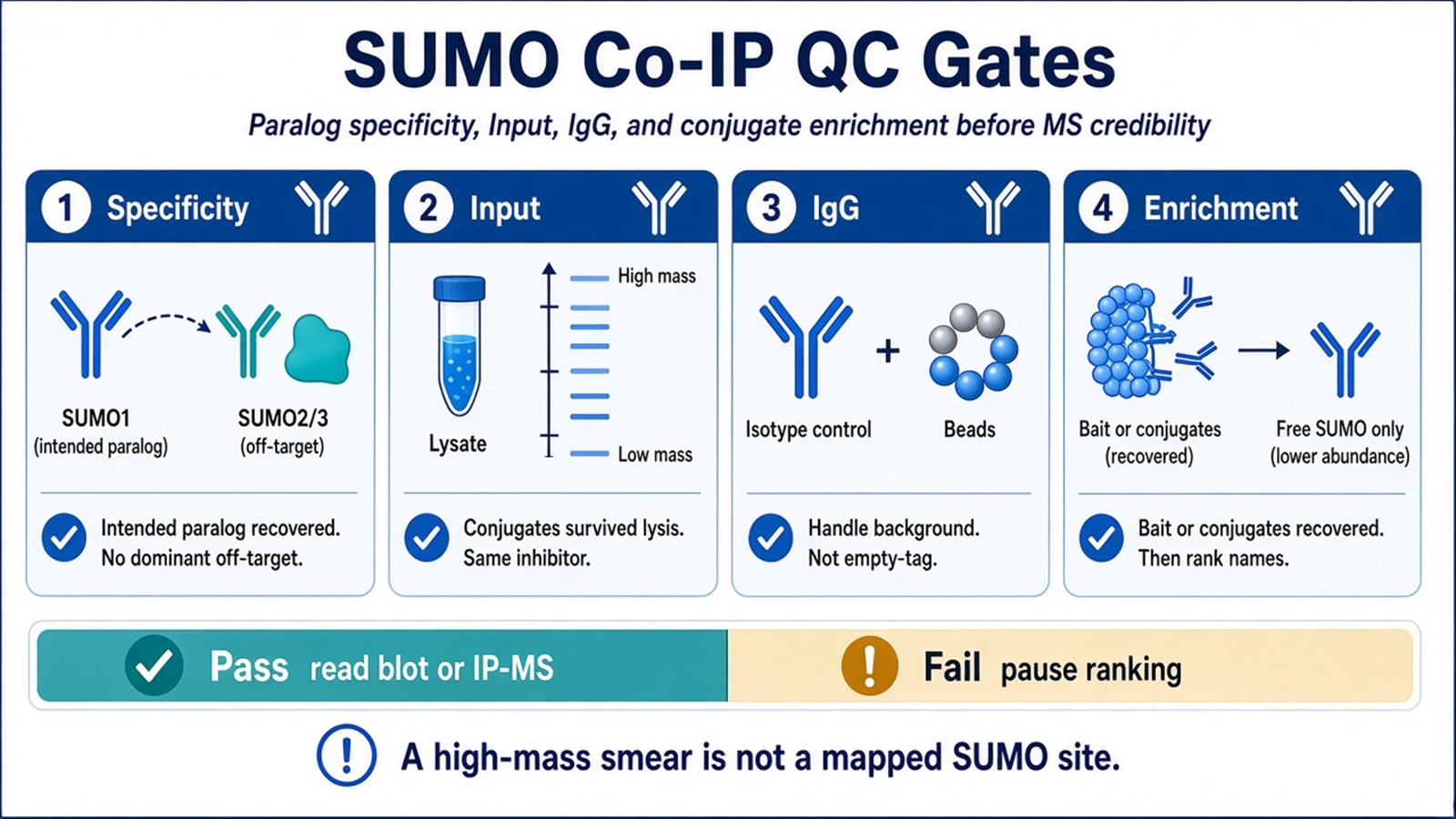
Figure 2. Mass spectrometry credibility starts after SUMO or conjugate recovery is shown versus inhibitor-matched Input and IgG.
Common Biases and Result Boundaries
The common bias is treating a 12-step endogenous protocol as transferable, then adding transfected SUMO to make the blot look stronger. Another bias is reading every protein in a SUMO IP as a covalent substrate, including proteins that bind free SUMO or the antibody handle. Omitting isopeptidase inhibition makes conjugates disappear and then looks like a negative interaction. Over-washing a native SUMO Co-IP can strip partners while leaving free SUMO on the beads.
Do not write a successful SUMO bait IP as proof that every remaining protein is SUMOylated. Do not write a missing high-mass band as proof that the substrate is not modified in the cell. Absence can mean the wrong paralog antibody, deconjugation during lysis, over-washing, or a bait that is not expressed in the tested state.
Prefer native endogenous Co-IP or IP-MS when the claim is co-recovery with SUMO or a SUMOylated bait. Prefer a denaturing SUMO IP or a dedicated site workflow when the claim is covalent attachment. Prefer tagged SUMO capture only when no IP-competent endogenous antibody exists and tagging is acceptable. Mixed enrichment-MS projects can be reviewed under the MS-Based Protein-Protein Interaction Analysis Service.
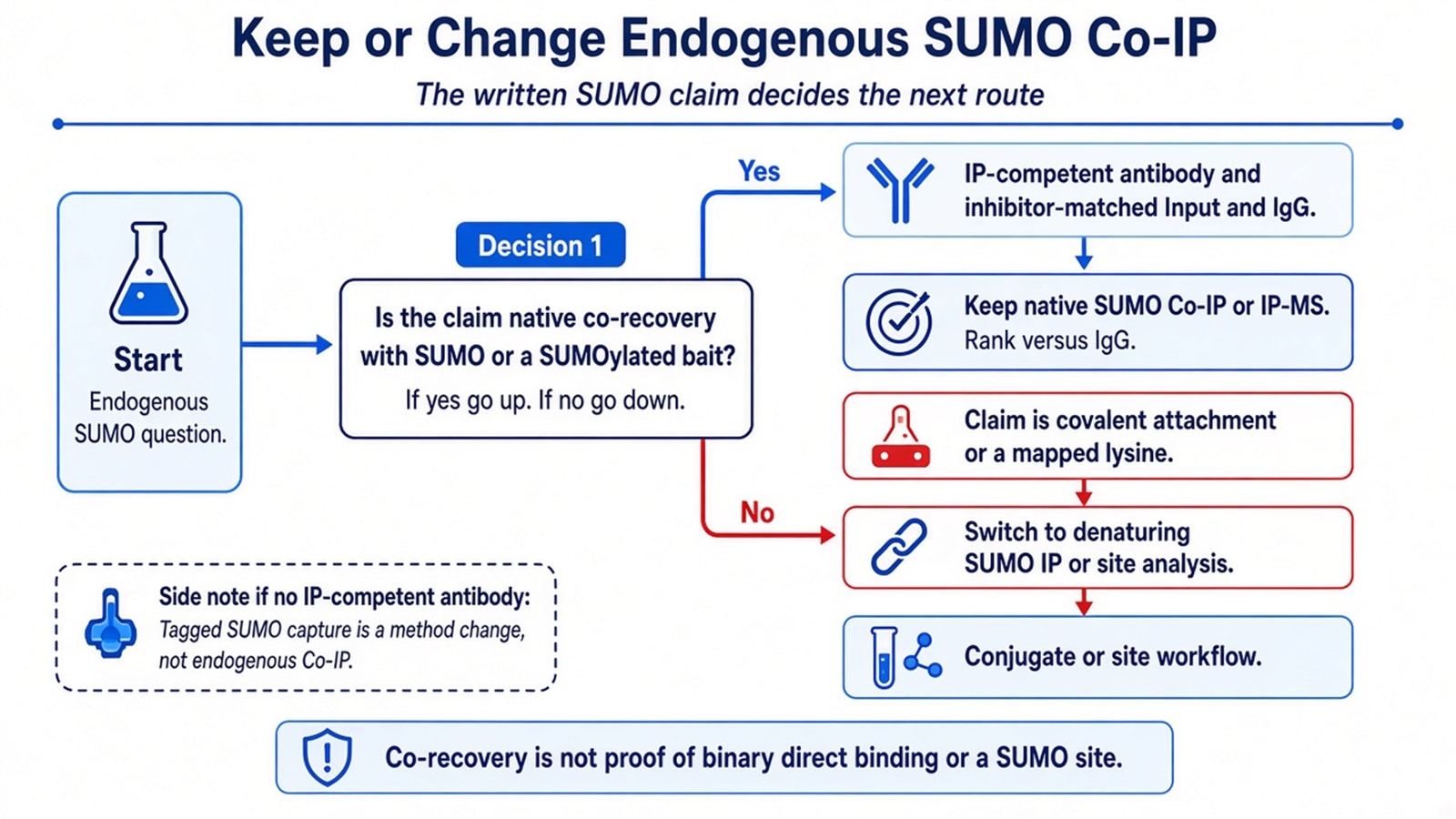
Figure 3. Stay with endogenous SUMO Co-IP only while the claim is co-recovery and native bait or conjugate recovery is documented.
Endogenous SUMO Co-IP and IP-MS support candidate co-recovery or conjugate enrichment after antibody, Input, IgG, and bait recovery are shown. They do not certify a SUMO site or a binary interactome.
Once the SUMO claim, paralog antibody, inhibitor-matched Input and IgG plan, and the intended blot or IP-MS readout are defined, the project can be scoped as endogenous SUMO Co-IP or IP-MS. Researchers can review the MtoZ Biolabs IP-Mass Spectrometry Service for sample evaluation and SUMO-protocol planning.
Frequently Asked Questions
1. Is NEM required for every endogenous SUMO Co-IP?
An isopeptidase block is required when the claim depends on intact conjugates. Input, IgG, and bait IP must receive the same block. The inhibitor does not create SUMOylation.
2. Can a SUMO1 antibody be used to report SUMO2/3 conjugates?
Only if that clone is shown to recover SUMO2/3 under the planned IP chemistry. Paralog cross-reactivity on blot is not IP-grade proof.
3. Does a high-mass smear after SUMO Co-IP prove the substrate is SUMOylated?
No. The smear is a candidate conjugate pattern. A site-level assay is required before a lysine is written as SUMOylated.
4. Can transfected SUMO replace an endogenous SUMO Co-IP?
No. Overexpression changes abundance and partner occupancy. Treat it as tagged capture, not as the endogenous state.
5. When should endogenous SUMO Co-IP move to denaturing SUMO IP or site analysis?
Move when the written claim is covalent attachment rather than native co-recovery. Keep Input and a matched control on that route as well.
Reference
- M.H. Tatham, M.S. Rodriguez, D.P. Xirodimas, R.T. Hay (2009). Detection of protein SUMOylation in vivo. Nat. Protoc., 4, 1363-1371. https://doi.org/10.1038/nprot.2009.128
- I.A. Hendriks, A.C.O. Vertegaal (2016). A comprehensive compilation of SUMO proteomics. Nat. Rev. Mol. Cell Biol., 17, 581-595. https://doi.org/10.1038/nrm.2016.81
- M. Uhlen, A. Bandrowski, S. Carr, A. Edwards, J. Ellenberg, E. Lundberg, D. L. Rimm, H. Rodriguez, T. Hiltke, M. Snyder, T. Yamamoto (2016). A proposal for validation of antibodies. Nat. Methods, 13, 823-827. https://doi.org/10.1038/nmeth.3995
- M.Y. Hein, N.C. Hubner, I. Poser, J. Cox, N. Nagaraj, Y. Toyoda, I.A. Gak, I. Weisswange, J. Mansfeld, F. Buchholz, et al. (2015). A human interactome in three quantitative dimensions organized by stoichiometries and abundances. Cell, 163, 712-723. https://doi.org/10.1016/j.cell.2015.09.053
- H. Choi, B. Larsen, Z.Y. Lin, A. Breitkreutz, D. Mellacheruvu, D. Fermin, Z.S. Qin, M. Tyers, A.C. Gingras, A.I. Nesvizhskii (2011). SAINT: probabilistic scoring of affinity purification-mass spectrometry data. Nat. Methods, 8, 70-73. https://doi.org/10.1038/nmeth.1541
