



Ratio compression in tandem mass tag (TMT) proteomics is diagnosed when measured reporter-ion fold changes are systematically closer to one than the expected biological contrast, especially in complex digests acquired with MS2 reporters. It arises mainly because co-isolated peptides in the precursor window also release reporter ions and dilute channel differences. Compression weakens relative magnitude estimates inside a closed plex; it does not create absolute protein concentration. Ordinary TMT remains limited to relative quantification because reporter intensities lack a matched calibrator and peptide ionization responses are not universal conversion factors. Absolute amount requires stable isotope-labeled standards (SIS) or an equivalent calibration model outside the discovery TMT table (Ting et al. 2011).
Researchers who already have a closed TMT plex or compressed-ratio concerns can also review the MtoZ Biolabs TMT Quantitative Proteomics Analysis Service for project-specific feasibility and acquisition planning.
How Ratio Compression Arises
TMT labels peptides so that channels share one MS1 precursor and release distinct reporters after fragmentation. In conventional MS2 quantification, reporters are taken from the same isolation event used for identification. When nontarget peptides enter that window, they contribute reporters even if they contribute little usable sequence evidence for the target. The mixed reporter population pulls large true ratios toward one. That underestimation is ratio compression (Ting et al. 2011).
Two conditions make the problem severe: high peptide density in tissue or biofluid digests, and shallow fractionation that leaves many co-eluting precursors in each liquid chromatography-tandem mass spectrometry (LC-MS/MS) run. Isolation width, plex size, and chromatography all change how often co-isolation occurs. Naming TMT without those parameters does not specify quantitative quality.
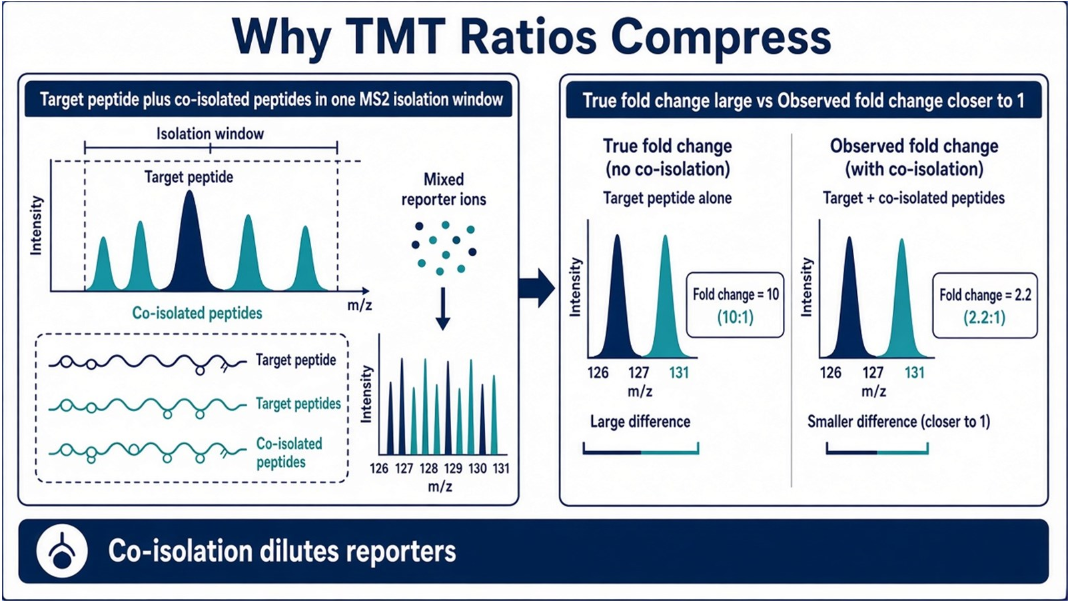
Figure 1. Ratio compression arises when co-isolated peptides dilute reporter-ion differences; the observed fold change moves toward one.
A compressed TMT ratio is still a relative channel comparison; it is a weaker estimate of the true fold change.
Troubleshooting: Compression Versus Other Ratio Failures
Treat underestimated fold changes as a decision tree before changing every search filter.
|
Symptom or finding |
Likely cause |
First check |
|---|---|---|
|
Many true contrasts look smaller than orthogonal assays or known spikes |
MS2 co-isolation / ratio compression |
Isolation width, fractionation, MS2 vs MS3 plan |
|
One channel globally high or low |
Load mismatch before labeling |
Protein assay and digest yields |
|
Unlabeled or partially labeled peptides abundant |
Labeling chemistry failure |
Amine buffers, reagent excess, quench, cleanup |
|
Sample IDs disagree with channel map |
Mixing or annotation error |
Rebuild channel map; do not normalize away the swap |
|
Study needs ng/mL or other concentration units |
Wrong quantitative claim for TMT |
Move to AQUA/SIS absolute assay design |
Computational post-correction or reference-channel scaling may adjust magnitudes under stated assumptions. They do not prove that co-isolation was removed, and they do not convert the matrix into absolute concentration.
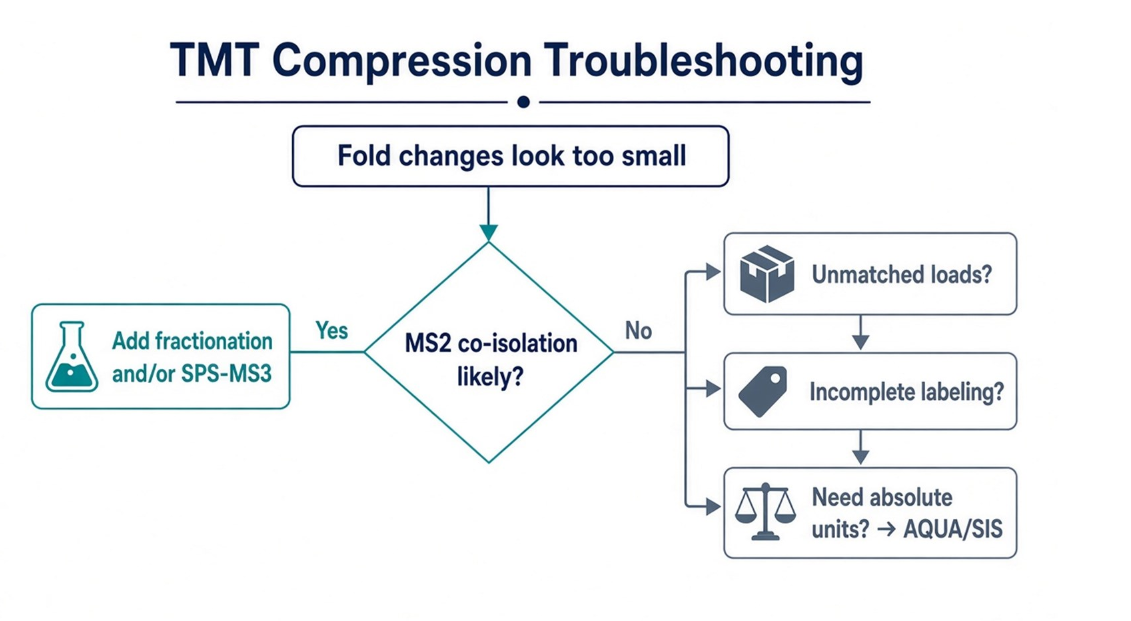
Figure 2. Confirm whether the problem is reporter co-isolation, upstream labeling failure, or an absolute-unit requirement before choosing the next method.
Why TMT Quantification Is Limited to Relative Claims
TMT reporter intensities compare channels inside one multiplex set. Three design facts keep ordinary TMT relative.
1. No calibrator is required by the labeling chemistry
A complete TMT kit can be run without SIS peptides or a concentration curve. Relative ratios are then the intended product. Absolute amount needs matched standards and a stated calibration model, usually as a separate targeted assay.
2. Ionization response is peptide-specific
Reporter height for protein A cannot be ranked against protein B as molar amount. Different peptides ionize differently, so intensity is not a universal concentration factor.
3. Compression changes magnitude, not claim type
Even after SPS-MS3 reduces co-isolation on compatible instruments (McAlister et al. 2014), the readout remains a relative ratio inside the plex. Cleaner reporters improve relative accuracy; they do not invent calibrated units.
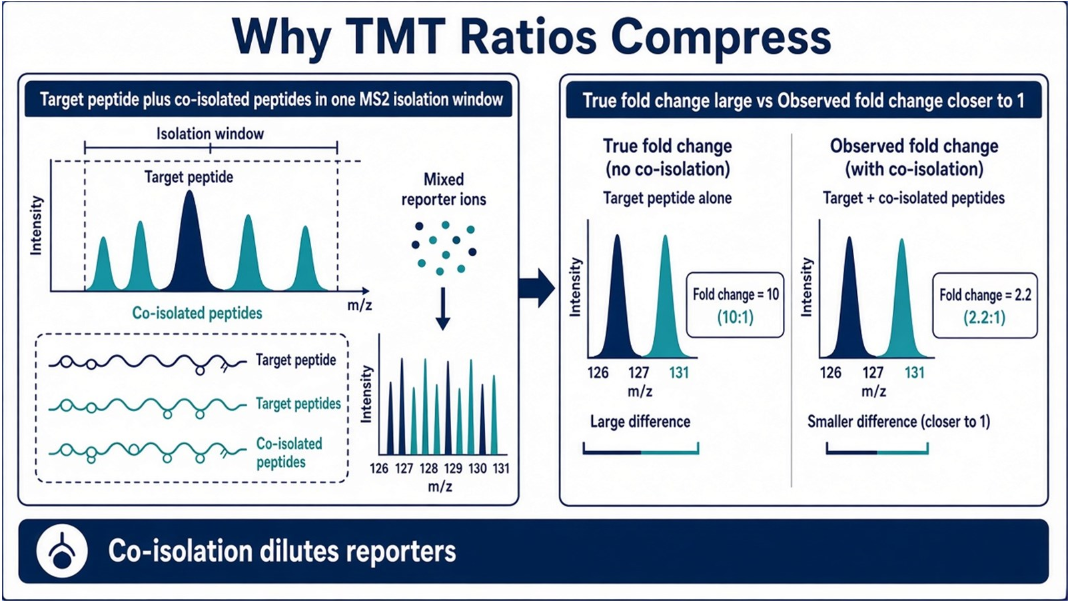
Figure 3. Ratio compression affects how large a relative change appears; absolute concentration still requires standards and calibration outside ordinary TMT discovery tables.
For acquisition-level mitigation of compression, researchers can refer to TMT MS3 and SPS-MS3: How to Mitigate Ratio Compression and Enhance Quantitative Accuracy and How Can SPS-MS3 Be Utilized to Optimize TMT Workflows and Minimize Ratio Compression?. For absolute unit design, see Absolute Protein Quantification: Methods and Uses.
Judgment Criteria: When TMT Still Fits Despite Compression Risk
|
Study need |
TMT often still fits |
Reassess before labeling |
|---|---|---|
|
Claim |
Relative ranking or directional change inside one plex |
Concentration, ppm, or stoichiometric absolute units |
|
Matrix |
Complex digest acceptable if fractionation or MS3 is planned |
Expect MS2 alone to recover true large fold changes |
|
Design |
Cohort freezes in one commercial kit |
Open enrollment after mixing |
|
Mitigation path |
Fractionation and/or SPS-MS3 available when magnitude matters |
Platform cannot support MS3 and density stays high |
|
Upstream QC |
Loads matched; labeling complete; channel map locked |
Chemistry already confounds reporters |
Prefer TMT when same-run relative comparison is the goal and compression risk is managed by design. Prefer unlabeled LFQ or DIA when samples must stay independent. Prefer AQUA or other SIS absolute assays when defined units are required.
Limits and Application Boundaries
Compression can raise false negatives for large differentials and bias pathway lists that depend on fold-change cutoffs. Residual interference can remain even after MS3. Cross-plex comparison still needs bridging. Diagnostic cutoffs and clinical decision rules sit outside ordinary research TMT reporting unless a separately validated assay framework is in place.
Typical applications remain multi-condition drug studies, genotype or treatment panels, and biomarker discovery cohorts that accept relative ratios inside a frozen plex. When the scientific decision needs concentration, redesign for absolute quantification rather than over-interpreting reporter height.
Once the compression diagnosis, relative-versus-absolute claim, and mitigation path are defined, the project can be evaluated as a TMT quantitative design study. Researchers can review the MtoZ Biolabs TMT Quantitative Proteomics Analysis Service for sample evaluation, feasibility assessment, and workflow planning. For absolute follow-up on a shortlist, see the Absolute Quantitative Analysis (AQUA) Service.
Frequently Asked Questions
1. How do I know the issue is ratio compression?
Many contrasts shrink toward one while identification still looks usable, and orthogonal or spike-in ratios are larger than TMT MS2 ratios. Global channel skew or unlabeled peptides point elsewhere first.
2. Does ratio compression mean TMT cannot be used?
No. It means relative magnitudes may be underestimated in dense digests. Fractionation, narrower isolation, and SPS-MS3 can reduce the effect when the claim is still relative.
3. Can SPS-MS3 make TMT absolute?
No. SPS-MS3 improves reporter specificity for relative ratios. Absolute amount still needs matched standards and calibration.
4. Can software fully restore true fold changes?
Post-processing adjustments are assumption-dependent. Report them as such. They are not equivalent to cleaner reporter isolation or to an absolute assay.
5. Why can ionization intensity not give concentration in TMT?
Peptide response factors differ. Without a matched calibrator for the analyte, intensity supports relative comparison, not amount in defined units.
Reference
- L. Ting, R. Rad, S.P. Gygi, W. Haas (2011). MS3 eliminates ratio distortion in isobaric multiplexed quantitative proteomics. Nat. Methods, 8, 937-940. https://doi.org/10.1038/nmeth.1714
- G.C. McAlister, D.P. Nusinow, M.P. Jedrychowski, M. Wuhr, E.L. Huttlin, B.K. Erickson, R. Rad, W. Haas, S.P. Gygi (2014). MultiNotch MS3 enables accurate, sensitive, and multiplexed detection of differential expression across cancer cell line proteomes. Anal. Chem., 86, 7150-7158. https://doi.org/10.1021/ac502040v
- A. Thompson, J. Schafer, K. Kuhn, S. Kienle, J. Schwarz, G. Schmidt, T. Neumann, C. Hamon (2003). Tandem mass tags: a novel quantification strategy for comparative analysis of complex protein mixtures by MS/MS. Anal. Chem., 75, 1895-1904. https://doi.org/10.1021/ac0262560
