



Endogenous verification asks whether two proteins associate at native expression levels in the relevant cell or tissue. That sentence is narrower than asking whether the pair can interact after tagging, overexpression, or transfer into yeast. Co-immunoprecipitation (Co-IP) with antibodies against the untagged proteins is the usual first biochemical check. Endogenous immunoprecipitation–mass spectrometry (IP-MS) can open the partner list without introducing a tag. Tagged affinity purification–mass spectrometry (AP-MS), yeast two-hybrid (Y2H), fluorescence resonance energy transfer (FRET), bimolecular fluorescence complementation (BiFC), and immunofluorescence remain useful, but they answer different claims. Immunofluorescence reports co-localization. FRET and BiFC report tagged proximity or complementation. Y2H reports nuclear reconstitution in yeast. Tagged AP-MS reports a neighborhood around an epitope-tagged bait.
A pair can pass a fusion assay and still fail an endogenous Co-IP, or the reverse, if the tag, host, or wash changes occupancy. The verification plan should therefore name which result is allowed to support the word endogenous.
Researchers who already have a nominated pair, native antibodies, or a project objective can also review the MtoZ Biolabs Protein-Protein Interaction Analysis Service for project-specific feasibility and analysis planning.
What Counts as Endogenous Verification
Endogenous work starts from the untagged proteins in the intended cell or tissue, uses an antibody or another reagent that recognizes the native product, and keeps overexpression off the first claim. Knock-in tags at the endogenous locus sit in a gray zone: copy number may be native, but the tag can still change interfaces or traffic. Those experiments should be labeled as endogenous-locus fusions, not as untagged Co-IP.
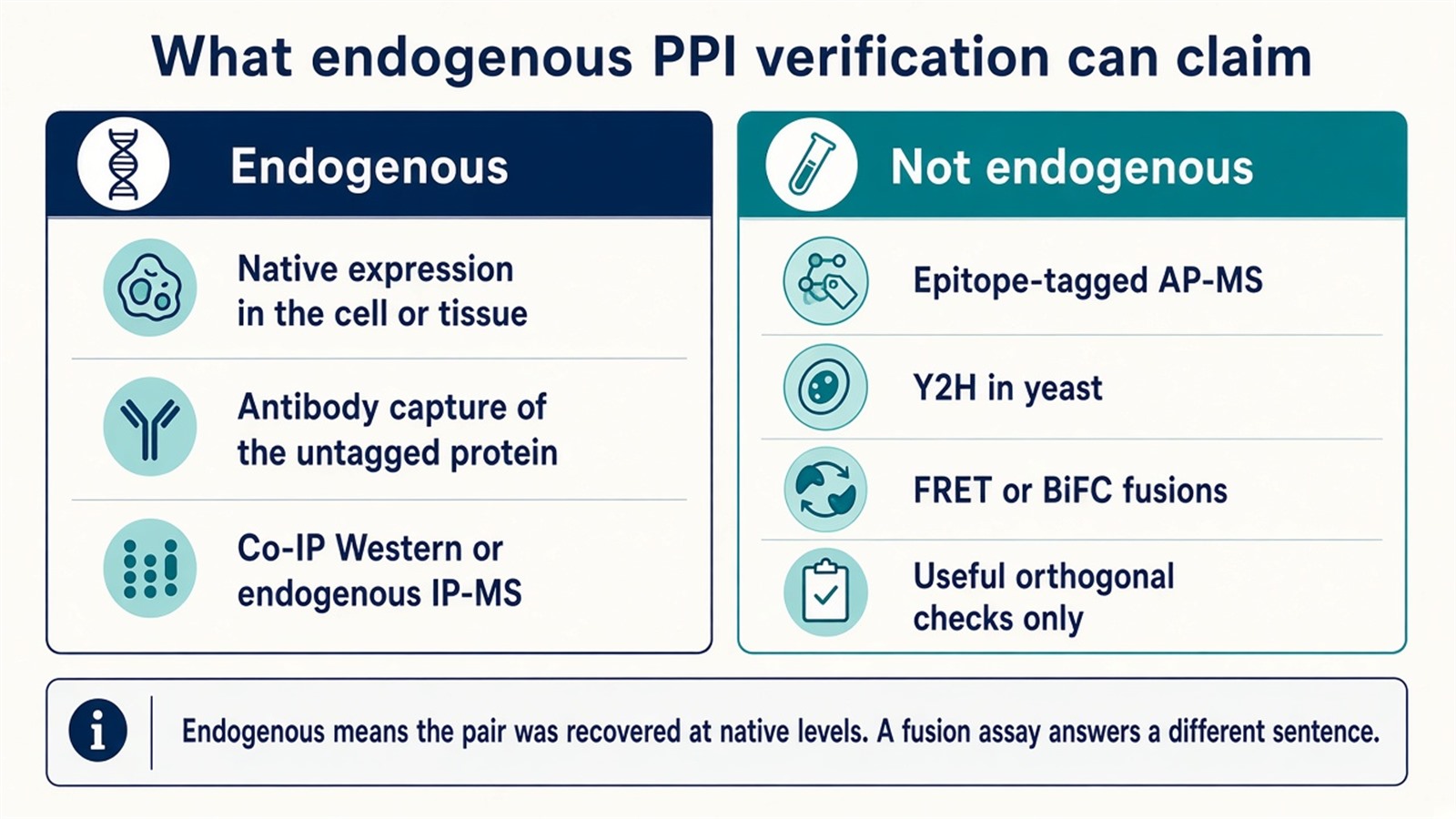
Figure 1. Endogenous verification recovers a native pair by antibody capture. Tagged AP-MS, Y2H, FRET, and BiFC are orthogonal layers and do not inherit the endogenous label.
Endogenous means native level and native sequence in the sample. A successful fusion assay does not convert the result into that claim.
Methods Used to Verify or Support a Nominated Pair
1. Co-Immunoprecipitation (Co-IP)
Co-IP is the primary endogenous method when antibodies exist for at least one partner. An antibody captures protein A from lysate; a Western then asks whether protein B remains after the stated lysis and wash. Isotype, bead-only, and preferably reciprocal Co-IP decide whether the band can be read.
Co-precipitation suggests a wash-stable association. It does not prove a direct binary contact and it loses many transient pairs. Antibody quality is part of the result. For how Co-IP sits among other assessment assays, Common Methods for Assessing Protein-Protein Interactions provides a complementary method map.
2. Affinity Purification–Mass Spectrometry (AP-MS) and endogenous IP-MS
Classic AP-MS purifies an epitope-tagged bait and identifies associated proteins by LC-MS/MS. That is a powerful discovery or orthogonal neighborhood assay. It is not endogenous verification of the two untagged proteins.
The endogenous mass spectrometry route is IP-MS: an antibody against the native bait, matched controls, and peptide identification of the nominated prey or of an open partner list. Empty-bead and isotype controls belong in the same set. For tagged AP-MS design limits, How to Identify Protein–Protein Interactions Using Mass Spectrometry provides a more detailed explanation of evidence type.
3. Yeast Two-Hybrid (Y2H)
Y2H can retest a published pair by reconstituting a transcription-factor reporter in yeast. The assay is a binary genetic check, not an endogenous cellular check. Membrane proteins and modification-dependent mammalian contacts are often missed. A Y2H positive does not verify the pair in the original tissue.
4. Fluorescence Resonance Energy Transfer (FRET)
FRET measures energy transfer between two fluorophores when they approach within a few nanometers. The common format uses fluorescent fusions and often overexpression. It can add live-cell timing for a closed tagged pair. It does not verify the untagged endogenous contact.
5. Bimolecular Fluorescence Complementation (BiFC)
Each partner is fused to a split fluorescent fragment. Interaction reconstitutes fluorescence. BiFC can show where a tagged pair comes together. Some formats lock the complex after complementation. The result is a fusion complementation event, not endogenous co-precipitation.
6. Immunofluorescence
Antibodies with distinct fluorophores can show whether two endogenous proteins occupy the same compartment. Co-localization is necessary background for many interaction claims. It is not physical association. Shared endoplasmic reticulum or nuclear staining does not substitute for Co-IP.
The original grouping that places Y2H, BiFC, and immunofluorescence together as live-cell visualization is not accurate. Y2H is a yeast reporter. Immunofluorescence is usually performed on fixed cells. Only tagged FRET or BiFC, among this set, routinely watches a pair in living cells.
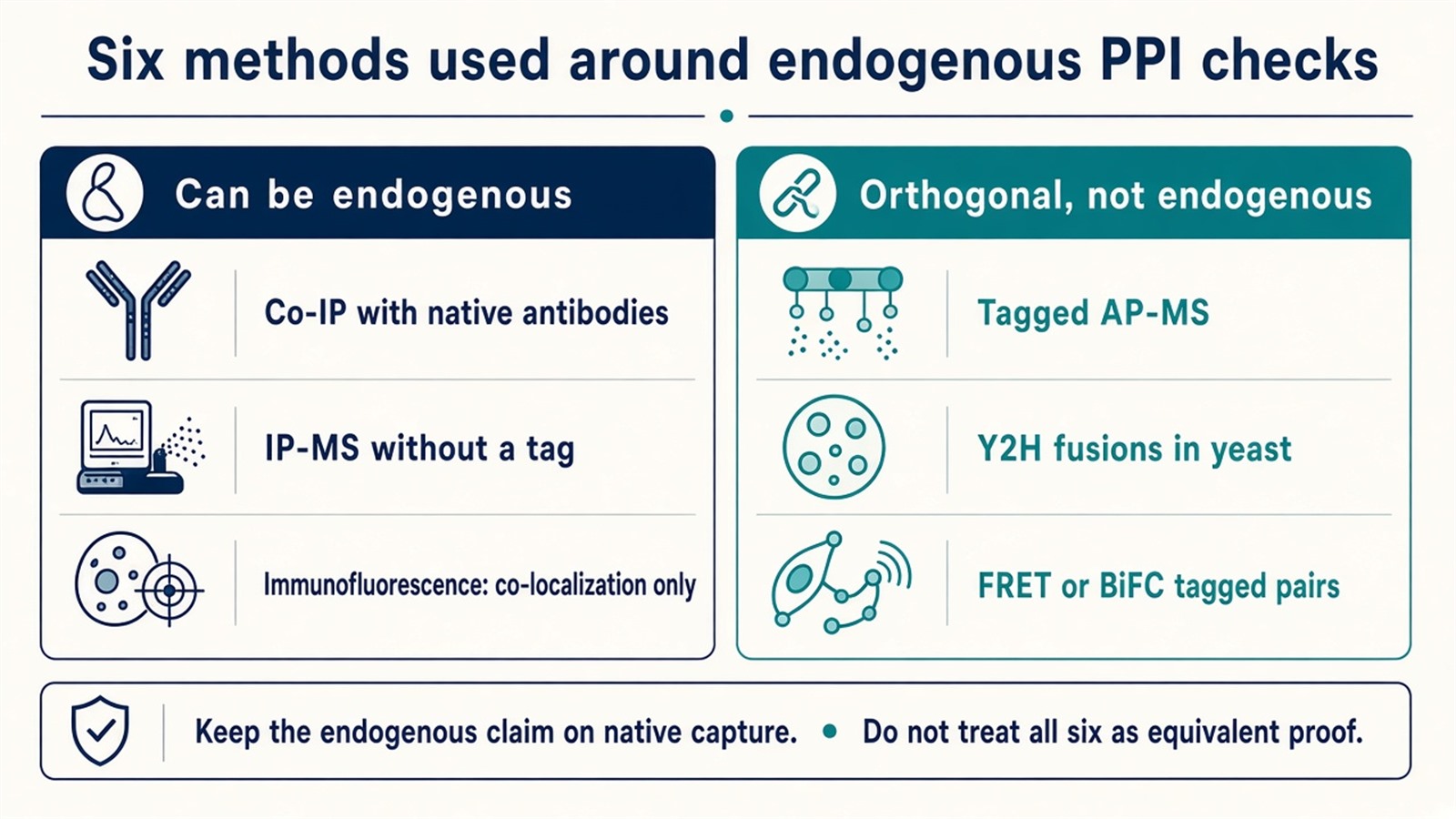
Figure 2. Co-IP, endogenous IP-MS, and immunofluorescence can stay on native proteins; tagged AP-MS, Y2H, FRET, and BiFC remain useful only as separately labeled layers.
How to Choose a Verification Path
If both antibodies work, start with Co-IP, including a reciprocal experiment when reagents allow.
If the prey antibody is weak but the bait antibody is IP-grade, endogenous IP-MS can test whether the nominated protein is present in the eluate.
If the next sentence is only about shared location, immunofluorescence is sufficient and should not be written as interaction proof.
If native Co-IP is negative or impossible, tagged AP-MS, Y2H, FRET, or BiFC can still be run as orthogonal evidence. Those results should not be summarized as endogenous verification.
Protein stability, membrane localization, and wash sensitivity still decide whether a native complex survives lysis. Method choice follows those traits, not a generic ranking of biochemical versus imaging assays. For claim-first selection beyond the endogenous pair question, How to Analyze Protein–Protein Interactions provides a more detailed explanation of analysis claims and method fit.
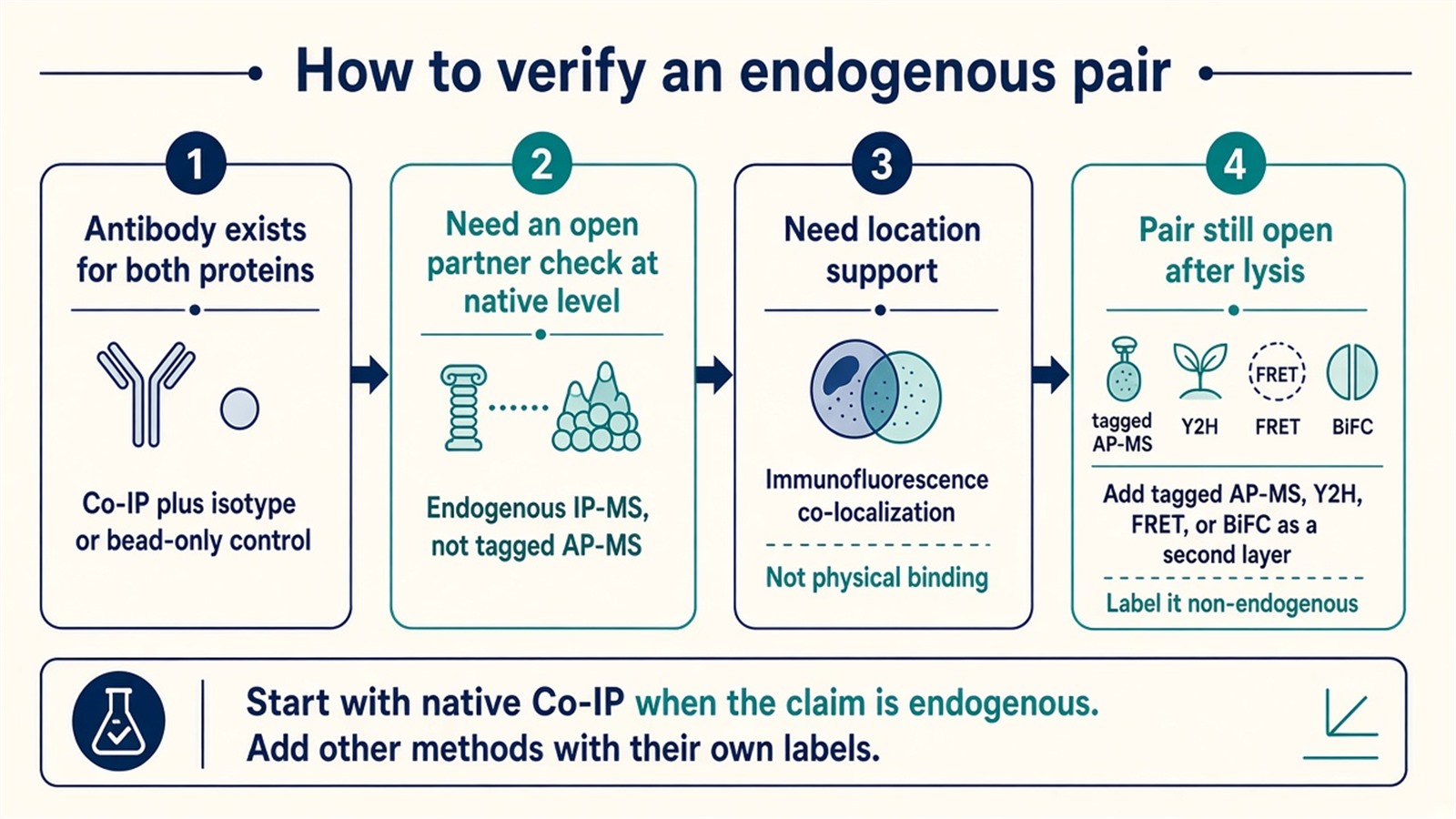
Figure 3. Native Co-IP or IP-MS carries the endogenous claim; immunofluorescence supports location; tagged or yeast assays are added only as a second, labeled layer.
Experimental Limits and Design Boundaries
Endogenous Co-IP fails when the epitope is hidden, the pair is wash-sensitive, or the antibody pulls down abundant contaminants. Reciprocal blots and isotype controls do not convert a remaining contaminant into a partner. Tagged AP-MS can create non-physiological neighbors. Y2H, FRET, and BiFC change sequence context. Immunofluorescence over-interprets overlap. Diagnostic language sits outside ordinary research verification unless a separately validated assay framework is in place.
Project Planning and Service Scope
A usable endogenous plan names the two proteins, the host cell or tissue, the native antibodies, the lysis and wash, and whether a tagged or yeast overlay will be added. MtoZ Biolabs scopes antibody or affinity-tag strategies across common cell systems, Orbitrap-class LC-MS/MS for endogenous IP-MS or tagged AP-MS, and pairwise Western follow-up. Recovery of a low-abundance native pair still depends on antibody performance and wash stringency, not on listing six methods.
Once the endogenous claim, native reagents, and optional orthogonal layer are defined, the project can be scoped as a pairwise PPI verification study. Researchers can review the MtoZ Biolabs Protein-Protein Interaction Analysis Service for project-specific sample evaluation, feasibility assessment, and workflow planning.
Frequently Asked Questions
1. What is the first method for verifying an endogenous pair?
Co-IP with native antibodies, plus isotype or bead-only controls, and a reciprocal blot when possible.
2. Does tagged AP-MS verify an endogenous interaction?
No. It reports partners of an epitope-tagged bait. Endogenous IP-MS is the mass spectrometry format that keeps the bait untagged.
3. Can Y2H, FRET, or BiFC replace endogenous Co-IP?
No. They can support a pair as orthogonal fusion or yeast evidence. They do not inherit the endogenous label.
4. Does immunofluorescence verify a physical interaction?
No. It shows whether two proteins occupy the same compartment. Binding still needs a biochemical or proximity assay matched to the claim.
5. If endogenous Co-IP is negative, is the interaction disproven?
Not always. The pair may be wash-sensitive, the epitope may be blocked, or the complex may be cell-state specific. A negative Co-IP limits the wash-stable native claim. It does not close every other evidence class.
Reference
- Berggard T., Linse S., James P. (2007). Methods for the detection and analysis of protein-protein interactions. Proteomics, 7, 2833-2842. https://doi.org/10.1002/pmic.200700131
- Gingras A.C., Gstaiger M., Raught B., Aebersold R. (2007). Analysis of protein complexes using mass spectrometry. Nat. Rev. Mol. Cell Biol., 8, 645-654. https://doi.org/10.1038/nrm2208
- Fields S., Song O. (1989). A novel genetic system to detect protein-protein interactions. Nature, 340, 245-246. https://doi.org/10.1038/340245a0
- Kerppola T.K. (2008). Bimolecular fluorescence complementation (BiFC) analysis as a probe of protein interactions in living cells. Annu. Rev. Biophys., 37, 465-487. https://doi.org/10.1146/annurev.biophys.37.032807.125842
- Sekar R.B., Periasamy A. (2003). Fluorescence resonance energy transfer (FRET) microscopy imaging of live cell protein localizations. J. Cell Biol., 160, 629-633. https://doi.org/10.1083/jcb.200210140
- Masters S.C. (2004). Co-immunoprecipitation from transfected cells. Methods Mol. Biol., 261, 337-350. https://doi.org/10.1385/1-59259-762-9:337
