



How to use GFP tags for co-immunoprecipitation (Co-IP) means expressing the bait as a green fluorescent protein (GFP) fusion, capturing that fusion with an anti-GFP reagent, and asking which proteins co-recover under a non-denaturing lysis (Rothbauer et al. 2008). The protocol-guide URL and the how-to-use-GFP-tags URL name the same tagged-capture task. They do not name an endogenous antibody Co-IP, a direct-binding certificate, or a complete interactome. Fluorescence can confirm that the fusion is expressed and where it localizes. It does not prove that every co-eluted protein touches the bait. The valid result is bait recovery plus partner evidence at the stringency that was used.
Researchers who already have a GFP-tagged bait, comparison groups, or a specific project objective can also review the MtoZ Biolabs Co-IP-MS Protein Interaction Analysis Service for project-specific feasibility and analysis planning.
What a GFP-Tag Co-IP Can Claim
A GFP-tag Co-IP reports proteins that remain associated with the fusion through lysis, capture, and wash. Western blot tests a prechosen prey. Liquid chromatography-tandem mass spectrometry (LC-MS/MS) expands the searchable partner space. Both readouts inherit overexpression, tag placement, and bead background.
The tag removes the need for a bait-specific immunoprecipitation antibody. It does not remove the need for a prey antibody if the endpoint is a Western blot of a known pair. GFP-Trap and related nanobody resins are high-affinity anti-GFP capture tools (Rothbauer et al. 2008). High affinity improves bait recovery. It does not, by itself, make the lysate physiological or erase tag steric effects.
Empty GFP, untagged bait, and bead-only captures are part of the claim. A prey that binds GFP or the resin in the absence of the fused bait is not a bait-specific partner. Colocalization supports spatial proximity. It is not a substitute for the precipitation.
GFP-tag Co-IP recovers a fusion and its wash-surviving partners; it does not certify a native, untagged complex.
How the Tagged Capture Is Set Up
Build the fusion so the GFP moiety is accessible and the bait still reaches the intended compartment. N-terminal and C-terminal fusions can differ in folding, trafficking, and partner access. A single orientation is a starting construct, not a finished proof. Vector names such as pEGFP-N1 or pEGFP-C1 identify a common cloning format. They do not define the scientific claim.
Expression must be high enough to recover bait and low enough that the fusion does not form new, concentration-driven contacts. Transient transfection in a workhorse line is a convenience. Stable or lower expression is often closer to the intended biology. Fluorescence is a planning check for integrity and localization, not a binding assay.
Lyse under non-denaturing conditions, on ice or at 4 °C, with protease inhibition, so complexes that can survive detergent remain intact. Detergent identity, salt, and wash count trade recovery against background. A harsher wash favors stable particles and loses weak or transient contacts. Those buffer choices are study parameters. They are not a single locked recipe for every bait.
Capture uses washed anti-GFP beads or GFP-Trap resin, then elution for gel analysis or on-bead digestion for MS. Conventional anti-GFP immunoglobulin and nanobody resins are both tagged-bait captures. They differ in reagent format and elution behavior. Naming GFP-Trap does not make the experiment an endogenous Co-IP.
Design choice |
What the result can support |
What it cannot support by default |
|---|---|---|
N- versus C-terminal GFP |
Whether that orientation recovers bait and a tested prey |
That the untagged protein uses the same partners |
GFP-only or empty-vector capture |
Prey that binds GFP or resin without the fused bait |
A clean background if the control was omitted |
Closed-pair Western blot |
Presence of a prechosen prey with the fusion |
An open partner list |
Co-IP plus LC-MS/MS |
Candidate proteins that co-recovered with the fusion |
Direct contact or a tissue interactome |
Harsh wash |
Enrichment of wash-stable associations |
Recovery of weak signaling contacts |
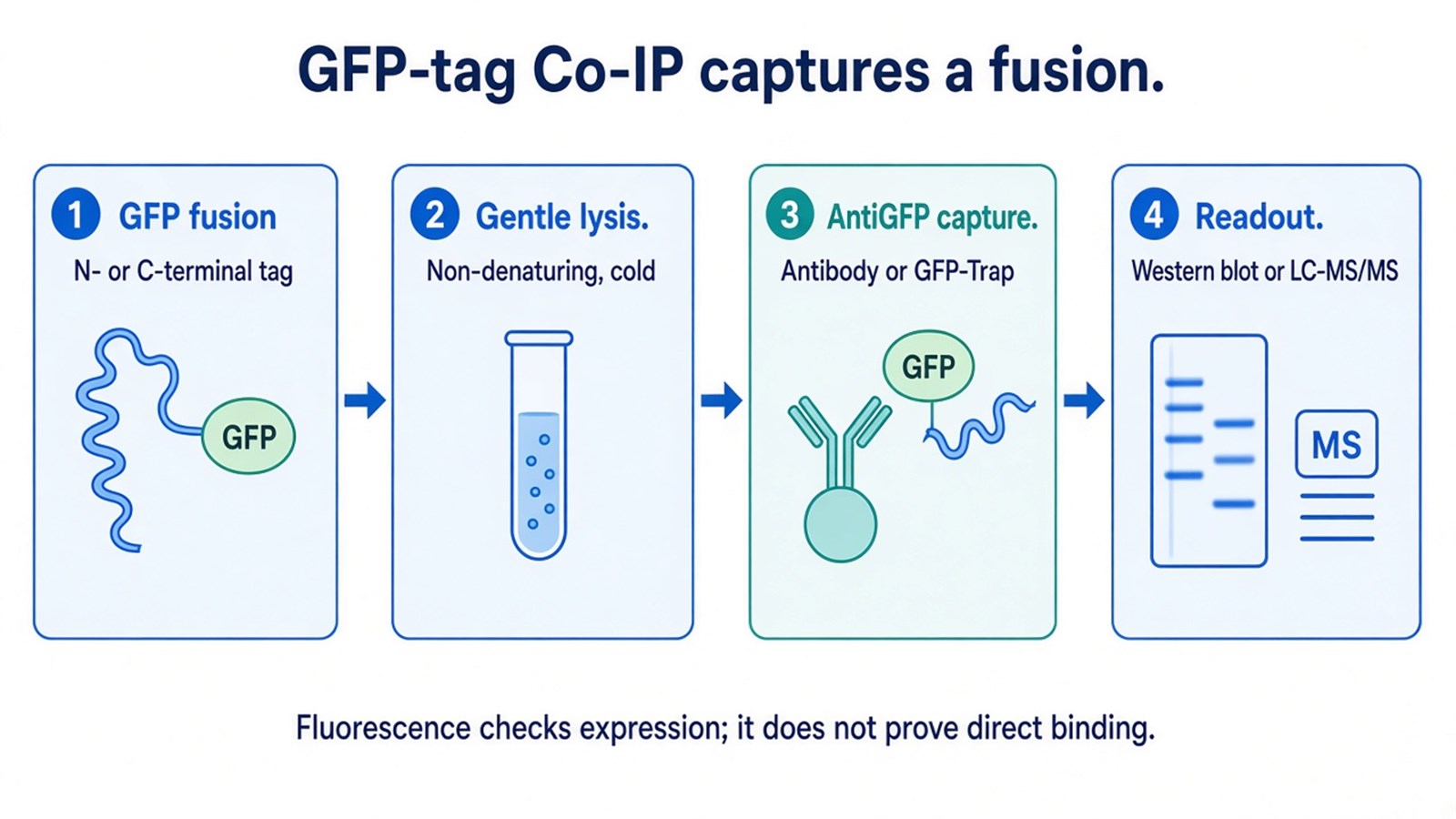
Figure 1. GFP-tag Co-IP expresses a fusion, captures it under non-denaturing lysis, and reads a closed pair by blot or an open candidate list by MS.
When GFP-Tag Co-IP Fits the Study
The assay fits when a GFP or enhanced GFP (EGFP) fusion is already the working construct, when no immunoprecipitation-grade antibody exists for the untagged bait, and when fluorescence is useful for checking expression. A closed pair with a prey antibody fits Western blot. An open partner search after GFP-only and bead controls fits Co-IP-MS.
Reassess GFP-tag Co-IP when tagging is not allowed, when overexpression would change the complex, or when the needed claim is an endogenous, untagged neighborhood. An epitope tag such as FLAG or HA is a different capture chemistry with a smaller moiety. It does not automatically outperform GFP. Endogenous antibody capture remains the matching route when a competent immunoprecipitation antibody exists and native expression is required.
Researchers who need to determine whether an endogenous antibody capture or a tagged bait better matches the claim can refer to Endogenous IP-MS vs Tagged Pull-Down MS Strategies for more detailed guidance.
In MtoZ Biolabs Co-IP-MS offerings, GFP-tagged baits are typically captured with a validated anti-GFP or GFP-Trap workflow, then identified by LC-MS/MS against matched GFP-only or bead controls. Service configuration is not an academic rule that other laboratories must copy, and it does not include a diagnostic or GMP release intended use.
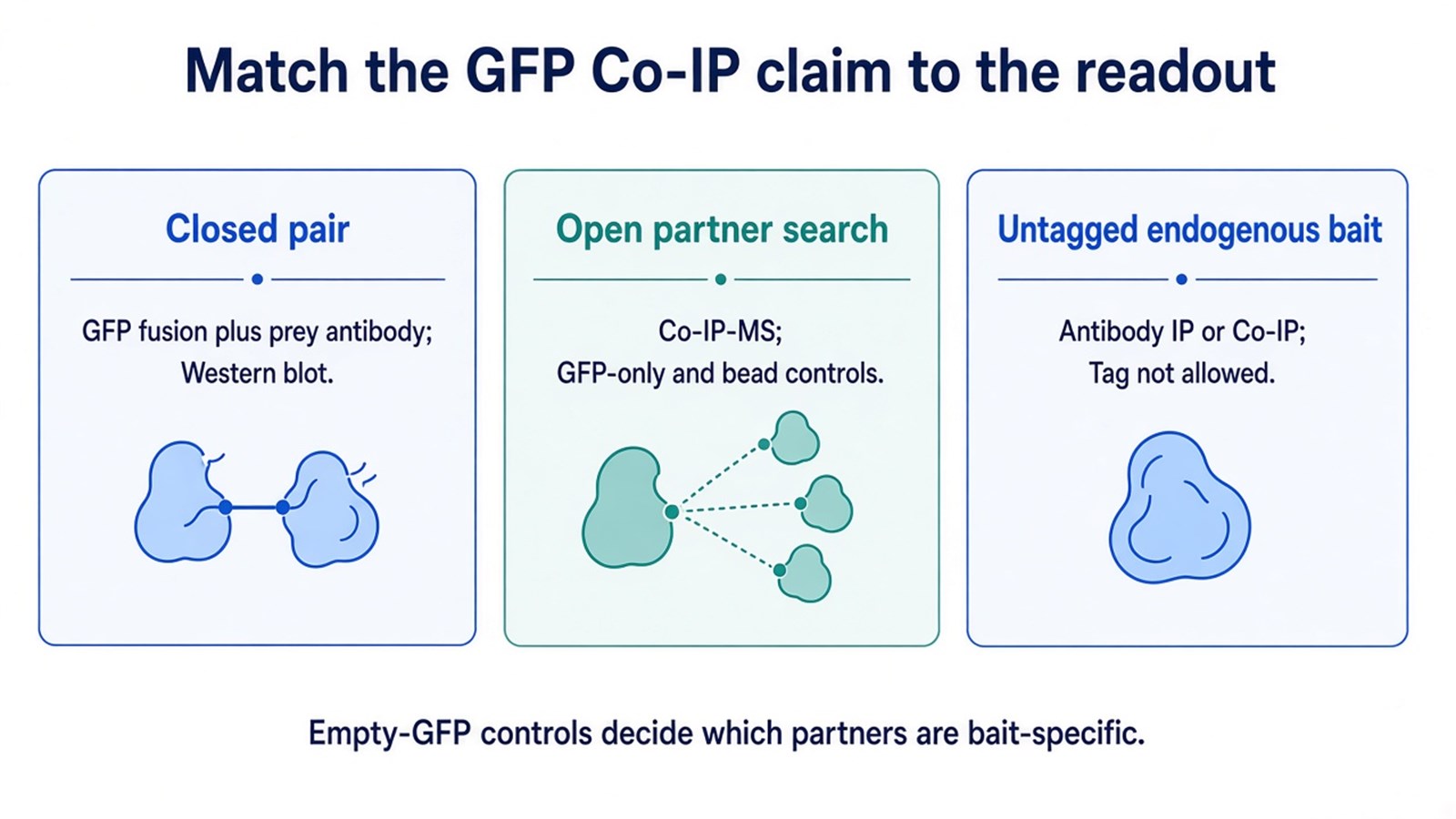
Figure 2. GFP-tag Co-IP fits a usable fusion; a closed prey stays on blot, an open list needs MS plus GFP-only controls, and a native bait stays on antibody capture.
A GFP fusion is a tagged system; empty-GFP controls decide which partners are bait-specific.
How GFP Co-IP Results Should Be Read
Read bait recovery first. If the fusion is truncated, mislocalized, or absent from the eluate, partner bands are not interpretable. Input, flow-through, and bound fractions show whether capture worked and whether the prey was depleted.
A long MS list is a ranked candidate set. Recurrent bead binders and GFP-associated proteins should be subtracted or down-weighted before pathway language. Network drawings and public-database overlays are annotations added after the elution. They do not convert a tagged Co-IP into a disease or drug-target map.
For studies focused primarily on which interaction assay records which evidence class, Methods for Detecting Protein-Protein Interactions (PPIs) provides a more detailed explanation of Co-IP, pull-down, and proximity methods beyond GFP capture.
Frequently Asked Questions
1. Is GFP-tag Co-IP the same as endogenous Co-IP?
No. The bait is a GFP fusion, usually overexpressed. Endogenous Co-IP uses an antibody against the untagged cellular protein.
2. Does GFP-Trap prove that recovered proteins bind the bait directly?
No. The resin recovers proteins that survive capture with the fusion. Direct contact needs a defined-pair or interface assay.
3. Should every GFP Co-IP go to mass spectrometry?
No. A closed pair with a working prey antibody can stop at Western blot. MS fits an open list after GFP-only and bead controls are in place.
4. Does fluorescence colocalization replace the precipitation?
No. Colocalization reports proximity in the image. Co-IP reports co-recovery after lysis and wash.
Once the fusion orientation, capture reagent, controls, and Western versus MS endpoint are defined, the project can be evaluated as a GFP-tag Co-IP study. Researchers can review the MtoZ Biolabs Co-IP-MS Protein Interaction Analysis Service for project-specific sample evaluation, feasibility assessment, and workflow planning.
