



Experimental and computational methods detect protein–protein interactions (PPIs) in different ways. Experimental assays measure a physical event: binary reconstitution in yeast, antibody or tag enrichment, live-cell proximity, or resonance-energy transfer. Computational methods propose candidate edges from structure, homology, co-expression, docking, machine learning, or network context. The useful comparison is not which class is more accurate in the abstract. It is which layer is allowed to support the next sentence, and when the two layers should be run as a loop.
PPIs organize signal transduction, metabolic regulation, and many disease-associated processes. Mapping those networks guides target nomination and later mechanistic work. High-throughput capture and structure prediction have expanded both layers. They have not made a docking score equivalent to an AP-MS enrichment, and they have not made a mass spectrometry table free of false positives. Diagnostic or precision-medicine claims sit outside ordinary research PPI reporting unless a separately validated assay framework is in place.
Researchers who already have a defined protein pair, predicted shortlist, or project objective can also review the MtoZ Biolabs Protein-Protein Interaction Analysis Service for project-specific feasibility and analysis planning.
What Each Class Is Allowed to Report
Experimental methods report that an interaction-related event was observed under a stated condition. Computational methods report that an interaction is plausible given the features and training data used. Treating a predicted edge as measured, or a single AP-MS prey as a genome-wide fact, is the usual source of over-read results.
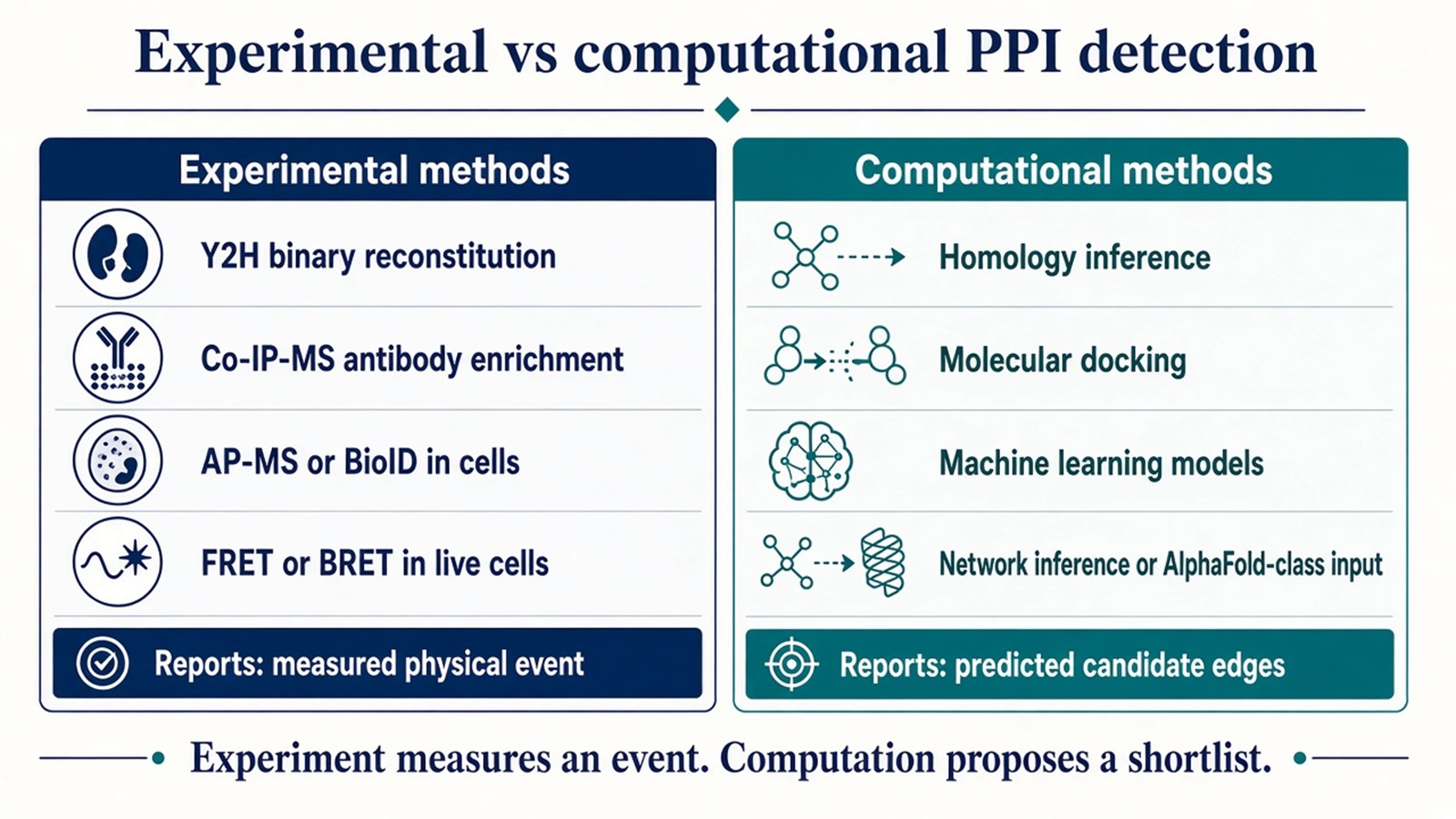
Figure 1. Experimental methods measure Y2H, Co-IP-MS, AP-MS, BioID, or FRET/BRET events; computational methods propose homology, docking, machine-learning, or network shortlists.
Experiment measures an event. Computation proposes a shortlist. Those outputs are complementary, not interchangeable accuracy scores.
Experimental Methods for Protein Interaction Detection
Principles and common techniques
Experimental approaches detect physical contact, co-enrichment, or proximity.
Yeast two-hybrid (Y2H) uses transcriptional activation to report binary binding in yeast. Co-immunoprecipitation (Co-IP) coupled with mass spectrometry enriches antibody-captured complexes and identifies partners. Affinity purification–mass spectrometry (AP-MS) and BioID map bait-associated or proximal proteins under near-native cellular handling. FRET and BRET monitor selected pairs in living cells by resonance-energy transfer.
Advantages
Direct measurement can support a physical or proximity claim that a database edge cannot. Cellular AP-MS and BioID keep the bait in a biological background that docking on isolated chains does not provide. FRET or BRET can add live-cell timing for a closed pair. Interface, occupancy, or kinetic detail is available only when the assay was designed for that readout, not because the method class is experimental.
Limitations
Throughput is limited for pair-by-pair assays such as FRET. Mass spectrometry platforms and antibody or tag resources raise cost and calendar time. Many contacts are condition-specific and will be missed if the lysis, labeling window, or cell state is wrong. False-positive rates are not inherently low. Y2H, Co-IP, and AP-MS each carry background that must be filtered with matched controls. Mass spectrometry is not a low-error exception.
For how these experimental families are chosen in practice, How to Analyze Protein–Protein Interactions provides a more detailed explanation of claim-to-method fit.
Computational Methods for Protein Interaction Detection
Principles and common techniques
Computational approaches integrate structure, evolutionary relationship, gene co-expression, and curated PPI databases. Deep learning and structure-prediction tools such as AlphaFold can supply models or features for later inference (Jumper et al. 2021). Common strategies include homology-based inference, molecular docking, machine-learning models such as random forests or deep networks, and network-based guilt-by-association.
Advantages
Computation can triage genome-wide pair space at a cost dominated by compute rather than wet-lab reagents. It is useful when experimental coverage is thin, including some membrane or low-abundance proteins that are hard to express or purify. The output is a prioritized list, not a demonstration that those hard proteins now have measured partners.
Limitations
Predictive performance follows input quality and whether the model generalizes beyond its training interactions. There is no direct experimental evidence until a wet-lab test is done. Training sets are biased toward well-studied proteins, which can hide novel interaction types and recycle known hubs.
How the Two Classes Complement Each Other
A single class does not map a complete PPI landscape. A practical loop is to let computation narrow candidates, then let experiment measure a subset with quantitative or spatial follow-up. Machine-learning hits can be tested by AP-MS in a cellular model. Supported edges stay; unsupported predictions are dropped. That loop can reduce the number of pull-downs. It does not produce a high-confidence network until the experimental layer has controls and a declared score.
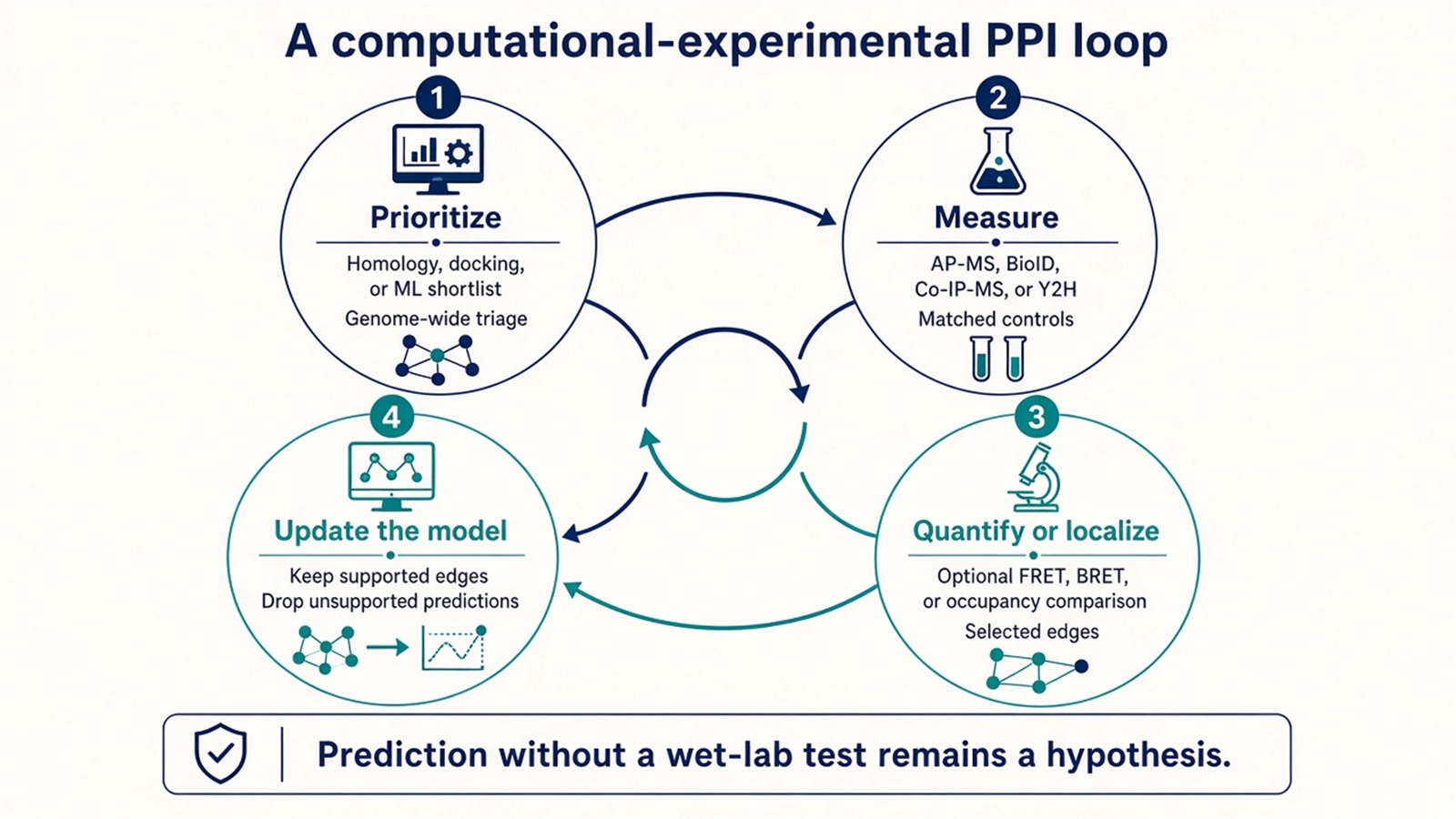
Figure 2. Computation prioritizes; experiment measures; optional FRET or occupancy assays test selected edges; the model is updated only after unsupported predictions are dropped.
Decision |
Experimental methods |
Computational methods |
|---|---|---|
What the result is |
Observed event under a stated assay |
Predicted plausibility |
Typical strength |
Physical or proximity evidence |
Genome-wide triage |
Typical cost driver |
Capture reagents and MS or imaging time |
Compute and training data |
Main error mode |
Assay background and missed conditions |
Training bias and untested scores |
Can stand alone as a PPI claim |
Only for the event that was measured |
No |
Application Scenarios and Strategy Selection
Basic mechanism work should lead with experimental methods and use computation for triage or pathway context. Large-scale network mapping can lead with computational coverage, then spend AP-MS, BioID, or Y2H on priority edges. Drug-interface projects need structure-aware prediction and wet-lab occupancy or binding data together. Neither a docking pose nor an unscored interactome is target proof.
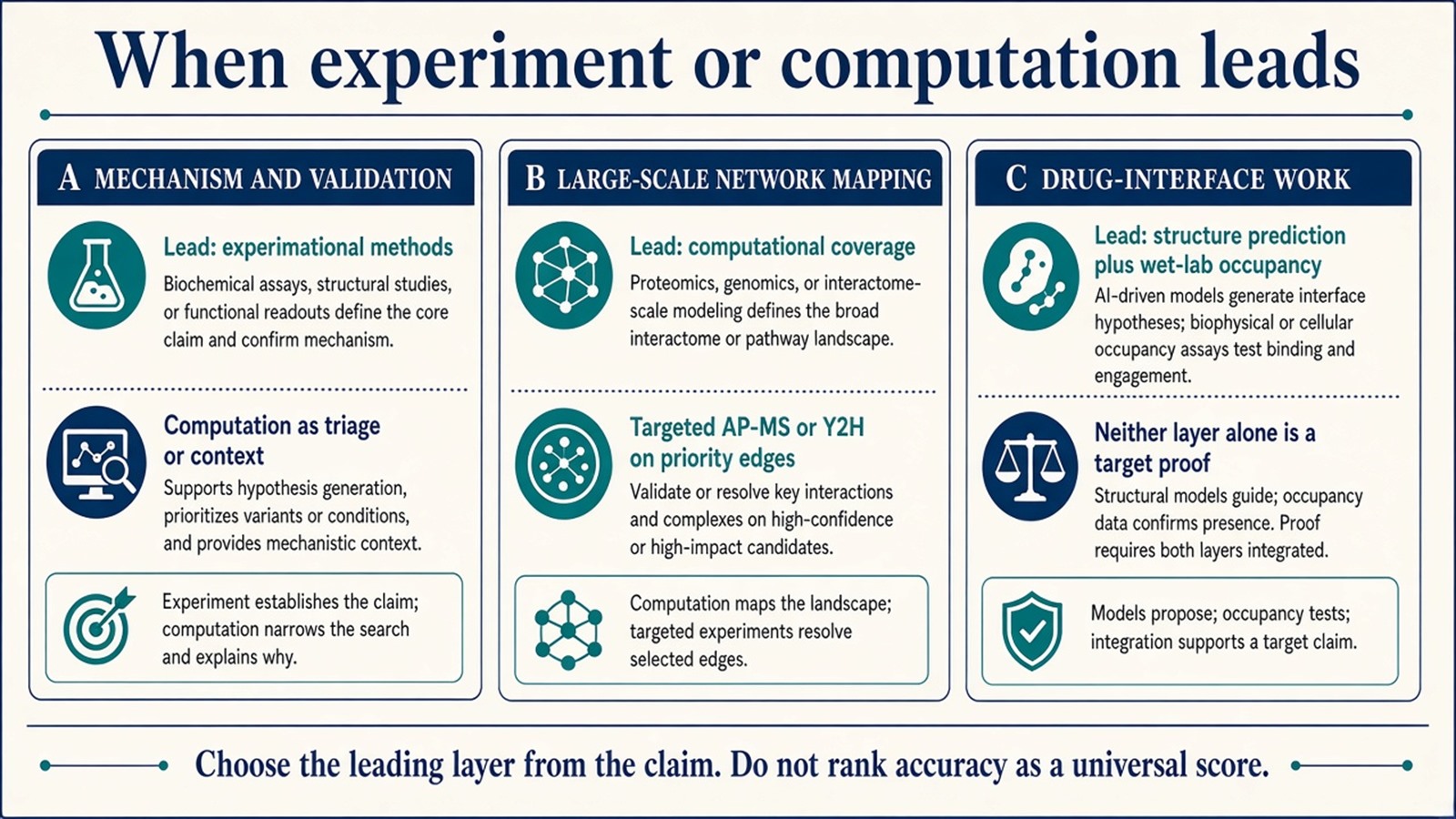
Figure 3. Lead with experiment for mechanism, with computation for coverage, and with both for interface work; do not rank one class as universally more accurate.
For high-throughput experimental options that often receive computational shortlists, Advantages and Disadvantages of High-throughput PPI Detection provides a more detailed comparison of Y2H, AP-MS, proximity labeling, and in silico-plus-wet-lab designs.
Experimental Limits
Experimental accuracy is assay-specific. Computational coverage is hypothesis-specific. Integration improves efficiency only when each layer keeps its claim. AlphaFold-class models can inform docking or interface hypotheses. They do not replace Co-IP-MS, AP-MS, or a binding assay. Diagnostic and therapeutic-strategy language should wait for a validated edge.
Project Planning and Service Scope
A usable plan names whether the next deliverable is a predicted shortlist, a measured partner table, or a selected-pair live-cell check. MtoZ Biolabs can scope AP-MS, BioID, and related mass spectrometry validation together with bioinformatics prioritization. Customized solutions still start from the claim, not from a platform slogan.
Once the leading layer and validation path are defined, the project can be scoped as an experimental, computational, or combined PPI study. Researchers can review the MtoZ Biolabs Protein-Protein Interaction Analysis Service for project-specific sample evaluation, feasibility assessment, and workflow planning.
Frequently Asked Questions
1. Are experimental PPI methods more accurate than computational methods?
Not as a universal rank. Experiment is stronger for a measured event. Computation is stronger for triage. Each has its own false-positive class.
2. Can AlphaFold or docking replace AP-MS?
No. Structure prediction can propose an interface. AP-MS or an orthogonal assay is still required to show that the pair associates in the sample.
3. Why do experimental PPI methods still have false positives?
Y2H, Co-IP, and AP-MS capture different backgrounds. Mass spectrometry lists need matched controls and scoring. Direct detection is not the same as low error.
4. Can computation discover membrane or low-abundance interactions that experiments miss?
It can prioritize pairs that are hard to express or purify. Discovery is complete only after an experimental test that fits those proteins.
5. What is a defensible computational-experimental workflow?
Prioritize a shortlist, measure a subset with AP-MS, BioID, Co-IP-MS, or Y2H, then keep only supported edges. Do not report the full predicted network as validated.
Reference
- Fields S., Song O. (1989). A novel genetic system to detect protein-protein interactions. Nature, 340, 245-246. https://doi.org/10.1038/340245a0
- Gingras A.C., Gstaiger M., Raught B., Aebersold R. (2007). Analysis of protein complexes using mass spectrometry. Nat. Rev. Mol. Cell Biol., 8, 645-654. https://doi.org/10.1038/nrm2208
- Jumper J., Evans R., Pritzel A., et al. (2021). Highly accurate protein structure prediction with AlphaFold. Nature, 596, 583-589. https://doi.org/10.1038/s41586-021-03819-2
- Berggard T., Linse S., James P. (2007). Methods for the detection and analysis of protein-protein interactions. Proteomics, 7, 2833-2842. https://doi.org/10.1002/pmic.200700131
