



Affinity purification-mass spectrometry (AP-MS) asks which proteins remain with a captured bait after lysis, washing, and LC-MS/MS identification. Endogenous IP-MS recovers a native bait with an antibody and reports co-enriched partners under cellular or tissue expression. Tagged pull-down MS uses an immobilized recombinant or epitope-tagged bait to test binding under defined chemistry. Both routes return candidate interactors, not proof of direct contact or a complete binary map (Hein et al. 2015). Prefer endogenous IP-MS when native stoichiometry and localization matter and an IP-competent antibody exists. Prefer tagged pull-down MS for domain, mutant, or reconstituted binding, or when no suitable IP antibody is available. Detection stops at enrichment versus matched controls; high-confidence lists still need background filters and orthogonal follow-up.
Researchers who already have a named bait, planned controls, and a written interaction claim can also review the MtoZ Biolabs Protein-Protein Interaction Analysis and MS-Based Protein-Protein Interaction Analysis Service for project-specific AP-MS feasibility and capture planning.
What Each AP-MS Route Is Designed to Answer
The first comparison step is to match each method to a primary research claim. AP-MS is the shared measurement class: affinity capture plus MS identification of proteins that survive the wash. Endogenous IP-MS and tagged pull-down MS differ in bait context, not in the fact that a mass spectrometer is used.
Endogenous IP-MS asks which proteins associate with a native bait under cellular or tissue conditions that preserve endogenous expression. It is used when tagging is undesirable, when physiological localization matters, or when antibody-based capture of the authentic protein is required.
Tagged pull-down MS asks which proteins bind a defined bait outside, or partly outside, the full endogenous assembly context. It is used for hypothesis testing, domain mapping, mutant binding comparisons, and screens that benefit from a controlled recombinant bait.
Both strategies generate candidate interactors rather than final proof of direct binding. Large-scale AP-MS maps describe complex membership and abundance context more than a complete set of binary contacts. The useful difference is the biological context of capture and the controls needed for interpretation.
Antibody-based intake is scoped through the IP-Mass Spectrometry Service. Fusion bait and immobilized pull-down identification are scoped through the Fusion Protein Interaction Analysis Service | Pull-Down and MS and GST Pull Down Assay Service.
AP-MS reports co-recovery of proteins with a captured bait; it does not by itself prove a direct contact surface.
Bait Enrichment, Background Proteins, and Control Design
High-confidence AP-MS lists fail more often at enrichment QC than at the search engine. The bait must be recovered in the eluate at a level that can support partner ranking. If bait peptides are weak or missing, partner names in the same file are not interpretable as a neighborhood.
Background proteins are expected. Bead binders, antibody contaminants, highly abundant cytoskeletal or ribosomal proteins, and tag-binding proteins appear in many affinity eluates. Treating every identified name as a biological partner overstates the capture. A contaminant frequency catalog such as the CRAPome is a prior on how often a protein appears in control purifications, not a proof that a name is false in the current matrix (Mellacheruvu et al. 2013).
Controls must match the capture handle. Endogenous IP-MS typically needs isotype or empty-bead controls, and, when feasible, a bait-depleted or knockout lysate. Tagged pull-down MS typically needs empty-tag, tag-only, or resin-only controls, plus a well-blocked immobilized bait. Unrelated-antibody or GST-only resins answer a different background question than a missing-bead blank.
|
Control class |
Endogenous IP-MS |
Tagged pull-down MS |
What it can support |
|---|---|---|---|
|
Empty bead or resin |
Bead binders |
Bead binders |
Subtract resin-only proteins |
|
Isotype or empty tag |
Antibody background |
Tag or fusion background |
Subtract handle-specific binders |
|
Bait-depleted lysate |
Antibody plus lysate without bait |
Optional if knockout exists |
Test bait dependence |
|
Process replicate |
Same IP recipe |
Same immobilization recipe |
Estimate capture noise |
Wash stringency is part of the method. High salt or detergent can remove weak or transient partners. Mild washes retain more candidates and more background. The wash recipe belongs next to the partner table; it is not a software afterthought.
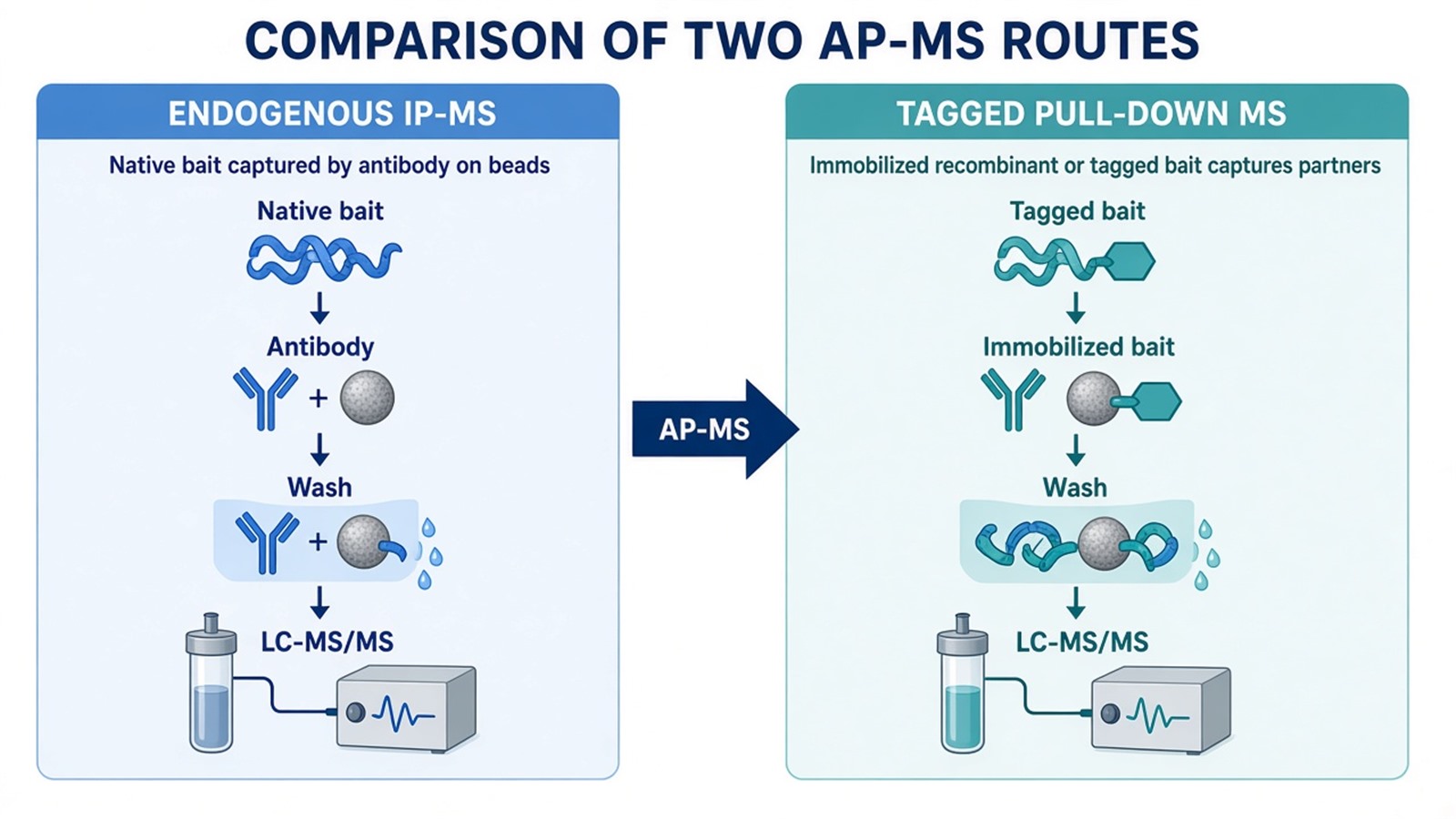
Figure 1. Endogenous IP-MS and tagged pull-down MS share AP-MS readout; they differ in bait context and the handle used for capture.
Filtering High-Confidence Interactors
Identification of a protein in an AP-MS eluate is not a confidence call. Ranking requires bait recovery, control frequency, and a declared enrichment rule. Probabilistic scoring such as SAINT uses bait versus control counts to assign a probability that a prey is specifically co-purified (Choi et al. 2011). Frequency in public contaminant repositories helps flag proteins that commonly survive affinity resins.
Those tools still operate on enrichment tables. They do not convert a co-purified name into a direct binder, a stoichiometry, or a cellular occupancy. Reciprocal IP, a defined-pair pull-down, or an orthogonal route such as proximity labeling or crosslinking is still required if the claim moves from co-recovery to engagement.
A practical filtering sequence is:
- Confirm bait peptides and expected bait coverage in the eluate.
- Remove proteins that fail identification or quantitation QC.
- Rank remaining names against matched controls, not against an unmatched public list alone.
- Flag high-frequency bead or antibody contaminants for extra scrutiny.
- Keep a shortlist for orthogonal tests rather than publishing the full eluate as the interactome.
For how AP-MS lists constrain discovery without predicting structure, see How Can Mass Spectrometry Be Used to Analyze or Predict Protein-Protein Interactions?. For one-direction enrichment versus reciprocal recovery, see Mutual Protein Identification.
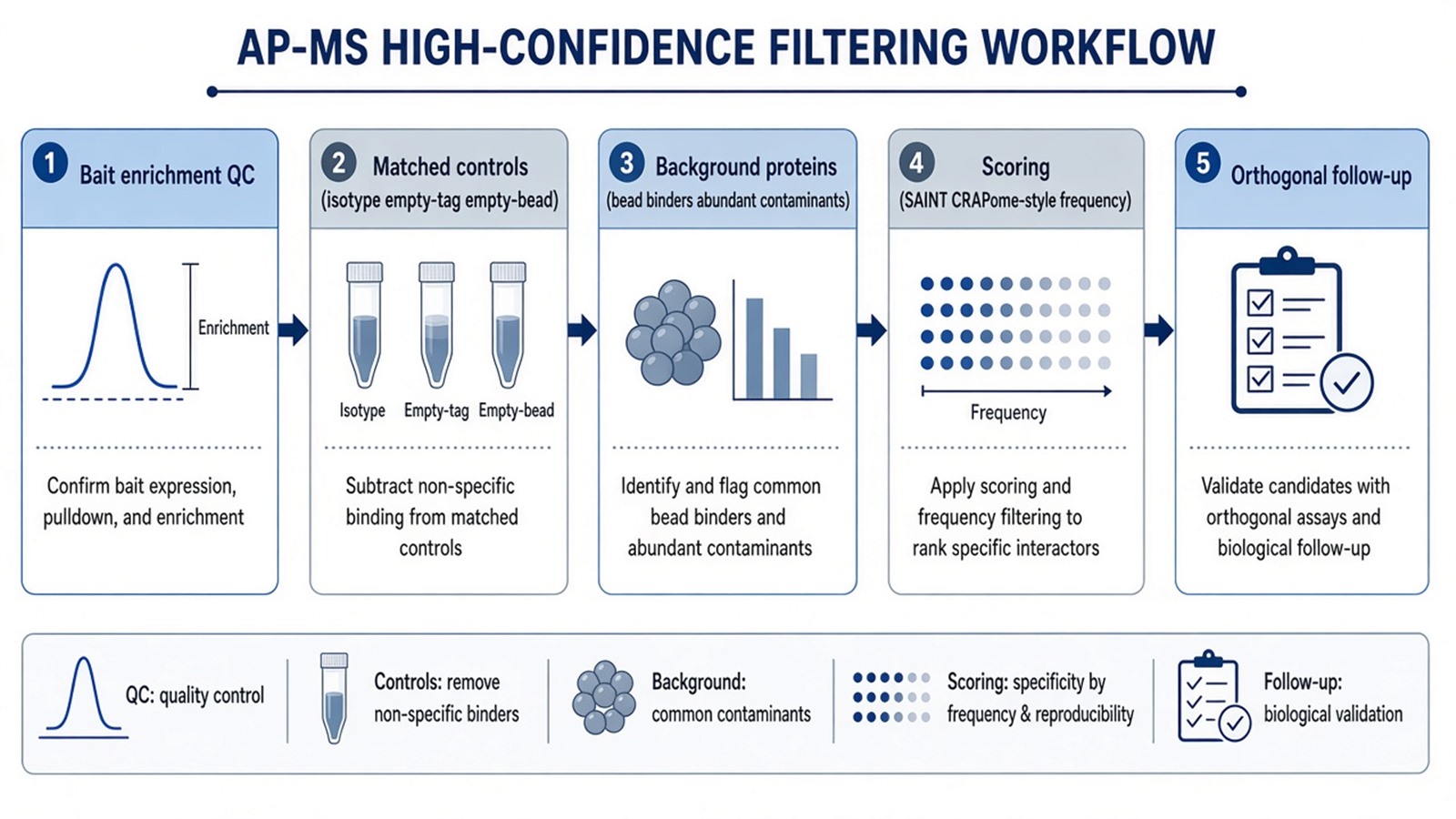
Figure 2. High-confidence AP-MS shortlists start from bait recovery and matched controls, not from an unfiltered protein table.
Judgment Criteria: Choosing Endogenous IP-MS or Tagged Pull-Down MS
A practical choice depends on bait context, antibody or tag dependence, discovery goal, and validation burden.
|
Decision factor |
Endogenous antibody IP-MS |
Tagged recombinant pull-down |
|---|---|---|
|
Typical bait |
Native cellular or tissue protein |
Recombinant or immobilized tagged bait |
|
Capture handle |
Antibody |
Affinity tag or immobilized bait |
|
Best for |
Physiological neighborhood discovery |
Controlled binding and domain tests |
|
Main requirement |
IP-competent antibody |
Well-behaved recombinant bait |
|
Main risk |
Antibody performance and background |
Non-physiological binding artifacts |
|
Typical next step |
Reciprocal IP or functional assays |
Return-to-cell or endogenous confirmation |
Prefer endogenous IP-MS when the claim depends on native expression, localization, or tissue context and the antibody performs under IP conditions suitable for MS. Prefer tagged pull-down MS when the question is domain, mutant, or reconstituted binding, or when no IP-competent antibody exists. Prefer sequencing both routes when discovery and mechanism are both required.
Reassess endogenous IP-MS when bait abundance is too low for recovery or when antibody cross-reactivity cannot be controlled. Reassess tagged pull-down MS as a first discovery method when overexpression, missing cofactors, or immobilization chemistry would invent binding that does not occur in cells.
Screening-level method choice among IP-MS, AP-MS, pull-down, and proximity labeling is covered in Measuring Protein-Protein Interactions.
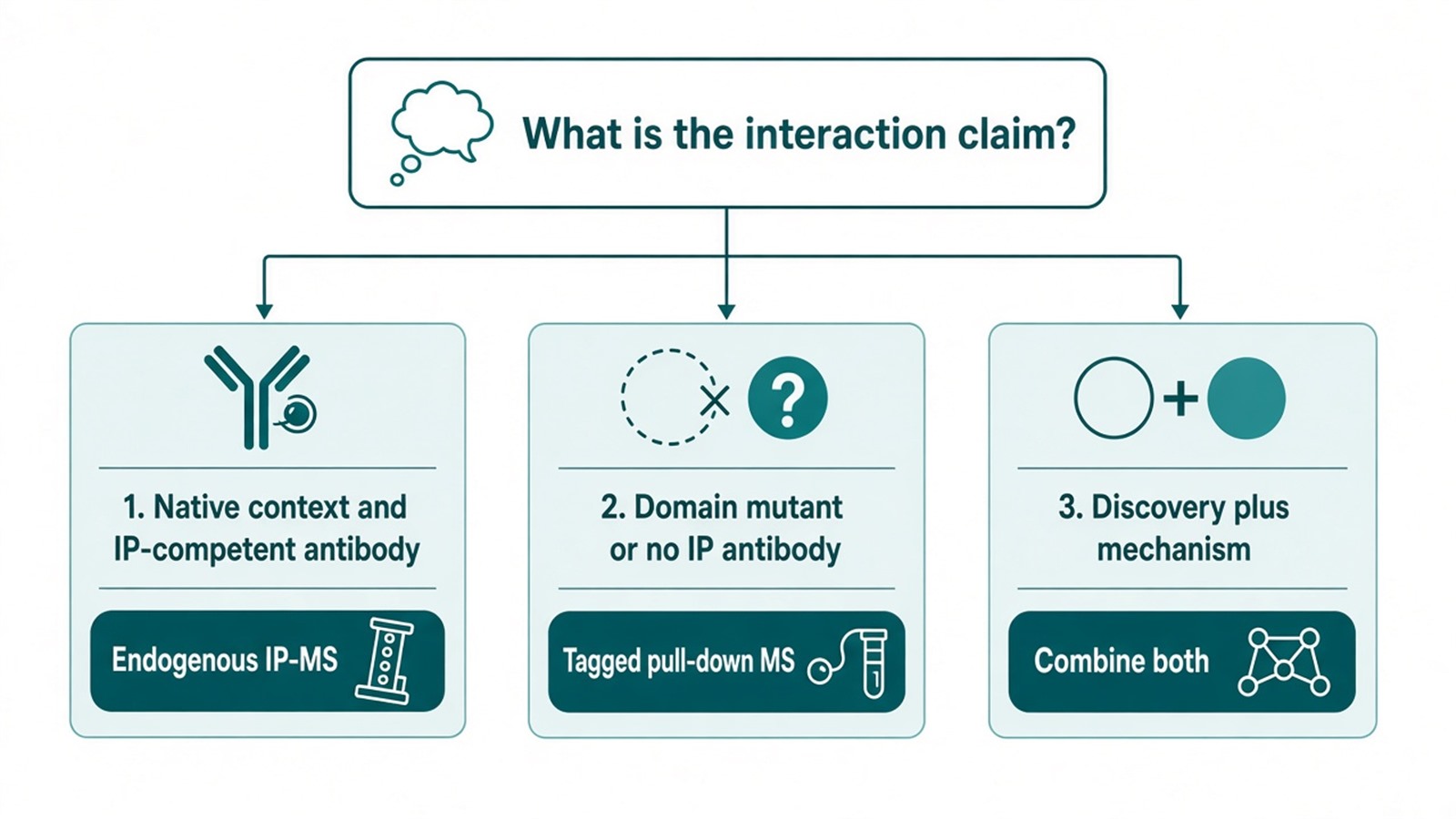
Figure 3. Strategy follows the interaction claim and available capture handle, not the word AP-MS alone.
Common Biases and How to Read the Result
Antibody cross-reactivity can pull down off-target proteins that then look like partners. Overexpressed tagged baits can saturate partners or create assemblies that do not exist at endogenous levels. Immobilized recombinant baits can expose surfaces that are buried in cells, or miss complexes that require native cofactors. Harsh lysis can destroy weak associations before capture. Mild lysis can leave organelles intact and pull in neighborhood proteins that never bound the bait.
After scoring, a protein-level value can support a relative statement: protein B is enriched with bait A versus the matched control inside this capture recipe. Peptide support, bait recovery, control frequency, and wash conditions belong next to that statement. Ordinary AP-MS tables should not rank different proteins as tighter binders by spectral count alone, infer a diagnostic interaction, or transfer a partner list from one lysis buffer to another study as a conserved complex.
Pathway maps interpret a shortlist. They do not repair a missing control or a failed bait enrichment. A later requery of the same raw files can add peptides that the first search missed. It cannot repair a design in which all bait IPs were processed separately from all controls.
An AP-MS table supports enrichment of named proteins with a captured bait under stated controls, not a certified interactome or a direct-binding certificate.
When the Two Strategies Should Be Combined
Combination is useful when discovery and mechanistic testing are both part of the same study. Endogenous enrichment defines which partners appear in native context. Pull-down assays then ask whether selected partners can bind a defined bait construct under controlled conditions.
Combination also helps when antibody evidence is incomplete. A tagged cellular affinity purification or pull-down screen can generate candidates, while a later endogenous IP tests whether key partners are recovered from the native protein. Overlapping but non-identical shortlists are expected because expression context, wash chemistry, bait concentration, and complex stability differ.
Once the interaction claim, bait handle, and control set are defined, the project can be scoped as endogenous IP-MS, tagged pull-down MS, or a staged AP-MS sequence. Researchers can review the MtoZ Biolabs IP-Mass Spectrometry Service and Fusion Protein Interaction Analysis Service | Pull-Down and MS for sample evaluation and capture planning.
Frequently Asked Questions
1. Is endogenous IP-MS the same as AP-MS?
AP-MS is the broader class of affinity capture plus MS. Endogenous IP-MS is the antibody-on-native-bait route inside that class. Tagged pull-down MS is the recombinant or epitope-handle route.
2. When is the endogenous route preferred over recombinant pull-down?
Use the endogenous route when the interaction claim depends on the native bait in cells or tissues and an IP-competent antibody is available.
3. Does pull-down enrichment prove that an interaction occurs in cells?
No. It shows binding under the assay conditions used. Cellular relevance usually needs endogenous confirmation.
4. Can the two methods give different partner lists for the same bait?
Yes. Expression context, wash chemistry, bait concentration, and complex stability differ, so overlapping but non-identical shortlists are common.
5. What is the minimum control set before calling an AP-MS partner high confidence?
At least matched handle controls (isotype or empty tag) plus empty-bead or resin controls, documented bait recovery, and a declared enrichment rule versus those controls. Orthogonal confirmation is still required for a direct-binding claim.
Reference
- M.Y. Hein, N.C. Hubner, I. Poser, J. Cox, N. Nagaraj, Y. Toyoda, I.A. Gak, I. Weisswange, J. Mansfeld, F. Buchholz, et al. (2015). A human interactome in three quantitative dimensions organized by stoichiometries and abundances. Cell, 163, 712-723. https://doi.org/10.1016/j.cell.2015.09.053
- H. Choi, B. Larsen, Z.Y. Lin, A. Breitkreutz, D. Mellacheruvu, D. Fermin, Z.S. Qin, M. Tyers, A.C. Gingras, A.I. Nesvizhskii (2011). SAINT: probabilistic scoring of affinity purification-mass spectrometry data. Nat. Methods, 8, 70-73. https://doi.org/10.1038/nmeth.1541
- D. Mellacheruvu, Z. Wright, A.L. Couzens, J.P. Lambert, N.A. St-Denis, T. Li, Y.V. Miteva, S. Hauri, M.E. Sardiu, T.Y. Low, et al. (2013). The CRAPome: a contaminant repository for affinity purification-mass spectrometry data. Nat. Methods, 10, 730-736. https://doi.org/10.1038/nmeth.2557
