






DDA vs. DIA vs. TMT in LC-MS/MS Proteomics: How to Choose the Right Strategy
Introduction
A proteomics team planning an LC-MS/MS project often faces three names in the same methods discussion: DDA, DIA, and TMT. A collaborator may recommend DDA for deep identification. A bioinformatics colleague may argue for DIA because missing values are lower across cohorts. A core facility may suggest TMT multiplexing to compare six conditions in one run. Each option is valid in the right context, but they are not interchangeable labels for the same experiment.
DDA and DIA are LC-MS/MS acquisition strategies that define how precursor ions are selected and fragmented during the chromatography run. TMT is an isobaric labeling approach that enables multiplexed quantitative comparison across samples combined in one MS run. Strategy selection therefore requires two decisions: how the instrument acquires spectra, and how samples are labeled and compared.
This article compares DDA, DIA, and TMT in LC-MS/MS proteomics, explains what each strategy measures, and provides a practical framework for choosing the right approach based on project goals, sample design, and reporting needs.
What DDA, DIA, and TMT Each Mean
Understanding the three terms starts with separating acquisition mode from quantitation chemistry.
Data-dependent acquisition (DDA) selects the most intense precursor ions in each survey scan for MS/MS fragmentation. DDA prioritizes spectral diversity and deep peptide identification in individual runs. It is widely used in discovery proteomics when the primary goal is to identify many proteins and generate candidate lists.
Data-independent acquisition (DIA) fragments peptides across predefined mass windows in a systematic manner rather than selecting only the most intense precursors. SWATH and related DIA modes improve measurement consistency across samples because the same windows are acquired in every run. DIA is often chosen for cohort-scale quantitative comparison.
Tandem mass tag (TMT) labeling attaches isobaric reporter tags to peptide N-termini and lysine residues after digestion. Samples from different conditions are labeled, combined, and analyzed in one LC-MS/MS run. Reporter ion intensities in the MS/MS spectrum support relative quantitation across the multiplexed channels. TMT is a labeling strategy that is commonly paired with DDA acquisition.
DDA and DIA answer how the mass spectrometer acquires data. TMT answers how samples are compared within or across runs.
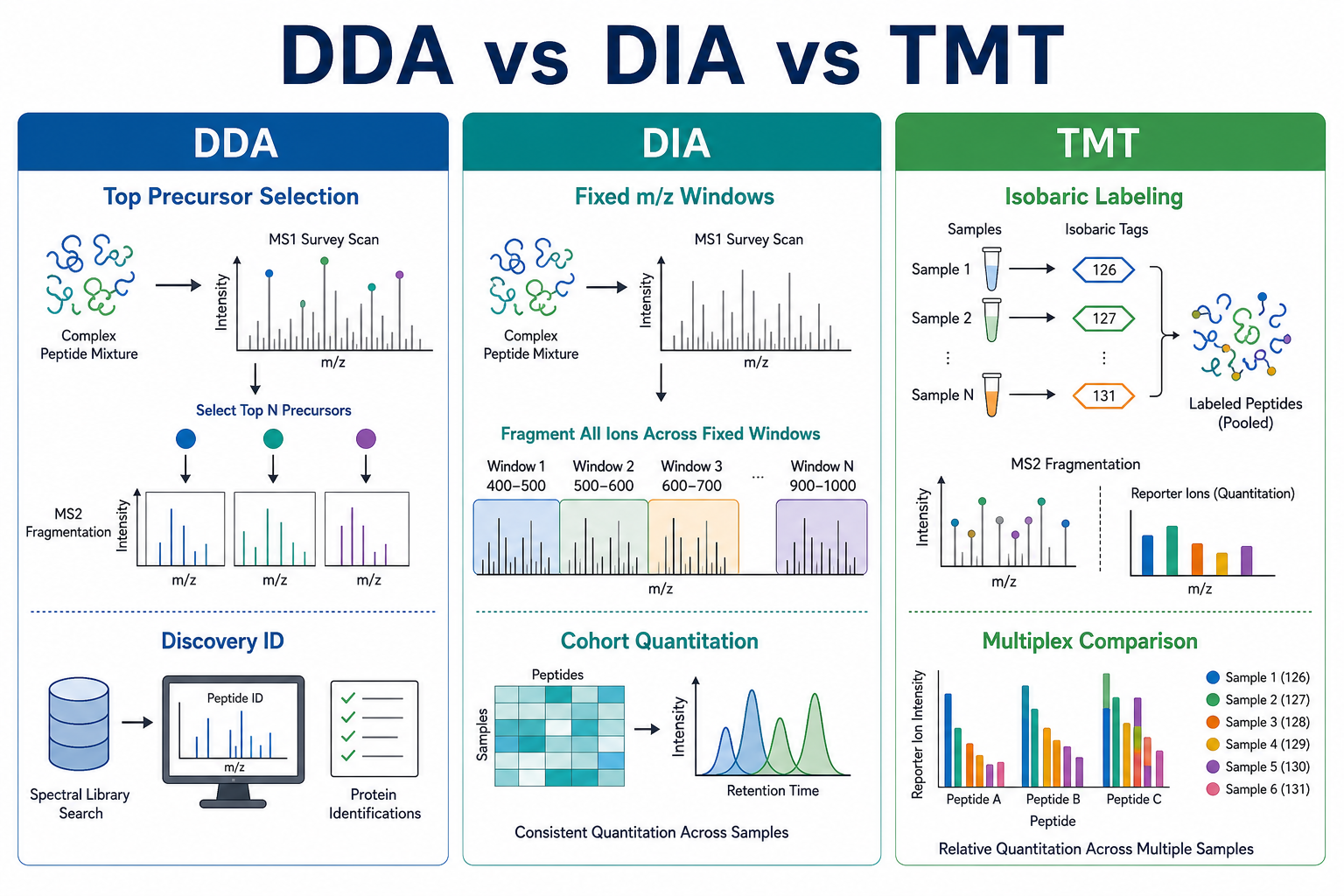
Figure 1. DDA and DIA are LC-MS/MS acquisition strategies, while TMT is an isobaric labeling approach for multiplexed quantitative comparison.
Side-by-Side Comparison of DDA, DIA, and TMT
The three strategies differ across acquisition logic, quantitation basis, and typical project fit.
|
Feature |
DDA |
DIA |
TMT |
|---|---|---|---|
|
Strategy type |
Acquisition mode |
Acquisition mode |
Isobaric labeling |
|
Fragmentation logic |
Top intense precursors per cycle |
Fixed m/z windows across mass range |
Depends on paired acquisition |
|
Identification depth |
Strong in single runs |
Depends on library and search workflow |
Moderate when multiplexed |
|
Quantitative consistency |
Variable missing values across runs |
More consistent across cohorts |
Strong within multiplex set |
|
Multiplexing |
One sample per run (standard) |
One sample per run (standard) |
Multiple samples per run (6 to 18 channels) |
|
Sample preparation |
Standard digestion and cleanup |
Standard digestion; library helpful |
Additional labeling and pooling steps |
|
Best suited for |
Discovery ID and candidate nomination |
Cohort quantitation and reproducibility |
Multi-group comparison in one run |
|
Main limitation |
Stochastic precursor selection |
Library and analysis complexity |
Ratio compression and labeling cost |
Researchers should treat DDA versus DIA as an acquisition decision and evaluate TMT separately as a quantitation design choice that can be combined with DDA.
DDA in LC-MS/MS Proteomics
DDA remains the default acquisition mode for discovery-focused LC-MS/MS proteomics.
In each LC cycle, the instrument performs a survey MS scan, ranks precursor ions by intensity, and fragments the top N ions for MS/MS analysis. This approach maximizes the number of distinct peptide spectra collected in a single run because the instrument follows the most abundant signals present at each retention time.
DDA is well suited to protein identification in complex mixtures, interaction proteomics, PTM discovery, and treatment screens. Label-free quantitation can be added, although missing values may exceed those in DIA cohorts because precursor selection varies between runs.
DIA in LC-MS/MS Proteomics
DIA addresses reproducibility limitations of DDA by systematizing fragmentation across the mass range.
Instead of selecting only intense precursors, the instrument isolates predefined m/z windows and fragments all peptides within each window. Every sample in a cohort receives the same acquisition scheme, which reduces random missing values and supports more consistent peptide measurement across replicates and batches.
DIA workflows are often paired with spectral libraries. Analysis software extracts and quantifies peptide signals from window-level fragmentation data across the study set.
DIA fits cohort-scale quantitative comparison across treatment groups, patient specimens, or multi-batch studies. It is less ideal when only single-run identification depth is required or sample number is too small to benefit from cohort consistency.
TMT in LC-MS/MS Proteomics
TMT is a chemical labeling strategy that enables multiplexed quantitative comparison within a single LC-MS/MS run.
After digestion, peptides from different samples are labeled with distinct TMT reporter channels, pooled, and analyzed together. During MS/MS fragmentation, reporter ions are released and their intensities reflect the relative abundance of each peptide across the multiplexed conditions.
TMT supports efficient comparison when multiple biological groups must be measured under controlled instrument conditions. A 6-plex or higher TMT design can reduce run-to-run variability for the pooled set because all channels are acquired in the same analysis.
TMT is commonly combined with DDA acquisition and is widely used in treatment comparisons, time-course studies, and multi-condition screens where statistical comparison across groups is the primary output. Limitations include labeling cost, additional sample handling steps, and ratio compression when protein abundance differences are large. TMT does not replace the need to plan biological replicates within each channel.
Related Services
Label-Free Quantitative Proteomics Service, MS Based
DIA based Protein Quantitative Service
TMT Quantitative Proteomics Analysis Service
SWATH Based Protein Quantitative Service
Quantitative Proteomics Service
Researchers choosing between DDA, DIA, and TMT can consult MtoZ Biolabs to review sample number, comparison design, and the LC-MS/MS strategy best matched to discovery or quantitative goals.
How to Choose the Right Strategy
Strategy selection should begin with the evidence type the project must deliver.
Choose DDA when the primary goal is deep protein identification, candidate nomination, or PTM discovery in a limited sample set. DDA with label-free quantitation is a common entry point for treatment screens and interaction proteomics.
Choose DIA when the primary goal is reproducible quantitative comparison across many samples and missing value control matters for downstream statistics. DIA is often preferred for larger cohorts and multi-batch studies.
Choose TMT when multiple conditions must be compared within the same MS run and multiplexed relative quantitation is part of the experimental design. TMT is appropriate when group comparison, not single-run identification depth alone, drives the study.
|
Research Goal |
Recommended Strategy |
Reason |
|---|---|---|
|
Unbiased protein identification |
DDA |
Prioritizes MS/MS diversity for database searching |
|
Treatment screen with few replicates |
DDA plus label-free |
Efficient discovery with basic comparison |
|
Cohort abundance comparison |
DIA |
Consistent window-based acquisition across samples |
|
Six-condition group comparison |
TMT plus DDA |
Multiplexed quantitation in one run |
|
PTM site discovery |
DDA after enrichment |
Deep fragmentation of enriched modified peptides |
|
Multi-batch clinical specimens |
DIA |
Reduces stochastic missing values across batches |
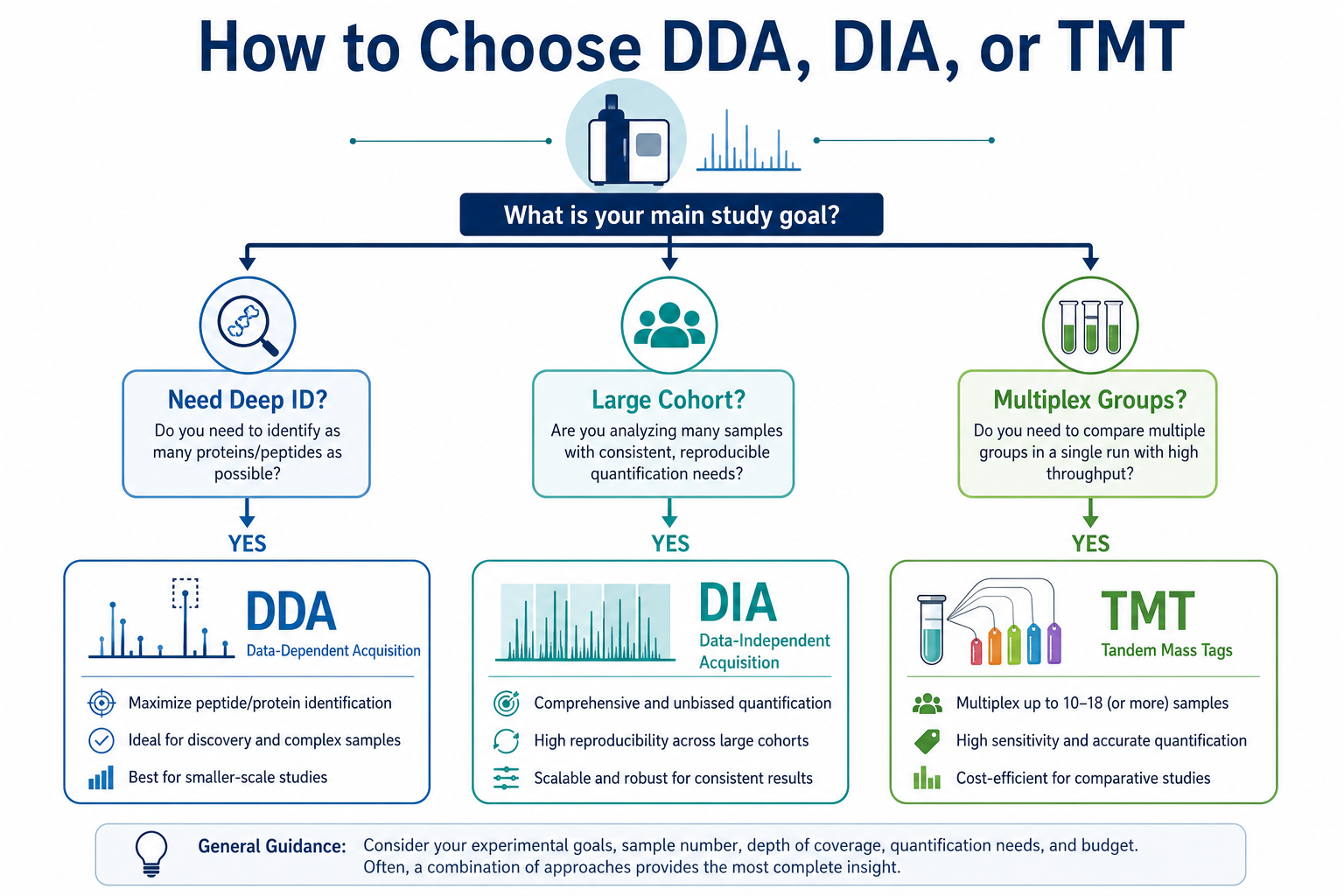
Figure 2. Strategy selection depends on whether the project prioritizes identification depth, cohort reproducibility, or multiplexed group comparison.
Common Strategy Combinations and Misunderstandings
DDA, DIA, and TMT are often discussed as if they are mutually exclusive options. In practice, they occupy different layers of experimental design.
DDA plus label-free quantitation is a common discovery and comparison workflow without chemical labeling. DDA plus TMT combines discovery-style acquisition with multiplexed reporter quantitation. DIA plus label-free quantitation is a frequent choice for large cohort studies. DIA plus TMT is less common but can be applied in specialized multiplex designs.
A frequent misunderstanding is treating TMT as a replacement for DDA or DIA. TMT defines how samples are compared. The acquisition mode still determines how spectra are collected. Another misunderstanding is expecting DDA alone to provide cohort-scale quantitative consistency equal to DIA. Stochastic precursor selection makes DDA stronger for identification than for large reproducibility-focused comparisons.
Practical Planning Checklist
Before locking a strategy, confirm the primary output, replicate number per group, total sample count, batch structure, labeling budget, and whether a DIA spectral library exists. PTM enrichment or biologics mapping may shift the acquisition priority toward DDA depth.
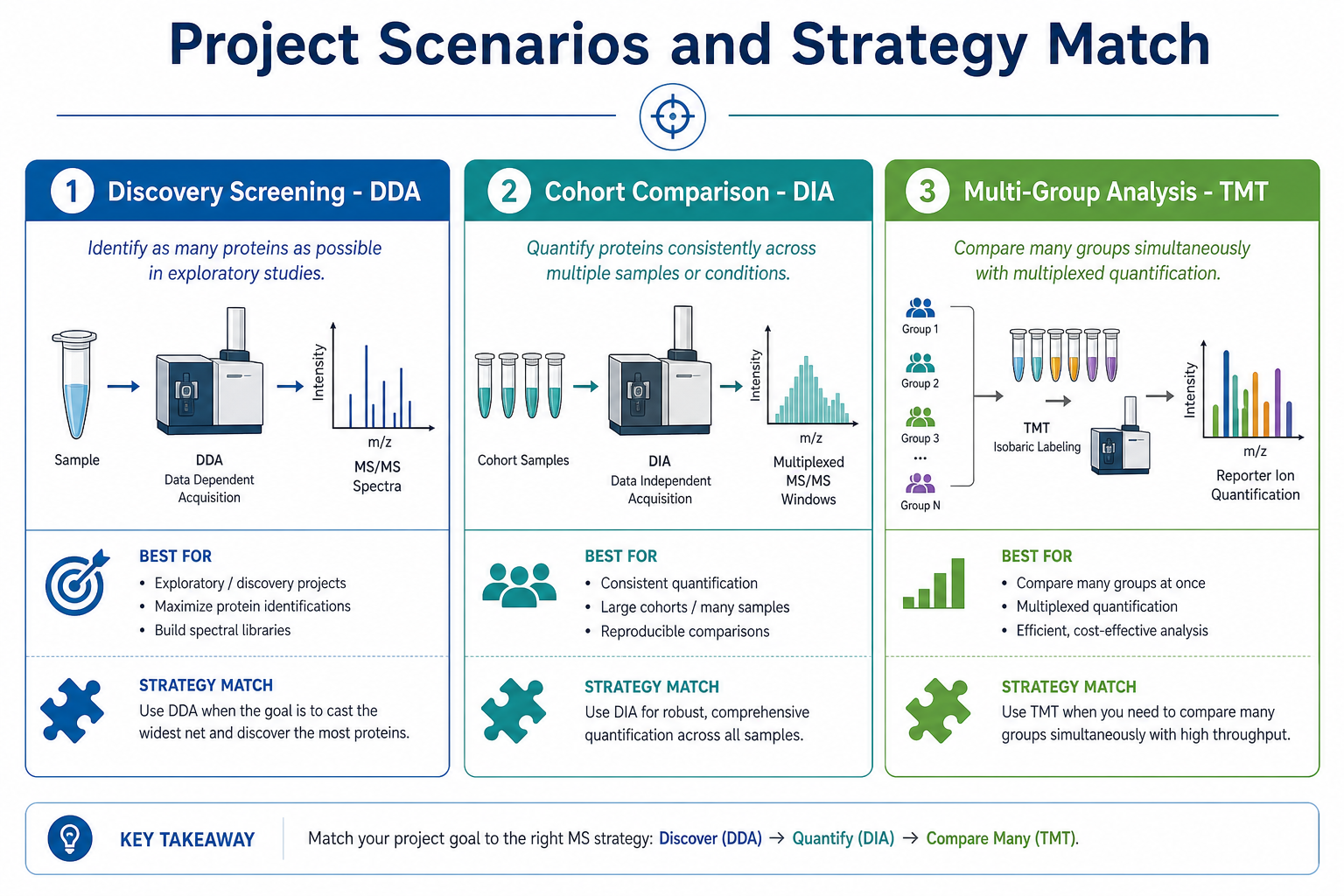
Figure 3. Project scenarios such as discovery screening, cohort comparison, and multiplex group analysis map to different DDA, DIA, and TMT strategy choices.
Frequently Asked Questions
1. What is the main difference between DDA and DIA?
DDA fragments the most intense precursor ions in each cycle. DIA fragments peptides across predefined mass windows systematically, which improves consistency across samples in a cohort.
2. Is TMT an acquisition mode like DDA or DIA?
No. TMT is an isobaric labeling method for multiplexed quantitation. It is commonly combined with DDA acquisition during LC-MS/MS analysis.
3. When should I choose TMT over label-free DDA or DIA?
TMT is appropriate when multiple conditions must be compared in the same MS run and multiplexed relative quantitation is part of the study design. Label-free DDA or DIA may be preferred when labeling steps are not required or sample number is large.
4. Can DDA support quantitative proteomics?
Yes. DDA with label-free quantitation supports group comparison, but missing values may be higher across runs than in DIA cohort studies.
5. Which strategy is best for large clinical cohorts?
DIA is often selected for large cohorts because window-based acquisition reduces stochastic missing values and supports more consistent peptide measurement across specimens and batches.
Conclusion
DDA, DIA, and TMT address different layers of LC-MS/MS proteomics design. DDA prioritizes deep identification through intensity-based precursor selection. DIA systematizes fragmentation for reproducible quantitation across sample cohorts. TMT enables multiplexed group comparison within a single run through isobaric reporter labeling. The right strategy depends on whether the project requires discovery depth, cohort consistency, or multiplexed quantitative comparison.
Matching acquisition mode and labeling approach to the study goal reduces repeat analysis and improves the usability of proteomics reports. Teams planning an LC-MS/MS project can contact MtoZ Biolabs to review sample design and select the DDA, DIA, or TMT workflow best suited to their identification and quantitation requirements.
How to order?




