



Quantitative proteomics compares protein abundance across conditions using mass spectrometry (MS). The two common relative strategies are label-free quantification (LFQ) and isobaric labeling. LFQ uses independent liquid chromatography-tandem mass spectrometry (LC-MS/MS) injections per sample and rebuilds comparability by alignment and normalization, often with MS1 MaxLFQ under data-dependent acquisition (DDA) or fragment chromatograms under unlabeled data-independent acquisition (DIA) (Cox et al. 2014). Isobaric labeling, including tandem mass tag (TMT) and isobaric tags for relative and absolute quantitation (iTRAQ), pools tagged channels and reads relative ratios from reporter ions after fragmentation (Thompson et al. 2003; Ross et al. 2004). Both support same-protein relative change inside a defined plan, not calibrated absolute concentration without matched standards.
Researchers who already have defined samples, comparison groups, or a specific project objective can also review the MtoZ Biolabs Label-Free Quantitative Proteomics Service and TMT Quantitative Proteomics Analysis Service for project-specific feasibility and analysis planning.
Strategy Overview at a Glance
Layer |
Label-free quantification (LFQ) |
Isobaric labeling (TMT / iTRAQ class) |
|---|---|---|
Labeling chemistry |
None; unlabeled digests |
Amine-reactive isobaric tags per channel |
Sample handling |
Independent injections per sample |
Channels pooled after labeling |
Quantitative readout |
MS1 areas or DIA fragment features |
Reporter-ion ratios at MS2 or MS3 |
Drift control |
Run order, QC pools, normalization |
Shared chromatography inside one plex |
Typical acquisition |
DDA-LFQ or unlabeled DIA |
DDA-style reporter readout (not DIA as a tag) |
Valid claim |
Relative discovery across matched runs |
Relative ratios inside one closed plex |
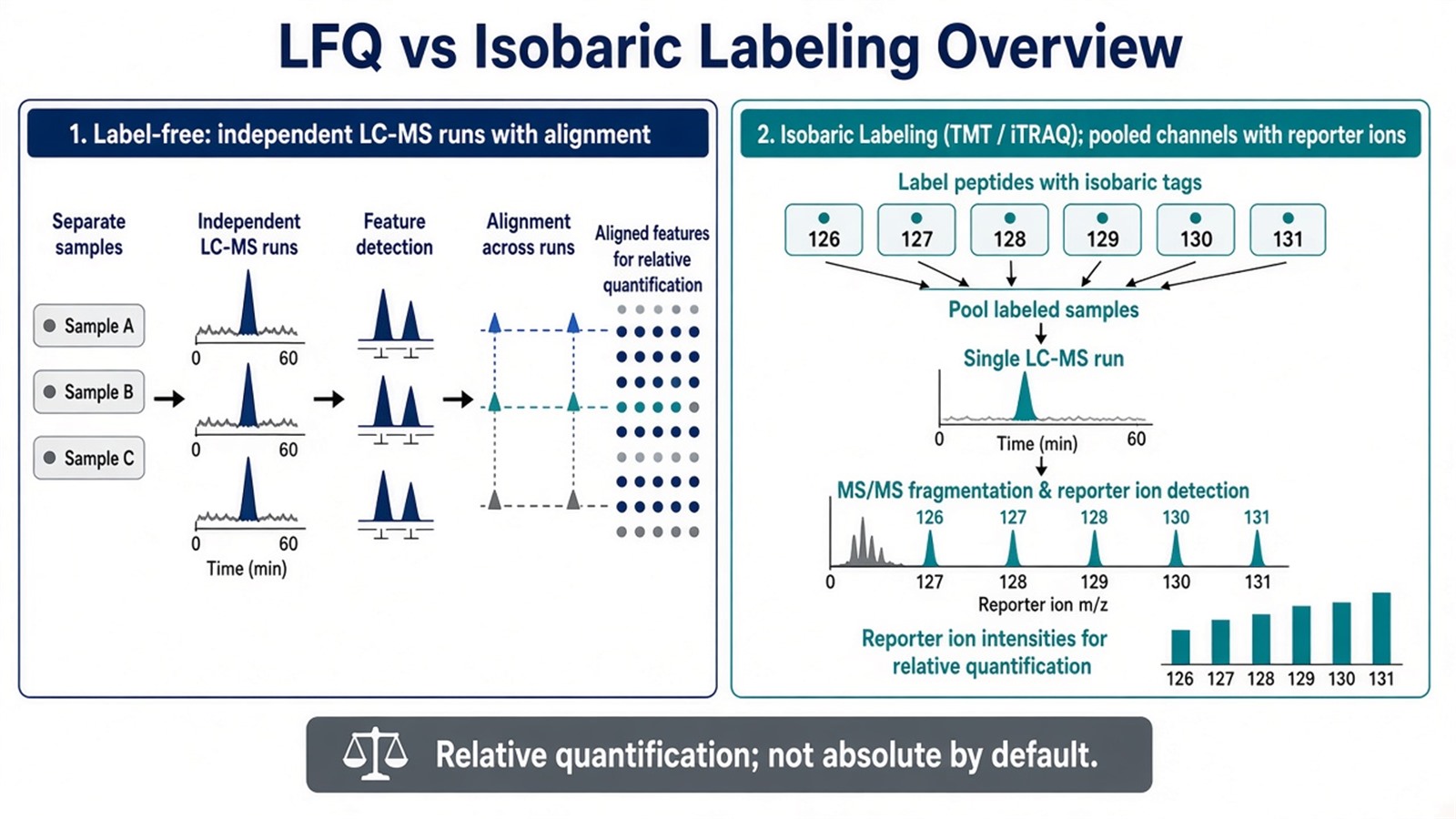
Figure 1. LFQ and isobaric labeling are alternative relative quantitative strategies that differ in mixing, readout, and cohort rules.
Strategy choice is about which constraint you can control: open enrollment and unlabeled injections, or a closed multiplex plex with same-run comparison.
Label-Free Quantification in This Comparison
LFQ estimates relative protein abundance from peptide signals recorded across separate runs. After tryptic digestion, each sample enters the mass spectrometer without isobaric or metabolic tags. Software aligns features, normalizes intensities, and summarizes to protein-level values. DDA-LFQ relies on identified MS1 peak areas. Unlabeled DIA relies on scheduled-window fragment extraction. Spectral counting can rank abundance coarsely but is usually weaker for subtle fold changes than intensity-based LFQ.
LFQ fits exploratory cohorts, clinical collections that arrive in batches, matrices where amine labeling is risky, and studies that may add compatible samples later. Its main limits are run-to-run drift, stochastic missing values under DDA, and dependence on normalization when batch structure is weak.
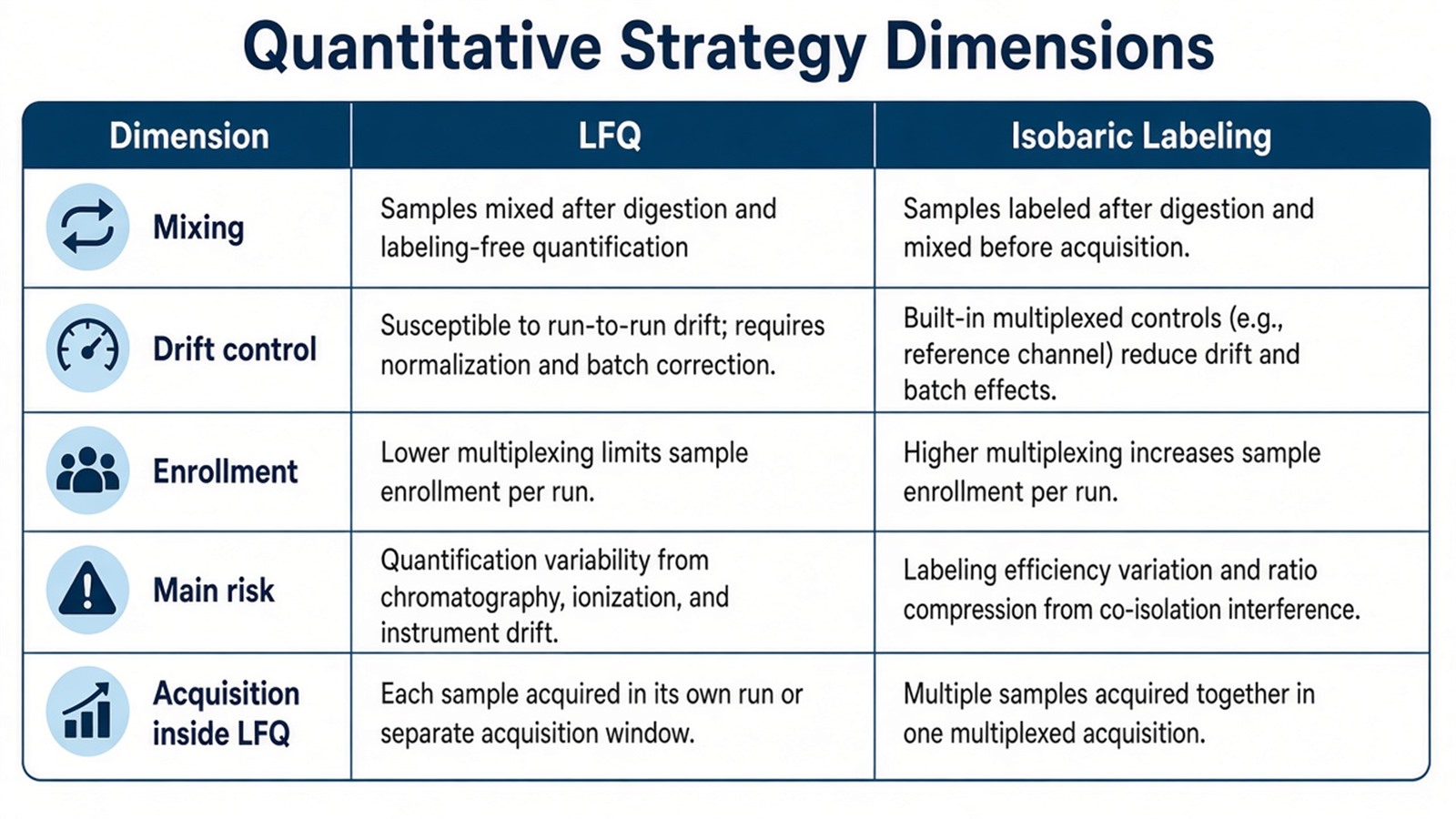
Figure 2. The practical difference is not only labeling cost but mixing rules, drift, and the main quantitative failure mode for each strategy.
For LFQ operations, see What Is Label-Free Analysis? LFQ Principles, Workflow, Advantages, and Limitations. For DDA versus DIA inside LFQ, see DIA vs. DDA in Label-Free Quantitative Proteomics: A Comparative Analysis. For biomedical use patterns, see A Complete Guide to Label-Free Quantitative Proteomics (LFQ) in Biomedical Research.
Isobaric Labeling in This Comparison
Isobaric reagents attach channel-specific tags that share precursor mass at MS1 and release distinct reporter ions after fragmentation. TMT and iTRAQ belong to the same strategic class: multiplex relative quantification inside one combined LC-MS/MS path. Channel count is finite per kit. Enrollment closes once samples are mixed. Ratio compression from co-isolated peptides at MS2 can limit fold-change dynamic range unless fractionation, narrower isolation, or MS3 routes such as synchronous precursor selection MS3 (SPS-MS3) are planned.
Isobaric labeling fits multi-arm treatment panels, genotype contrasts, and dose designs that can be frozen in one plex without forcing unrelated samples into spare channels. It does not replace absolute quantification and does not remove chemistry failures such as incomplete labeling.
For reporter-ion mechanism detail, see Introduction to TMT Reporter Ions and Mass Spectrometry Analysis. For compression limits, see How Does Ratio Compression Arise in TMT-Based Quantitative Proteomics and Why Is It Limited to Relative Quantification?.
Judgment Criteria: LFQ or Isobaric Labeling
Study need |
Prefer LFQ |
Prefer isobaric labeling (TMT / iTRAQ class) |
Reassess both |
|---|---|---|---|
Cohort structure |
Sample number or timing exceeds one plex |
Groups and replicates fit one kit |
Absolute concentration required |
Chemistry |
Labeling impractical or too costly |
Clean amine labeling feasible |
Closed peptide panel ready |
Enrollment |
Samples may arrive later under one regime |
Channel map fixed before mixing |
Diagnostic cutoff needed |
Quantitative priority |
Independent-run relative discovery |
Same-run reporter ratios |
Targeted PRM/MRM with SIS |
Risk you can manage |
Normalization, QC, missing values |
Compression, plex design, MS2/MS3 plan |
Neither relative discovery claim fits |
Prefer LFQ when samples must stay unlabeled and comparability is rebuilt across runs. Prefer isobaric labeling when every planned contrast can share one labeled injection and same-run ratios are the scarce resource. Prefer stable isotope-labeled standard (SIS) or AQUA-style assays when defined absolute units are required. Prefer PRM or MRM when targets are closed.
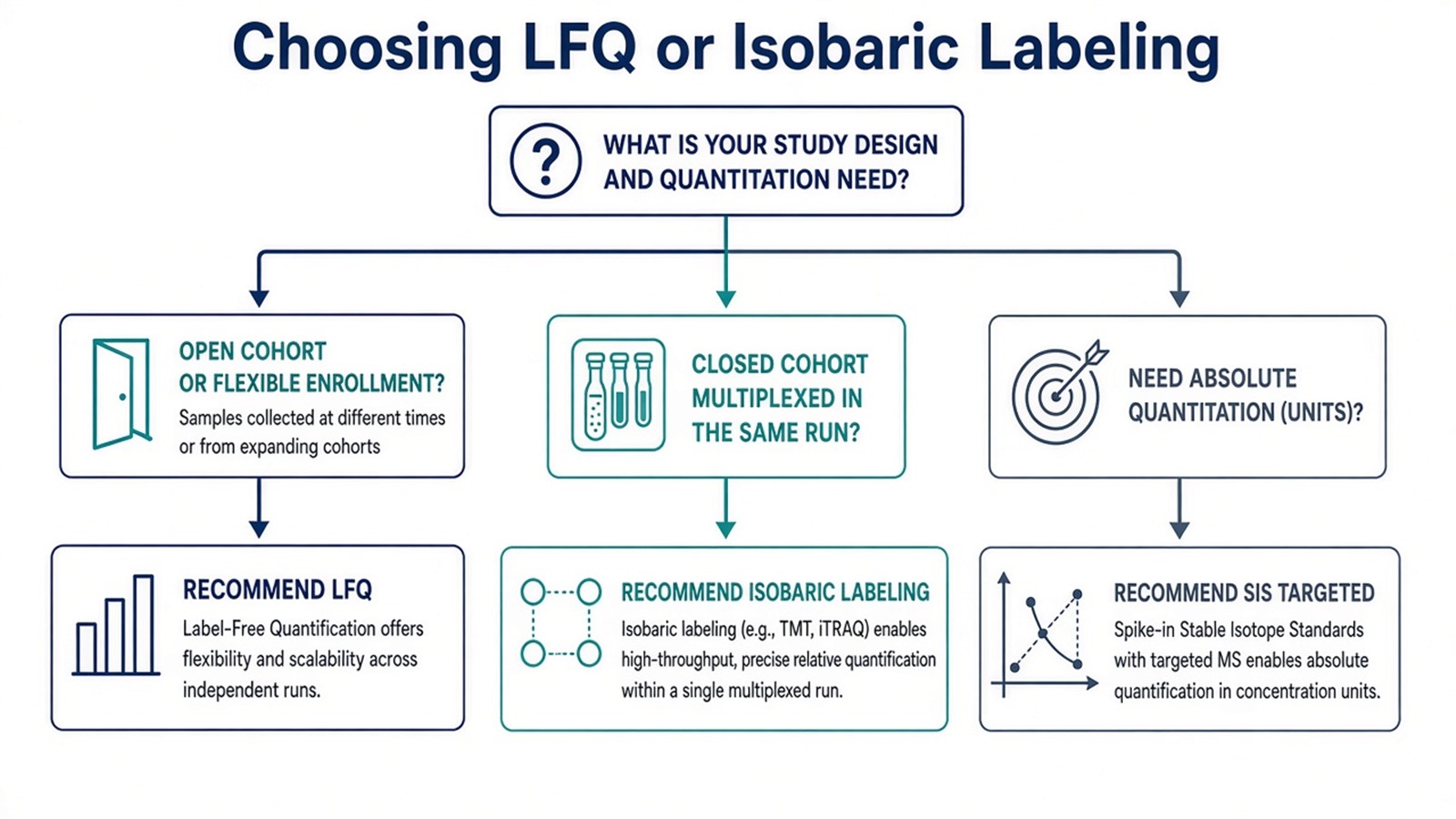
Figure 3. Start from cohort rules and the quantitative claim, then pick LFQ, isobaric labeling, or a targeted absolute route.
For a focused pairwise brief, see TMT vs Label Free Quantitative Proteomics and TMT vs Label Free. For acquisition plus labeling stacks, see DDA vs. DIA vs. TMT in LC-MS/MS Proteomics: How to Choose the Right Strategy. For advantage lists, see Advantages and Disadvantages of Label-Free Quantitative Proteomics and Advantages and Disadvantages of TMT-Based Quantitative Proteomics Analysis.
Limits and Application Boundaries
LFQ does not remove batch effects without design. Isobaric labeling does not remove ratio compression without acquisition and fractionation controls. Calling either strategy high precision without stating QC, plex layout, or normalization overstates method class alone. Pathway enrichment from either route reflects list overrepresentation, not proven pathway activity in patients.
Typical LFQ applications include heterogeneous clinical biofluids in discovery mode, evolving preclinical cohorts, archival formalin-fixed material where labeling is avoided, and large screens where independent injection scales better than repeated plexes. Typical isobaric applications include multi-condition drug or genotype panels inside one kit, time-course designs that fit channel count, and studies that prioritize same-run relative contrast over open enrollment.
Diagnostic cutoffs, regulatory assay claims, and cross-study absolute stoichiometry sit outside ordinary LFQ or isobaric discovery reporting unless a separately validated framework is in place.
Once the labeling decision, acquisition mode inside LFQ if applicable, and relative comparison design are defined, the project can be scoped as an LFQ or isobaric study. Researchers can review the MtoZ Biolabs Label-Free Quantitative Proteomics Service and TMT Quantitative Proteomics Analysis Service. For unlabeled DIA options, see Label-Free DIA Quantitative Proteomics.
Frequently Asked Questions
1. Are TMT and iTRAQ the same strategy as LFQ?
No. They are isobaric labeling classes with pooled multiplex readout. LFQ is unlabeled with independent runs.
2. Is LFQ always cheaper than isobaric labeling?
Reagent cost often favors LFQ at scale, but total cost follows sample number, fractionation, instrument time, and analysis labor, not the label-free name alone.
3. Can LFQ and isobaric results be merged casually?
Cross-strategy comparison needs bridging design and explicit normalization. They are not interchangeable matrices without planning.
4. Does isobaric labeling remove batch effects for all samples?
It dampens injection drift among channels in the same plex. It does not fix wrong channel maps, incomplete labeling, or absolute concentration claims.
5. Where do absolute quantification methods fit?
SIS peptides, AQUA, and related targeted assays address absolute units. Both LFQ and isobaric routes remain relative unless such standards are added.
Reference
- J. Cox, M.Y. Hein, C.A. Luber, et al. (2014). Accurate proteome-wide label-free quantification by delayed normalization and maximal peptide ratio extraction, termed MaxLFQ. Mol. Cell. Proteomics, 13, 2513-2526. https://doi.org/10.1074/mcp.M113.031591
- A. Thompson, J. Schaefer, K. Kuhn, S. Kienle, J. Schwarz, G. Schmidt, T. Neumann, C. Hamon (2003). Tandem mass tags: a novel quantification strategy for comparative analysis of complex protein mixtures by MS/MS. Anal. Chem., 75, 1895-1904. https://doi.org/10.1021/ac0262560
- P.L. Ross, Y.N. Huang, J.N. Marchese, et al. (2004). Multiplexed protein quantitation in Saccharomyces cerevisiae using amine-reactive isobaric tagging reagents. Mol. Cell. Proteomics, 3, 1154-1169. https://doi.org/10.1074/mcp.M400049-MCP200
