



Co-IP for low-expression proteins is a sensitivity-limited capture, not a standard immunoprecipitation run with a larger blot exposure. Endogenous bait is scarce, so antibody occupancy is low, abundant proteins occupy the bead surface, and weak partners fall below detection before the spectrometer starts. The usable path combines a sample in which the bait is less scarce, an IP-grade antibody, a lysis that can keep a fragile complex, and an IP-MS readout when a gel cannot see the prey. One enrichment step does not repair all four limits.
Co-immunoprecipitation (Co-IP) still reports proteins that remain with a bait after a stated wash. When that bait is a low-copy signaling node or a scarce complex subunit, the same wash that cleans an abundant IP can empty the pellet. Cross-linking, pre-clearing, and low-background magnetic beads can help only when they are matched to that scarcity. They do not convert a missing bait into a biologically meaningful interactome.
Researchers who already have a scarce endogenous bait, a weak Western, or an IP-MS question can also review the MtoZ Biolabs Co-IP-MS Protein Interaction Analysis Service for project-specific feasibility and analysis planning.
Why Low-Expression Proteins Are Hard in Co-IP
Co-IP depends on recovering enough bait to bring associated proteins out of the lysate. When the bait is scarce, three losses happen together. Capture occupancy drops because antigen is limiting. Non-specific proteins still bind beads and antibody at their usual efficiency, so they dominate the eluate. True partners, already stoichiometric to a rare bait, fall below Western and often below a poorly enriched MS injection.
Gel-based readouts become insensitive first. IP-MS can still see peptides that never appear as a stained band. It does not outperform a matched Western when the pair is already nominated and abundant enough to blot. For failure modes that are not abundance-limited, including a missing antibody or a stripped complex, Causes of Co-IP Experimental Failure: Common Pitfalls and Troubleshooting Strategies provides a complementary mode map.
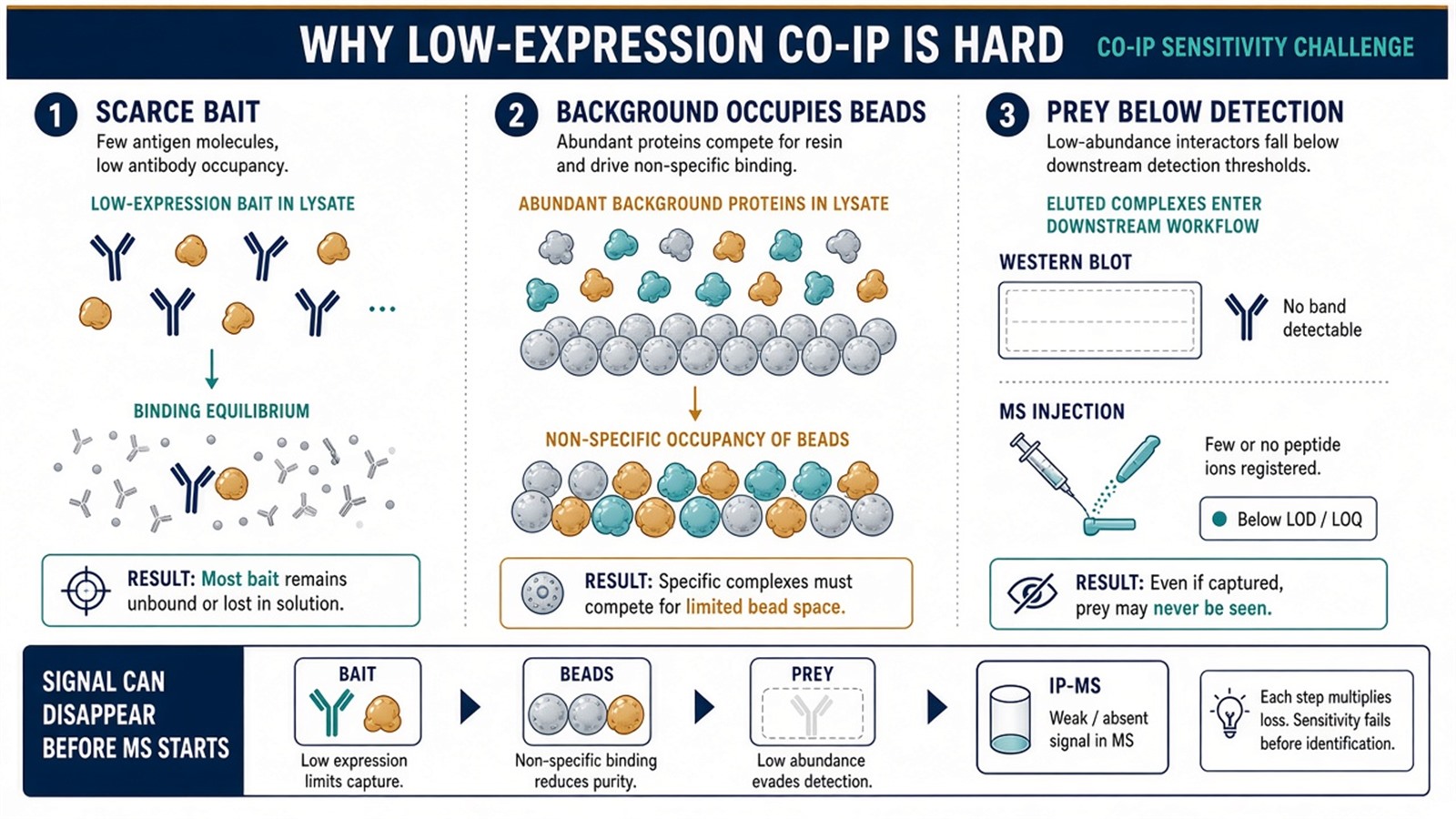
Figure 1. Scarce bait lowers capture occupancy. Background still occupies the resin. Partners can disappear before Western or a thin IP-MS injection.
Treat the experiment as a limited-bait problem. More wash, or a longer exposure, does not create antigen that was never captured.
Enrichment Strategies When the Bait Is Scarce
Choose the biological system first
The simplest gain is a sample in which the bait is less scarce. That may be another cell line, a tissue with higher endogenous expression, a physiological stimulus that raises occupancy, or a controlled low-copy induction system. Increasing starting cell or tissue mass is often more defensible than jumping to strong overexpression. Mild or inducible expression can recover complexes that were below the antibody’s reach. Strong overexpression creates collision partners and is no longer an endogenous Co-IP. For that distinction, How Can Endogenous Interactions Between Two Proteins Be Verified? provides a complementary native-versus-tagged discussion.
Antibody selection and bead strategy
High-affinity, IP-validated antibodies matter more when antigen is limiting. For MS-oriented Co-IP, covalent coupling of the antibody to magnetic beads reduces heavy- and light-chain contamination and can tighten wash handling. Bead overload is a common error: extra resin adds background faster than it adds a scarce bait. Match bead volume to the antibody mass, not to a protocol written for abundant targets.
Protect complexes during lysis
Low-expression proteins are often in transient or weak assemblies. Work cold, include protease and phosphatase inhibitors, and start from a gentle detergent such as NP-40. Digitonin is a membrane-leaning alternative when the biology requires it, not a default upgrade. Maximizing protein release with SDS or harsh sonication can raise total yield and still dissolve the only complex that mattered.
Optimize specificity without washing away the signal
Pre-clearing on empty beads or control IgG can lower some resin binders. It also consumes lysate, which is expensive when the bait is already scarce. Reducing bead load and shortening idle binding time can improve specificity with less material loss. Wash stringency is a trade-off: sticky contaminants leave, and weak true partners leave with them. For leftover-signal classes after a matched IgG, How to Reduce High Background Signals in Co-IP Assays? provides a complementary one-variable discussion.
Optional chemical cross-linking, such as DSP, can keep some neighbors in the pellet through a harsher wash. The result is then a crosslinking-assisted capture, not the original native Co-IP.
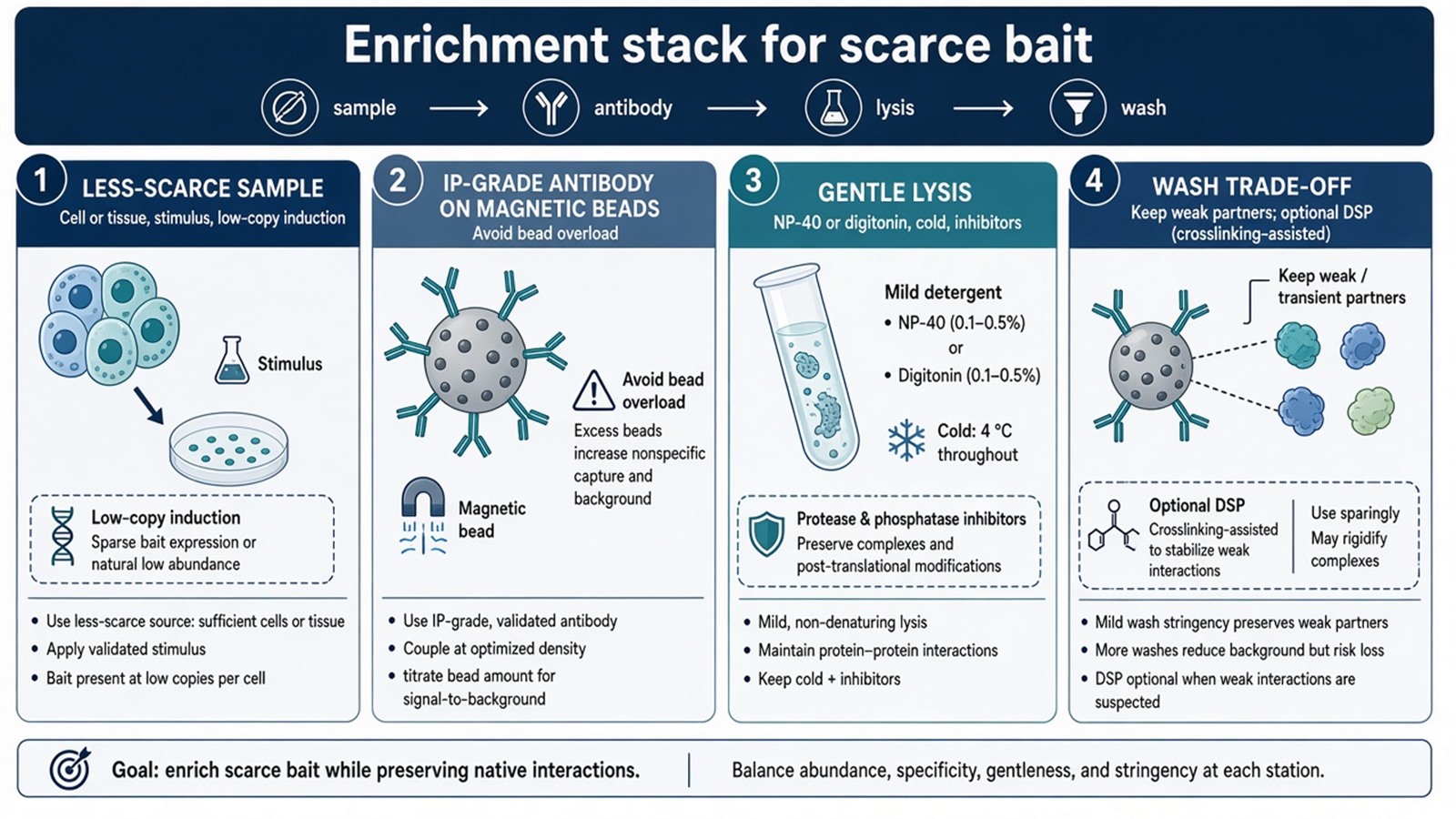
Figure 2. Start from a sample in which the bait is less scarce, then match antibody, lysis, and wash to that limited occupancy. Extra beads and extra salt are not enrichment.
Why IP-MS Is Often Necessary
For low-expression baits, partners may be invisible by gel staining even when the immunoprecipitation recovered the bait. High-resolution nanoLC-MS/MS improves peptide detection from a small eluate and allows contaminant annotation, label-free comparison, or a SILAC-style specificity contrast when the cells can be labeled. That is a sensitivity and filtering gain. It is not automatic interactome discovery, and it does not replace a matched isotype or empty-tag arm.
Use IP-MS when the partners are unknown, too scarce to blot, or need a scored table against controls. Keep Western when a nominated prey is already visible and the claim is that single pair. For the coupling steps after a usable IP, How to Combine Co-IP with Mass Spectrometry for Protein Interaction Analysis? provides a complementary workflow discussion.
Troubleshooting When Abundance Is the Constraint
Problem |
Likely reason when the bait is scarce |
Practical next step |
|---|---|---|
No bait recovery |
Antibody weak, or starting antigen below occupancy |
Revalidate an IP-grade antibody; increase tissue or cell input; change to a less-scarce context |
High background |
Bead or antibody binders outcompete a rare bait |
Lower bead load; cross-link the antibody; pre-clear only if lysate remains; match the IgG mass |
Interactors disappear |
Complex lost in lysis or wash |
Gentler detergent; colder handling; optional DSP, labeled as crosslinking-assisted |
MS signal too weak |
Peptide load after IP is too low |
Improve bait capture first; reduce contaminants; use nanoLC-MS on the same eluate |
The table is abundance-centered. It is not a substitute for the six-mode failure map used when the bait is not scarce.
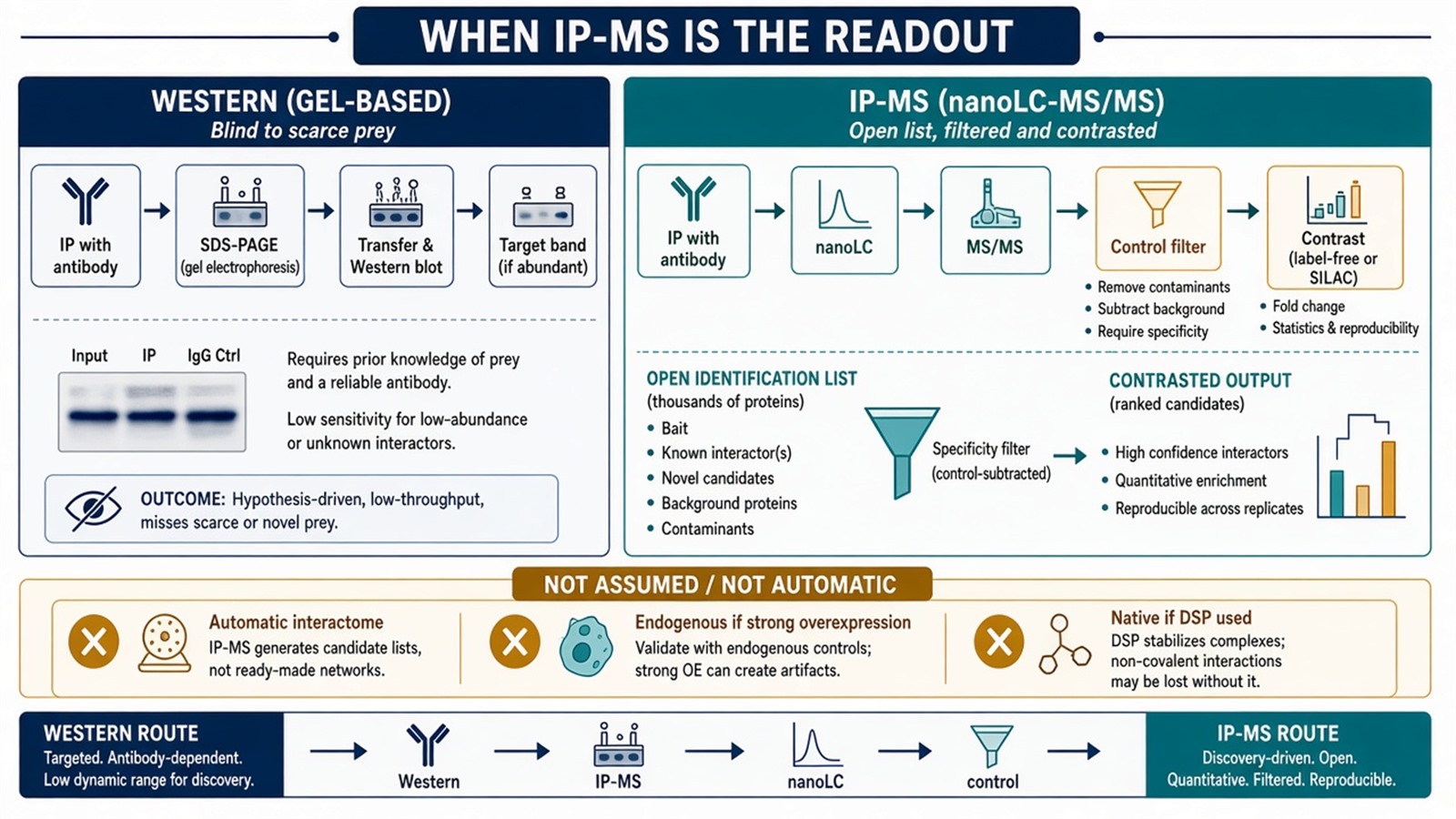
Figure 3. A gel can miss a real, scarce prey. IP-MS can read that eluate. DSP or a high-dose tag can return signal and still change what the experiment may claim.
Experimental Limits
Low-expression Co-IP can recover a shortlist. It cannot guarantee that every physiological neighbor of a scarce protein was retained. More starting material raises some partners and some contaminants together. Diagnostic language sits outside ordinary research capture unless a separately validated assay framework is in place.
Project Planning and Service Scope
A usable low-expression plan names the bait abundance in the chosen sample, the antibody, the input mass, the lysis class, and whether the readout is Western or IP-MS. MtoZ Biolabs scopes antibody or tag Co-IP from limited input and Orbitrap-class nanoLC-MS/MS when the eluate is too thin for a gel. Recovery still follows antigen amount and capture chemistry, not the instrument name.
Once the sample, antibody, and readout are defined, the project can be scoped as a low-input Co-IP-MS study. Researchers can review the MtoZ Biolabs Co-IP-MS Protein Interaction Analysis Service for project-specific sample evaluation, feasibility assessment, and workflow planning.
Frequently Asked Questions
1. Why does Co-IP fail more often for low-expression proteins?
Because the bait is scarce, capture occupancy is low and downstream detection is weak, while background proteins still bind beads and antibody efficiently.
2. Should I overexpress a low-expression protein for Co-IP?
Only as a controlled, labeled rescue. Mild or inducible expression can raise occupancy. Strong overexpression can create artificial partners and is not an endogenous result.
3. When is IP-MS better than Western blot detection?
When partners are unknown, too scarce to visualize on a gel, or must be scored against a control table. Western remains appropriate for a nominated pair that already blots.
4. Does pre-clearing always help when material is limited?
No. Pre-clearing can remove some resin binders and also consumes lysate. Use it when leftover sample remains after the bait IP is loaded.
5. Does DSP rescue a native low-expression Co-IP?
It can keep some neighbors through wash. The experiment is then crosslinking-assisted capture, not the original native Co-IP.
Reference
- Lin J.S., Lai E.M. (2017). Protein-protein interactions: co-immunoprecipitation. Methods Mol. Biol., 1615, 211-219. https://doi.org/10.1007/978-1-4939-7033-9_17
- Gingras A.C., Gstaiger M., Raught B., Aebersold R. (2007). Analysis of protein complexes using mass spectrometry. Nat. Rev. Mol. Cell Biol., 8, 645-654. https://doi.org/10.1038/nrm2208
- Mellacheruvu D., Wright Z., Couzens A.L., et al. (2013). The CRAPome: a contaminant repository for affinity purification-mass spectrometry data. Nat. Methods, 10, 730-736. https://doi.org/10.1038/nmeth.2557
- Dunham W.H., Mullin M., Gingras A.C. (2012). Affinity-purification coupled to mass spectrometry: basic principles and strategies. Proteomics, 12, 1576-1590. https://doi.org/10.1002/pmic.201100523
- Smits A.H., Vermeulen M. (2016). Characterizing protein-protein interactions using mass spectrometry: challenges and opportunities. Trends Biotechnol., 34, 825-834. https://doi.org/10.1016/j.tibtech.2016.02.014
