



ChIP-Seq is used to map genomic regions associated with a known transcription factor, chromatin-associated protein, or histone modification. Researchers can compare these occupancy profiles across experimental conditions to investigate changes in protein-associated chromatin and explore their potential roles in gene regulation.
Researchers planning a genome-wide occupancy study can use the MtoZ Biolabs ChIP-Sequencing (ChIP-Seq) Service to discuss target suitability, sample context, controls, and analysis goals. For a broader view of how occupancy evidence fits with other interaction measurements, see Protein Interaction Analysis: What It Reveals, Key Methods, and Applications.
What ChIP-Seq Measures in Protein–Chromatin Studies
Chromatin immunoprecipitation followed by sequencing begins with a defined target, usually a transcription factor, chromatin-associated protein, or histone modification. An antibody enriches chromatin fragments carrying that target, and sequencing identifies genomic regions represented more strongly in the enriched material than in an appropriate background. This protein-centered direction differs from the DNA Pull-Down Assay Service approach, which begins with a defined DNA sequence and asks which proteins can be captured.
For a sequence-specific transcription factor, enriched regions can support a genome-wide occupancy map under the sampled condition. For a histone mark, the result describes the distribution of a chromatin feature rather than occupancy by one DNA-binding factor. These targets also produce different signal shapes. Transcription factors often generate relatively localized enrichment, while some histone marks occupy broader domains. Peak-calling and quality evaluation should therefore match the target class rather than apply one universal model.
Crosslinking can preserve protein-associated chromatin, including complexes in which the immunoprecipitated protein is connected to DNA through other molecules. Consequently, ChIP-Seq does not by itself distinguish direct DNA contact from indirect recruitment. It also does not identify protein partners within the recovered complex. The method answers where target-associated chromatin is enriched, with resolution and completeness constrained by fragment size, antibody behavior, genomic mappability, and biological context.
Designing ChIP-Seq Comparisons and Controls
A ChIP-Seq study should be designed around the biological comparison of interest. Treatment versus control can reveal condition-associated occupancy changes. Mutant versus wild type can test whether a sequence, domain, or pathway influences chromatin recruitment. Different cell states or tissues can reveal context-specific occupancy, but differences in cellular composition may also alter the apparent signal. Sample identity, collection, chromatin preparation, and processing batch should therefore be considered before sequencing.
Antibody Specificity
Antibody specificity is central to reliable chromatin profiling. An antibody that recognizes a target in an immunoblot may not perform adequately in ChIP-Seq because the target's epitope and surrounding molecular environment differ between assays. Validation evidence from the relevant species, sample type, and experimental context is therefore important. For transcription factors, the antibody should enrich the intended protein. For histone modification studies, it should distinguish the target modification from related chromatin marks. Existing evidence from immunoprecipitation, knockout material, or other appropriate validation approaches can help establish antibody suitability (Landt et al., 2012).
Controls and Replicates
Input DNA and IgG controls address different sources of background. Input DNA represents chromatin before immunoprecipitation and helps account for differences in DNA representation and sample-specific background. IgG controls assess nonspecific recovery associated with the immunoprecipitation procedure. Target-appropriate positive and negative controls can provide additional evidence of specificity.
Biological replicates should represent independent biological samples relevant to the research question, rather than repeated libraries prepared from the same chromatin sample. Replicates help assess variability within and between experimental conditions and support reliable differential occupancy analysis.
Sample input and cross-linking conditions should be selected according to the target, material, and experimental design. Sample collection, chromatin preparation, and processing batches should also be kept sufficiently consistent across comparison groups to limit technical variation.
From Sequencing Reads to Binding Regions
ChIP-Seq analysis converts sequencing reads into genomic regions that can be evaluated and compared. The initial quality assessment examines read quality, library complexity, duplication, mapping, fragment characteristics, and enrichment patterns. Reads are aligned to an appropriate reference genome, and low-confidence mappings are evaluated according to the analysis strategy. Repetitive or poorly mappable regions require particular attention because technical limitations can affect their representation.
Peak calling identifies regions enriched relative to an estimated background. The selected approach should reflect the target's signal pattern, including whether enrichment is relatively narrow or distributed across broader genomic domains. Quality assessment can include enrichment at expected genomic features, replicate concordance, and visual inspection of representative loci. Peak annotation then associates enriched regions with genomic features such as promoters, gene bodies, and distal regulatory regions. These annotations provide a basis for downstream biological interpretation.
For studies comparing conditions, differential occupancy analysis evaluates normalized signal across defined genomic regions. Differences in peak counts alone do not establish changes in occupancy because sequencing depth, background, and peak-calling settings can affect the number of detected regions. Quantitative comparisons should account for sample variability and report the uncertainty associated with estimated changes.
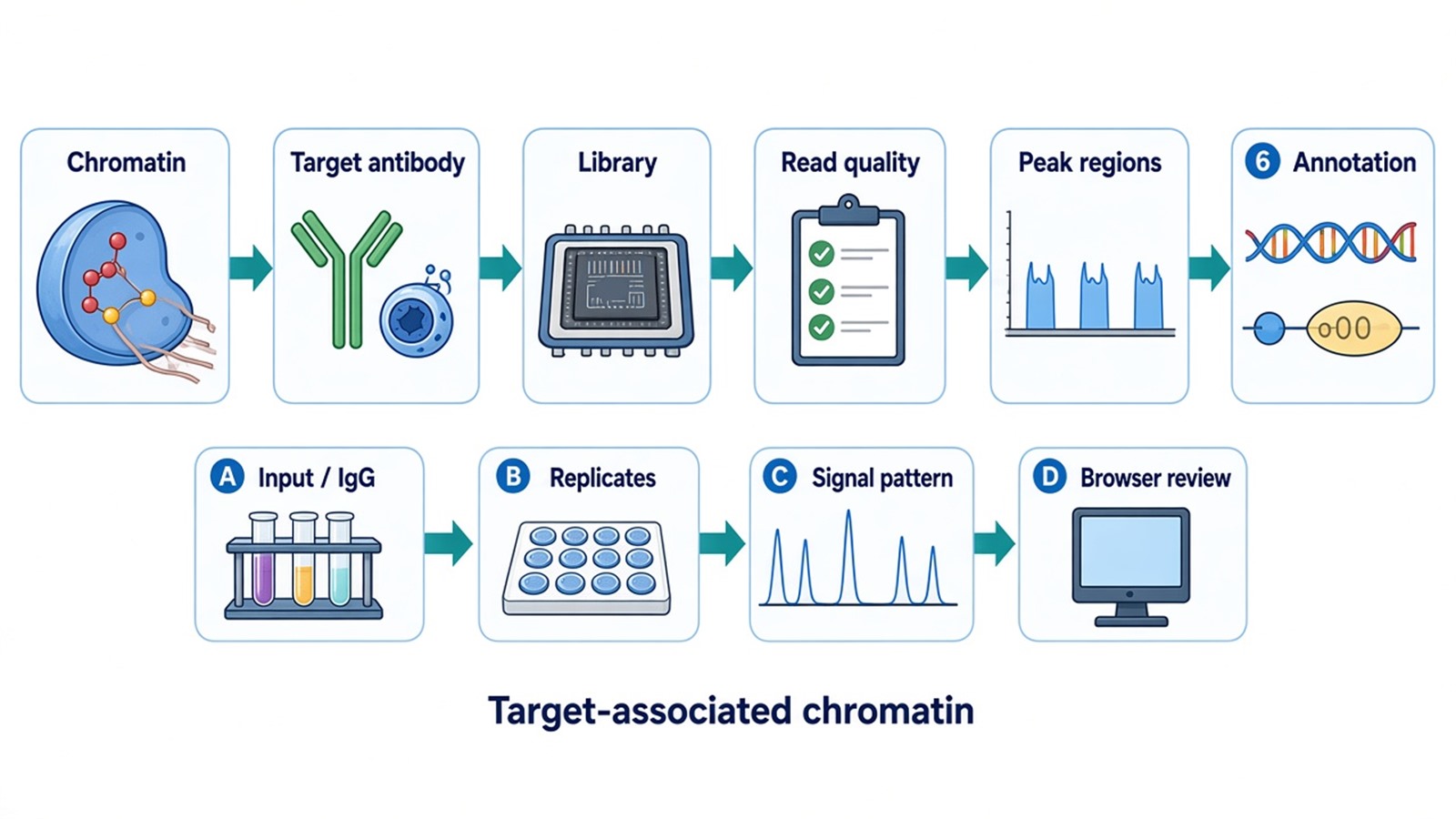
Figure 1. The workflow connects chromatin capture, sequencing quality, reproducible enrichment, genomic annotation, and the highest claim supported by each output.
Interpreting ChIP-Seq Results and Their Biological Significance
ChIP-Seq results help researchers identify genomic regions associated with a protein of interest or a histone modification under specific experimental conditions. For transcription factors, enriched regions provide candidate occupancy sites. For histone modifications, the genomic distribution of the mark can reveal chromatin patterns associated with different regulatory states.
The genomic location of a peak can suggest potential regulatory relationships, but proximity to a gene alone does not establish that the region regulates that gene. Similarly, motif enrichment can identify DNA sequence patterns associated with a set of peaks, providing clues about potential sequence-specific recognition. However, these patterns do not independently establish direct binding by the target protein. Because ChIP-Seq can capture indirectly associated chromatin complexes, occupancy results should be interpreted in the context of the target and the biological system.
Comparing occupancy profiles across experimental conditions can reveal changes in protein-associated chromatin. To investigate their biological significance, researchers can integrate ChIP-Seq results with gene expression measurements or other relevant molecular data. For example, a change in transcription factor occupancy near a candidate regulatory region, together with a corresponding change in gene expression, can support a regulatory hypothesis.
Further experiments can test that hypothesis. ChIP-qPCR can validate enrichment at selected genomic regions, while perturbing the target protein or candidate regulatory element can help determine whether it contributes to the observed biological response. The choice of validation strategy should follow the specific question raised by the ChIP-Seq results.
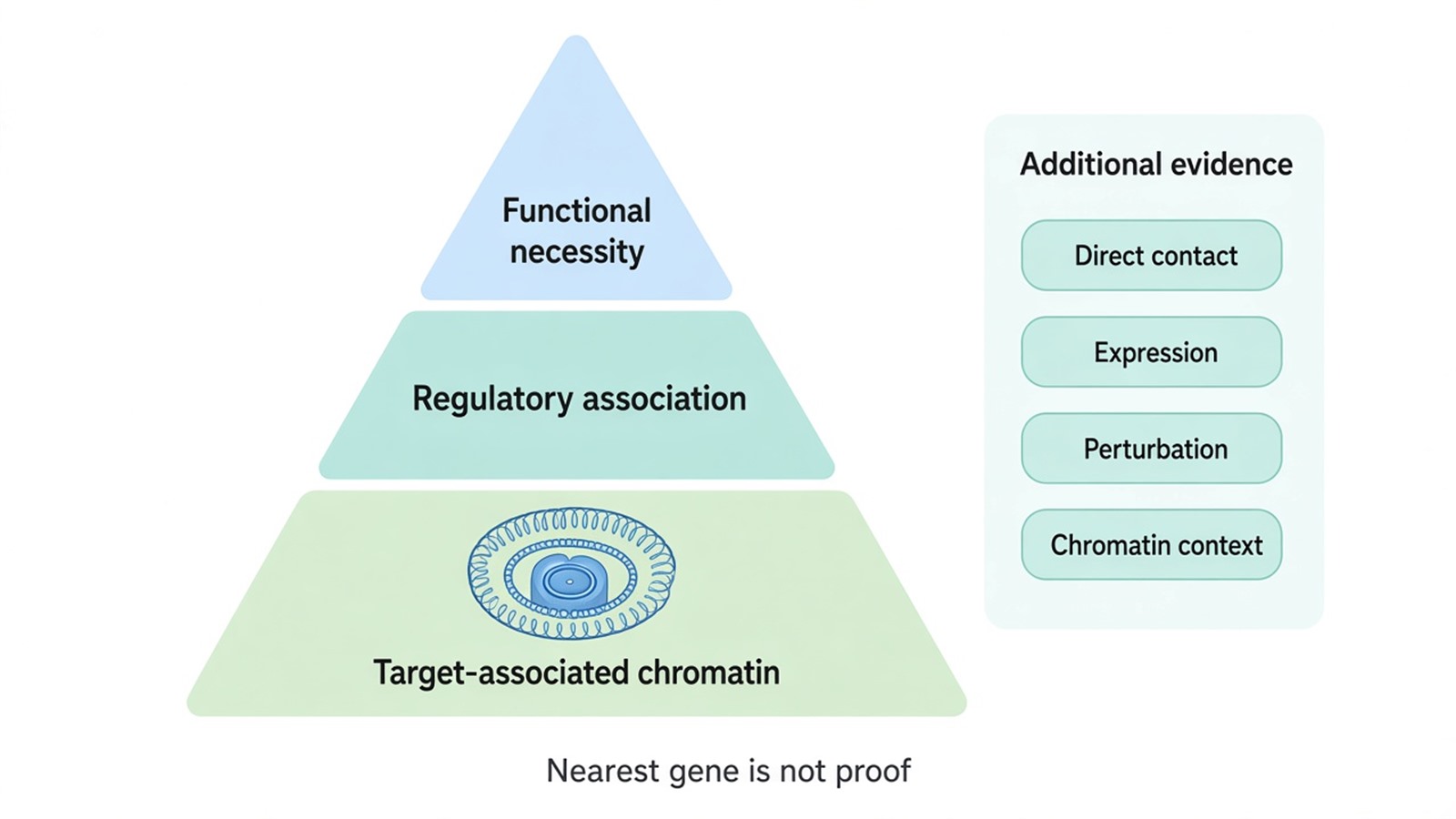
Figure 2. Reproducible enrichment supports an occupancy claim, while direct contact, transcriptional regulation, and functional necessity require additional evidence.
When CUT&Tag or DNA Pull-Down May Be More Suitable
CUT&Tag is another protein-centered method for mapping chromatin-associated targets. Antibody-tethered transposase creates sequencing-ready fragments near the target in situ, often with low background and efficient use of limited material. Method choice should consider target biology, antibody compatibility, sample state, established laboratory evidence, and the comparison being made. Researchers evaluating this route can review (CUT&Tag for Protein-DNA and Chromatin Binding Analysis).
DNA pull-down reverses the starting direction. A defined wild-type, mutant, promoter, enhancer, or variant-containing DNA sequence serves as bait to capture candidate proteins from an extract. This can be useful when the DNA element is known but the associated proteins are not. However, capture from an extract does not reproduce genome-wide occupancy or prove that an interaction occurs in intact cells. ChIP-Seq is better aligned with a known protein and an unknown set of genomic regions.
The decision should follow the required evidence. Choose ChIP-Seq when the protein or chromatin mark is known and the task is mapping associated genomic regions. Consider CUT&Tag when in situ tagmentation, background profile, or limited starting material make it a better fit. Consider DNA pull-down when a defined sequence is known and candidate protein discovery is required. Sample starting amount, background profile, and output type — occupancy map versus candidate protein list — should be reviewed together.
Frequently Asked Questions
1. Can ChIP-Seq be planned for a post-translationally modified transcription factor?
It may be feasible if an antibody specifically recognizes the modified form in the relevant chromatin context. The design must distinguish total-protein occupancy from modification-specific occupancy and include controls that address antibody selectivity. If only the total protein is immunoprecipitated, ChIP-Seq cannot assign peaks specifically to the modified fraction.
2. What information is needed before requesting a ChIP-Seq project assessment?
Provide the organism and reference genome, sample type, target protein or histone mark, available antibody evidence, biological comparison, expected number of independent samples, and the claim the study should support. Existing pilot data and known positive or negative loci are also useful for feasibility and quality planning.
3. Should every differential peak be linked to the nearest gene?
Nearest-gene annotation is a useful starting hypothesis, not a regulatory assignment. Distal elements can contact non-nearest genes, and some peaks may not have a simple target-gene relationship. Expression data, chromatin contacts, perturbation, or targeted validation can refine candidate links.
4. Can ChIP-Seq identify proteins bound to one promoter?
Not in an unbiased manner. ChIP-Seq starts with a known target protein and tests where its associated chromatin occurs. If the promoter sequence is known but the proteins are unknown, a DNA-centered capture strategy is generally more aligned with the question.
Conclusion
ChIP-Seq is most informative when a known chromatin target, validated antibody strategy, meaningful biological comparison, and appropriate controls are defined together. Read processing and peak calling convert sequence data into enriched regions, but biological conclusions must remain at the occupancy level until supported by expression, perturbation, direct-binding, or other orthogonal evidence.
Planning a ChIP-Seq study? Contact MtoZ Biolabs to discuss your research objectives and identify an appropriate approach for profiling protein-associated chromatin.
Reference
- A. Barski, S. Cuddapah, K. Cui, T.Y. Roh, D.E. Schones, Z. Wang, G. Wei, I. Chepelev, K. Zhao (2007). High-resolution profiling of histone methylations in the human genome. Cell, 129, 823-837. https://doi.org/10.1016/j.cell.2007.05.009
- S.G. Landt, G.K. Marinov, A. Kundaje, P. Kheradpour, F. Pauli, S. Batzoglou, B.E. Bernstein, P. Bickel, J.B. Brown, P. Cayting, Y. Chen, G. DeSalvo, C. Epstein, K.I. Fisher-Aylor, G. Euskirchen, M. Gerstein, J. Gertz, A.J. Hartemink, M.M. Hoffman, V.R. Iyer, Y.L. Jung, S. Karmakar, M. Kellis, P.V. Kharchenko, Q. Li, T. Liu, X.S. Liu, L. Ma, A. Milosavljevic, R.M. Myers, P.J. Park, M.J. Pazin, M.D. Perry, D. Raha, T.E. Reddy, J. Rozowsky, N. Shoresh, A. Sidow, M. Slattery, J.A. Stamatoyannopoulos, M.Y. Tolstorukov, K.P. White, S. Xi, P.J. Farnham, J.D. Lieb, B.J. Wold, M. Snyder (2012). ChIP-seq guidelines and practices of the ENCODE and modENCODE consortia. Genome Research, 22, 1813-1831. https://doi.org/10.1101/gr.136184.111
