



Yes. GST pull-down and Western blot can be performed after transfection in 293T cells when the GST-bait is expressed and soluble, a GST-only transfection is processed in parallel, and input blots confirm both bait and prey before the beads are loaded. HEK293T (293T) cells take up plasmid efficiently because they express SV40 large T antigen and amplify vectors that carry an SV40 origin. That property makes a mammalian GST-fusion easy to produce for a glutathione (GSH) capture. It does not make the resulting band an endogenous interaction. The useful first decision is which protein is made in 293T: the GST-bait, the prey, or both. Those three designs share GSH beads and an anti-GST or anti-prey blot. They do not share the same claim.
A protocol that transfects only the GST-bait, skips GST-only, and calls every prey band a partner is not an effective 293T GST pull-down. Overexpression in 293T can glue proteins that never meet at physiological dose.
Researchers who already have a mammalian GST vector, a 293T stock, or a nominated pair for this design can also review the MtoZ Biolabs GST Pull Down Assay Service for project-specific feasibility and analysis planning.
What “Effectively” Means Here
Effective means a readable blot: GST-bait recovered on GSH beads, prey reduced or absent in the GST-only lane, and input showing that both proteins were present in the lysate. It does not mean a native-cell complex, a binding constant, or a network. For the four-step GST procedure without the 293T question, What Is the General Procedure for GST Pull-Down Analysis of Protein–Protein Interactions? provides a complementary general workflow.
293T is chosen because transfection efficiency is high and protein yield for a pull-down is often sufficient from one or two dishes. Parental HEK293 without T antigen can work. It usually yields less plasmid-driven protein when the vector uses an SV40 origin.
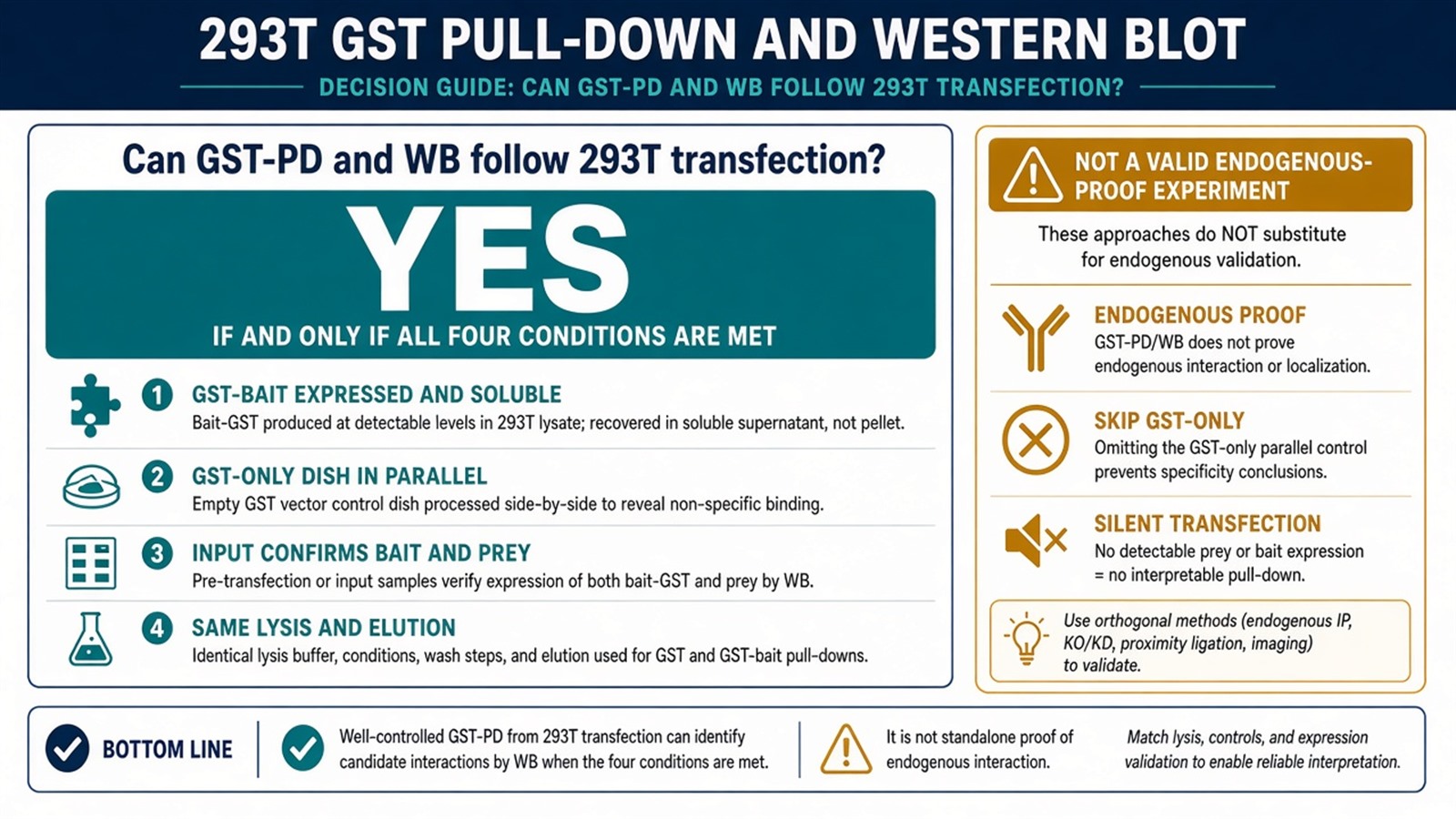
Figure 1. 293T supplies the overexpression lysate. GSH beads capture GST-bait. Western blot reads bait and a nominated prey against a GST-only arm. Effectiveness is a blot, not an endogenous proof.
Confirm input expression first. A pull-down on a silent transfection cannot be rescued by a longer blot.
Two Designs That Are Often Mixed
Design A. Mammalian GST-bait in 293T
Transfect a GST-fusion plasmid, commonly a pEBG-class vector, into 293T. Co-transfect a tagged prey when the pair is nominated. Lyse, bind GSH beads, wash, elute, and blot anti-GST plus the prey antibody. This is the design the original page describes. The entire pair is overexpressed in the same cytoplasm. Contacts can form after lysis as well as before.
Design B. Bacterial GST-bait, 293T prey lysate
Express and immobilize GST-bait from E. coli, then offer a 293T lysate that contains transfected or endogenous prey. The 293T step is only the prey source. Folding and modifications of the bait follow the bacterial host. This is a hybrid of the general GST procedure and a 293T transfection. It is not “GST pull-down following transfection” in the Design A sense.
A third variant transfects prey only and uses purified mammalian GST-bait from a separate 293T dish. Write which proteins were made where. Mixing Design A language with Design B reagents is a common reason a 293T GST pull-down looks empty.
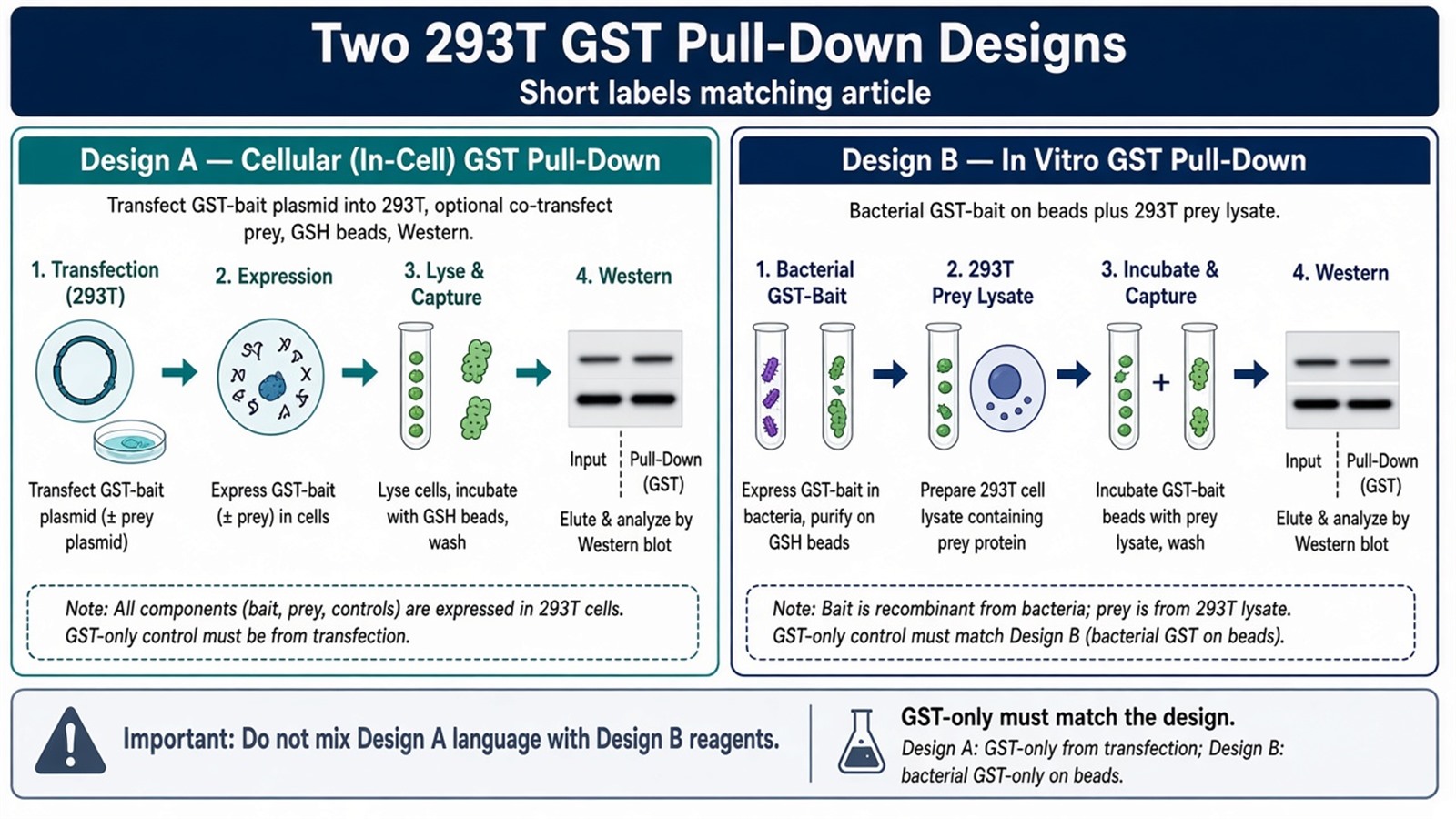
Figure 2. Design A: transfect GST-bait, optionally prey, then GSH capture. Design B: bacterial GST-bait beads plus a 293T lysate. GST-only must match the design.
Transfection of 293T Cells
Seed 293T so that density at harvest still leaves the monolayer attached. Introduce the GST plasmid with a reagent the line already tolerates; PEI and lipid reagents are both used. Harvest at 24–48 hours is common. Longer expression can raise yield and can raise aggregation. A GST-only plasmid, matched for promoter and amount, is transfected in a parallel dish. Single-transfection dishes (bait only, prey only) document that neither protein is required for the other’s expression artifact.
Do not assume every 293T lot transfects equally. Check GFP or input GST on a small well before scaling to a pull-down dish.
Cell Lysis
Lyse on ice in a non-denaturing buffer with protease inhibitors. 293T lysates are rich in transfected protein. A harsh sonication can raise total protein and still dissolve the pair. Clarify, keep an input aliquot, then offer the remainder to GSH beads. Use the same lysis on the GST-only dish.
Purification of the GST Fusion Protein
Glutathione agarose or magnetic GSH beads collect the mammalian GST-fusion and proteins that remain through the wash. Pre-clearing on empty GSH beads can lower resin binders. It does not replace GST-only. Bead volume should match GST-bait amount; excess resin raises background. For GST–GSH chemistry independent of 293T, GST Fusion Protein Pull-Down Assay provides a complementary method overview.
Elution
Reduced glutathione competes GST off the bead. Incomplete elution looks like a failed transfection on the blot. SDS elution or boiling beads in sample buffer is an alternative for Western blot when GSH release is poor. Use the same exit on GST-only. On-bead boiling is acceptable for a nominated blot. It is a poor exit if the next step is a clean MS list.
Western Blot Analysis
Load input and eluate from GST-bait and GST-only on the same gel. Anti-GST, or an antibody to the fused cargo, confirms bait recovery. The prey antibody tests co-recovery. A prey band in GST-only is tag or resin background. A prey band only in the bait lane, with both inputs positive, is an effective 293T GST pull-down result. It remains an overexpression association. Reciprocal capture, a lower-dose transfection, or an endogenous Co-IP is a different claim. For antibody capture of an untagged pair, Workflow of Co-Immunoprecipitation for Protein Interaction Analysis provides a complementary cellular workflow.
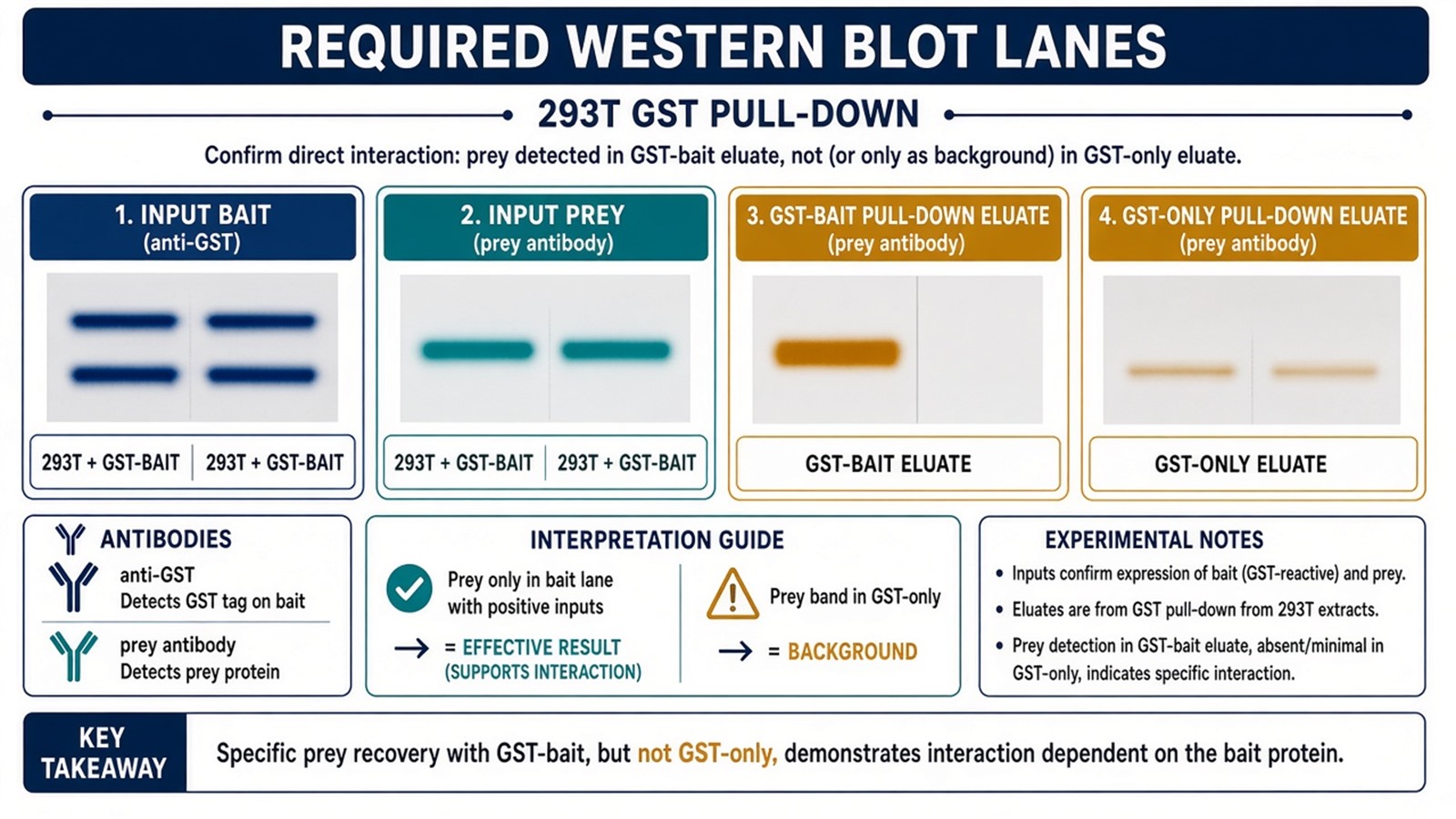
Figure 3. Required lanes: input bait, input prey, GST-bait pull-down, GST-only pull-down. A prey band without those lanes is not an effective result.
When the Answer Is No
The assay is not effective when GST-bait is invisible on input, when the fusion is insoluble, when GST-only is omitted, when Design A and Design B are mixed, or when the claim is an endogenous complex in 293T. 293T is also a poor first host when the contact needs a tissue-specific partner that this line does not express.
Experimental Limits
A successful 293T GST pull-down blot reduces, rather than removes, overexpression artifact. Diagnostic language sits outside ordinary research reporting unless a separately validated assay framework is in place.
Project Planning and Service Scope
A usable 293T plan names the design (A or B), the GST-only plasmid, harvest time, lysis class, GSH bead load, elution, and the prey antibody, before the first transfection. MtoZ Biolabs scopes mammalian or hybrid GST pull-down and Western, and LC-MS/MS when the eluate must be opened. Interpretability still follows the input and GST-only lanes, not the cell-line name.
Once that blot is the intended readout, the project can be scoped as a GST pull-down. Researchers who need a tag capture after 293T expression can review the MtoZ Biolabs Pull-Down Assay Service for project-specific sample evaluation, feasibility assessment, and workflow planning.
Frequently Asked Questions
1. Can GST pull-down and Western blot be done after 293T transfection?
Yes, when GST-bait is expressed, GST-only is run, and input confirms bait and prey. The blot reports an overexpression association.
2. Why use 293T instead of HEK293?
293T expresses SV40 large T and usually yields more protein from SV40-origin plasmids. The pull-down chemistry does not change.
3. Must the prey also be transfected?
No. Endogenous 293T prey can be blotted if the antibody is good and occupancy is high enough. Co-transfection is used when the endogenous level is too low.
4. Is a GST-only dish required if I already have bacterial GST protein?
Yes, if Design A was used. A bacterial GST protein is not the control for a mammalian GST transfection.
5. Does a positive 293T blot prove the proteins interact in the tissue of interest?
No. It proves co-recovery after overexpression in 293T. Tissue or endogenous Co-IP is a separate experiment.
Reference
- Smith D.B., Johnson K.S. (1988). Single-step purification of polypeptides expressed in Escherichia coli as fusions with glutathione S-transferase. Gene, 67, 31-40. https://doi.org/10.1016/0378-1119(88)90005-4
- Vikis H.G., Guan K.L. (2004). Glutathione-S-transferase-fusion based assays for studying protein-protein interactions. Methods Mol. Biol., 261, 175-186. https://doi.org/10.1385/1-59259-762-9:175
- Einarson M.B., Pugacheva E.N., Orlinick J.R. (2007). GST Pull-down. CSH Protoc., 2007, pdb.prot4757. https://doi.org/10.1101/pdb.prot4757
- DuBridge R.B., Tang P., Hsia H.C., et al. (1987). Analysis of mutation in human cells by using an Epstein-Barr virus shuttle system. Mol. Cell. Biol., 7, 379-387. https://doi.org/10.1128/mcb.7.1.379
- Pear W.S., Nolan G.P., Scott M.L., Baltimore D. (1993). Production of high-titer helper-free retroviruses by transient transfection. Proc. Natl. Acad. Sci. U.S.A., 90, 8392-8396. https://doi.org/10.1073/pnas.90.18.8392
