



No. Crosslinking mass spectrometry (XL-MS) can support proximity and a distance-compatible model. A single inter-protein crosslink does not prove that two proteins bind each other through a physical interface. The measured event is a chemical link between reactive residues that were close enough, accessible enough, and present at high enough local concentration to react. That link can sit on a direct contact. It can also sit on two proteins held near each other by a third subunit, a membrane region, a condensate, or a crowded compartment.
Affinity purification still reports who co-enriched with a bait. XL-MS adds residue-level proximity, not a verdict. For when a partner list versus a residue pair is the next sentence, Co-IP-MS vs XL-MS: Which Protein Interaction Workflow Should You Choose? provides a complementary workflow page. For why Co-IP-MS cannot supply the interface either, Can Co-IP Followed by Mass Spectrometry Determine the Binding Sites Between Two Proteins? provides a complementary site-claim page.
Researchers who already have a defined complex and need residue-proximity evidence can also review the MtoZ Biolabs Crosslinking Mass Spectrometry Protein Interaction Analysis Service for project-specific feasibility and analysis planning.
What Crosslinking MS Actually Measures
A bifunctional reagent links two compatible side chains within a spacer length and a reaction geometry. The mixture is digested. Crosslinked peptides are identified by liquid chromatography–tandem mass spectrometry (LC-MS/MS). If a lysine on protein A is linked to a lysine on protein B, those residues were close enough to react under that condition. The result can constrain a complex model or test a predicted interface. It is not a binding assay, and it does not map conformational change by itself.
Crosslink formation depends on residue accessibility, kinetics, local concentration, reagent permeability, flexibility, and handling. A missing crosslink does not prove absence of contact. The right residues may be absent, buried, too far for that spacer, or poorly detected.
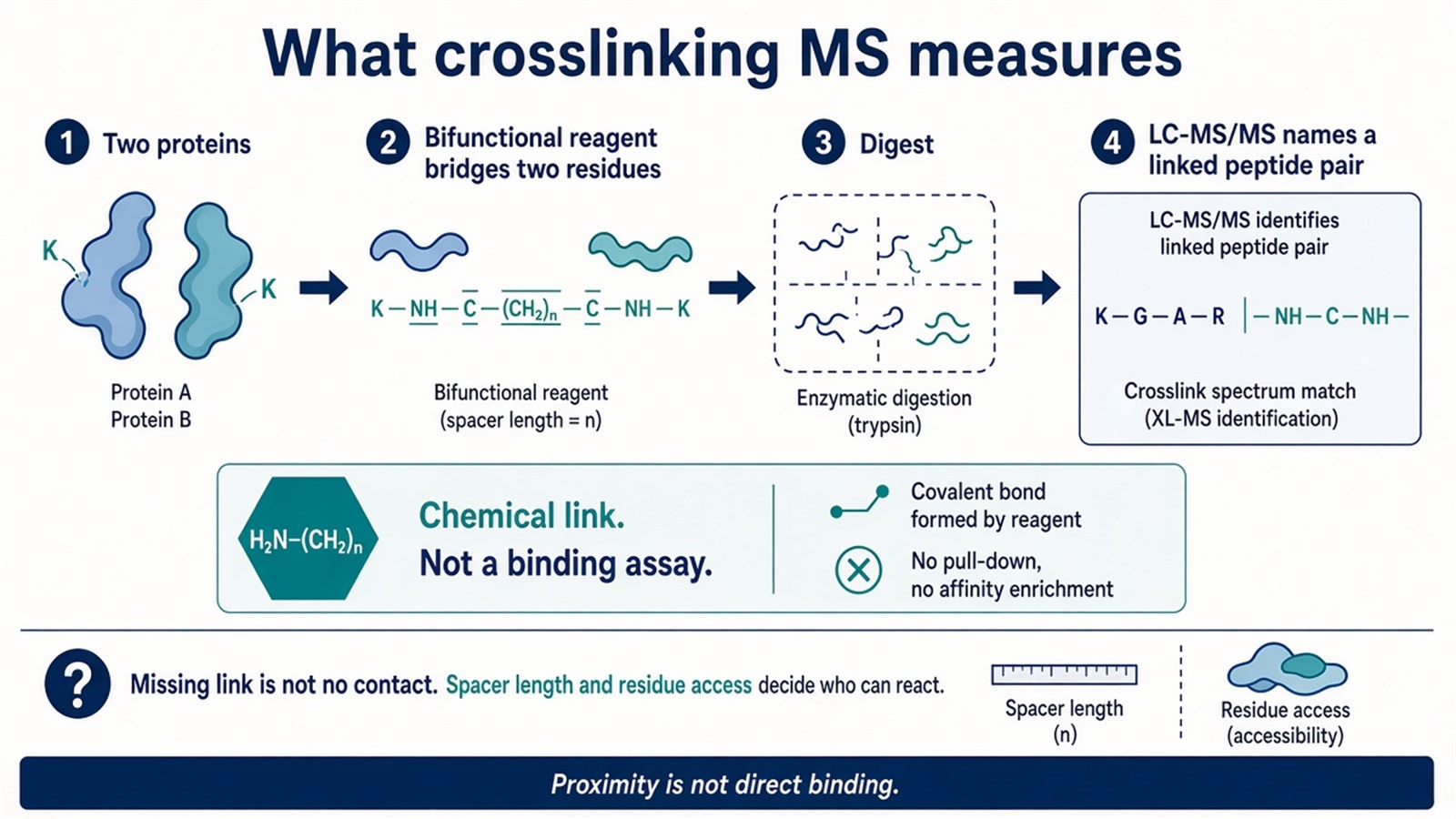
Figure 1. XL-MS identifies a covalently linked peptide pair. Direct binding is a later claim. A missing link is not absence of contact.
Write the claim before the reagent. A residue pair is proximity. Direct binding is a different sentence.
Why a Crosslink Is Not Proof of Direct Binding
A direct interaction means two proteins contact each other at an interface. XL-MS can support that sentence only when the linked residues sit on a plausible surface and the signal is reproducible. Three common geometries produce proximity without that contact.
Proteins A and B can be held near each other by protein C. The A–B crosslink is then distance-compatible. The primary interface may be A–C or B–C.
The same two proteins can share a membrane microdomain, organelle, condensate, or chromatin region. Local concentration raises the chance of a link even when the pair is not a stable binder.
Flexibility can bring residues together in one snapshot of an ensemble. The snapshot can be real. It is not a stable direct interface without supporting data.
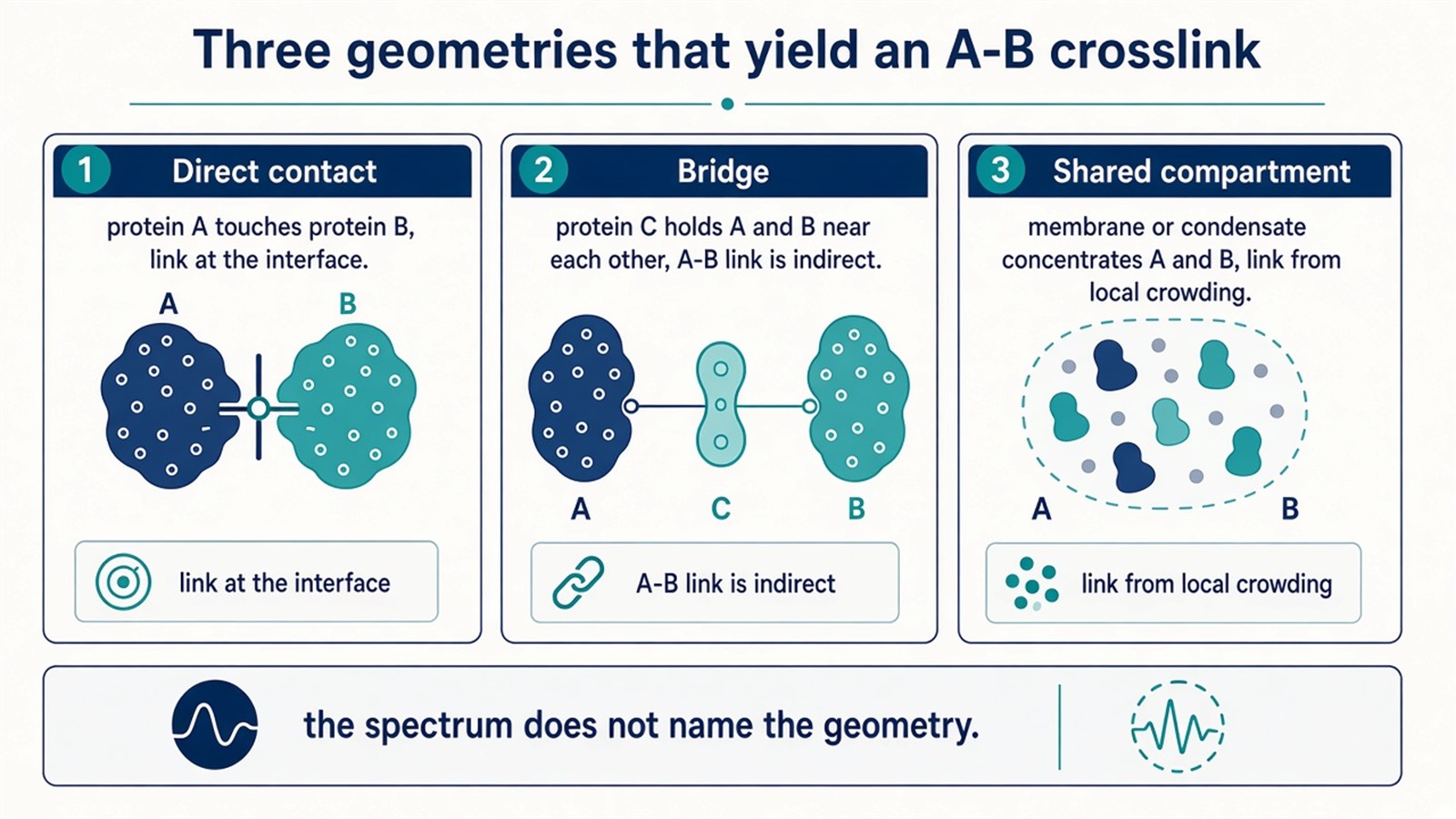
Figure 2. Direct contact, a bridging subunit, and a shared compartment can all yield an inter-protein crosslink. The spectrum does not name which geometry was used.
When the Evidence Gets Stronger
One crosslink is suggestive proximity. Several reproducible links that cluster at a coherent, solvent-accessible, distance-allowed surface are stronger. A condition-dependent or mutation-sensitive link can support a regulated or interface-related model. Treatment can also move abundance or localization. A mutation can also unfold the protein.
The original evidence ladder remains. None of its rungs converts XL-MS into proof.
Evidence type |
What it supports |
Main limit |
|---|---|---|
Single inter-protein crosslink |
Two residues were close enough to react |
Indirect proximity or a transient snapshot |
Multiple interface-consistent crosslinks |
A plausible contact region or complex model |
Still needs chemical and biological controls |
Condition-specific crosslinks |
The link changes with treatment |
Abundance or localization may have changed |
Mutation-sensitive crosslinks |
The nominated surface is involved |
Folding or expression may have changed |
Orthogonal association |
Independent support that the proteins meet |
Each assay has its own bias |
Replicates, a declared crosslink-level false-discovery threshold, and a reduction in the relevant negative control belong on every rung. For the no-crosslinker, quenched-reagent, and dose arms that make an in-cell file readable, What Controls Are Needed for Co-IP-MS and In-Cell Crosslinking MS? provides a complementary control page. For how XL-MS sits among other MS evidence types, How to Identify Protein–Protein Interactions Using Mass Spectrometry provides a complementary evidence map.
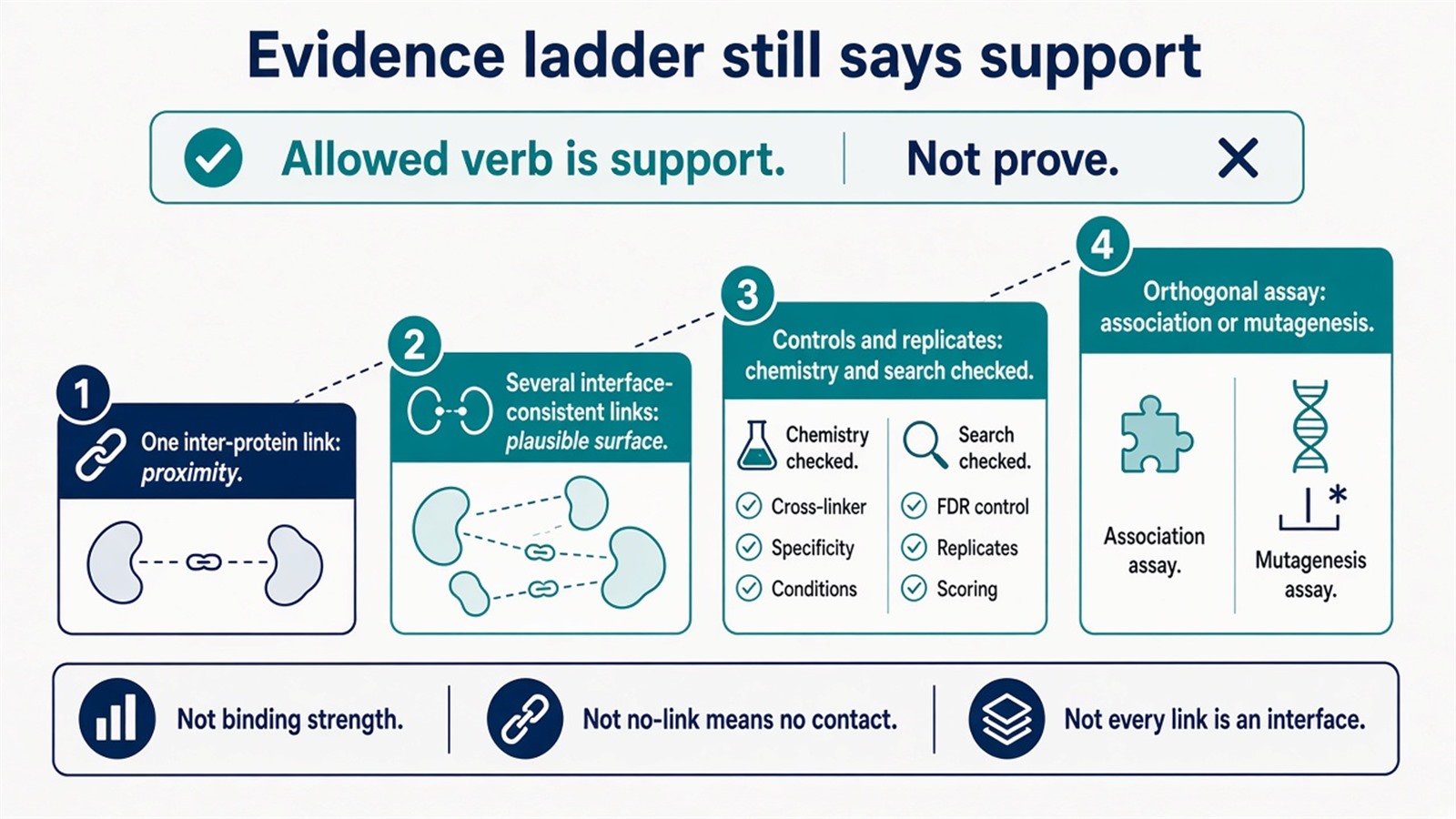
Figure 3. Confidence rises when links replicate, fit a surface, fall in controls, and meet an orthogonal assay. The allowed verb remains support, not prove.
How to Phrase the Conclusion
A single reproducible inter-protein crosslink supports close proximity. Several links at a predicted interface, plus an orthogonal association assay, can support a direct-interaction model. The sentence “crosslinking MS proves direct binding” is not earned by adding those assays. Better wording stays at the evidence level:
- The XL-MS data support spatial proximity between protein A and protein B.
- The crosslinks are consistent with a direct interaction model.
- Crosslinking MS and mutagenesis together support this surface.
- The model is supported by XL-MS, Co-IP, and structural compatibility.
Common mistakes remain the ones already named. Every inter-protein link is not an interface. Reagent class, spacer, and permeability change who can be linked. Absence of a link is not absence of contact. Raw crosslink counts are not binding strength. Abundance, digestion, enrichment, and acquisition depth move those counts.
If the next sentence is only “are these proteins near each other,” XL-MS can be the first method. If the next sentence is a direct interface or a therapeutic-binding claim, pair XL-MS with perturbation and an orthogonal biochemical assay.
Experimental Limits
XL-MS reduces a sample to what a chosen reagent, a digestion, a search, and a false-discovery rule can report. Diagnostic or drug-binding language sits outside ordinary research reporting unless a separately validated assay is in place.
Project Planning and Service Scope
A usable XL-MS plan names the claim, the reagent, the no-crosslinker arm, and the validation that will be allowed, before the first reaction. MtoZ Biolabs scopes crosslinking MS with Orbitrap-class LC-MS/MS. Interpretability still follows those arms, not a residue-pair slogan.
Once the next sentence is a wash-stable association rather than a residue pair, the project should not be forced through XL-MS alone. Researchers who need that pellet can review the MtoZ Biolabs Co-IP-MS Protein Interaction Analysis Service for project-specific sample evaluation, feasibility assessment, and workflow planning.
Frequently Asked Questions
1. Can crosslinking MS prove that two proteins bind directly?
No as a standalone result. Multiple interface-consistent, control-filtered links can support a direct-interaction model. Proof is the wrong verb.
2. What does an inter-protein crosslink mean?
Two residues on different proteins were close enough and chemically accessible enough to be linked. The result supports proximity.
3. Can a crosslink be a false positive?
Yes. Search error, weak false-discovery control, carryover, nonspecific proximity, reagent artifact, and poor spectra all produce them.
4. What methods support an XL-MS claim?
The method must match the claim. Reciprocal Co-IP or a folded-protein pull-down can support association. Mutagenesis, HDX-MS, or a model can test a nominated surface. A functional assay tests output, not contact.
5. Does no crosslink mean no interaction?
No. Reactive residues may be absent, buried, out of spacer range, or poorly detected.
Reference
- O'Reilly F.J., Rappsilber J. (2018). Cross-linking mass spectrometry: methods and applications in structural, molecular and systems biology. Nat. Struct. Mol. Biol., 25, 1000-1008. https://doi.org/10.1038/s41594-018-0147-0
- Leitner A., Faini M., Stengel F., Aebersold R. (2016). Crosslinking and mass spectrometry: an integrated technology to understand the structure and function of molecular machines. Trends Biochem. Sci., 41, 20-32. https://doi.org/10.1016/j.tibs.2015.10.008
- Yu C., Huang L. (2018). Cross-linking mass spectrometry: an emerging technology for interactomics and structural biology. Anal. Chem., 90, 144-165. https://doi.org/10.1021/acs.analchem.7b04431
- Iacobucci C., Piotrowski C., Aebersold R., et al. (2019). First community-wide, comparative cross-linking mass spectrometry study. Anal. Chem., 91, 6953-6961. https://doi.org/10.1021/acs.analchem.9b00658
- Sinz A. (2018). Cross-linking/mass spectrometry for studying protein structures and protein-protein interactions: where are we now and where should we go from here? Angew. Chem. Int. Ed., 57, 6390-6396. https://doi.org/10.1002/anie.201709559
