



No. Co-immunoprecipitation followed by mass spectrometry (Co-IP-MS) can identify proteins that remain with a bait after a stated wash. It cannot, by itself, determine the binding sites between two proteins. The eluate is a wash-stable neighborhood. The spectrometer reports peptide-identified proteins, or a relative occupancy ratio, not the residues that form the interface.
Co-IP pulls down a target and proteins that survive lysis and wash. Mass spectrometry then names those partners. That combination is useful for an open interactome table. Direct mapping of a contact surface remains a different physical question. A prey that co-purifies may bind the bait, may bind a bridge, or may stick to the resin. None of those outcomes localizes a binding site.
Researchers who need a partner list rather than an interface can also review the MtoZ Biolabs Co-IP-MS Protein Interaction Analysis Service for project-specific feasibility and analysis planning.
What Co-IP-MS Can and Cannot Report
A completed Co-IP-MS study can return a control-filtered protein table around one bait. It can support a later decision to test a nominated pair by Western or to move that pair into a site-mapping assay. It cannot assign the amino acids that hold the pair together, and it cannot replace a structure of the complex.
Domain-truncation Co-IP can ask whether a fragment still comes down. That is a coarse domain test. It is still not a residue-level binding site. For how Co-IP is coupled to LC-MS/MS when the goal is the partner list, How to Combine Co-IP with Mass Spectrometry for Protein Interaction Analysis? provides a complementary workflow discussion.
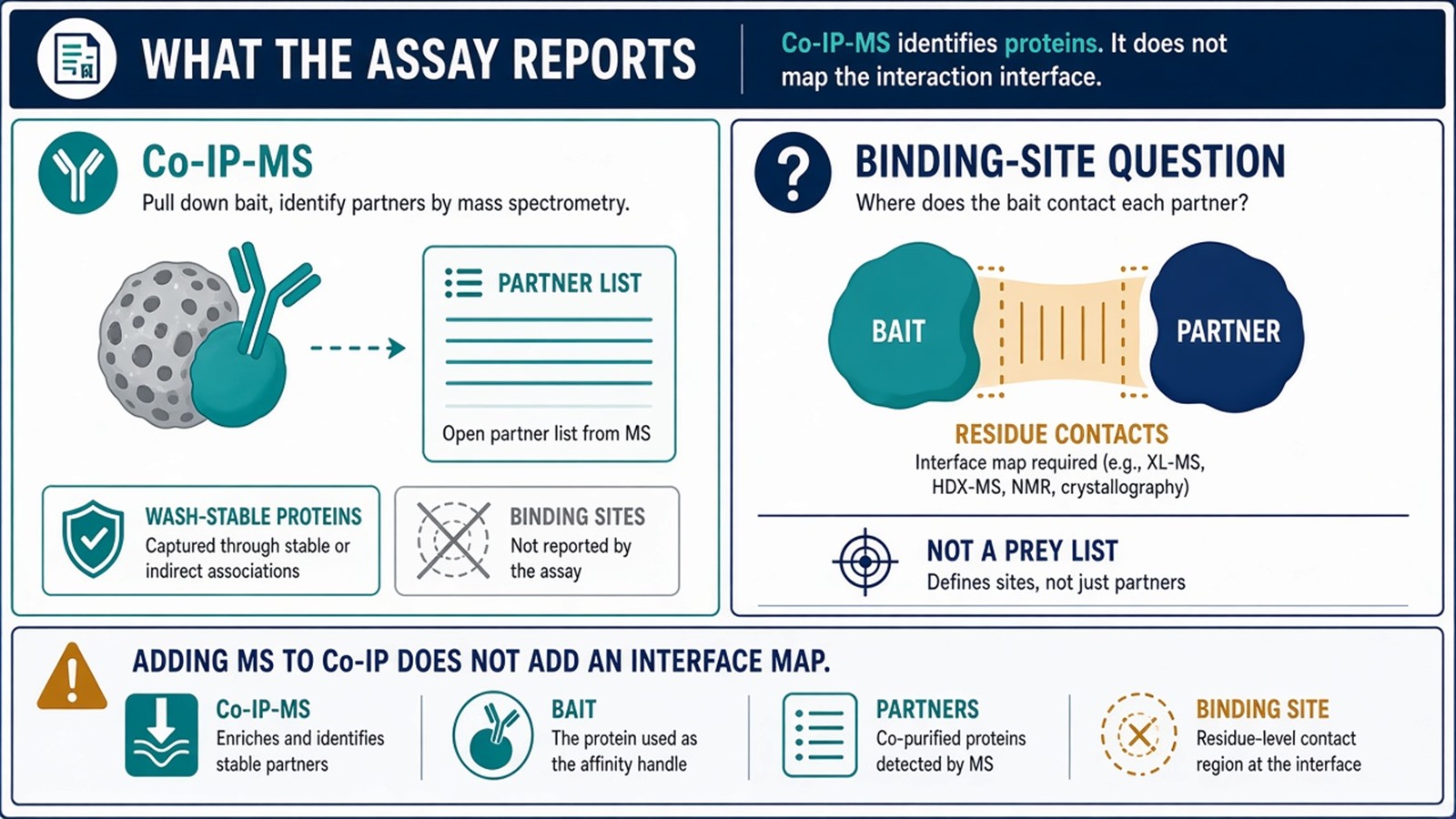
Figure 1. Co-IP-MS identifies proteins that remain with the bait. Binding-site work asks which residues contact each other. Those are not the same table.
Ask for partners or for sites before queuing the capture. Adding a mass spectrometer to Co-IP does not add an interface map.
Methods That Can Constrain Binding Sites
The four routes already named on this page remain the usual next experiments. Each constrains a different claim.
1. Proteolytic protection assay
The complex is incubated with a protease such as trypsin, and the digestion pattern is compared with that of the free proteins. Buried or occupied surfaces are often cleaved more slowly. Comparing peptide maps before and after complex formation can nominate protected regions. The readout is a footprint, not a precise residue pair. Mixed complexes, incomplete digestion, and conformational change outside the interface all move the pattern.
2. Crosslinking mass spectrometry
A bifunctional reagent such as BS3 forms covalent bonds between amino acids that are close enough for that spacer. After digestion and LC-MS/MS, identified crosslinked peptides support contact-site inference. XL-MS reports proximity at the time of reaction. Coverage is sparse relative to a full interface, and a crosslink is not automatically the functional binding hotspot. For when to leave Co-IP-MS for this chemistry, Co-IP-MS vs XL-MS: Protein Interaction Workflow Guide provides a complementary workflow comparison. For how XL-MS sits among other MS evidence types, How to Identify Protein–Protein Interactions Using Mass Spectrometry provides a more detailed evidence-type map.
3. Site-directed mutagenesis
Residues suspected to sit in the interface are mutated, and binding or Co-IP recovery is compared with the wild-type pair. Loss of recovery supports functional relevance of those residues. Gain or loss can also come from folding, trafficking, or expression change. Mutagenesis tests a hypothesis. It does not generate the site map.
4. Structural biology methods
X-ray crystallography, nuclear magnetic resonance (NMR), and cryo-electron microscopy (cryo-EM) can show an interface when a defined complex can be reconstituted or imaged. Those methods are not performed on a routine Co-IP eluate from a whole-cell lysate. Resolution depends on the specimen, not on calling the structure atomic.
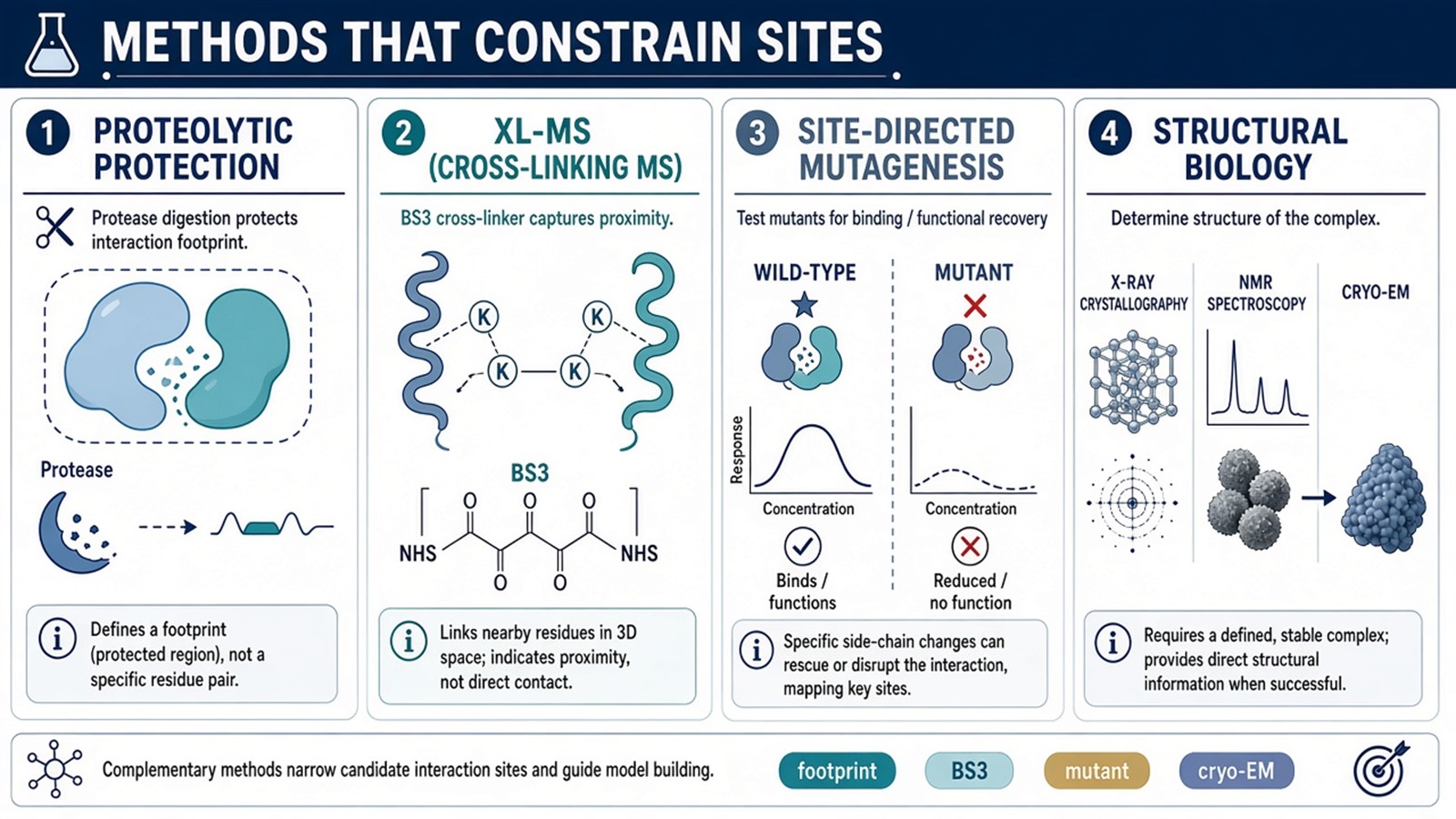
Figure 2. Footprinting nominates protected regions. XL-MS reports residue proximity. Mutagenesis tests nominated residues. Structure visualizes an interface when the complex can be prepared.
How to Choose After a Co-IP-MS Partner List
Use Co-IP-MS when the next sentence is which proteins remain with this bait.
Use XL-MS when the next sentence needs residue-level proximity on a defined pair or complex.
Use mutagenesis when a short residue list already exists and must be tested in a recovery or binding assay.
Use crystallography, NMR, or cryo-EM when the complex can be isolated or reconstituted at the amount and purity those methods require.
Complementary use is sequential, not additive. A Co-IP-MS table can nominate the pair. XL-MS or a footprint can constrain the surface. Mutagenesis can test that surface. Integration does not, by itself, finish a regulatory mechanism.
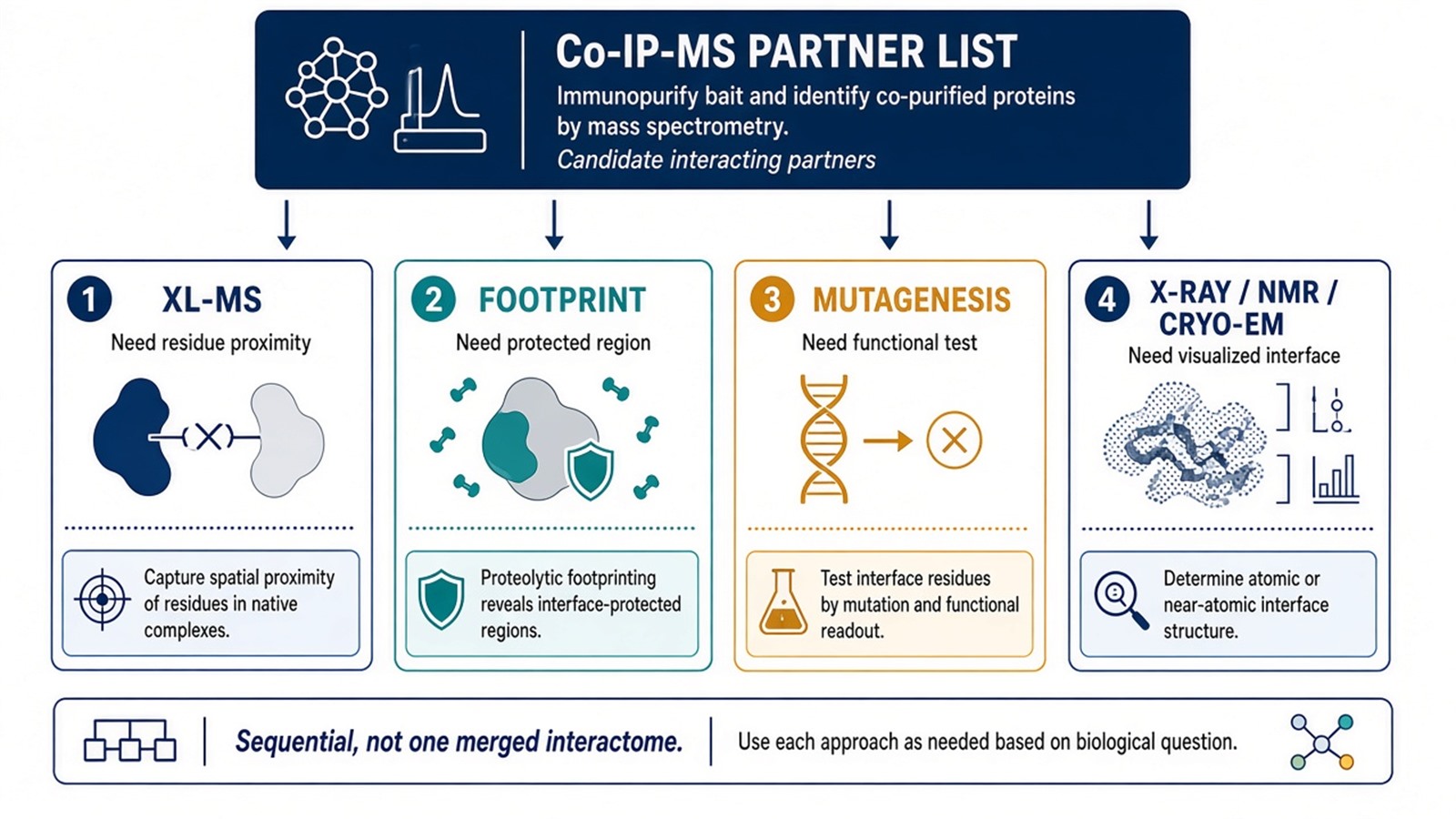
Figure 3. Partner identification and site mapping are separate campaigns. The Co-IP-MS list is an input to site work, not a substitute for it.
Experimental Limits
Co-IP-MS will keep returning partners, including bridges and bead binders, no matter how high the instrument resolution. XL-MS coverage stays incomplete. Footprints and mutants can be read as sites when they only report protection or loss of recovery. Diagnostic or drug-interface language sits outside ordinary research mapping unless a separately validated assay framework is in place.
Project Planning and Service Scope
A usable plan names whether the deliverable is a partner table or a contact-site table. MtoZ Biolabs scopes antibody or tag Co-IP-MS for the first and XL-MS with reagents such as BS3 for the second, on Orbitrap-class LC-MS/MS. Site assignment still depends on crosslink identification and the declared false-discovery rule, not on attaching Co-IP to the same spectrometer.
Once the question is written as partners or as sites, the project can be scoped accordingly. Researchers who need residue-level proximity after a Co-IP shortlist can review the MtoZ Biolabs Crosslinking Mass Spectrometry Protein Interaction Analysis Service for project-specific sample evaluation, feasibility assessment, and workflow planning.
Frequently Asked Questions
1. Can Co-IP followed by mass spectrometry determine binding sites between two proteins?
No. It determines which proteins remain with the bait after wash. Binding sites need a contact-site or structural assay.
2. Does identifying both proteins by MS mean the interface was found?
No. Identification says both chains were in the eluate. It does not say which residues touched.
3. Can domain truncation Co-IP replace XL-MS?
It can ask whether a fragment still co-purifies. That is a domain-level test, not a residue contact map.
4. Is BS3 crosslinking just Co-IP-MS with an extra reagent?
No. The extra chemistry creates covalent residue pairs that Co-IP-MS does not record. The search and the claim both change.
5. Should structure always follow Co-IP-MS?
Only when a defined complex can be prepared. Most Co-IP eluates are not crystallography or cryo-EM samples.
Reference
- Leitner A., Walzthoeni T., Kahraman A., et al. (2010). Probing native protein structures by chemical cross-linking, mass spectrometry, and bioinformatics. Mol. Cell. Proteomics, 9, 1634-1649. https://doi.org/10.1074/mcp.R000089-MCP201
- Gingras A.C., Gstaiger M., Raught B., Aebersold R. (2007). Analysis of protein complexes using mass spectrometry. Nat. Rev. Mol. Cell Biol., 8, 645-654. https://doi.org/10.1038/nrm2208
- Dunham W.H., Mullin M., Gingras A.C. (2012). Affinity-purification coupled to mass spectrometry: basic principles and strategies. Proteomics, 12, 1576-1590. https://doi.org/10.1002/pmic.201100523
- Feng Y., De Franceschi G., Kahraman A., et al. (2014). Global analysis of protein structural changes in complex proteomes. Nat. Biotechnol., 32, 1036-1044. https://doi.org/10.1038/nbt.2999
- O'Reilly F.J., Rappsilber J. (2018). Cross-linking mass spectrometry: methods and applications in structural, molecular and systems biology. Nat. Struct. Mol. Biol., 25, 1000-1008. https://doi.org/10.1038/s41594-018-0147-0
