


What are protein-protein interactions (PPIs)? They are physical associations in which two or more proteins form a complex, or a short-lived contact, through noncovalent forces such as hydrogen bonds, hydrophobic contacts, and electrostatic attraction (Nooren and Thornton 2003). Brief introduction of protein-protein interaction (PPI), protein-protein interactions, and PPI protein-protein interaction name the same definition. They do not name a detection method, a pathway certificate, or a drug-target claim. A stable machine, a kinase-substrate encounter, and a database edge are not the same observation. A cis contact joins domains on one chain. A trans contact joins separate polypeptides. Direct binding and sharing a third partner are different claims. The valid statement is an association at the level the evidence supports.
Researchers who already have defined bait proteins, comparison groups, or a specific project objective can also review the MtoZ Biolabs IP-MS Protein Interactomics Analysis Service for project-specific feasibility and analysis planning.
What a PPI Claim Can Mean
A PPI claim answers whether proteins associate. It does not, by itself, answer how the association was detected, whether the contact is direct, or whether the pair is a medicine. Most textbook PPIs are noncovalent. Covalent links such as disulfide bonds, ubiquitination, or a chemical cross-link are a different chemistry. Those links can stabilize a complex. They are not the default meaning of a PPI sentence.
Direct association means surfaces on two proteins meet. Indirect association means a third protein or a small ligand holds them in one particle. Co-recovery from a lysate can report either case. Proximity labeling can mark a neighbor that never binds the bait. A fluorescence resonance energy transfer (FRET) signal reports close fluorophores, not a mapped interface.
Stable assemblies, such as a ribosome, a proteasome, or tetrameric hemoglobin, persist as functional particles. Transient contacts, such as a kinase and its substrate or a G protein and an effector, form and release with a stimulus. Regulatory pairs, such as an inhibitor bound to an enzyme, sit between those poles. Duration is a property of the complex under stated conditions. It is not a disease label.
A PPI is a supported association between proteins, not a renamed pathway, database score, or treatment plan.
How Interaction Types Differ
The useful split is the claim the type can carry. A binary pair can be tested as two partners. A multi-protein particle can contain proteins that never touch. Domain-domain contacts and disordered-segment contacts are both PPIs. They do not share the same mutational or structural follow-up.
Interface language should stay modest. An interface is the contacting surface inferred from structure, cross-linking, or a defined-pair assay. A surface patch listed in a figure is not automatically that interface. Cis interactions inside one polypeptide explain folding or autoinhibition. They are not a second protein-protein detection problem unless a second chain is present.
Network words such as module and hub describe graph topology after many associations have been collected. A hub protein has many reported partners. That count depends on the assays and filters behind the graph. Topology does not prove that every edge is a direct contact, and it does not identify a diagnostic marker.
Disease names, including p53-MDM2 or a MAPK cascade, illustrate why a bait was chosen. They do not convert a definition page into a clinical map. Computational docking, homology models, and AlphaFold-style pair predictions can nominate interfaces. They remain hypotheses until an experiment records the association.
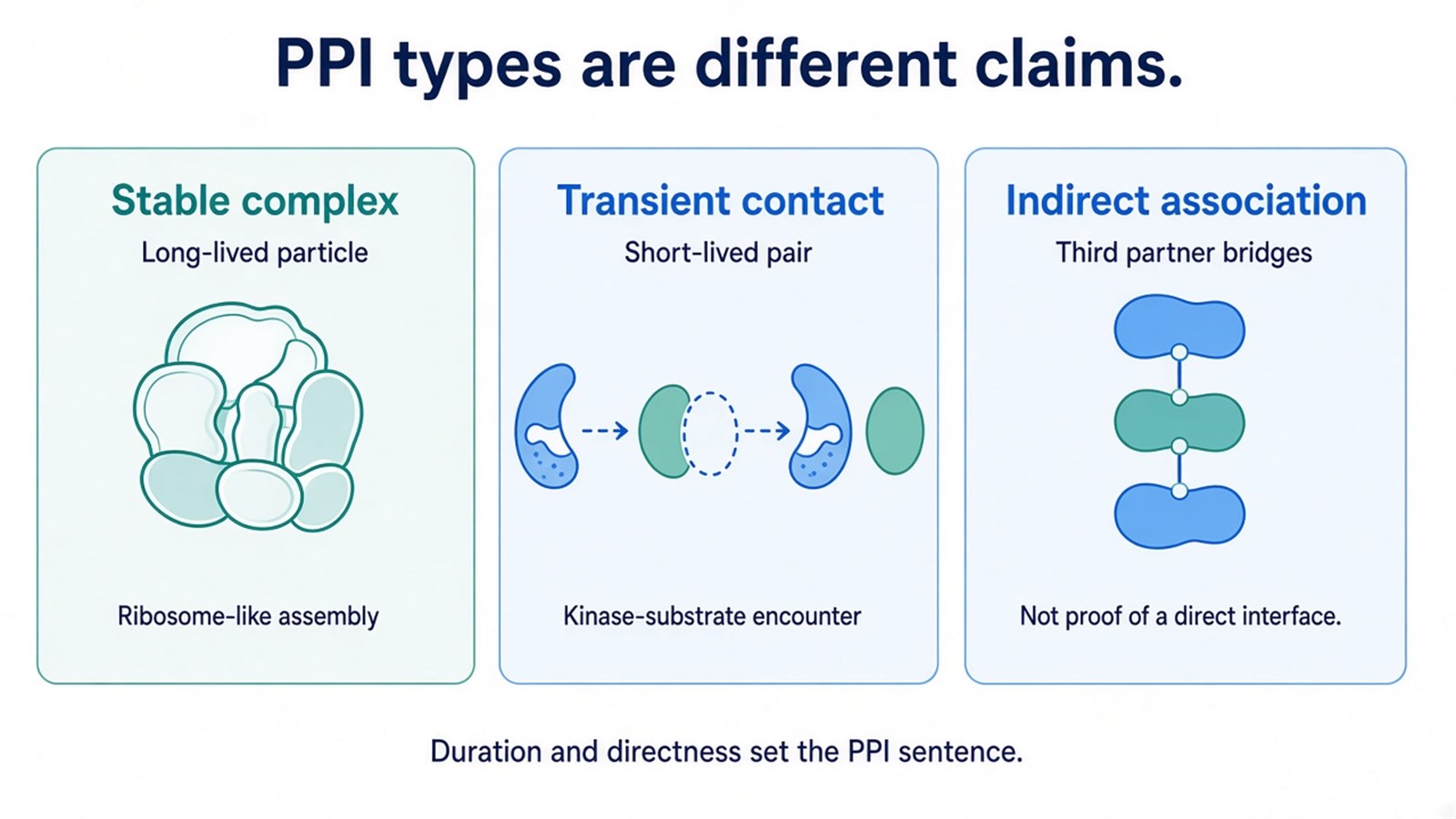
Figure 1. PPI types differ by duration and by whether the contact is direct, indirect, or part of a larger particle.
What Studying PPIs Can Support
A PPI study can support a statement that a bait associates with named partners in a defined system, after controls that match the assay. It can support a comparison of that association across a treatment, a mutant, or a time point when the same capture chemistry is held constant. It can supply candidates for a later defined-pair or functional test.
It cannot, from the definition alone, rank every cellular process, certify a drug target, or issue a precision-medicine plan. STRING, BioGRID, IntAct, and similar resources mix experimental records, text mining, and prediction. An edge in those graphs is a literature or score object. It is not a new measurement in the sample on the bench.
Yeast two-hybrid (Y2H), co-immunoprecipitation (Co-IP), affinity purification-mass spectrometry (AP-MS), pull-down, BioID, cross-linking mass spectrometry (XL-MS), FRET, and surface plasmon resonance (SPR) implement different evidence types. Sequence-based prediction is not a wet-lab detection method. Quantitative tags such as tandem mass tags (TMT) can compare an already-enriched set. They do not define what a PPI is.
For studies focused primarily on which assay records which association evidence, Methods for Detecting Protein-Protein Interactions (PPIs) provides a more detailed explanation of method fit and result limits.
In MtoZ Biolabs IP-MS offerings, an interaction project is typically framed as bait enrichment plus identification of co-recovered proteins, not as a definition of every PPI class. Service configuration is not an academic rule that other laboratories must copy, and it does not include a diagnostic or GMP release intended use.
Term used in PPI writing |
What it can mean |
What it does not mean by default |
|---|---|---|
Stable complex |
A long-lived particle under the stated conditions |
A permanent bond in every buffer |
Transient interaction |
A short-lived, often stimulus-linked contact |
An undetectable or unimportant pair |
Direct interaction |
Surfaces on two proteins meet |
Every protein in one elution |
Indirect interaction |
A third partner or ligand bridges the pair |
Proof that the pair never touches |
Interactome |
A collected set of reported associations |
A complete or clinical network |
Database edge |
A stored record or score |
A measurement in the current sample |
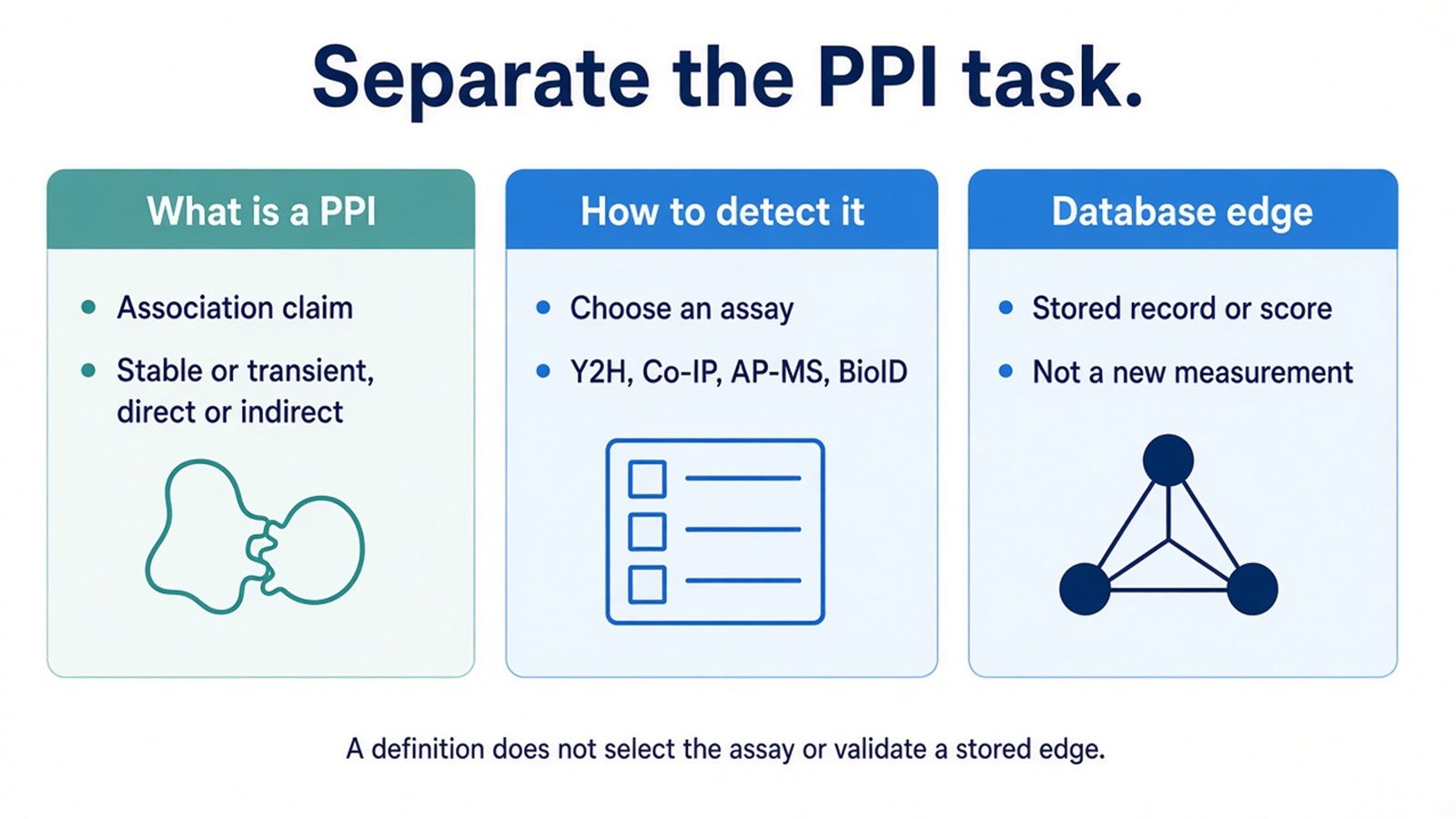
Figure 2. A PPI definition names the association claim; method choice and database lookup are separate tasks.
Knowing what a PPI is does not select the assay or validate a stored network edge.
How a PPI Statement Should Be Read
Read the bait, the system, and the evidence class before reading the biology sentence. An association recovered by antibody capture in a lysate is not the same object as a yeast reporter pair or a sensor Kd. Weak or transient contacts can be real and still fail a harsh wash. Abundant contaminants can be recovered and still fail a specificity filter.
When the next decision is which enrichment route to use after the association claim is clear, researchers can refer to IP-MS vs. Co-IP-MS vs. AP-MS: Which Workflow Fits Your Study? for a more detailed strategy-selection framework.
Orthogonal follow-up belongs with any high-stakes partner. Reciprocal recovery, a second evidence class, or a functional perturbation tests whether the first observation still holds. A larger font on a network figure does not replace that step.
Frequently Asked Questions
1. Are protein-protein interactions the same as covalent protein linkages?
No. The usual PPI claim is a noncovalent association. Disulfides, ubiquitin marks, and chemical cross-links are covalent chemistries that can accompany a complex.
2. Does an entry in STRING or BioGRID prove a PPI in the current sample?
No. Those resources store mixed evidence and scores. They do not replace a measurement under the study's conditions.
3. Is a brief introduction of PPI a methods catalog?
No. The definition states what association means. Method choice is a separate task once the needed evidence type is named.
4. Does a disease-associated PPI become a diagnostic or drug certificate?
No. A research association in a defined system is not a diagnostic cutoff or a proof of target occupancy.
Once the bait, the intended association type, and the evidence needed to support that type are defined, the project can be evaluated as a PPI study. Researchers can review the MtoZ Biolabs IP-MS Protein Interactomics Analysis Service for project-specific sample evaluation, feasibility assessment, and workflow planning.
