



Choose from the evidence type, not from a platform name. Affinity purification–mass spectrometry (AP-MS) reports proteins that remain with a bait through lysis, capture, and wash. BioID and TurboID report proteins that were close enough to a bait–ligase fusion to be biotinylated in live cells. Those are not interchangeable labels for the same experiment. Neither table proves binary binding or permanent complex membership.
AP-MS asks which names co-purify with this bait under these enrichment conditions. BioID asks which names were labeled near this fusion during a long biotin window, typically many hours with BirA*. TurboID asks the same proximity question in about ten minutes. A short radius around the fusion is a working estimate. It is not a measured sphere. For the AP-MS definition of that first question, What Is the AP-MS Technique? provides a complementary definition page.
Researchers who already have a tagged bait and need wash-stable co-enrichment can also review the MtoZ Biolabs Affinity Purification-Mass Spectrometry Service for project-specific feasibility and analysis planning.
Two Physical Bases
AP-MS captures the bait from lysate. What survives the kinetic filter is digested and identified by liquid chromatography–tandem mass spectrometry (LC-MS/MS). For the capture–wash–elute chain behind that table, How AP-MS Works provides a complementary mechanism page. BioID and TurboID biotinylate nearby lysines before the cell is opened. Streptavidin then recovers labeled proteins. Labeling happens before lysis. Enrichment does not. Both proximity routes still lyse and bind a bead.
The original timing contrast stays. TurboID is faster. Faster is not cleaner. TurboID often writes a larger ligase-only background than BioID because more lysines are marked in the short pulse. Shorter windows can support a timed stimulus. They do not reduce labeling artifacts by default, and they do not leave cellular organization undisrupted. For the ligase-versus-ligase choice that does not include AP-MS, BioID&TurboID provides a complementary ligase page.
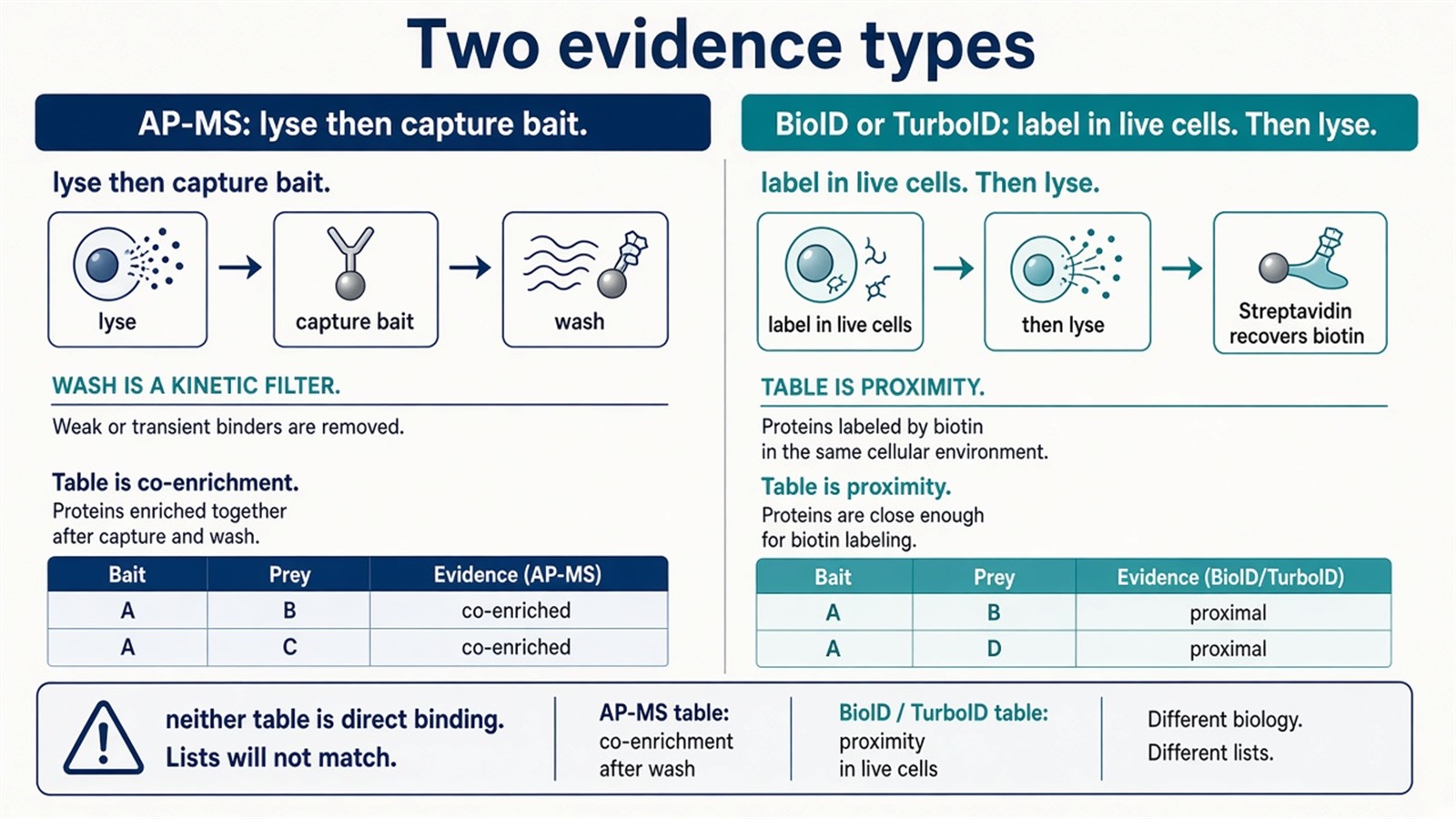
Figure 1. Left: lyse, capture, wash, rank. Right: biotinylate in cells, then streptavidin. The lists are not expected to match.
Name whether the next table must survive a wash or only have been nearby. A fusion ligase does not convert proximity into co-purification.
Decision Factors, Recast
Physical basis remains the first split: post-lysis co-recovery versus pre-lysis labeling.
AP-MS is biased toward associations that survive detergent and salt. Proximity labeling can mark neighbors that would have fallen off the resin. Marked is not bound. Transient or membrane-proximal neighbors may appear in a streptavidin table and still fail an AP-MS wash. That is a class difference, not a sensitivity ranking.
AP-MS commonly uses an epitope tag. Antibody capture of an endogenous bait is usually planned as IP-MS on this site. BioID and TurboID require a ligase fusion and a localization check. Orientation and compartment decide what “near” means. A mislocalized ligase redefines the neighborhood.
Background profiles differ. AP-MS shows bead and tag binders. Proximity labeling shows spatially broad biotin, endogenous carboxylases, and ligase-only proteome. Empty-tag is the AP-MS arm. Ligase-only, matched for localization, is the proximity arm. An empty vector without enzyme is not that arm.
Decision factor |
AP-MS |
BioID |
TurboID |
|---|---|---|---|
Evidence |
Wash-stable co-enrichment |
Live-cell proximity, hours |
Live-cell proximity, ~10 min |
Fits |
Associations that survive the written wash |
Neighborhood when a long window is acceptable |
Same neighborhood when a short window is required |
Bait |
Tag, or antibody as IP-MS |
Bait–BirA* fusion |
Bait–TurboID fusion |
Control |
Empty-tag or bead-only |
Ligase-only |
Ligase-only, often larger |
Main risk |
Indirect co-recovery |
Proximity is not binding |
Same, plus a larger ligase-only list |
The table routes a project. It does not replace a pilot.
When Each Route Is the First Table
AP-MS fits when the claim is wash-stable recovery, capture chemistry can be matched across mutants or treatments, and a tag or an IP-grade antibody already exists. It is a poor first table when the contact is expected to fall apart in the planned lysis.
BioID fits when the claim is a live-cell neighborhood and a multi-hour biotin window is acceptable. Membrane or organelle baits that recover poorly after harsh lysis are a reason to consider proximity, not a rule that membrane work must use a ligase. Fusion that mislocalizes the bait closes this route. For the BirA* method page, BioID Proximity Labeling provides a complementary BioID page.
TurboID fits the same neighborhood claim when the window must be short. It does not fit because faster labeling is expected to be quieter. Localization and ligase-only still have to be written first. For the evolved ligase page, TurboID Proximity Labeling provides a complementary TurboID page.
A combined plan is useful when both properties are needed: names that survive a wash, and names that were nearby before lysis. Overlap is a queue, not proof of direct binding. Constructs and both control menus should be designed before the first fusion is cloned.
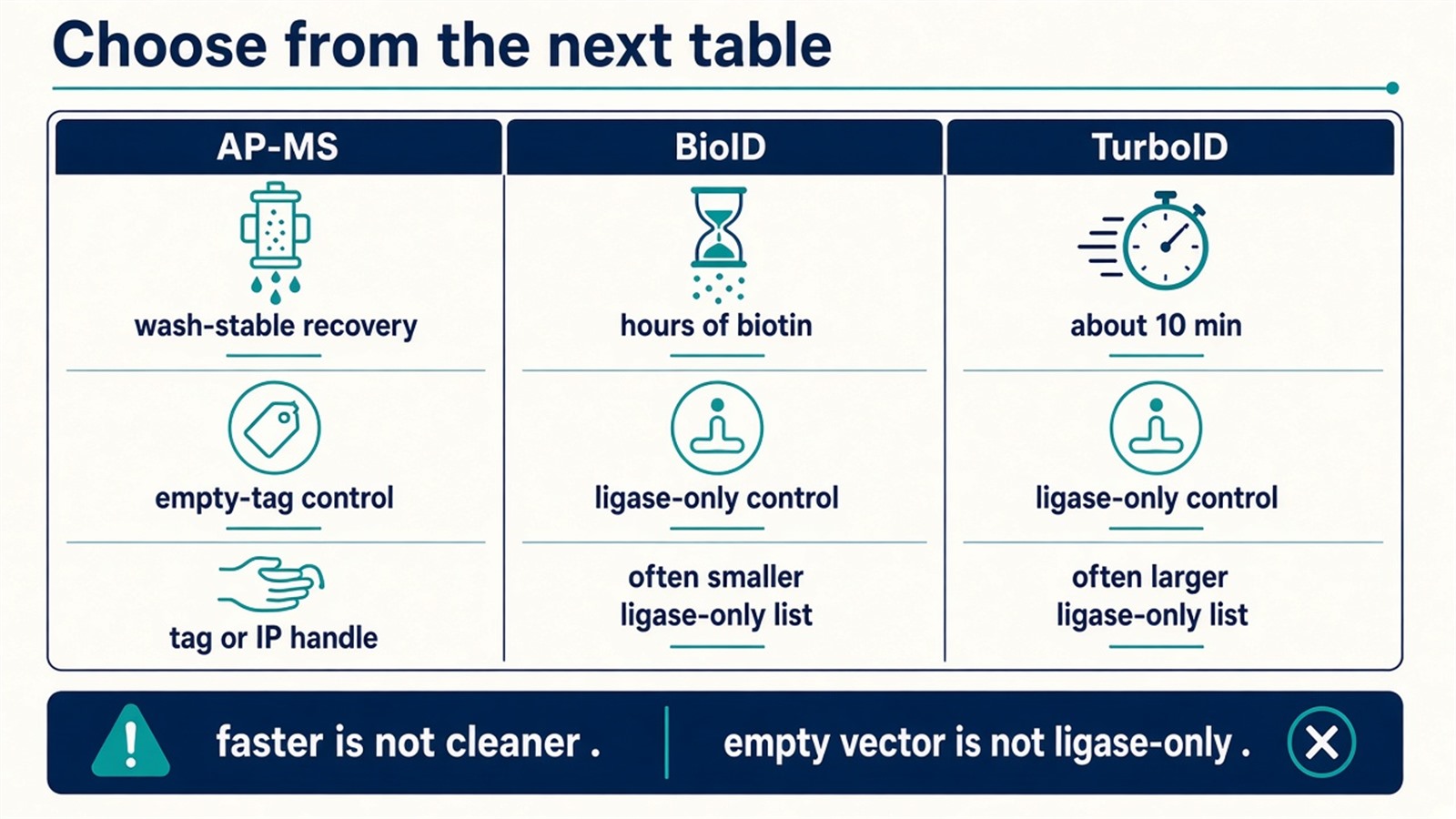
Figure 2. AP-MS: empty-tag. BioID: hours, often smaller ligase-only. TurboID: about ten minutes, often larger ligase-only. Faster is not cleaner.
Experimental Limits
The choice reduces a project to one physical basis, one control class, and one claim level. Diagnostic interactome or time-resolved-mechanism language sits outside ordinary research reporting unless a separately validated assay is already named.
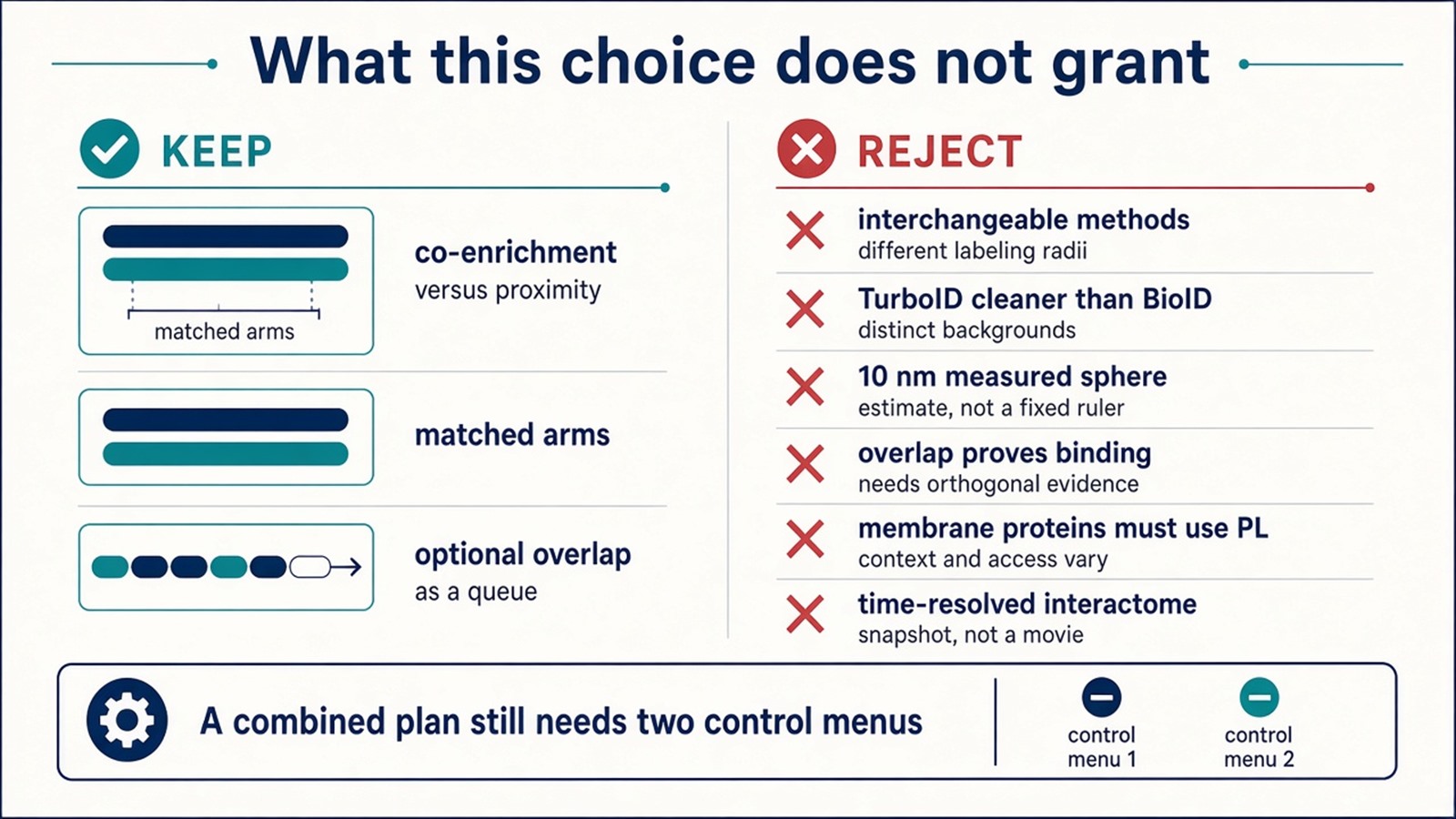
Figure 3. Keep: two evidence types and two control menus. Not granted: interchangeable methods, TurboID as cleaner BioID, or overlap as direct binding.
Project Planning and Service Scope
A usable request names whether the next table must survive a wash, whether a ligase fusion is acceptable, the labeling window, and the orthogonal assay that would be required for a binding sentence. MtoZ Biolabs scopes AP-MS and proximity-labeling MS on Orbitrap-class LC-MS/MS. Interpretability still follows those arms, not a brand-name choice.
Once the next sentence is a streptavidin neighborhood rather than a wash-stable pellet, this comparison should hand off. Researchers who need that table can review the MtoZ Biolabs Proximity Labeling Mass Spectrometry Service for project-specific sample evaluation, feasibility assessment, and workflow planning.
Frequently Asked Questions
1. Is TurboID just a faster BioID?
It is a faster ligase in the same proximity workflow. The window is shorter. The background is often larger, not smaller.
2. Will AP-MS recover the same proteins as BioID or TurboID?
Not as a rule. One table is wash-stable recovery. The other is pre-lysis proximity.
3. Can proximity labeling prove direct binding?
No. Neighbors can be labeled whether or not they bind the bait.
4. Should membrane baits always use BioID or TurboID?
No. Use proximity when the planned AP-MS wash is expected to drop the contact. Fusion and ligase-only still have to work.
5. Can AP-MS and TurboID be used in one project?
Yes, as two evidence types. Overlap is a shortlist, not a binding proof.
Reference
- Roux K.J., Kim D.I., Raida M., Burke B. (2012). A promiscuous biotin ligase fusion protein identifies proximal and interacting proteins in mammalian cells. J. Cell Biol., 196, 801-810. https://doi.org/10.1083/jcb.201112098
- Branon T.C., Bosch J.A., Sanchez A.D., et al. (2018). Efficient proximity labeling in living cells and organisms with TurboID. Nat. Biotechnol., 36, 880-887. https://doi.org/10.1038/nbt.4201
- May D.G., Scott K.L., Campos A.R., Roux K.J. (2020). Comparative application of BioID and TurboID for protein-proximity biotinylation. Cells, 9, 1070. https://doi.org/10.3390/cells9051070
- Gingras A.C., Gstaiger M., Raught B., Aebersold R. (2007). Analysis of protein complexes using mass spectrometry. Nat. Rev. Mol. Cell Biol., 8, 645-654. https://doi.org/10.1038/nrm2208
- Mellacheruvu D., Wright Z., Couzens A.L., et al. (2013). The CRAPome: a contaminant repository for affinity purification-mass spectrometry data. Nat. Methods, 10, 730-736. https://doi.org/10.1038/nmeth.2557
