



High-throughput protein–protein interaction (PPI) detection expands how many pairs, complexes, or neighborhoods can be surveyed in one campaign. It does not make Yeast Two-Hybrid (Y2H), affinity purification–mass spectrometry (AP-MS), BioID or TurboID, protein microarrays, protein-interaction chips, and in silico prediction interchangeable. Each route reports a different physical event: binary reconstitution in yeast, wash-stable co-purification, live-cell proximity, immobilized in vitro binding, chip-based affinity, or a computational shortlist. Advantages and disadvantages have to be read against that event, not against a generic throughput ranking.
PPIs remain central to intracellular signal transduction, metabolic regulation, and transcriptional control. Systems-biology projects use high-throughput PPI methods to nominate drug-target hypotheses, map disease-associated complexes, and annotate uncharacterized proteins. Sensitivity, specificity, native context, and cost do not rise together. A method that screens many pairs can miss membrane contacts. A method that recovers cellular complexes can miss weak binders lost in the wash.
Researchers who already have a defined bait, candidate set, or project objective can also review the MtoZ Biolabs Protein-Protein Interaction Analysis Service for project-specific feasibility and analysis planning.
What High-throughput PPI Detection Can and Cannot Claim
High-throughput work can return many candidate pairs or bait-associated proteins, support parallel comparison across conditions when the capture chemistry is held constant, and, on chip platforms, add Kd or kinetic readouts after a shortlist exists. It cannot automatically prove direct binding for every listed prey, reconstruct a complete interactome from one platform, or place a Y2H hit into a native membrane or organelle context. Computational screens add coverage. They add a second false-positive class until wet-lab methods are applied.
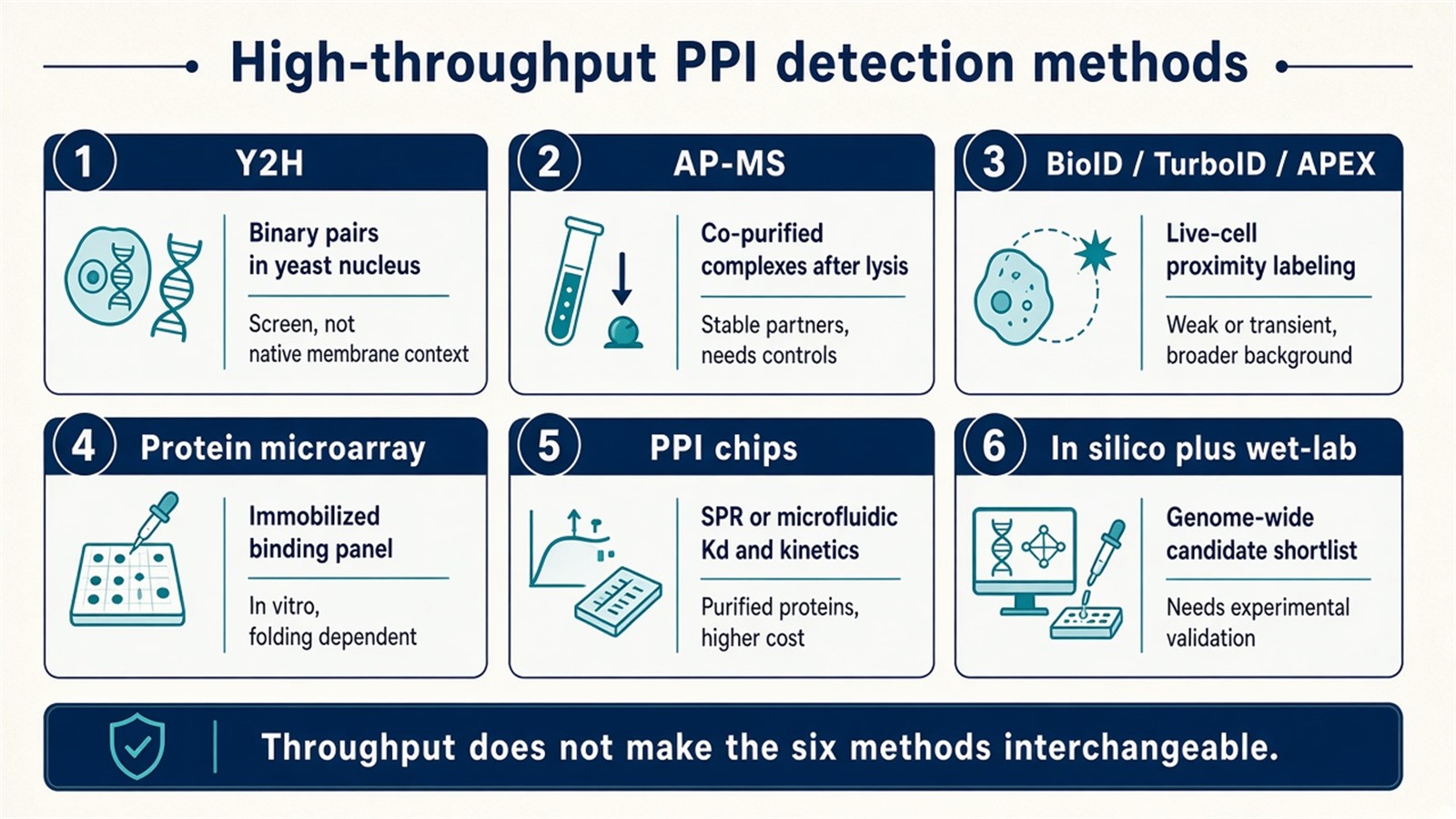
Figure 1. Common high-throughput PPI routes differ by what they capture: binary yeast pairs, co-purified complexes, live-cell proximity, in vitro panels, chip affinities, or predicted shortlists.
Throughput changes how many candidates can be collected. It does not change which physical event the method is allowed to claim.
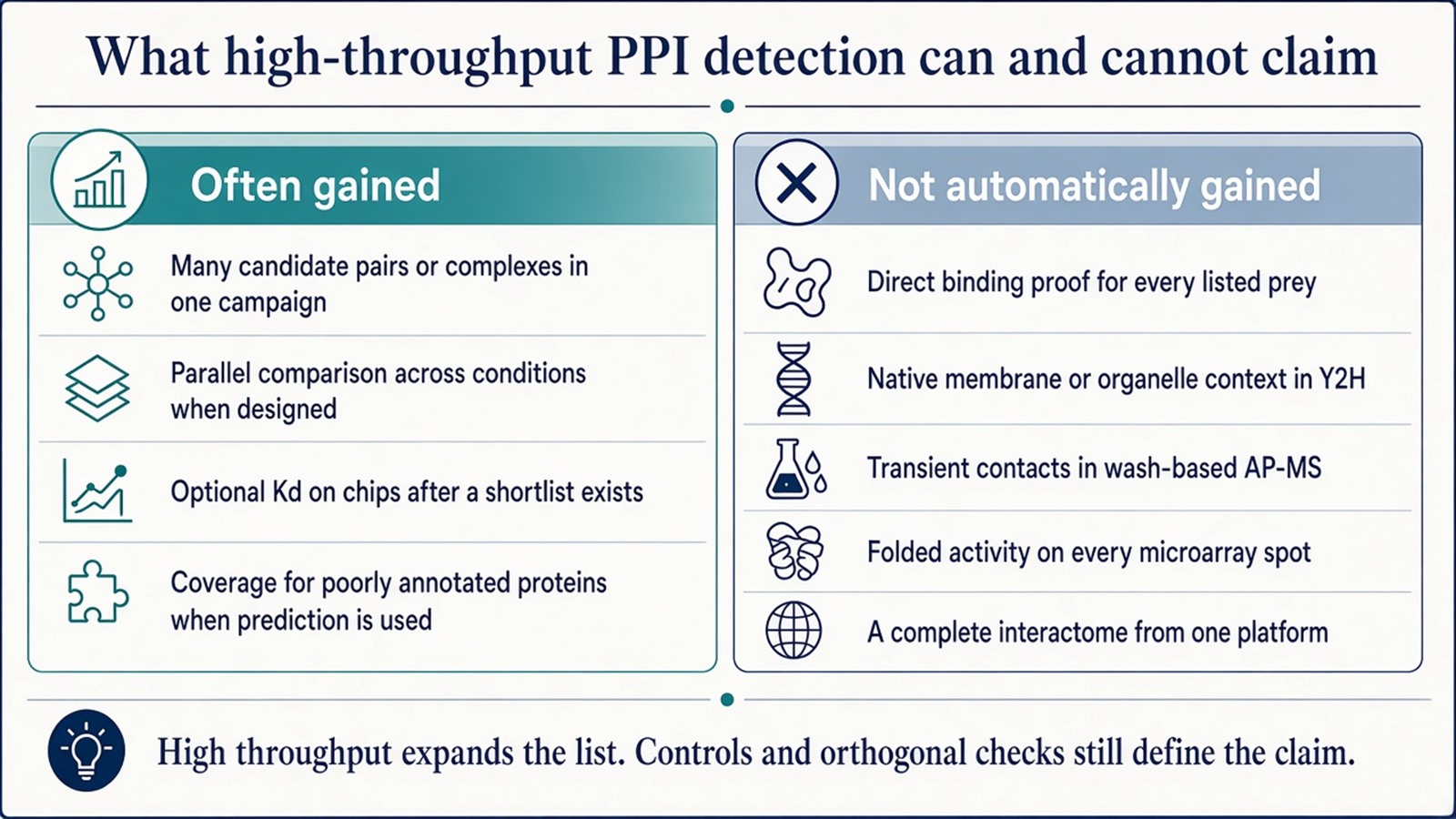
Figure 2. High-throughput PPI detection can enlarge a candidate list; controls and orthogonal checks still decide whether a listed prey supports the intended claim.
Method-by-Method Advantages and Limitations
1. Yeast Two-Hybrid (Y2H)
Y2H detects direct binary interactions and can support domain-level pairing when both fusions enter the yeast nucleus. The assay is technically established, relatively inexpensive, and suitable for large pairwise screens or first-pass network maps.
It is restricted to nuclear reporter reconstitution, so many membrane proteins and organelle-restricted contacts are out of scope. False positives and false negatives are common and require further validation. Y2H does not report dynamic interactions in the native mammalian environment.
2. Affinity purification–mass spectrometry (AP-MS)
AP-MS captures proteins that remain associated with a bait under near-physiological lysis and a stated wash. Combined with high-resolution LC-MS/MS, it can identify many co-purified partners and, with label-free or TMT designs, compare occupancy across conditions. That is a bait-centered complex inventory, not a complete cellular interactome.
The method favors stable or moderately stable complexes and is less effective for many transient or weak interactions. Non-specific binders require empty-vector, tag-only, or equivalent controls. Tagging or overexpression can create partners that do not bind the endogenous protein.
3. Biotin-based proximity labeling (BioID / TurboID / APEX)
Proximity labeling captures transient and weak associations by biotinylating proteins near a ligase- or peroxidase-fused bait in living cells. It can be directed to specific subcellular localizations and is often more practical than wash-based AP-MS for some membrane neighborhoods. TurboID shortens the labeling window relative to classical BioID; APEX uses a different labeling chemistry with its own quenching and toxicity constraints.
Broad labeling reduces specificity and demands strict background controls. Extensive biotinylation increases the complexity of the downstream MS table. The fusion can alter bait localization or function.
When the fork is wash-stable co-purification versus live-cell proximity, researchers can refer to AP-MS vs BioID and TurboID: How to Choose for a more detailed strategy-selection framework.
4. Protein microarrays
Protein microarrays support in situ high-throughput binding panels, including thousands of immobilized proteins in one experiment, and can be standardized for antibody-specificity or ligand-screening work.
They depend on purified expression. Folding and activity on the surface may be limited. The format is predominantly in vitro and does not fully reflect intracellular complexes. Multi-protein assemblies are generally outside its claim.
5. Protein-interaction chips (PPI chips)
PPI chips use microfluidics or surface plasmon resonance-class surfaces for dense, often automated, real-time monitoring. Quantitative Kd and kinetic parameters help separate stronger from weaker binding on purified reagents. Some chips can be reused across cycles, which improves sample use after candidates already exist.
Protein purity, activity, and stability remain bottlenecks. Cost is high, so the format is usually a validation or screening step on a shortlist rather than a first-pass cellular interactome. Most platforms are poor fits for interactions that need cofactors or colocalization that cannot be reconstituted on the surface.
6. Computational prediction with experimental validation
In silico screens use structure, co-expression, evolutionary covariation, or docking to propose genome-wide candidates. They complement experimental coverage for new species, poorly annotated proteins, or rare pathways and can focus later wet-lab work.
Predictions inherit algorithm and training-set error. Biological relevance still requires systematic tests such as AP-MS, Y2H, or PPI chips. Incomplete structures and stale annotations constrain what can be proposed.
Technical Comparison and When to Combine Methods
Method |
What a high-throughput run reports |
Main advantage |
Main limitation |
Typical use |
|---|---|---|---|---|
Y2H |
Binary pairs in yeast |
Direct pairing; scalable screen |
Nuclear constraint; false calls |
First-pass pairwise map |
AP-MS |
Co-purified proteins after wash |
Near-physiological complexes; optional quantification |
Misses many weak binders; tag artifacts |
Cellular complex composition |
BioID / TurboID / APEX |
Proteins labeled near the bait |
Transient or localized neighborhoods |
Broad background; fusion effects |
In situ or membrane-proximal screens |
Protein microarray |
In vitro binding to immobilized proteins |
Dense panel; automation |
Folding and non-cellular context |
Antibody or ligand panels |
PPI chips |
Kd or kinetics on purified pairs |
Real-time affinity |
Cost and protein quality |
Shortlist validation |
In silico plus wet-lab |
Predicted candidate edges |
Genome-wide triage |
Must be experimentally tested |
Under-annotated proteins or new species |
No single high-throughput PPI technique captures every interaction type. A common path is Y2H or an in silico shortlist for candidates, AP-MS or BioID for cellular context, and PPI chips or SPR-class assays when a Kd is required. Proteomic, metabolomic, or functional assays can follow. They do not convert an unscored screen into a validated network.
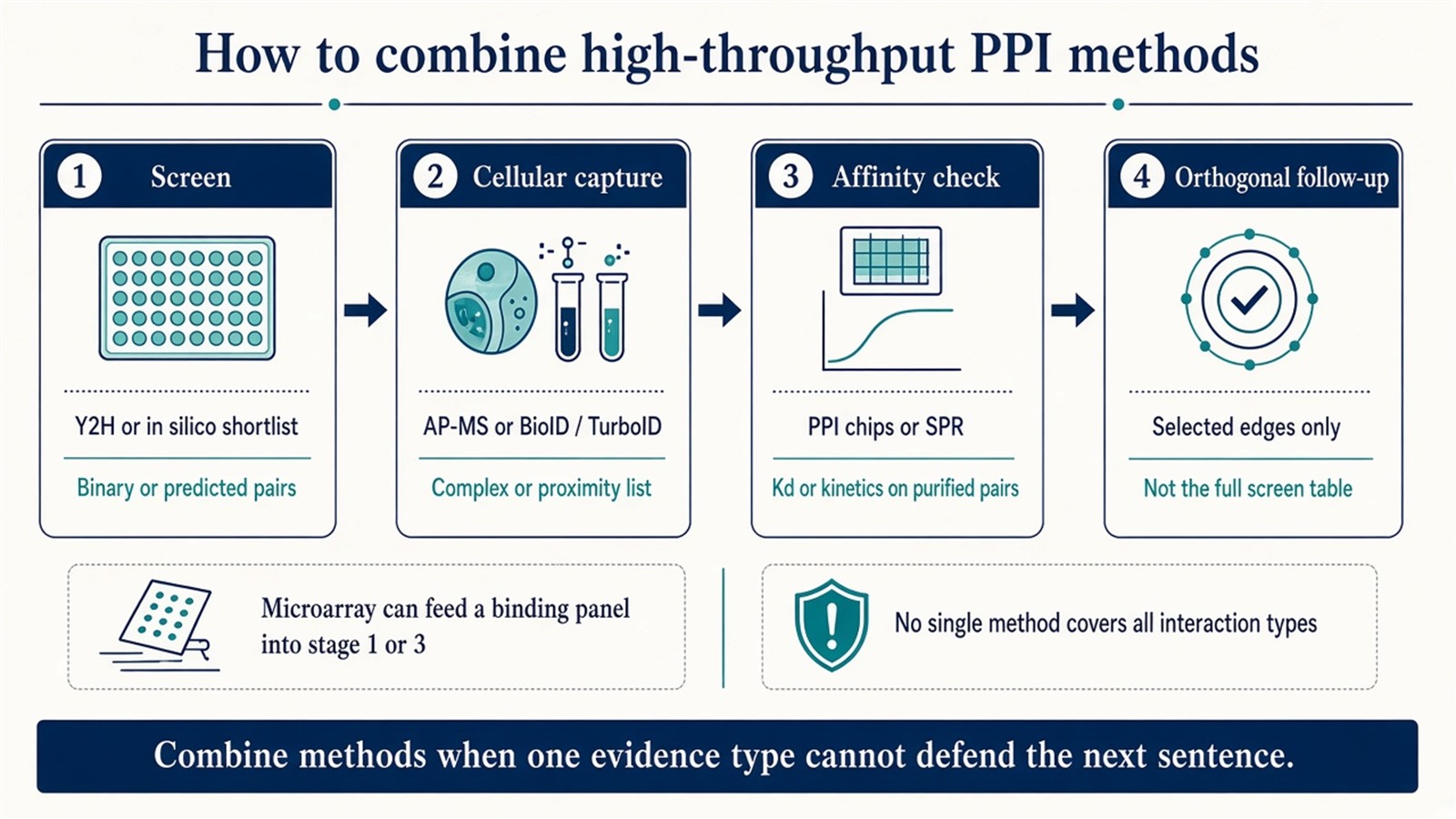
Figure 3. High-throughput PPI methods are combined by evidence type: screen pairs, capture cellular context, then measure affinity or run orthogonal checks on selected edges.
For claim-first method selection beyond throughput, How to Analyze Protein–Protein Interactions provides a more detailed explanation of when Co-IP, AP-MS, Y2H, and biophysical assays fit.
Experimental Limits
High throughput increases both true candidates and systematic artifacts. Cross-method overlap stays limited when Y2H, AP-MS, and BioID measure different events. A chip Kd is not a cellular occupancy. A predicted docking pose is not an AP-MS enrichment. Diagnostic or companion-diagnostic claims sit outside ordinary research PPI reporting unless a separately validated assay framework is in place.
Project Planning and Service Scope
A usable high-throughput PPI plan names the evidence type, the bait or library, the control set, and which hits will enter cellular or affinity follow-up. MtoZ Biolabs can scope AP-MS, BioID, and TurboID campaigns together with scored data analysis. Network construction and target nomination remain limited by the capture chemistry and the declared filters.
Once the method family and validation path are defined, the project can be scoped as a high-throughput PPI study. Researchers can review the MtoZ Biolabs Protein-Protein Interaction Analysis Service for project-specific sample evaluation, feasibility assessment, and workflow planning.
Frequently Asked Questions
1. Is AP-MS the most advantageous high-throughput PPI method?
No. AP-MS fits wash-stable cellular complexes. Y2H, proximity labeling, microarrays, and chips remain better when the claim is binary pairing, live-cell proximity, an in vitro panel, or a Kd.
2. Why do Y2H and AP-MS disagree on the same bait?
They capture different physical events. Limited overlap is expected and is not, by itself, proof that one screen failed.
3. Can BioID or TurboID replace AP-MS for every weak interaction?
No. Proximity lists include neighbors that never form a stable complex. AP-MS still fits when the claim is co-purification after wash.
4. Do protein microarrays or PPI chips report cellular complexes?
No. Both depend on presented or purified proteins. Cellular context still needs AP-MS, Co-IP, or proximity labeling.
5. Can computational prediction stand alone as a high-throughput PPI result?
No. In silico output is a shortlist. AP-MS, Y2H, or chip assays are still required before a biological claim is made.
Reference
- Fields S., Song O. (1989). A novel genetic system to detect protein-protein interactions. Nature, 340, 245-246. https://doi.org/10.1038/340245a0
- Gingras A.C., Gstaiger M., Raught B., Aebersold R. (2007). Analysis of protein complexes using mass spectrometry. Nat. Rev. Mol. Cell Biol., 8, 645-654. https://doi.org/10.1038/nrm2208
- Roux K.J., Kim D.I., Raida M., Burke B. (2012). A promiscuous biotin ligase fusion protein identifies proximal and interacting proteins in mammalian cells. J. Cell Biol., 196, 801-810. https://doi.org/10.1083/jcb.201112098
- Branon T.C., Bosch J.A., Sanchez A.D., et al. (2018). Efficient proximity labeling in living cells and organisms with TurboID. Nat. Biotechnol., 36, 880-887. https://doi.org/10.1038/nbt.4201
- Berggard T., Linse S., James P. (2007). Methods for the detection and analysis of protein-protein interactions. Proteomics, 7, 2833-2842. https://doi.org/10.1002/pmic.200700131
