



Low-abundance protein quantification matters for early biomarker candidate work, drug-target follow-up, and signaling studies where the proteins of interest sit far below dominant matrix proteins. Conventional data-dependent acquisition (DDA) often spends cycle time on intense precursors, so sparse targets can be missing or unstable across runs. Parallel reaction monitoring (PRM) addresses part of that problem by scheduling known peptide precursors and recording high-resolution product-ion spectra for targeted quantification. The advantage is focused selectivity on a closed list. The challenge is that naming the peptide does not create ionization, and matrix suppression can still leave a scheduled target undetectable.
Researchers planning closed-list confirmation of sparse targets can review the MtoZ Biolabs Parallel Reaction Monitoring (PRM) Service for panel feasibility, enrichment needs, and assay scoping before cohort acquisition.
From SRM/MRM to PRM for Sparse Targets
PRM is a high-resolution targeted method related to selected reaction monitoring or multiple reaction monitoring (SRM/MRM). SRM/MRM locks precursor-to-product transitions before acquisition on a triple quadrupole. PRM isolates scheduled precursors on high-resolution platforms and stores full product-ion spectra, so quantitative and qualifier fragments can be chosen after the run. That post-acquisition flexibility is especially useful when low-abundance signals sit near interfering ions and the best fragment is not obvious during early method setup.
PRM remains a closed-list assay. It does not survey an open proteome, and panel size is limited by chromatographic peak width and MS2 cycle time. Broader discussion of how PRM is used for sparse targets is available in How Does PRM Technology Facilitate the Analysis of Low-Abundance Proteins?.
Advantages of PRM in Low-Abundance Quantification
1. Accurate-Mass Fragment Review
High-resolution product-ion spectra help separate target fragments from near-isobaric background more effectively than unit-resolution transition monitoring alone in many complex digests. That selectivity supports higher identification confidence when signal intensity is weak.
2. Post-Acquisition Fragment Selection
Unlike SRM/MRM, PRM does not require every quantitative transition to be locked before acquisition. Analysts can keep, replace, or drop fragments after seeing interference patterns, which improves robustness when low-abundance peaks are unstable across matrix backgrounds.
3. Acquisition Time Focused on Named Targets
Because PRM spends MS2 time on the inclusion list rather than on stochastic survey peaks, scheduled peptides have a clearer chance to be sampled repeatedly across the chromatographic peak. That focus helps sparse targets relative to DDA, provided the peptides ionize and survive prep.
4. Compatibility With Complex Matrices When Interference Dominates
In high-dynamic-range samples such as plasma or cerebrospinal fluid digests, accurate-mass fragment review can reduce false quantification from co-eluting background. Enrichment, depletion, or fractionation may still be required before PRM if the matrix overwhelms the target.
5. Optional Stable Isotope Standards
Stable isotope-labeled peptides can normalize prep and ionization variability for relative or absolute claims. Standards do not create detectability if the light peptide never appears above noise.
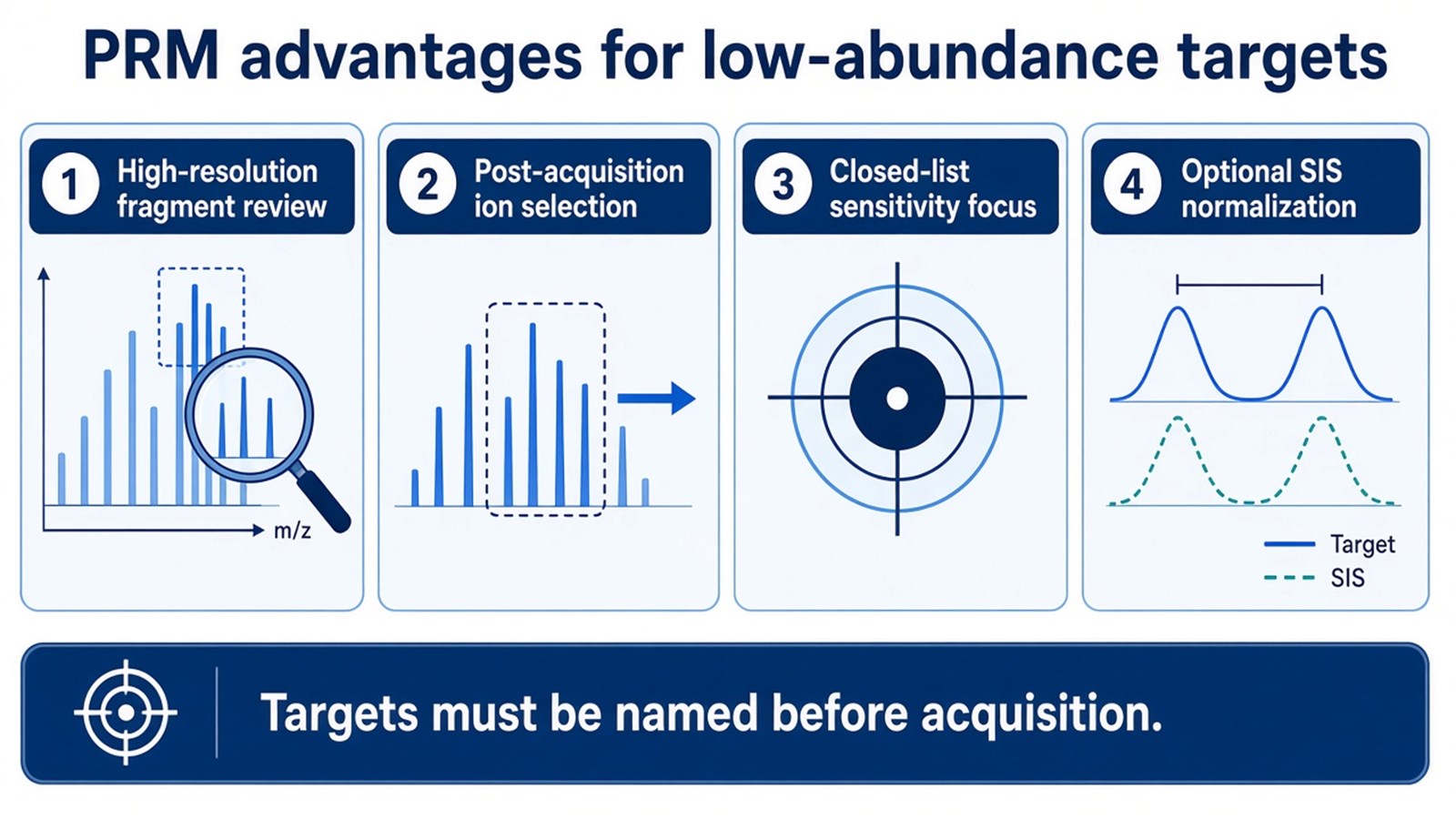
Figure 1. PRM improves low-abundance quantification mainly by focusing high-resolution fragment evidence on named peptides; targets must still be detectable after prep.
Challenges That Remain for Low-Abundance PRM
1. Limited Detectability of Some Target Peptides
Proteotypic candidates may ionize poorly, adsorb during cleanup, or sit outside the practical chromatographic window. Scheduling such peptides on a PRM list does not recover them. Alternate surrogates or enrichment may be needed.
2. Matrix Suppression and Dynamic Range
Biological samples can span a very wide protein concentration range. High-abundance species and residual metabolites can suppress ionization or co-isolate inside the precursor window, leaving low-abundance targets intermittent even under PRM.
3. Reproducibility Near the Detection Edge
Signals close to the limit of detection are sensitive to digestion yield, load matching, retention-time drift, and fill-time settings. Consistent quantification across batches needs matched prep, QC pools, and realistic acceptance criteria rather than instrument slogans alone.
4. Panel Size Versus Cycle Time
Adding more low-abundance targets shortens dwell or fill time per precursor. Oversized panels undersample peaks and can erase the sensitivity gain that motivated PRM. Split methods or staged shortlists are often more reliable than packing every candidate into one inclusion list.
5. Data Review Burden
Skyline-class tools help visualize fragment chromatograms, but interference adjudication for weak peaks still requires experienced review. Automated exports without qualifier checks can turn noise into false confirmation.
Dimension |
PRM advantage for sparse targets |
Challenge if ignored |
|---|---|---|
Selectivity |
Accurate-mass fragment review |
Co-isolation still admits interference |
Method setup |
Fragments selectable after acquisition |
Poor peptide choice cannot be fixed by MS2 |
Sensitivity focus |
Cycle time spent on named precursors |
Panel overpacking reduces peak sampling |
Matrix fit |
Useful in complex digests after pilot |
Plasma dynamic range may still need enrichment |
Quantitative claim |
Relative confirmation; absolute with SIS |
Near-limit signals without QC look biological |
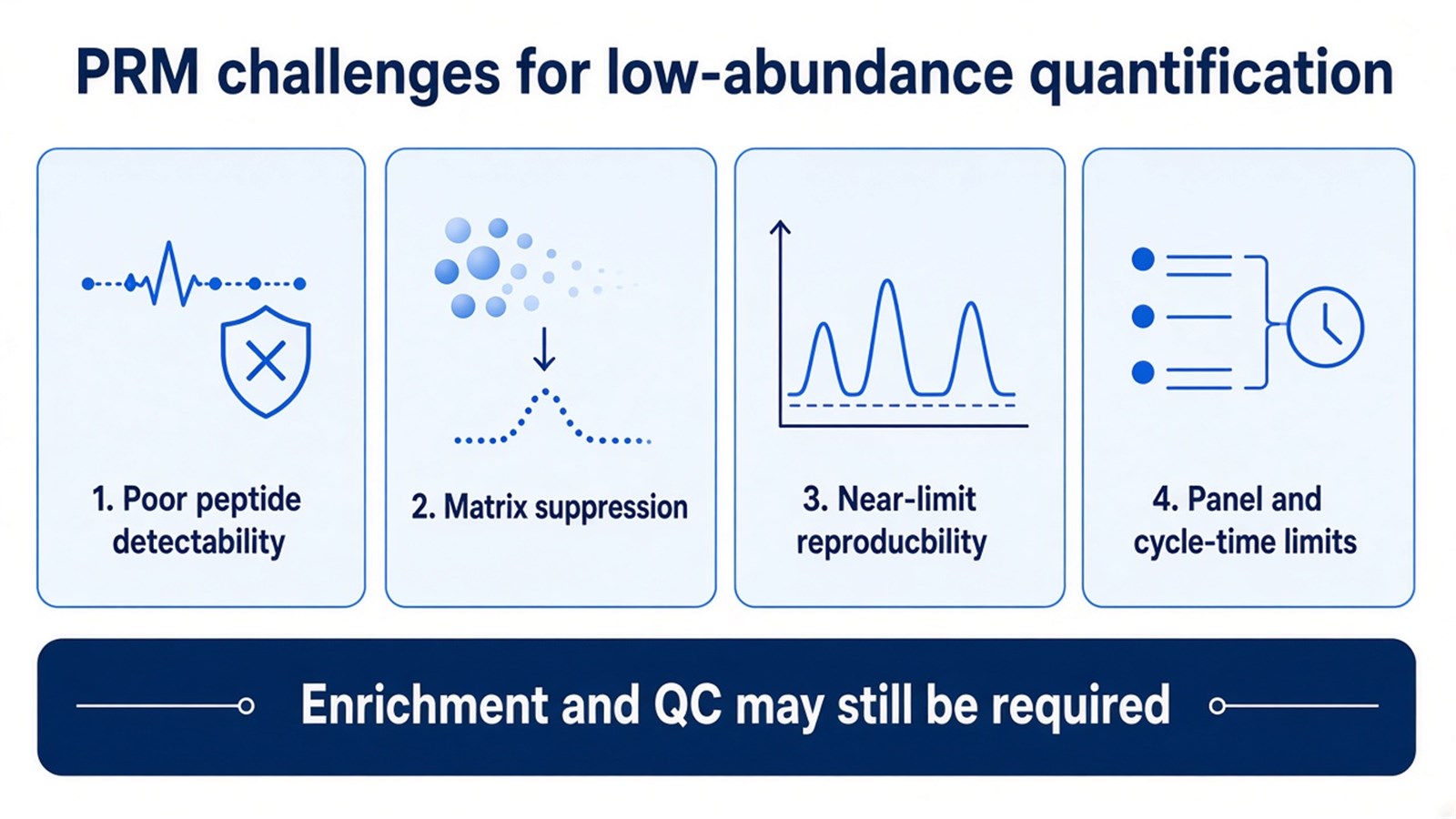
Figure 2. Low-abundance PRM still fails when peptides ionize poorly, matrix suppression dominates, or panels exceed cycle-time limits.
Mechanism-level comparison with transition-locked methods is covered in Mechanism of Parallel Reaction Monitoring.
When the Advantages Outweigh the Challenges
PRM often fits when a shortlist of low-abundance proteins is already named, matrix pilots show usable peptide signals, and fragment-level confirmation is needed before biological follow-up. It is a weaker first choice when the inventory is still open, when no proteotypic peptide survives enrichment pilots, or when absolute concentration is required without standards and calibration.
Typical research uses include confirmation of discovery-nominated sparse biomarkers, pharmacodynamic tracking of a focused signaling panel, and staged follow-up after depletion or enrichment. Multi-center clinical decision cutoffs and precision-medicine certificates sit outside ordinary research PRM reporting unless a separately validated assay framework is declared.
Conclusion
PRM offers clear advantages for low-abundance protein quantification when targets are known: high-resolution fragment review, post-acquisition ion selection, and acquisition time focused on a closed list. The same setting still carries challenges in peptide detectability, matrix suppression, near-limit reproducibility, panel scheduling, and data review. More reliable projects pilot surrogates in the real matrix, keep panels within cycle-time limits, and match relative or absolute claims to the QC package in hand. Researchers evaluating that trade-off can contact MtoZ Biolabs to review target peptides, enrichment options, and reporting needs, and can also consult the MtoZ Biolabs Parallel Reaction Monitoring (PRM) Service for project-specific feasibility and method planning.
