



Four-dimensional quantitative proteomics here means liquid chromatography-tandem mass spectrometry (LC-MS/MS) with an added ion mobility separation dimension before fragmentation, so precursors are resolved by retention time, m/z, and mobility before MS/MS (Meier et al. 2020). In project language, 4D-DIA is windowed data-independent acquisition (DIA) with mobility-aware extraction. 4D-PRM is parallel reaction monitoring (PRM) with mobility constraints on a closed peptide list (Peterson et al. 2012). The comparison below helps choose between open discovery and closed confirmation, not between two names for the same experiment.
Both routes remain quantitative only under a declared claim. Unlabeled 4D-DIA usually returns a relative protein matrix after library or library-free extraction (Gillet et al. 2012). 4D-PRM returns relative fragment traces for scheduled peptides, or peptide amounts when a matched stable isotope-labeled internal standard (SIS) is present (Gerber et al. 2003). In MtoZ Biolabs offerings, unlabeled discovery is commonly run as DIA including mobility-enhanced schedules, and named proteins are typically followed by PRM, with mobility scheduling when the platform supports it.
What 4D-DIA and 4D-PRM Mean for Quantitative Projects
4D-DIA keeps an open inventory. Scheduled m/z windows fragment many precursors per cycle. Ion mobility spreads co-eluting ions in the mobility dimension, which can reduce fragment overlap during extraction compared with mobility-free DIA on complex digests (Meier et al. 2020). Quantification still comes from extracted fragment chromatograms under false discovery rate (FDR) and interference rules, not from precursor counts alone.
4D-PRM closes the list. Only predefined precursors are isolated, often with mobility and retention filters when the method is built. High-resolution fragment spectra support relative remeasurement across batches for those peptides. Proteins outside the schedule are not quantified in that assay.
The fourth dimension is shared infrastructure, not a single method. Mobility helps both routes with separation. It does not turn 4D-DIA into targeted confirmation or remove the need for method development on 4D-PRM.
Choose 4D-DIA when the protein list is open and the claim is a relative contrast. Choose 4D-PRM when names are frozen and remeasurement is the claim.
Researchers who need generic DIA extraction principles can refer to DIA Data Analysis Methods in Proteomics. For scheduled isolation on closed lists, see Principle of Targeted Proteomics.
How 4D-DIA and 4D-PRM Compare in Practice
Dimension |
4D-DIA |
4D-PRM |
|---|---|---|
Protein list |
Open discovery |
Closed, scheduled peptides |
Quantitative signal |
Extracted DIA fragments |
Targeted fragment traces |
Typical claim |
Relative matrix across groups |
Relative confirmation; SIS for amount |
Throughput emphasis |
Many proteins per injection |
Many samples on a short panel |
Method development |
Window scheme, library or library-free extractor |
Peptide, mobility, and schedule QC |
Main limit |
Interference and missingness in open matrix |
Unseen proteins; duty-cycle cap |
A comparison table does not replace a methods record. Window width, cycle time, mobility settings, extractor version, and FDR thresholds must still be declared with the matrix or panel.
Discovery-first projects more often start with 4D-DIA when enrollment is open or the contrast needs a wide inventory. Confirmation-first projects more often start with 4D-PRM when a prior list already exists and the next decision needs scheduled remeasurement. Many workflows run 4D-DIA first and 4D-PRM on a shortened list. That sequence is a design choice, not a platform requirement.
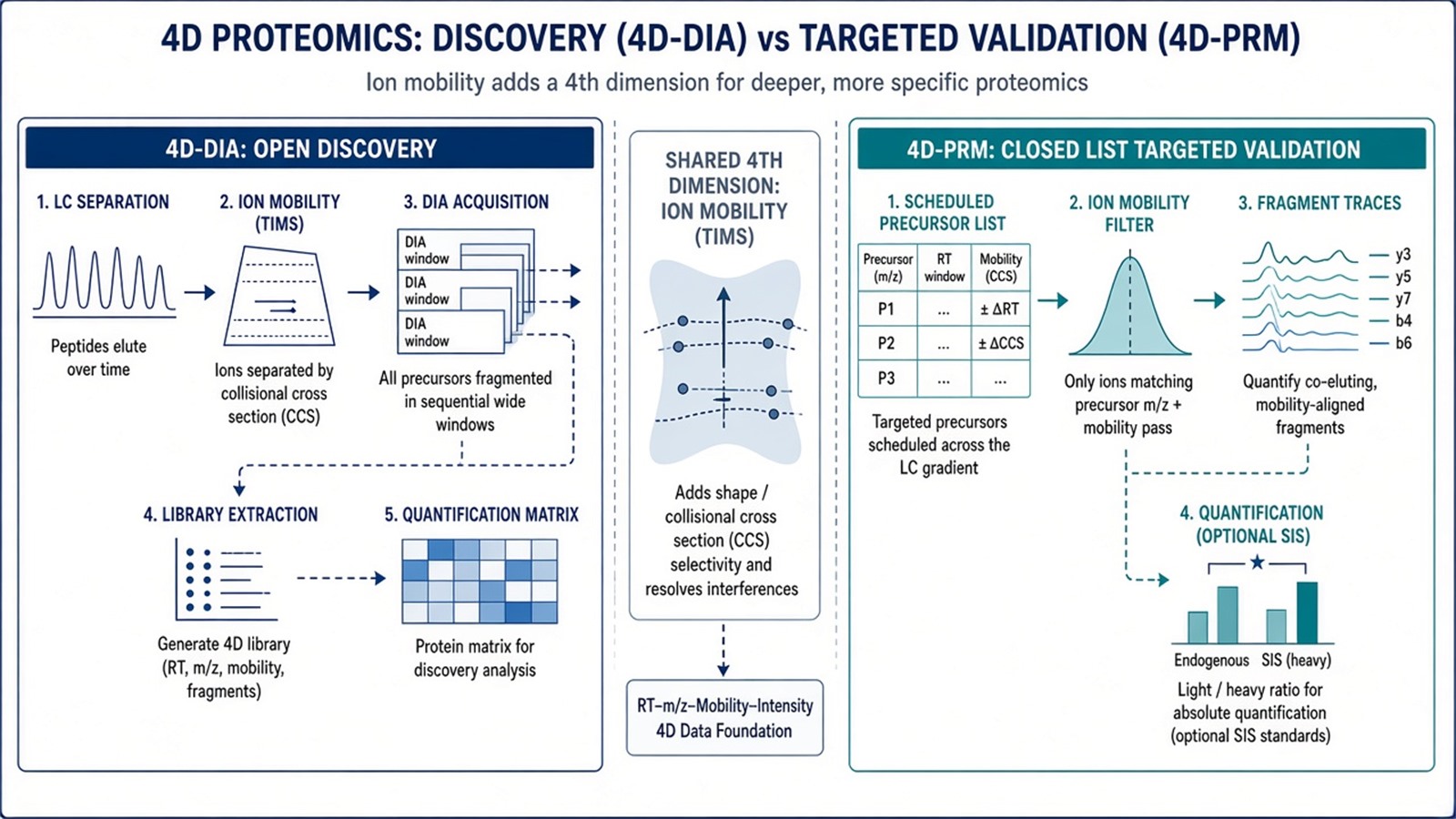
Figure 1. Ion mobility adds separation to both routes; list status and claim type still separate 4D-DIA from 4D-PRM.
Shared Workflow Steps That Diverge Between Routes
Both projects still begin with matched extraction, digestion, and cleanup. They diverge at acquisition and analysis.
4D-DIA workflow spine:
- Confirm contrast and relative claim.
- Acquire windowed DIA with a declared mobility and m/z plan.
- Extract peptides by spectral library or library-free search under FDR control (Rosenberger et al. 2017).
- Filter interference, normalize, roll up proteins, test the predefined contrast.
4D-PRM workflow spine:
- Freeze proteotypic peptides and mobility-retention targets.
- Build and pilot the scheduled method in the study matrix.
- Acquire cohort samples with QC inserts.
- Integrate fragment traces; apply SIS rules only when amount is claimed.
Where time is spent differs. 4D-DIA spends effort on extraction, alignment, and missing-value policy. 4D-PRM spends effort on panel size, duty cycle, and qualifier rules. Running 4D-PRM as a substitute for open 4D-DIA undercounts discovery. Running 4D-DIA alone when regulators or transfer need a locked panel undercounts confirmation work.
Parameters and Limits That Drive the Choice
Parameter |
4D-DIA sensitivity |
4D-PRM sensitivity |
|---|---|---|
List status |
Needs open contrast |
Needs closed names |
Panel or window plan |
Window width and cycle time |
Peptide count versus duty cycle |
Library or schedule |
Library provenance or direct search |
Locked transitions and mobility filters |
Matrix complexity |
Interference filters critical |
Interference and co-elution QC |
Claim unit |
Relative discovery default |
Relative confirmation; SIS for amount |
Cohort stage |
Exploratory or screening |
Validation or monitoring |
Limits follow the same table. 4D-DIA does not prove clinical utility of candidates. 4D-PRM does not inventory proteins absent from the panel. Mobility improves separation for both routes. It does not remove missing values in low-abundance discovery or extend a panel beyond chromatographic duty cycle.
Software choice and compute load are implementation details. They do not change the list-status rule. Instrument brand names are not a substitute for declaring windows, FDR, and contrast.
Researchers who need targeted trade-offs after route choice can refer to Advantages and Disadvantages of Targeted Proteomics. For three-axis selection across labeling and acquisition, see Protein Quantification Method.
How to Choose 4D-DIA or 4D-PRM for the Next Project
Use list status, sample stage, and claim unit together.
Project need |
Route that often fits |
Recheck before committing |
|---|---|---|
Open inventory, relative contrast |
4D-DIA |
Contrast undefined before acquisition |
Many groups, discovery screening |
4D-DIA with locked extractor |
Mixed extractors mid cohort |
Short list after prior discovery |
4D-PRM |
Panel longer than one duty cycle |
Multi-batch remeasurement of same peptides |
4D-PRM with locked schedule |
Schedule built in different matrix |
Amount on named peptides |
4D-PRM plus matched SIS |
Discovery intensities as concentration |
Only three to five known targets |
4D-PRM or MRM panel |
Full 4D-DIA when list already closed |
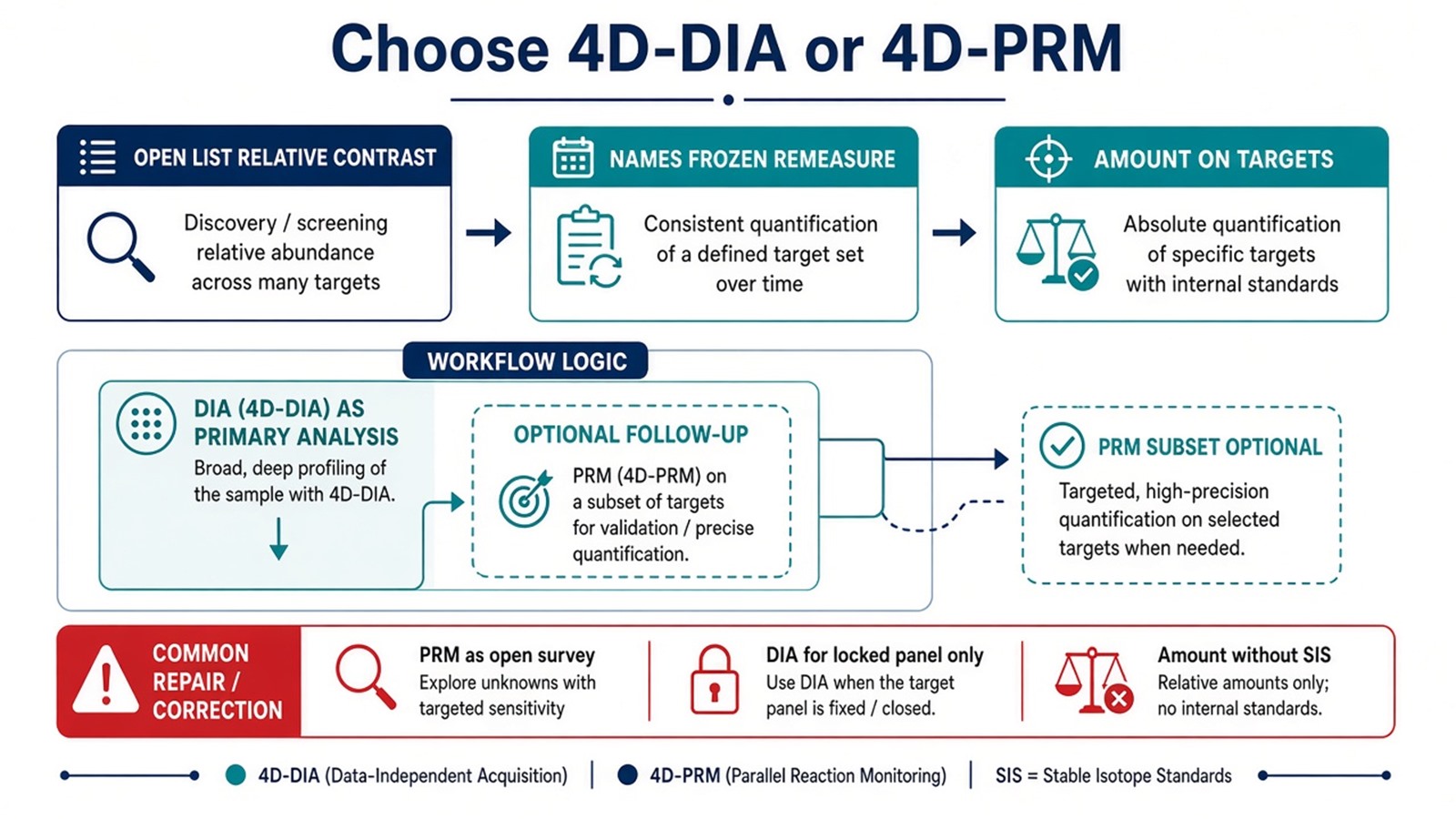
Figure 2. Choose 4D-DIA for open relative discovery and 4D-PRM for closed remeasurement; amount claims need SIS on targeted assays.
4D-DIA more often fits first-pass discovery with mobility-enhanced DIA. 4D-PRM more often fits confirmation when names freeze. Exceptions exist when a small validated panel never needed discovery, or when a pilot 4D-DIA matrix already supports a tiny PRM subset without reopening the list.
Teams that already have list status, matrix, contrast, and follow-up goal can also review the MtoZ Biolabs Quantitative Proteomics Service for project-specific 4D-DIA and 4D-PRM planning.
Frequently Asked Questions
1. Does ion mobility make 4D-DIA and 4D-PRM interchangeable?
No. Mobility adds separation to both. List status and claim type still differ.
2. Should every discovery project add 4D-PRM?
No. Add 4D-PRM when names freeze and decisions need scheduled remeasurement or SIS amount on a closed list.
3. Can 4D-DIA replace 4D-PRM for regulatory-style monitoring?
Only when a validated targeted method is not required. Open DIA matrices are discovery tools. Locked panels fit PRM-style confirmation.
4. Is library-free 4D-DIA always faster to start?
It can remove a separate library campaign. Extraction, FDR, and interference QC still take defined effort before contrasts are trusted.
5. Does higher protein count from 4D-DIA mean better quantitative decisions?
No. Depth and quantitative precision differ. Contrast quality and missing-value rules matter more than raw counts.
MtoZ Biolabs can support 4D-DIA discovery and 4D-PRM confirmation planning when sample type, list status, study design, and the intended claim are available.
If further evaluation of window schemes, library strategy, panel size, or discovery-to-PRM staging is needed, project details can be submitted for a feasibility review.
Reference
- S.A. Gerber, J. Rush, O. Stemman, M.W. Kirschner, S.P. Gygi (2003). Absolute quantification of proteins and phosphoproteins from cell lysates by tandem MS. Proc. Natl. Acad. Sci. U.S.A., 100, 6940-6945. https://doi.org/10.1073/pnas.0832254100
- L.C. Gillet, P. Navarro, S. Tate, H. Rost, N. Selevsek, L. Reiter, R. Bonner, R. Aebersold (2012). Targeted data extraction of the MS/MS spectra generated by data-independent acquisition: a new concept for consistent and accurate proteome analysis. Mol. Cell. Proteomics, 11, O111.016717. https://doi.org/10.1074/mcp.O111.016717
- F. Meier, A.D. Brunner, O. Frank, M.T. Krauss, M. Koch, H. Teichert, C. Trede, J. Kosinski, T. Park, M. The, M. Mann (2020). diaPASEF: parallel accumulation-serial fragmentation combined with data-independent acquisition. Nat. Methods, 17, 1229-1236. https://doi.org/10.1038/s41592-020-00998-0
- A.C. Peterson, J.D. Russell, D.J. Bailey, M.S. Westphall, J.J. Coon (2012). Parallel reaction monitoring for high resolution and high mass accuracy quantitative, targeted proteomics. Mol. Cell. Proteomics, 11, 1475-1488. https://doi.org/10.1074/mcp.O111.013698
- G. Rosenberger, S. Liu, J. Röst, H.L. Ludwig, C. Buil, B. Borchers, R. Aebersold, L. Collins (2017). Statistical control of peptide and protein error rates in large-scale targeted data-independent acquisition analyses. Nat. Commun., 8, 14224. https://doi.org/10.1038/ncomms14224
